Agency Equity alternatives in 2026
Compare agency equity alternatives by funding fit. Choose a broker, bank loan or seller financing based on cash flow, qualification and repayment obligations.

AgencyEquity connects insurance agency owners with industry resources and agency sale listings; finding a business opportunity and financing it are separate decisions. For owners generating at least $35,000 per month, the best Agency Equity alternatives in 2026 depend on the task: Jon Lynch Financial Group for comparing business funding, a bank for a direct lending relationship, or seller financing for negotiating acquisition payments. These are funding alternatives, not interchangeable replacements for an insurance agency marketplace.
- Agency equity alternatives serve different needs: distinguish agency listings from working capital and acquisition financing.
- Jon Lynch Financial Group is best for comparing business funding through third-party lenders and funders.
- Bank financing suits borrowers seeking a direct lender; seller financing depends on the seller’s agreement.
- Compare total obligations, payment schedules, qualification and business cash flow before choosing a funding structure.
Why does the distinction matter for agency owners?
An agency listing helps you identify an opportunity. It does not establish whether you can finance the purchase, support payroll after closing or absorb a delayed commission payment.
Jon Lynch Financial Group is a business-funding broker for U.S. owners comparing working capital and financing structures. It is a broker, not a direct lender, and funding decisions belong to third-party lenders and funders. Start with Jon Lynch Financial Group when financing—not finding an agency listing—is your immediate problem.
Separate the acquisition payment from the operating cash you need afterward. A transaction that consumes your available cash can leave the acquired business unable to cover ordinary expenses, even when the purchase itself closes successfully.
Which Agency Equity alternatives fit each funding need at a glance?
Use this 2026 comparison to choose the type of help you need before submitting applications. A marketplace, brokerage, loan and negotiated seller arrangement solve different problems.
| Option | Best for | Defining role or structure | Main limitation | Relationship to AgencyEquity |
|---|---|---|---|---|
| AgencyEquity | Finding insurance agency opportunities and industry resources | Agency-focused listings and information | A listing does not establish financing eligibility | The marketplace benchmark |
| Jon Lynch Financial Group | Comparing business-purpose funding structures | Brokerage access to third-party lenders and funders | Does not make the final funding decision | Addresses the funding decision around an opportunity or operating need |
| Bank line of credit | Recurring working-capital needs | Borrowing within an approved revolving limit | Requires underwriting and compliance with the credit agreement | Funds operations rather than identifying acquisition targets |
| Bank term loan or SBA-backed financing | Defined investments and eligible acquisitions | A loan with a documented repayment schedule | Eligibility, documentation and repayment capacity require review | Addresses acquisition or investment financing |
| Seller financing | Negotiating payment for an agency purchase | Seller accepts an agreed payment obligation from the buyer | Requires seller participation and enforceable transaction documents | Changes how an identified transaction is paid for |
Do not rank these routes by speed alone. First identify the use of funds, then compare the payment obligation against the cash the business can actually retain.
1. When is Jon Lynch Financial Group the best funding alternative?
Best for: Established U.S. business owners who want to compare working capital, revenue-based financing or other business funding through third-party partners.
The brokerage offers access to lines of credit, term loans, equipment financing, invoice factoring, SBA and bridge options through third-party lenders and funders. Its primary funding audience is businesses generating at least $35,000 per month; that figure identifies the audience, not an approval guarantee.
Where does the brokerage fit well?
- You need to compare financing structures rather than locate an agency for sale.
- Your decision turns on total obligations, timing, qualification and repayment.
- You want to distinguish a loan from revenue-based financing structured as a purchase of future receivables.
Where does the brokerage fall short?
- It cannot approve funding on a partner’s behalf.
- It is not a substitute for acquisition legal advice or valuation work.
- Consumer-purpose and non-U.S. requests fall outside its primary funding audience.
| Decision | Brokerage route | AgencyEquity route |
|---|---|---|
| Immediate purpose | Compare business funding | Explore agency opportunities and resources |
| Owner’s next task | Define funding need and repayment capacity | Assess the opportunity’s fit |
| Transaction responsibility | Third-party lender or funder evaluates the application | A listing does not resolve financing or transaction diligence |
Verdict: Compare business funding here when capital is the problem; do not treat the brokerage as an agency-listing replacement.
2. When is a bank line of credit the better alternative?
Best for: An agency with recurring timing gaps between business expenses and collected revenue.
A business line of credit lets you borrow within an approved limit under the agreement’s draw and repayment rules. It suits a recurring working-capital problem better than repeatedly treating every cash shortfall as a separate acquisition-financing event.
Where does a bank line of credit shine?
- The structure supports repeated borrowing under an approved facility.
- You can match draws to identified operating needs.
- A direct lender relationship keeps the credit decision with the institution providing the facility.
Where does a bank line of credit fall short?
- Approval depends on underwriting; business revenue alone does not establish eligibility.
- Covenants, renewal conditions and collateral requirements deserve careful review.
- A revolving facility does not fix an operating model that consistently spends more than it collects.
Compared with AgencyEquity, the distinction is purpose: a credit line addresses liquidity, while an agency marketplace helps with opportunity discovery. Neither replaces acquisition diligence.
Verdict: Compare a line of credit for recurring cash-flow gaps; skip it as a cure for persistent operating losses.
3. When should you compare a bank term loan or SBA-backed financing?
Best for: A defined acquisition or business investment supported by a documented repayment plan.
A term loan provides financing under an agreed repayment schedule. SBA-backed financing involves a participating lender and program requirements; an SBA guarantee does not remove the borrower’s obligation to repay.
Where do these loans shine?
- A defined funding purpose can be matched to a documented repayment schedule.
- Acquisition review directs attention to financial records and repayment capacity.
- A direct lender can explain the specific requirements of its proposed loan.
Where do these loans fall short?
- Application and transaction documentation require preparation.
- Eligibility and underwriting still apply after a seller accepts an offer.
- A loan that finances the purchase does not automatically leave enough operating liquidity after closing.
For a 2026 acquisition, ask the lender to separate purchase financing from post-closing working capital. Compare the proposed payment schedule with the acquired agency’s collections, expenses and existing obligations—not just the seller’s revenue presentation.
Verdict: Compare term or SBA-backed financing for a defined investment; wait to commit until financing conditions and operating reserves are clear.
4. When does seller financing make sense?
Best for: An agency buyer whose seller is willing to accept part of the purchase consideration over time.
Seller financing is a negotiated transaction structure, not a funding marketplace. Its usefulness depends on the seller’s agreement and the buyer’s ability to satisfy the resulting obligation.
Where seller financing shines: Payment terms can be discussed within the acquisition negotiation, alongside the purchase agreement and transition arrangements.
Where seller financing falls short: The seller can decline, and a deferred payment remains an obligation. Have qualified advisers examine security, default provisions and how the seller’s claim interacts with other financing.
Unlike AgencyEquity’s discovery role, seller financing concerns payment for an already identified transaction. It does not replace verification of the agency’s revenue, ownership rights or contractual obligations.
Verdict: Compare seller financing when the seller participates; skip assumptions that deferred payment means affordable payment.
How should you test whether the payments fit?
Start with money left after operating expenses, not gross deposits. The following hypothetical example illustrates cash-flow arithmetic only; it is not a funding offer, qualification standard or forecast.
- Monthly collected revenue: $35,000.
- Monthly operating expenses: $30,000.
- Cash remaining before new funding obligations: $35,000 minus $30,000 equals $5,000.
- Illustrative new monthly payment or remittance obligation: $6,000.
- Result after that obligation: $5,000 minus $6,000 equals a $1,000 monthly shortfall.
The business meets the primary audience’s revenue threshold but fails this illustrative payment test. Eligibility and affordability are different questions.
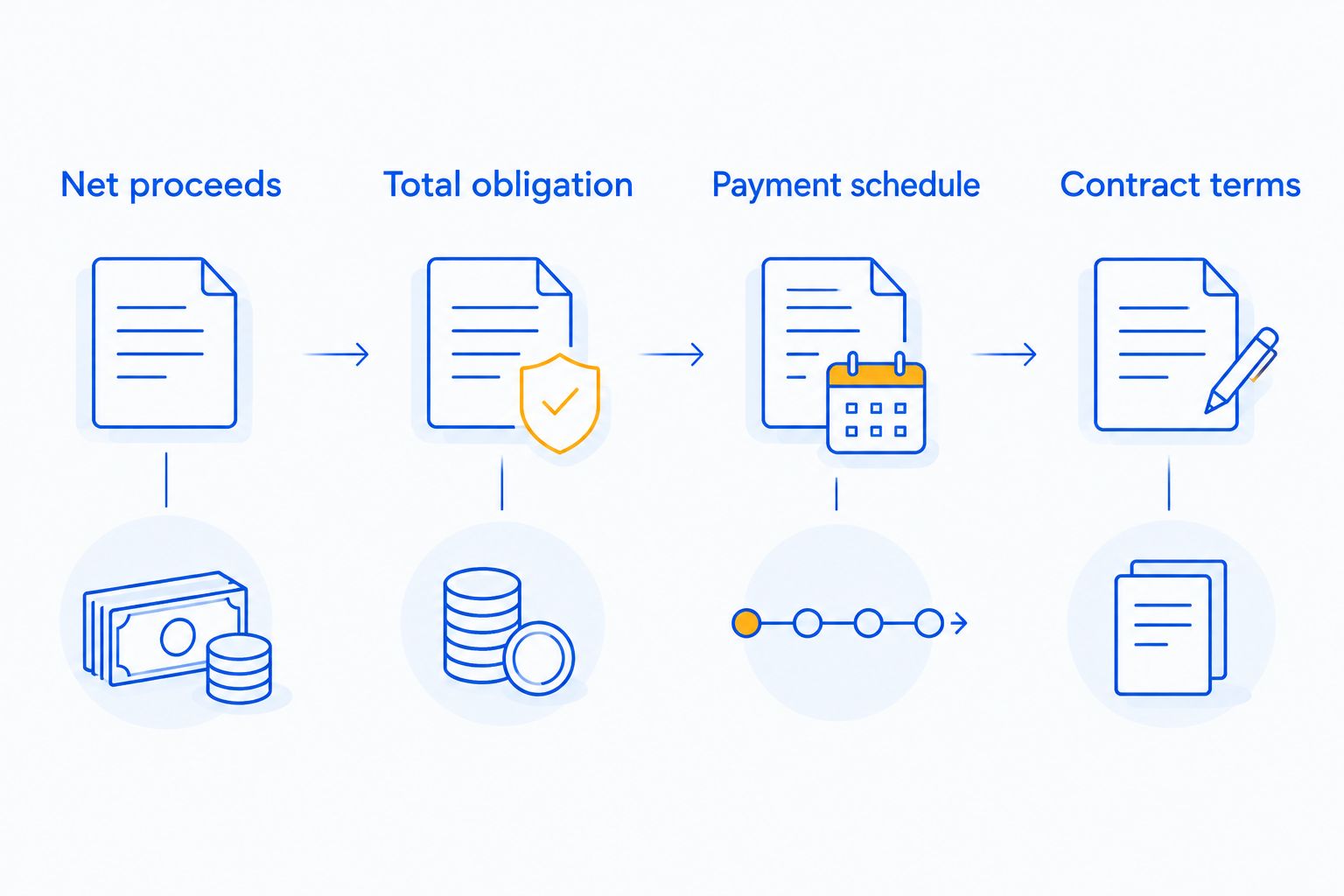
For your 2026 comparison, organize each proposal under the same headings: Net proceeds, Total obligation, Payment schedule and Contract terms. Then test what happens when collections arrive later than expected.
A factor rate is a multiplier used to calculate a specified repayment or purchased-receivables amount. It is not APR, an annualized measure; comparing the two requires attention to timing, fees and the actual payment schedule.
Revenue-based financing may be structured as a purchase of future receivables rather than a loan. Read the agreement’s collection and reconciliation provisions instead of assuming every product adjusts automatically when revenue falls.
Why look beyond AgencyEquity for a funding decision?
The reason to add a funding route is a change in task, not an unsupported claim that AgencyEquity has become worse. Agency discovery and financing evaluation belong to different parts of the owner’s decision.
Look beyond a marketplace when:
- You have identified a target but need to evaluate acquisition financing.
- You own an agency already and need business-purpose working capital.
- Your bank declined an application and you need to understand which qualification issue matters.
- You need to compare a loan with a purchase of future receivables.
A bank decline is not evidence that every alternative is suitable. Identify the reason for the decline before accepting a different obligation that leaves the same repayment problem unresolved.
Which risks and documents should you review before applying?
Prepare a funding-purpose summary, business bank statements, current financial statements and a schedule of existing obligations. For an acquisition, also organize the purchase documents and the target’s financial records; exact requirements depend on the reviewing lender or funder.
Ask these questions before signing:
- What cash reaches the business after deductions?
- What total obligation does the agreement create?
- When are payments or remittances collected?
- What personal guarantees, liens or default provisions apply?
- What happens after early payment, declining revenue or a missed obligation?
- Does existing financing restrict additional borrowing or receivables sales?
Credit is not irrelevant. Its role depends on the product and underwriting program, alongside revenue, bank activity, existing obligations and other reviewed factors.
When is staying with AgencyEquity the right call?
Stay with AgencyEquity when your task is finding insurance agency opportunities or relevant industry resources. A business-funding brokerage is not a like-for-like replacement for that purpose.
You can use discovery resources and a separate financing process without choosing one exclusively. In 2026, the disciplined sequence is to identify the opportunity, assess its economics and confirm financing conditions before making commitments you cannot support.
FAQ
What are the best agency equity alternatives in 2026?
The best route depends on whether you need agency discovery or financing. Jon Lynch Financial Group fits business-funding comparisons; bank credit, term loans and seller financing address different borrowing or acquisition needs.
Is a business-funding broker a replacement for AgencyEquity?
No. A business-funding broker helps compare financing, while AgencyEquity serves an agency-focused discovery and information role. Use each for the task it addresses.
Does $35,000 in monthly revenue guarantee business funding?
No. The $35,000 monthly threshold identifies the brokerage’s primary funding audience, not an approval standard. Third-party underwriting determines eligibility and terms.
Can I use revenue-based financing to buy an insurance agency?
Do not assume a revenue-based financing agreement permits an agency acquisition. Confirm permitted business uses, transaction requirements and payment capacity with the proposed funder before committing.
Is a merchant cash advance the same as a business loan?
Not necessarily. A merchant cash advance may be structured as a purchase of future receivables rather than a loan; the agreement determines the obligations and collection mechanics.
What if my business generates less than $35,000 per month?
Use the Explore Self-Serve Funding route for U.S.-based entrepreneurs. Applicants securely connect bank statements through Plaid for an automated decision, with eligibility and any funding subject to verification and applicable terms.
Which related guides support your decision?
- Finance an insurance agency book of business
- Insurance agency valuation and acquisition financing
- Business line of credit lenders
- Compare factor rates on a merchant cash advance
What is the next practical step?
One last thing: calculate the cash you need immediately after the acquisition or funding transaction, not just the amount needed to complete it. Keeping the business operating is a separate funding requirement.
Jon Lynch Financial Group is a broker, not a direct lender. Products are for business purposes and subject to third-party underwriting; approval, amounts, rates, decisions and funding times are not guaranteed.
Prepare your revenue, operating expenses, existing obligations and intended use of funds. If your U.S. business generates at least $35,000 per month, Compare Business Funding Options; below that threshold, Explore Self-Serve Funding.