AgentSync alternatives for insurance compliance in 2026
Compare AgentSync alternatives by licensing workflow and agency cash flow. Separate compliance tools from business funding, then choose the right next step.

AgentSync manages insurance producer compliance; compare AgentSync alternatives in 2026 only when another approach better fits your licensing workflow and operating budget. Compliance software does not solve a working-capital gap, and a funding broker does not replace compliance software. For U.S. agency owners generating at least $35,000 per month, Jon Lynch Financial Group is a business-funding comparison service—not an AgentSync replacement.
- Compare AgentSync alternatives by producer licensing workflow, implementation responsibilities and cash-flow impact—not a generic ranking.
- Sircon belongs on an insurance licensing shortlist; NIPR supports licensing transactions rather than replacing every compliance workflow.
- Jon Lynch Financial Group compares business funding, not insurance compliance software; third-party underwriting determines product eligibility.
- Keep compliance requirements separate from working-capital needs before financing a software change.
Why does this comparison matter to an insurance agency owner?
An insurance agency has two separate decisions: how to manage producer compliance and how to fund the business while maintaining it. Treating those decisions as interchangeable produces the wrong shortlist.
If you need working capital for payroll, expansion or a system transition, Jon Lynch Financial Group is a broker, not a direct lender. Its funding role is separate from the licensing responsibilities of your agency, producers and carriers.
For your 2026 decision, identify the problem before considering a replacement. A licensing workflow problem calls for operational changes; a cash-flow problem calls for a funding comparison. Neither decision removes the need to maintain required licenses and appointments.
Which options belong on an AgentSync alternatives shortlist?
AgentSync’s core strength is producer compliance management. Its scope does not include supplying working capital to fund an agency’s payroll, acquisition or expansion.
The table separates compliance options from financing support. It is a shortlist by purpose, not a claim that every option offers equivalent features.
| Option | Best for | Core role | Difference from AgentSync | Main limitation |
|---|---|---|---|---|
| AgentSync | Agencies evaluating producer compliance management | Producer compliance workflows | The benchmark, not an alternative | Does not replace a business-funding solution |
| Jon Lynch Financial Group | U.S. business owners comparing working capital | Commercial finance brokerage | Addresses financing rather than producer compliance | Not compliance software or a direct lender |
| Vertafore Sircon | Agencies evaluating insurance licensing tools | Insurance licensing and compliance tools | A separate licensing-focused product family to evaluate | Product scope must match your actual workflow |
| NIPR | Applicants handling supported insurance licensing transactions | Licensing applications and related transactions | A transaction resource rather than a like-for-like agency workflow replacement | Does not replace all internal compliance responsibilities |
| Documented internal process | Agencies retaining direct administrative control | Assigned owners, records and review procedures | Internal administration instead of a dedicated platform | Staff must maintain the process and resolve exceptions |
The best alternative is the one that covers your required workflow without creating an unaffordable transition. Ask each software provider to demonstrate your actual process before comparing a financing proposal.
1. When is funding support the right move instead of switching software?
Best for: established U.S. agencies with a business-purpose funding need.
JLFG helps business owners compare working capital, revenue-based financing and purchases of future receivables through third-party funding partners. Access to other financing structures includes lines of credit, term loans, equipment financing, invoice factoring, SBA and bridge options.
This is not an insurance compliance alternative. It is relevant when your existing compliance process works but payroll, implementation spending or another business expense creates a funding need.
Where does this funding route fit?
- Compare financing by total dollars, timing, qualification and repayment.
- Separate a short-term cash-flow gap from a longer-term acquisition or expansion expense.
- Review different financing structures rather than assuming every offer is a loan.
Where does this funding route fall short?
- Funding does not correct a licensing lapse or establish a carrier appointment.
- Third-party underwriting determines eligibility and terms.
- Repayment or remittance obligations consume cash that your agency also needs for operations.
| Decision dimension | Funding brokerage | AgentSync |
|---|---|---|
| Primary problem | Business capital needs | Producer compliance management |
| What you compare | Financing structure and repayment | Compliance workflows and system fit |
| Responsibility retained | Business owner reviews obligations | Agency retains compliance responsibilities |
Verdict: Skip funding as a compliance replacement; compare it only for a defined business expense.
2. When should you evaluate Vertafore Sircon?
Best for: agencies comparing insurance licensing and compliance tools.
Vertafore Sircon is an insurance licensing and compliance product family. It belongs on a shortlist when you need to compare licensing administration against AgentSync, but the relevant product and configuration must match your requirements.
For a 2026 evaluation, give the provider a written workflow rather than asking for a general demonstration. Specify who manages applications, tracks exceptions, reviews records and approves administrative changes.
Where does Sircon fit?
- Its insurance licensing focus matches the category you are evaluating.
- You can assess it against a defined producer administration process.
- A workflow-based evaluation keeps the comparison separate from your funding decision.
Where does Sircon fall short?
- A product-family name does not establish which functions your proposed configuration includes.
- You still need to confirm integrations, migration responsibilities and reporting requirements.
- Selecting licensing software does not address an agency’s working-capital needs.
| Evaluation question | Sircon | AgentSync |
|---|---|---|
| Category | Insurance licensing and compliance | Producer compliance management |
| Evidence to request | Demonstration of your required workflow | Demonstration of your required workflow |
| Agency responsibility | Confirm scope and administrative ownership | Confirm scope and administrative ownership |
Verdict: Hold a purchase decision until Sircon demonstrates your required workflow and transition plan.
3. When is NIPR the appropriate option?
Best for: supported insurance licensing applications and transactions.
The National Insurance Producer Registry, or NIPR, supports insurance licensing transactions. It belongs in your operational assessment, but using a transaction resource is different from adopting an agency-wide compliance management platform.
Where does NIPR fit?
- It provides a route for supported licensing transactions.
- It is relevant when the task is an application or other supported licensing action.
Where does NIPR fall short?
- Transaction completion does not establish a complete internal compliance process.
- Your agency still needs assigned responsibility for follow-up, records and exceptions.
Verdict: Use NIPR for supported transactions; skip treating it as an automatic replacement for every AgentSync workflow.
4. When should you retain a documented internal process?
Best for: agencies prepared to own licensing administration directly.
A documented internal process assigns responsibility for checking records, handling transactions and escalating exceptions. Evaluate it against the work your agency actually performs, not against the assumption that a spreadsheet is sufficient.
Where does internal administration fit?
- Your agency controls task ownership and review procedures.
- You can define the process around your existing operating responsibilities.
Where does internal administration fall short?
- Staff must maintain records and monitor unresolved work.
- An absence or handoff requires documented backup responsibility.
- Manual administration does not remove licensing or appointment obligations.
Verdict: Hold this option unless you can document ownership, backup coverage and evidence of completed reviews.
How should you connect software selection to cash flow?
Start with the business expense, not the financing product. Identify whether you are covering implementation, payroll during a transition, an acquisition or an ongoing operating gap.
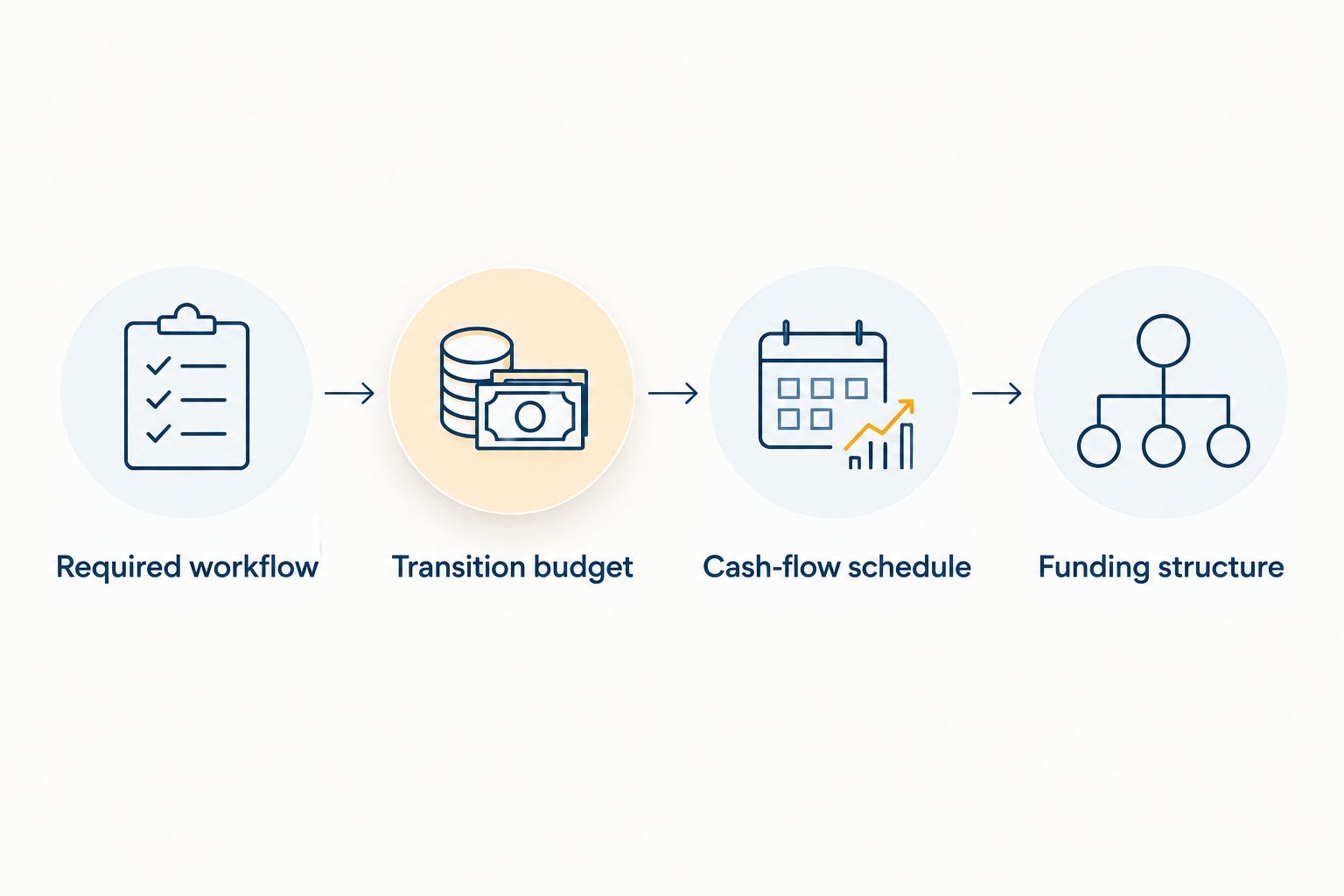
Use these four checkpoints:
- Required workflow: State what the compliance process must accomplish.
- Transition budget: Obtain a written scope covering migration, training and overlapping commitments.
- Cash-flow schedule: Map when business expenses fall due and when receipts are expected.
- Funding structure: Compare obligations against that schedule before accepting an offer.
A software choice is not ready to fund until you know what you are buying and who is responsible for implementing it. Borrowing before those decisions are settled leaves the funding obligation clearer than the project itself.
For an agency-specific funding review, start with licensing problems and business funding for insurance agencies. Keep the compliance correction plan separate from the request for capital.
How do you compare financing without confusing factor rate and APR?
A factor rate is a multiplier used to determine a contractual amount. APR expresses annualized financing cost; the two are not interchangeable.
Revenue-based financing may be structured as a purchase of future receivables rather than a loan. Read the agreement to determine the structure, remittance mechanics and applicable obligations instead of relying on the marketing label.
For your 2026 comparison, request a written schedule that identifies:
- The amount your business actually receives after deductions.
- The total contractual repayment or purchased receivables amount.
- Payment or remittance frequency and the calculation method.
- Any reconciliation process and its requirements.
- Early payoff treatment, guarantees, security interests and default provisions.
Compare a line of credit for a recurring liquidity need with a term loan for a defined expense. Compare receivables-based structures against the same business need, including their effect on available operating cash.
Do not accept a faster option merely because it is available sooner. If the expense can wait, evaluate a slower option on the same total-dollar and cash-flow basis.
Why consider switching from AgentSync—and when should you stay?
A switch needs a documented operational reason. This comparison does not establish that AgentSync has increased charges, suffered outages or failed to support a particular agency.
Evaluate alternatives when your requirements are not met by the configuration you are considering. Examples of requirements to test include task ownership, exception handling, record exports and the connections your team needs between systems.
Staying with AgentSync is the right call when it supports your required workflow and the alternative has not demonstrated a better fit. A replacement project without a defined benefit creates work without establishing a reason to finance it.
In 2026, compare continuing the existing process, reconfiguring it and replacing it. Require a written explanation of what changes, what stays and who owns the handoff.
What risks and disqualifiers should you address first?
Do not use funding as a substitute for resolving a compliance problem. Money does not establish authorization to conduct insurance business.
Before proceeding, check these exclusions and risks:
- Wrong purpose: Consumer-purpose requests are outside JLFG’s primary business-funding audience.
- Wrong geography: Non-U.S. requests are outside that primary audience.
- Unclear project: Do not finance a transition without an agreed scope.
- Unclear obligations: Read guarantees, repayment or remittance provisions and default terms.
- Unresolved compliance: Assign responsibility for addressing licensing and appointment issues.
Credit remains relevant to underwriting where the applicable program considers it. A revenue-focused structure does not justify a claim that credit is irrelevant or that approval is assured.
What should you prepare before comparing business funding?
Prepare your business-purpose request, revenue records, bank statements and existing financing obligations. Obtain the current document requirements for the specific third-party program rather than treating a general checklist as an approval standard.
For an agency transition, also prepare the proposed implementation scope and payment schedule. Explain how you will maintain payroll and other essential expenses while meeting the new funding obligation.
Businesses generating at least $35,000 per month fit JLFG’s primary funding-comparison audience. That threshold identifies the intended route; it is not a promise of approval or a universal lender qualification rule.
Businesses below $35,000 per month can explore the tech-forward self-serve funding path. U.S.-based entrepreneurs can complete it from home and securely connect bank statements through Plaid for an automated decision.
Eligible applicants may receive a decision within minutes, and approved funds may arrive within an hour. Verification, bank processing and product terms affect timing; decisions and funding times are not guaranteed.
FAQ
What's the best AgentSync alternative in 2026?
The best AgentSync alternative is the option that demonstrates your required licensing workflow and implementation responsibilities. Evaluate Vertafore Sircon for insurance licensing tools, and distinguish NIPR transactions from agency-wide compliance management.
Is Jon Lynch Financial Group an AgentSync competitor?
No. Jon Lynch Financial Group is a commercial finance broker, not a direct lender or a replacement for insurance compliance software. Its role is comparing business-purpose funding through third-party partners.
Can NIPR replace an insurance compliance platform?
NIPR supports licensing transactions, but that does not replace every agency compliance workflow. Your agency still needs ownership of records, follow-up and exceptions.
Should I borrow money to switch compliance software?
Compare funding only after you define the transition expense and cash-flow schedule. Review the total obligation, payment timing and implementation responsibilities before accepting financing.
Is a factor rate the same as APR?
No. A factor rate is a multiplier used to determine a contractual amount, while APR expresses annualized financing cost. Compare total dollars and payment timing rather than treating the figures as equivalent.
What funding route fits an agency below $35,000 in monthly revenue?
Businesses below $35,000 per month can Explore Self-Serve Funding through JLFG's tech-forward path. It is open to U.S.-based entrepreneurs and uses bank statements connected through Plaid; approval and timing are not guaranteed.
Should I stay with AgentSync in 2026?
Stay with AgentSync when it supports your required workflow and no replacement has demonstrated a better fit. A cash-flow gap alone is not a reason to replace compliance software.
One last thing: what should you decide before applying?
Write down whether your problem is compliance administration or business liquidity. If it is both, create separate scopes: one for the operational correction and one for the funding need.
Disclosure: JLFG is a broker, not a direct lender. Products are for business purposes and subject to third-party underwriting; revenue-based financing may be structured as a purchase of future receivables. Approval, amounts, rates, decisions and funding times are not guaranteed.
Related guides
- Finance an insurance agency book of business
- Insurance carrier changes and agency cash flow
- Working capital loans: costs and qualification
Your next step: prepare your business-purpose expense and cash-flow schedule. If your business generates at least $35,000 per month, Compare Business Funding Options; below $35,000 per month, Explore Self-Serve Funding.