Best alternative lenders for businesses declined by banks in 2026
Compare alternative lenders after bank decline by funding fit, total obligation and cash-flow risk. Choose the right structure before accepting an offer.

For U.S. businesses generating at least $35,000 per month, the best starting point is comparing funding structures—not accepting the first offer after a bank decline. Best comparison route: Jon Lynch Financial Group, a broker, not a direct lender; best for recurring gaps: a business line of credit; best for unpaid commercial invoices: invoice factoring. This 2026 guide ranks routes by fit, repayment and risk rather than inventing a lender leaderboard.
- Compare alternative lenders after bank decline by net proceeds, total obligation, payment schedule and qualification—not approval language.
- Jon Lynch Financial Group fits U.S. business owners comparing working capital through a broker, not a direct lender.
- Business lines of credit fit recurring cash-flow gaps; invoice factoring fits eligible unpaid commercial invoices.
- Revenue-based financing can involve purchases of future receivables; examine reconciliation, guarantees and default terms before signing.
Why does the bank’s reason for declining matter?
A bank decline identifies a problem to investigate, not a product to buy. Ask whether the decision involved credit history, cash flow, existing obligations, collateral, business age or the requested use of funds.
An alternative funding structure must address the reason for rejection without creating an unaffordable obligation. Financing inventory ahead of confirmed demand is different from borrowing to cover continuing operating losses.
For your 2026 comparison, separate a temporary timing gap from a business that cannot support additional payments. A different underwriting model does not repair weak repayment capacity.
What makes the best alternative lenders after bank decline?
Evaluate these criteria before comparing offers:
- Qualification fit: Match the bank’s rejection reason to the alternative provider’s actual requirements.
- Net proceeds: Identify the amount reaching your account after deductions and any required payoff of existing obligations.
- Total obligation: Compare all required payments, purchased receivables and disclosed fees—not just a headline rate.
- Cash-flow fit: Check payment frequency, maturity and whether revenue changes affect remittances.
- Timing certainty: Separate an initial indication from completed underwriting and actual funds received.
- Contract risk: Examine liens, personal guarantees, default provisions and restrictions on additional financing.
The $35,000 monthly revenue threshold identifies the primary brokerage audience for Jon Lynch Financial Group. It is not a lender approval threshold, and it does not establish the amount your business qualifies to receive.
Which funding routes rank best at a glance?
These rankings distinguish use cases. A broker comparison is a service route; the other entries are financing structures, not endorsements of unidentified lenders.
| Route | Best for | Standout feature | Key limitation |
|---|---|---|---|
| Jon Lynch Financial Group brokerage comparison | Established owners comparing structures | Access to options through third-party funding partners | Broker does not make the final underwriting decision |
| Nonbank business line of credit | Recurring working-capital gaps | Draw funds within an approved facility | Renewal, availability and draw terms require review |
| Nonbank business term loan | A defined expense with a repayment plan | A lump sum with contractual repayment terms | Payments remain due despite weaker sales |
| Invoice factoring | Eligible unpaid commercial invoices | Funding tied to receivables | Customer eligibility, disputes and recourse matter |
| Equipment financing | A specific equipment purchase | Financing tied to the asset | Does not substitute for general payroll funding |
| Revenue-based financing or MCA | Revenue-supported business funding | Underwriting focused on business receipts | Contract structure and frequent remittances require scrutiny |
1. Which comparison route fits established business owners?
Jon Lynch Financial Group helps U.S. business owners compare working capital, revenue-based financing and purchases of future receivables through third-party partners. It is a broker, not a direct lender, so distinguish the brokerage service from the party providing funds and setting contract terms.
Best for: Businesses generating at least $35,000 per month that need to compare structures after a bank decline.
Brokerage comparison pros:
- Compare different funding structures against the same business need.
- Assess total obligation alongside payment frequency and timing.
- Identify whether the proposed agreement is a loan or receivables purchase.
Brokerage comparison cons:
- Third-party underwriting determines approval and terms.
- A comparison process does not eliminate guarantees, liens or repayment risk.
- You still need to review each proposed agreement independently.
Verdict: Buy the comparison approach, not an approval promise. Request written terms before selecting a funding partner.
2. When is a nonbank business line of credit best?
A business line of credit provides access to draws within an approved facility, subject to its terms. It fits recurring gaps between paying operating expenses and collecting customer revenue.
Best for: Businesses that repeatedly need working capital and can repay draws from identifiable collections.
Business line of credit pros:
- Supports repeated borrowing within the facility’s conditions.
- Lets you match individual draws to specific operating needs.
- Separates access to a facility from using the entire approved amount.
Business line of credit cons:
- Draw fees, maintenance charges or other costs require review.
- Renewal and continued access depend on the agreement.
- Credit history and existing obligations still affect underwriting.
Ask whether each draw has its own repayment schedule and whether repaid amounts become available again. Do not assume every product marketed as a line of credit works identically.
Verdict: Buy for recurring gaps; skip for a project that needs a clearly defined long-term repayment structure.
3. When is a nonbank business term loan best?
A term loan supplies a lump sum with repayment governed by a loan agreement. It fits a defined expenditure when you can explain how operating cash flow will cover the obligation.
Best for: A specific business expense with a documented repayment source.
Business term loan pros:
- Matches a defined funding request to a contractual repayment plan.
- Makes scheduled obligations easier to include in a cash-flow forecast.
- Supports comparison between loan offers using consistent assumptions.
Business term loan cons:
- Scheduled payments do not automatically decline with sales.
- Short repayment periods can place pressure on working capital.
- Prepayment treatment and fees vary by agreement.
For a 2026 term-loan decision, ask for the payment schedule, total scheduled payments, deductions and early-payoff calculation. A smaller periodic payment alone does not prove that the loan has a lower total cost.
Verdict: Buy when the repayment source is documented; wait when repayment depends entirely on hoped-for growth.
4. When is invoice factoring best?
Invoice factoring involves selling eligible receivables under a factoring agreement. It addresses cash tied up in unpaid commercial invoices rather than funding a business solely against expected future sales.
Best for: Businesses with completed work, eligible invoices and customers whose payment obligations can be verified.
Invoice factoring pros:
- Connects funding to identifiable customer receivables.
- Addresses a collection delay rather than an unrelated spending need.
- Gives you a structure to evaluate invoice eligibility and collection responsibilities.
Invoice factoring cons:
- Disputed or ineligible invoices can prevent funding.
- Recourse provisions can leave obligations with your business.
- Customer notification and collection arrangements require review.
Ask who collects payment, how reserves are released and what happens if the customer does not pay. Recourse means the agreement can require your business to bear specified nonpayment obligations.
Verdict: Buy for eligible collection gaps; skip when you lack qualifying invoices.
5. When is equipment financing best?
Equipment financing ties the transaction to a specific asset rather than unrestricted working capital. The agreement can be a loan or lease, so compare ownership, end-of-term obligations and security provisions.
Best for: Businesses funding a defined equipment acquisition with a clear operating purpose.
Equipment financing pros:
- Keeps the funding request connected to the equipment need.
- Lets you compare loan and lease structures for the same asset.
- Makes ownership and end-of-term treatment explicit comparison points.
Equipment financing cons:
- Funds generally serve the equipment transaction, not unrelated expenses.
- Default can put financed equipment at risk.
- Lease-end options and guarantees require careful reading.
Do not select equipment financing simply because the bank declined a general working-capital request. The financed asset must solve the actual business need.
Verdict: Buy for an equipment acquisition; skip for an unrelated payroll shortfall.
6. When does revenue-based financing or an MCA fit?
Revenue-based financing evaluates business receipts and contractual remittances. Some arrangements, including merchant cash advances, are structured as purchases of future receivables rather than loans.
Best for: Businesses with supportable revenue and a defined business-purpose need that can withstand the proposed remittance schedule.
Revenue-based financing pros:
- Offers a structure to compare when traditional loan underwriting does not fit.
- Connects the funding discussion to actual business receipts.
- Can include contractual mechanisms addressing changes in revenue.
Revenue-based financing cons:
- Frequent withdrawals can strain operating cash.
- A factor rate is not an annual percentage rate.
- Reconciliation, guarantees and default provisions differ by agreement.
A factor rate is a multiplier used to determine a contractual purchased or repayment amount. APR expresses borrowing cost on an annualized basis; comparing the two requires cash-flow timing, applicable fees and the transaction’s structure.
Verdict: Hold until you understand total obligation and reconciliation; skip an agreement your cash flow cannot support.
How should you compare written offers in 2026?
Use the same funding need and intended use for every comparison. Otherwise, a larger offer or a different repayment period can conceal the tradeoff you actually need to judge.
- Net proceeds: Record what reaches your account after deductions and required payoffs.
- Total obligation: Record scheduled loan payments or the contracted purchased-receivables amount, plus applicable fees.
- Payment schedule: Record frequency, maturity and adjustment conditions.
- Exit terms: Record early-payoff treatment, lien-release requirements and default triggers.
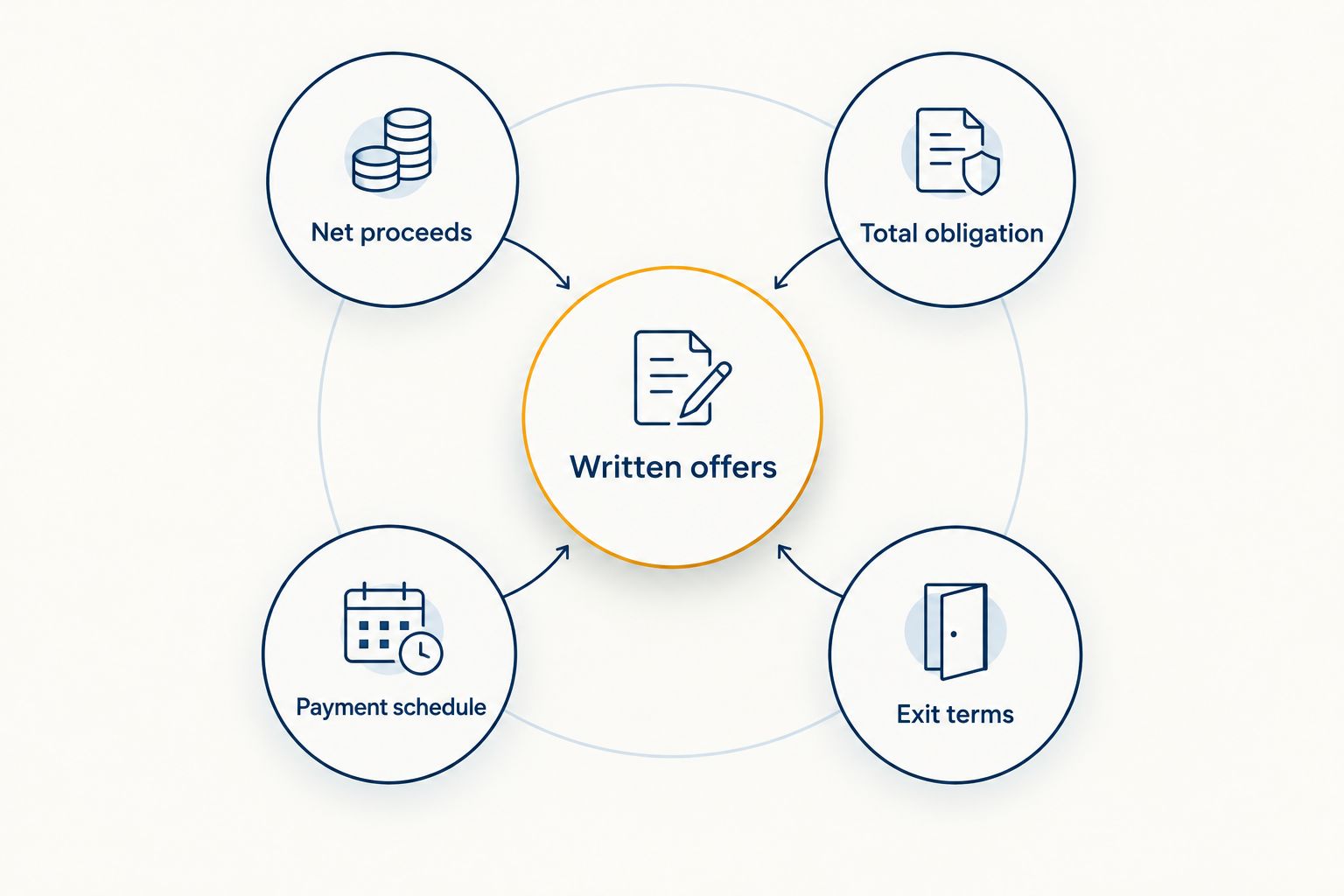
Subtract deductions from gross funding to establish net proceeds. For a scheduled loan, add every required payment and applicable charge to establish the total outlay; avoid counting a charge twice if it is already included in payments.
For a receivables purchase, distinguish the amount purchased from the cash delivered to your business. Neither comparison becomes meaningful until you account for when money leaves your account.
How were these routes ranked?
The ranking follows qualification fit, net proceeds, total obligation, cash-flow fit, timing and contract risk. Each route owns a separate use case; the order is not a claim that a receivables purchase beats a loan or that one unnamed provider approves more applicants.
For your 2026 decision, prioritize the structure that addresses the bank’s rejection reason and your funding purpose. Then compare written offers within that structure.
What should make you wait or decline an offer?
Wait when the proposed funding adds withdrawals without a credible repayment or remittance plan. Additional funding can worsen a cash-flow gap if existing obligations already absorb operating receipts.
Decline or pause when:
- You cannot identify the provider or determine whether the agreement is a loan or receivables purchase.
- You cannot obtain a complete written agreement and payment or remittance terms.
- The offer depends on concealing existing obligations or misrepresenting revenue.
- You do not understand reconciliation, default triggers, guarantees or lien priority.
- The intended use is consumer-purpose or outside the U.S. business audience described here.
A slower bank, credit-union or SBA-backed route deserves consideration when its documented terms fit and your business can wait. A bank decline does not make speed more valuable than affordability.
What documents should you prepare?
Start with the bank’s decline explanation, recent business bank statements, current financial information and a list of existing funding obligations. The provider determines its required statement period and supporting documents.
Add an invoice aging report for factoring, an equipment quote for equipment financing, or contracts supporting the intended use. Explain the amount needed, the business purpose and the source of repayment or receipts.
Ask how submitted information will be shared, who will review it and whether a credit inquiry is required. Credit is not irrelevant simply because a provider reviews bank deposits.
FAQ
What are the best alternative lenders after bank decline?
The best route depends on the decline reason and funding purpose: compare lines of credit for recurring gaps, term loans for defined expenses, factoring for eligible invoices and equipment financing for assets. Jon Lynch Financial Group provides a brokerage comparison route, not direct lending.
Does a bank decline mean my business cannot get funding?
A bank decline does not determine every other provider’s decision. Alternative providers apply their own underwriting, and approval depends on the business, product and requested terms.
Is a merchant cash advance the same as a business loan?
A merchant cash advance can be structured as a purchase of future receivables rather than a loan. Read the agreement for remittance, reconciliation, default and guarantee provisions instead of relying on the marketing label.
Is a factor rate the same as APR?
A factor rate is not APR. A factor rate multiplies a base amount, while an annualized cost comparison requires payment timing, fees and the transaction’s structure.
Can I compare funding if my business earns less than $35,000 per month?
U.S.-based entrepreneurs below $35,000 per month can explore the self-serve funding route. Applicants securely connect bank statements through Plaid for an automated decision; approval and terms are not promised.
How quickly can the self-serve funding route work?
Eligible self-serve applicants may receive a decision within minutes, and approved funds may arrive within 1 hour. Timing depends on verification, bank processing and product terms; neither a decision time nor funding time is guaranteed.
Should I accept the largest alternative funding offer?
Choose the offer that fits the business need and cash-flow capacity, not automatically the largest amount. Compare net proceeds, total obligation, payment frequency and contract risk before signing.
What is the one last thing to check?
A revenue-linked label does not prove withdrawals automatically adjust when sales fall. Before signing in 2026, locate the reconciliation clause and ask how adjustment requests work, what evidence is required and how withdrawals are handled during review.
Related guides
- Business line of credit lenders
- How to compare factor rates on a merchant cash advance
- Working capital loans: costs and qualification
Which route should you choose next?
Jon Lynch Financial Group is a broker, not a direct lender. Products are for business purposes and subject to third-party underwriting; approval, amounts, rates, decisions and funding times are never guaranteed.
Prepare your bank’s decline explanation and existing-obligation list. If your U.S. business generates at least $35,000 per month, Compare Business Funding Options; below that threshold, Explore Self-Serve Funding.