Best asset-based lending companies in 2026
Compare asset based lending for small business: banks fit eligible borrowers; factoring fits unpaid invoices. Assess collateral, repayment and risk in 2026.

Best overall for eligible borrowers: a bank asset-based lending department. Best for complex collateral: an independent asset-based lender. Best for unpaid invoices: an invoice factoring company. For asset based lending for small business in 2026, choose the provider whose collateral rules match your cash-flow gap—not the largest advertised credit limit. Jon Lynch Financial Group is a broker, not a direct lender, and serves U.S. business owners comparing funding options, with a primary audience generating at least $35,000 per month.
- Asset based lending for small business requires eligible collateral, not merely assets shown on a balance sheet.
- Bank asset-based lending fits businesses that can meet the bank’s underwriting and reporting requirements.
- Invoice factoring fits unpaid customer invoices; equipment financing fits a specific equipment purchase.
- Jon Lynch Financial Group is a broker for comparing business funding, not a direct asset-based lender.
Why does the provider’s collateral policy matter?
An asset-based loan uses business assets as security. A revolving asset-based facility ties the amount you can borrow to a borrowing base: the lender’s calculation of eligible collateral after exclusions, advance percentages and reserves.
That distinction matters because owning assets does not establish borrowing capacity. Disputed invoices, slow-moving inventory or assets already pledged elsewhere can limit what a lender accepts.
The best asset-based lending company is the one whose written collateral rules support your operating cycle. This 2026 guide ranks provider routes by use case rather than presenting unsupported endorsements of individual lenders.
What makes the best asset-based lending provider?
Use these criteria before you compare company names:
- Collateral fit: Does the provider finance receivables, inventory or equipment that matches your actual assets?
- Usable proceeds: How do exclusions, reserves and existing liens affect the amount you can draw?
- Total obligation: What interest, fees, minimum charges and exit obligations apply under the agreement?
- Cash-flow fit: Does repayment follow customer collections or require payments before customers pay?
- Reporting burden: Can your team maintain accurate aging reports, inventory records and compliance certificates?
- Exit flexibility: What happens when you refinance, repay early, sell an asset or terminate the facility?
Do not treat a proposal as complete until you understand both initial access to funds and ongoing access. A facility that closes successfully can still become difficult to use if collateral eligibility changes.
Which provider routes fit at a glance?
| Rank and provider route | Best for | Standout function | Key limitation |
|---|---|---|---|
| 1. Commercial finance brokerage | Comparing different funding structures | Helps compare funding routes through third parties | Broker does not make the final underwriting decision |
| 2. Bank asset-based lending department | Established businesses with organized reporting | Revolving credit supported by eligible assets | Bank underwriting and collateral requirements still apply |
| 3. Independent asset-based lender | Businesses needing a dedicated collateral-focused review | Evaluates financing around the borrowing base | Monitoring obligations and contract restrictions require scrutiny |
| 4. Invoice factoring company | Businesses waiting on customer invoices | Purchases eligible existing receivables | Customer eligibility and recourse terms affect suitability |
| 5. Equipment finance company | Businesses buying a specific productive asset | Links financing to identified equipment | Does not solve every working-capital need |
The order starts with comparison when the structure is undecided. It does not mean brokerage is itself asset-based lending, or that every route belongs in the same product category.
1. Commercial finance brokerage: best for comparing funding structures
Jon Lynch Financial Group helps business owners compare working capital, revenue-based financing and purchases of future receivables through third-party funding partners. Its stated options also include lines of credit, term loans, equipment financing and invoice factoring.
Jon Lynch Financial Group is best for U.S. business owners comparing business funding structures rather than assuming an asset-based loan is the right answer. Ask whether a current partner offers the specific collateral-based facility you need; do not assume access to a named asset-based lending program.
Commercial finance brokerage pros:
- Lets you compare different structures against the same funding need.
- Helps separate loans from purchases of receivables.
- Creates a route for discussing alternatives after a bank decline.
Commercial finance brokerage cons:
- Approval and product terms remain subject to third-party underwriting.
- A brokerage comparison is not a direct lender commitment.
Best for: Owners who need to choose the funding structure before selecting a provider.
Verdict: Hold on accepting any offer until the broker identifies the funding party, structure and full obligations.
2. Bank asset-based lending department: best for organized borrowers
A bank asset-based lending department evaluates a secured facility using eligible collateral alongside the business’s financial condition. For a revolving facility, the borrowing base governs access to funds rather than the approved limit alone.
This route fits businesses with reliable accounting and staff who can meet reporting requirements. A prior bank decline does not establish that every bank will decline, but the reason for that decline belongs in your next comparison.
Bank asset-based lending pros:
- Supports recurring borrowing against eligible collateral.
- Connects funding access to documented business assets.
- Provides a bank route to compare against nonbank proposals.
Bank asset-based lending cons:
- Collateral does not replace credit and financial underwriting.
- Reporting obligations and covenants can restrict flexibility.
Best for: Established borrowers with clean records and manageable reporting demands.
Verdict: Buy only when the written borrowing base and repayment terms fit your cash flow.
3. Independent asset-based lender: best for collateral-focused review
An independent asset-based lender operates outside the bank route and evaluates a facility around eligible business assets. Compare its collateral definitions directly with the bank proposal; the same balance sheet can produce different usable borrowing capacity under different agreements.
The meaningful distinction is contract design, not the word “independent.” Review reserves, customer concentration rules, reporting duties and default provisions before deciding that a nonbank facility fits better.
Independent asset-based lender pros:
- Offers a separate collateral-based route to evaluate.
- Gives you another set of eligibility rules to compare.
- Supports discussion of receivables and inventory financing where offered.
Independent asset-based lender cons:
- Reporting and collateral monitoring remain central obligations.
- Nonbank status does not establish easier approval or better terms.
Best for: Businesses seeking a dedicated collateral review beyond their existing bank.
Verdict: Hold until usable proceeds and ongoing obligations are clear in writing.
4. Invoice factoring company: best for unpaid customer invoices
Invoice factoring generally involves selling eligible existing invoices rather than borrowing through an asset-based revolving line. The factor’s review includes the invoices and the customers responsible for paying them.
Factoring is also different from a purchase of future receivables: existing invoices represent identified amounts already owed, while future-receivables funding concerns revenue not yet collected. Review recourse provisions, which specify when your business must bear responsibility for unpaid invoices.
Invoice factoring company pros:
- Targets cash tied up in unpaid invoices.
- Focuses attention on customer payment quality.
- Provides an alternative to a broader collateral-backed facility.
Invoice factoring company cons:
- Disputed or ineligible invoices limit the route’s usefulness.
- Collection arrangements and recourse obligations need careful review.
Best for: Businesses with completed work and eligible customer invoices awaiting payment.
Verdict: Buy only when invoice eligibility, customer communications and recourse terms are acceptable.
5. Equipment finance company: best for a specific asset purchase
Equipment financing connects funding to identified equipment rather than treating the entire working-capital cycle as the borrowing need. Loan and lease structures differ, so compare ownership, end-of-term obligations and the security agreement.
This route fits an equipment purchase. It is not interchangeable with a receivables-backed revolver used to cover payroll while customers take time to pay.
Equipment finance company pros:
- Matches financing to an identifiable business asset.
- Keeps the equipment decision separate from general working capital.
- Allows comparison of loan and lease structures where offered.
Equipment finance company cons:
- Equipment-focused proceeds do not address every operating expense.
- Ownership and end-of-term obligations depend on the contract.
Best for: Owners acquiring equipment with a defined business use.
Verdict: Skip this route for a general payroll gap; consider it for the equipment purchase itself.
How does an asset-based borrowing base work?
Start with the collateral you own, then separate what the lender accepts from what accounting records show. The lender applies the agreement’s advance percentages and reserves to calculate borrowing capacity.
The decision sequence is straightforward:
- Asset records: Identify receivables, inventory or equipment supporting the request.
- Eligibility review: Remove assets excluded under the proposed agreement.
- Advance calculation: Apply the contractual advance percentages.
- Reserve deductions: Account for reserves and outstanding borrowing.
- Available funds: Confirm the amount you can actually draw.
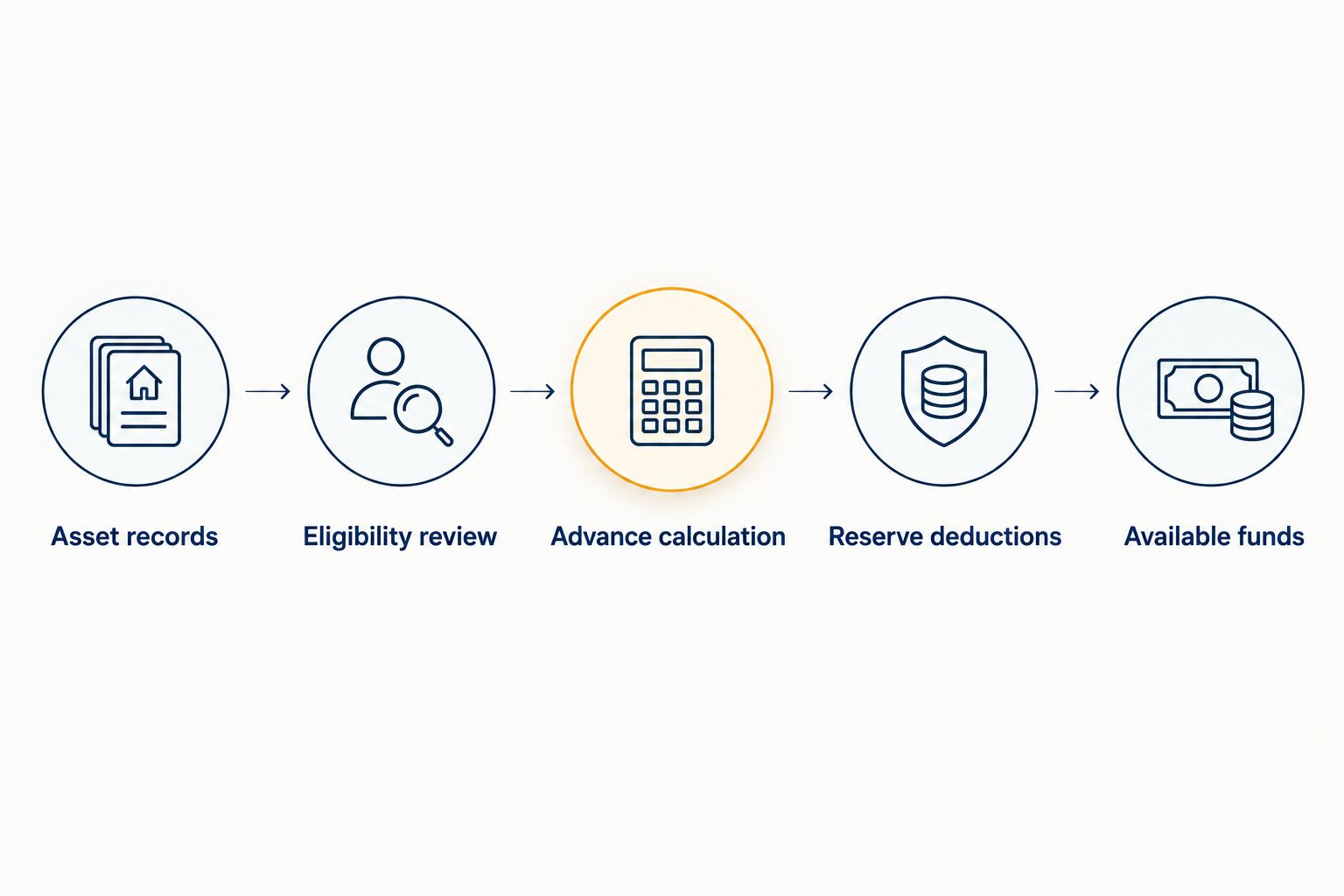
Borrowing capacity = eligible collateral multiplied by applicable advance percentages, minus reserves. Available draw capacity then accounts for amounts already borrowed and any other contractual limits.
For your 2026 comparison, ask each provider to apply its proposed rules to the same current asset records. That produces a useful side-by-side comparison without assuming a standard advance percentage or inventing a funding estimate.
How should you compare repayment and total obligations?
Request a written summary of net proceeds, interest, all applicable charges, payment frequency and termination obligations. Ask which charges apply even when you do not use the full facility.
A factor rate and an annual percentage rate are not interchangeable. A factor rate is a multiplier used to calculate a repayment or purchased-receivables amount; APR expresses annualized borrowing cost and depends on timing and applicable charges.
A purchase of future receivables is not automatically a loan. Review its legal structure, remittance provisions and any reconciliation process rather than assuming that a familiar payment schedule makes the products equivalent.
Compare the cash-flow consequences before comparing headline rates. A payment that falls before customer collections can create another funding gap even when the proposed proceeds cover the first one.
What risks can make asset-based lending the wrong fit?
Collateral-backed financing places business assets at risk under the security agreement. A blanket lien, meaning a security interest covering broad categories of assets, can also affect later financing.
Before proceeding in 2026, check:
- Existing liens: Can the proposed lender obtain the required lien position?
- Customer concentration: Does dependence on a small customer group reduce eligible receivables?
- Invoice quality: Are invoices disputed, overdue or subject to offsets?
- Inventory quality: Do obsolete or slow-moving goods affect eligibility?
- Reporting capacity: Can your team maintain the required records accurately?
- Personal exposure: Does the agreement include a personal guarantee?
Credit still matters. Collateral provides security; it does not erase underwriting, payment history or the obligations imposed on owners.
What documents should you prepare before comparing companies?
Prepare a current accounts-receivable aging report, accounts-payable aging report, financial statements and business bank statements. Add inventory records or equipment details when those assets support the request.
Also gather existing financing agreements, lien information and the contracts behind material receivables. Each provider determines its own requirements, so this is a preparation checklist—not an approval checklist.
Write down the business purpose, the funding gap and the source of repayment. Your comparison becomes clearer when every provider evaluates the same need rather than proposing unrelated amounts or structures.
How are these provider routes ranked?
The ranking follows collateral fit, usable proceeds, repayment, reporting demands and exit flexibility. It prioritizes matching the structure to the business need; it does not claim lender testing, verified approval outcomes or a universal winner.
Which route should you choose in 2026?
Default to a bank asset-based lending comparison when eligible collateral, financial records and reporting capacity support that route. Compare an independent asset-based lender when you need a separate collateral review, factoring when unpaid invoices are the specific problem, and equipment financing when the need is a defined asset purchase.
When the structure remains undecided, Jon Lynch Financial Group provides a brokerage route for comparing business funding. It is a broker, not a direct lender; products are for business purposes and remain subject to third-party underwriting and contract terms.
FAQ
What is asset based lending for small business?
Asset based lending for small business is financing secured by business assets such as eligible receivables, inventory or equipment. A revolving facility’s borrowing base determines how much you can draw under the agreement.
Which asset-based lending company is best for my business?
The best provider is the one whose collateral rules and repayment obligations match your operating cycle. Compare written proposals using the same asset records rather than choosing by an advertised limit.
Is invoice factoring the same as asset-based lending?
No. Factoring generally purchases existing invoices, while an asset-based loan uses assets as security for borrowing. Review the contract’s recourse and collection provisions.
Can I get asset-based lending after a bank decline?
A bank decline does not determine another provider’s decision. Identify the reason for the decline and compare it with the next provider’s collateral, credit and financial requirements; approval is not assured.
Does collateral mean my credit does not matter?
No. Collateral does not eliminate credit review or other underwriting requirements. Ask the provider how business credit, owner credit and existing obligations affect its decision.
Is a merchant cash advance an asset-based loan?
Not necessarily. A merchant cash advance may be structured as a purchase of future receivables rather than a loan secured by existing assets. Review the agreement’s structure, remittances and reconciliation terms.
Does Jon Lynch Financial Group lend directly?
No. Jon Lynch Financial Group is a broker, not a direct lender. Funding decisions and product terms remain with third-party lenders and funders.
What related guides help you compare alternatives?
- Business line of credit lenders
- Invoice factoring companies for small businesses
- Working capital loan costs and qualification
- Equipment financing companies
What is the next practical step?
Ask for the proposed borrowing-base calculation before accepting a facility limit. It exposes exclusions and reserves that a headline amount leaves out.
For U.S. businesses generating at least $35,000 per month, Compare Business Funding Options. Below $35,000 per month, Explore Self-Serve Funding through the tech-forward route, which uses a secure Plaid connection for bank statements and an automated decision; approval and timing are not assured.
Choose your business funding route
Match your monthly business revenue to the appropriate comparison or self-serve route.