Best Business Funding for Import-Export Companies 2026
Compare the best business funding for import and export companies in 2026: purchase of future receivables, invoice factoring, lines of credit, and SBA loans.

Best overall for import-export companies in 2026: purchase of future receivables — often structured as a merchant cash advance — because it funds off bank deposits, skips collateral, and covers supplier deposits or freight costs while you wait on buyer payment. Best for collecting on slow-paying buyer invoices: invoice factoring. Best for recurring container and inventory purchases: a business line of credit. Best lower-cost option for established importers and exporters: an SBA loan. Best for warehouse and handling equipment: equipment financing. Jon Lynch Financial Group is a broker, not a direct lender, and this ranking compares structures, not a single product.
- Best business funding for import and export companies in 2026 is purchase of future receivables for fast, collateral-free cash flow.
- Invoice factoring converts unpaid buyer invoices into cash without waiting out 30 to 90 day payment terms.
- A business line of credit fits recurring container and inventory purchases better than a one-time loan.
- SBA loans cost less over the life of the loan but take weeks, not days, to fund.
- Jon Lynch Financial Group is a broker, not a direct lender, and compares options across funding partners.
Why This Matters
Import-export companies carry a timing problem most domestic businesses don't: you pay a supplier deposit, cover ocean freight and customs duties, and then wait 30 to 90 days for a buyer to pay under standard trade terms. That gap is where cash-flow gaps and bank declines show up, not in the balance sheet at year-end. The funding structure you pick has to match that timing, or the repayment schedule fights your revenue cycle instead of supporting it.
If your import-export business generates at least $35,000 a month, you have enough revenue to compare structured funding options side by side on cost, speed, and repayment fit. Businesses under that threshold have a self-serve path worth exploring separately.
What Makes the Best Business Funding for Import-Export Companies
- Speed to funding measured against your actual shipping and customs timeline, not a generic "fast funding" claim
- Repayment schedule aligned with buyer payment terms — daily debits fight net-60 terms, a revolving line doesn't
- Collateral and documentation required: bank statements, purchase orders, or real estate, each unlocks a different product
- Total cost of capital in dollars repaid, not just a headline rate
- Flexibility across suppliers and seasons since import-export volume swings with buying cycles
- Qualification basis — cash flow and receivables versus personal credit score
Import-Export Funding Options at a Glance
| Option | Best For | Standout Feature | Key Limitation |
|---|---|---|---|
| Purchase of future receivables | Bridging supplier-to-buyer cash gaps | Funded off bank deposits, no collateral | Cost is measured in factor rate, not APR |
| Invoice factoring | Collecting cash tied up in buyer terms | Advances a percentage of invoice face value | Depends on your buyer's payment history too |
| Business line of credit | Recurring container and inventory buys | Revolving credit, reusable each cycle | Usually needs stronger credit than an MCA |
| SBA loan | Lower-cost capital for established firms | Government-backed, longer terms | Processing runs weeks, not days |
| Equipment financing | Warehouse and handling equipment | Equipment secures its own loan | Restricted to equipment purchases only |
1. Purchase of Future Receivables: Best Import-Export Funding for Bridging Supplier-to-Buyer Cash Gaps
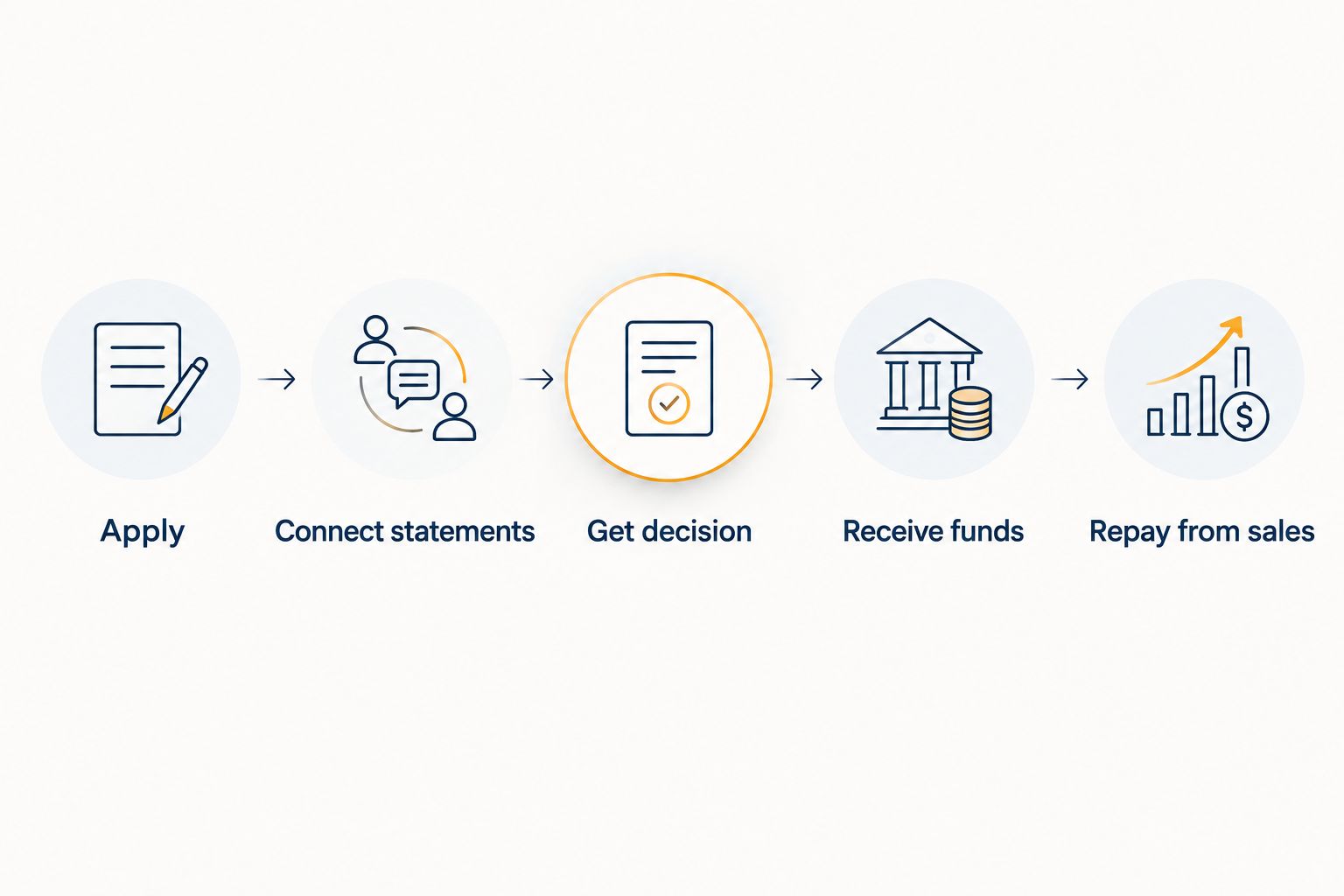
A purchase of future receivables — commonly structured as a merchant cash advance — provides a lump sum in exchange for a fixed share of future sales, repaid through daily or weekly debits instead of a fixed loan term. Underwriting leans on 3 to 6 months of bank deposits rather than collateral or a clean personal credit history. For import-export companies, that lump sum typically covers supplier deposits, ocean freight, and customs duties during the wait for buyer payment.
Illustrative example only: a $50,000 advance at a 1.35 factor rate means you repay $67,500 total, spread across daily or weekly debits over several months. That's not a quote — actual factor rates and terms vary by funding partner and file.
Purchase of future receivables pros:
- No collateral required against inventory, containers, or real estate
- Underwriting is based on bank deposits, not just a credit score
- One draw can cover supplier deposits, freight, and customs in a single transaction
- Structures can flex with revenue during slower shipping seasons
Purchase of future receivables cons:
- Costs more than a bank loan when measured against a comparable APR
- Daily or weekly debits can strain cash flow if buyer collections slip
- Works best as a bridge, not a permanent piece of your capital stack
Best for: import-export companies that need capital inside a single shipment cycle and can't wait out a bank's underwriting timeline.
Verdict: Compare this first if you need capital in weeks, not months.
2. Invoice Factoring: Best Import-Export Funding for Collecting on Unpaid Buyer Invoices
Invoice factoring sells an outstanding buyer invoice to a factoring company at a discount. The factor typically advances a percentage of the invoice's face value upfront, then releases the remainder — minus its fee — once your buyer pays. This fits exporters sitting on net-30, net-60, or net-90 terms who don't want to wait out the full cycle. For a detailed breakdown of advance rates and fee mechanics on similar B2B payment terms, see how invoice factoring works for freight brokers, who deal with comparable 30 to 90 day payment windows.
“If a 60-day payment term is standard in your buyer contracts, a funding structure built on daily debits works against your cash flow instead of for it.”
Invoice factoring pros:
- Cash is tied to invoices already earned, not projected future sales
- Approval leans partly on the buyer's credit, useful if your buyers are established companies
- Reduces how much weight your own credit score carries
Invoice factoring cons:
- Your buyer's payment history matters as much as yours
- Notification-style factoring means the buyer knows a third party is collecting
- Doesn't help before the invoice exists — supplier deposits still need separate funding
Best for: exporters with real invoices already in a buyer's hands on standard trade terms.
Verdict: Compare it if your bottleneck is unpaid invoices, not upfront capital.
3. Business Line of Credit: Best Import-Export Funding for Recurring Container and Inventory Purchases
A business line of credit is revolving: draw against it, repay it, and the limit frees back up for the next shipment. That structure fits recurring purchase orders, container bookings, and inventory restocking better than a lump-sum loan you'd need to reapply for every cycle. Details on qualification and lender fit are covered in the business line of credit lenders comparison.
Business line of credit pros:
- You draw only what you need and pay on the drawn balance
- Reusable for each shipping cycle without a new application
- Often costs less than a purchase of future receivables for qualified borrowers
Business line of credit cons:
- Approval generally requires stronger financials and credit than an MCA
- Credit limits may not scale fast enough for a sudden large order
- Underused lines can carry maintenance fees depending on the lender
Best for: import-export companies with steady order volume and solid financials who want reusable capital on hand.
Verdict: Compare it if your funding need repeats every shipping cycle.
4. SBA Loan: Best Import-Export Funding for Lower-Cost, Larger Capital
An SBA loan runs through an SBA-approved lender with a government guarantee behind it, which typically means longer repayment terms and lower rates than alternative financing. It suits established import-export companies with strong financials, tax returns, and documentation ready to go. Qualification specifics are covered in the SBA loan lenders guide.
SBA loan pros:
- Lower total cost of capital than an MCA or factoring for qualified borrowers
- Longer terms reduce the size of the monthly payment
- Can fund larger amounts for equipment, real estate, or expansion
SBA loan cons:
- Processing commonly runs several weeks to a few months, not days
- Requires more paperwork: tax returns, financials, a business plan
- A personal guarantee is standard, and collateral may be required
Best for: import-export companies planning ahead, not covering an urgent supplier deposit this week.
Verdict: Wait on this if you need cash now; compare it if you're planning next quarter.
5. Equipment Financing: Best Import-Export Funding for Warehouse and Logistics Equipment
Equipment financing funds forklifts, pallet racking, or container-handling machinery, with the equipment itself typically securing the loan. It's a narrower tool than the others on this list, built for one job. More on structuring and qualification is in the equipment leasing options guide.

Equipment financing pros:
- The equipment serves as its own collateral, which can ease approval
- Preserves other credit lines for inventory and shipping costs
- Payment terms often track the equipment's useful life
Equipment financing cons:
- Restricted to equipment purchases, not general working capital
- Doesn't touch supplier deposits or freight costs
- Older or specialized equipment may not qualify for full financing
Best for: import-export companies expanding warehouse or handling capacity, not covering a shipment cycle.
Verdict: Compare it when the need is equipment, not cash flow.
Compare Business Funding Options
See structures side by side before you commit to one.
How We Ranked These
Each option was measured against the same six criteria: speed against a real shipping timeline, repayment fit against buyer terms, collateral required, total dollar cost, flexibility across suppliers and seasons, and whether qualification runs on cash flow or credit score. Purchase of future receivables wins on speed and collateral; SBA wins on total cost; the rest fill specific gaps the other two don't cover.
Which Funding Option Should Import-Export Companies Choose?
For most import-export companies bridging the gap between a supplier deposit and buyer payment, purchase of future receivables is the default starting point in 2026 because it moves fast and doesn't require collateral. If unpaid invoices are the actual bottleneck, compare invoice factoring instead. If you're planning six months out with strong financials, an SBA loan costs less over the life of the deal. Whatever you pick, run the total dollar repayment against your buyer's actual payment terms before you sign — that's the number that decides whether the structure helps you or squeezes you.
FAQ
What is the best business funding for import and export companies in 2026?
Purchase of future receivables is the fastest fit for most import-export companies in 2026 because it funds off bank deposits without collateral. Invoice factoring or an SBA loan may cost less depending on your bottleneck.
Is a merchant cash advance the same as a business loan for import-export companies?
No. A merchant cash advance is typically structured as a purchase of future receivables, not a loan, and is priced with a factor rate instead of an APR. Repayment comes from a fixed share of future sales, not a fixed monthly payment.
How does invoice factoring work for exporters with net-60 payment terms?
A factoring company advances a percentage of the invoice's face value upfront, then releases the balance minus its fee once your buyer pays. It converts a net-60 wait into near-term cash without taking on new debt.
Can import-export companies qualify for an SBA loan?
Yes, established import-export companies with strong financials and documentation can qualify for an SBA loan. Processing commonly takes several weeks to a few months, so it fits planning ahead, not urgent supplier deposits.
What's the difference between factor rate and APR?
A factor rate is a flat multiplier applied to the amount advanced, such as 1.35, and doesn't account for time the way APR does. Converting a factor rate to an effective APR shows the true annualized cost before you compare it to a loan.
How fast can an import-export company get funded?
Timing depends on the product, the funding partner, and verification, and approval, amount, and funding time are never guaranteed. Purchase of future receivables and factoring generally move faster than an SBA loan or bank term loan.
Do I need collateral for import-export working capital?
Not for a purchase of future receivables, which is underwritten off bank deposits instead of collateral. A business line of credit, SBA loan, or equipment financing may require collateral or a stronger credit file.
Is Jon Lynch Financial Group a direct lender?
No. Jon Lynch Financial Group is a broker, not a direct lender, and compares options across third-party funding partners on cost, timing, and qualification.
One Last Thing
The costliest mistake import-export companies make isn't picking the wrong product on this list — it's stacking a second purchase of future receivables on top of an existing one to cover a customs delay. That doubles the daily debit pressure at the exact moment cash is tightest, and it's harder to unwind than it was to get into. Compare the total repayment on any new offer against what you're already paying out before you add a second position.