Business Funding for Veteran-Owned Startups: 2026 Picks
Business funding for veteran-owned startups: start with an SBA Microloan in 2026. Compare owner capital, acquisitions, equipment and established-revenue routes.

Best overall for a veteran-owned startup seeking outside capital: an SBA Microloan. Best for an acquisition: an SBA 7(a) loan. Best budget-first option: owner capital, if using it leaves enough cash to operate. In 2026, Jon Lynch Financial Group is best for veteran-owned businesses with established revenue comparing working-capital offers, not founders who have yet to make sales; it is a broker, not a direct lender. You can start with Jon Lynch Financial Group when your business is ready to compare funding structures.
- For business funding for veteran-owned startups, an SBA Microloan is the first outside-capital route to evaluate.
- Owner capital avoids repayment but can leave the business without a cash reserve.
- Jon Lynch Financial Group fits established owners comparing working capital, not pre-revenue startups.
- Compare total dollars paid, qualification, timing and repayment before choosing any offer.
Why does the startup stage change the answer?
A veteran-owned business with no sales has a different funding case from one collecting revenue every month. Lenders and funders review the business and the proposed use of funds; veteran ownership alone does not establish repayment capacity or secure approval. Start with the expense you need to pay, then choose the funding structure that matches it.
A founder paying startup expenses must protect the cash needed to open and operate. An owner buying an existing company needs acquisition financing. An operating business covering payroll while customers pay invoices needs working capital. Treating all three as the same request leads to poor comparisons.
In 2026, separate a genuine startup from an established business before considering revenue-based financing or a purchase of future receivables. Those structures depend on business receipts. Jon Lynch Financial Group’s primary funding audience is U.S. business owners generating at least $35,000 per month; that threshold is a routing guide for this brokerage, not a promise of eligibility.
What makes a funding option right for a veteran-owned startup?
Use these criteria before looking at an offer. A familiar program name tells you less than the dollars and obligations in its documents.
- Stage and revenue: Does the option fit a pre-revenue launch, an acquisition or a business already collecting payments?
- Use of funds: Is the money for general startup costs, a specific asset or a short-term cash-flow gap?
- Total cost: What will you pay in dollars, including fees, rather than only the advertised rate or factor?
- Repayment: Are payments fixed, tied to revenue or absent because you used your own money?
- Timing: Does the application, review and funding process fit the date the expense is due?
- Downside: What happens to operating cash, pledged assets or a personal guarantee if sales fall short?
Ask for the same information on every offer before comparing it. A lower payment is not necessarily a lower-cost choice if repayment lasts longer. Likewise, a quick decision does not establish that the funding is affordable.
Which veteran-owned startup funding options fit at a glance?
| Option | Best for | Standout feature | Key limitation |
|---|---|---|---|
| SBA Microloan | A smaller startup request with a defined use | Loan through a participating intermediary | Availability and underwriting depend on the intermediary |
| Owner capital | A founder who can fund launch costs without draining reserves | No lender payment | The founder bears the cash-flow risk directly |
| SBA 7(a) loan | Buying an existing operating business | Can address an acquisition financing need | Lender review and documentation take preparation |
| Equipment financing | Buying an identified business asset | Funding tied to the equipment purchase | Does not solve unrelated payroll or rent needs |
| Jon Lynch Financial Group brokerage | An established owner comparing working-capital structures | Comparison across third-party funding options | Not a direct lender or a fit for every pre-revenue business |
These are 2026 fit rankings, not an assertion that every applicant will qualify. Check current program requirements and the written terms of a specific offer before committing.
1. SBA Microloan: best funding for a defined startup expense
An SBA Microloan is a loan made through an intermediary rather than money handed directly to you by the SBA. It is the first outside-capital route to investigate when a veteran-owned startup has a specific business expense and can explain how it will repay the loan. The intermediary decides whether the application fits its program and underwriting.
SBA Microloan pros:
- Gives a startup a conventional loan structure to evaluate before considering receivables-based funding.
- Lets you match a defined request to a documented business use.
- Creates a clear repayment obligation you can put into a cash-flow forecast.
SBA Microloan cons:
- An application is not an approval, and intermediary requirements vary.
- Payments start whether or not the startup reaches its sales forecast.
- It is a poor match if the amount or permitted use does not fit your project.
Best for: A founder with a defined startup expense, a repayment plan and time to complete the intermediary’s review. Ask what documents the intermediary requires and what the full payment schedule looks like before applying elsewhere.
Verdict: Buy the fit, not the label. Pursue an SBA Microloan if the written terms support your startup forecast; hold if the payments depend on sales you cannot substantiate.
2. Owner capital: best funding when cash reserves stay intact
Owner capital means paying startup costs with money you already control. There is no lender payment on that contribution, but the money is no longer available for personal needs or a business cash shortfall. That tradeoff makes owner capital an operating decision, not automatically the cheapest sensible choice.
Owner capital pros:
- No application or third-party underwriting for the contribution itself.
- No debt payment attached to the money contributed.
- You decide which documented startup expenses to cover.
Owner capital cons:
- A launch can use up cash needed before customer payments arrive.
- You carry the loss if the business does not recover the investment.
- It may not cover the full equipment, inventory or acquisition need.
Best for: A founder who can identify the startup expense and preserve a separate reserve after paying it. In 2026, compare that remaining reserve with your forecasted expenses before calling this a budget option.
Verdict: Buy only with a reserve. Use owner capital for costs you can absorb; skip an all-cash launch if it removes the money required to keep operating.
3. SBA 7(a) loan: best funding for a business acquisition
An SBA 7(a) loan is a lender-originated loan backed by an SBA program, not a veteran-only award. It belongs on your list when your route into ownership is purchasing an existing business. The lender will review the transaction, borrower and ability to repay under its applicable requirements.
SBA 7(a) loan pros:
- Addresses a defined acquisition rather than forcing the purchase into a short-term cash-flow product.
- Gives you a loan payment schedule to compare with the acquired business’s projected cash flow.
- Provides a named program to discuss with participating lenders.
SBA 7(a) loan cons:
- Transaction documents and lender review require preparation.
- Debt payments remain due even if the acquired business underperforms.
- SBA program fit does not remove lender underwriting or borrower obligations.
Best for: A veteran buying an operating business with records that support the purchase and repayment case. For a launch with no company to acquire, start with a funding route tied to actual startup expenses instead.
Verdict: Buy for an acquisition. Compare the purchase documents, required cash contribution and full payment schedule before treating an SBA 7(a) loan as the answer.
4. Equipment financing: best funding for a specific asset
Equipment financing ties the request to an identifiable business asset. It gives you a narrower question to answer: will the asset support the business enough to justify its payment obligation? It is not a general substitute for money needed to cover every launch expense.
Equipment financing pros:
- Connects the funding request to a named purchase.
- Separates an equipment decision from a general working-capital need.
- Makes it easier to compare the asset’s expected business use with its payment schedule.
Equipment financing cons:
- It does not cover unrelated cash-flow gaps unless the agreement expressly allows that use.
- The agreement can create obligations involving the financed asset.
- Payments can begin before the asset produces enough revenue to support them.
Best for: A startup that knows what equipment it needs and has a credible plan for using it. In 2026, read the asset, payment, ownership and default terms together; a manageable payment alone does not make the purchase sound.
Verdict: Buy for the asset. Pursue equipment financing for an identified purchase; skip it as a workaround for unspecified operating expenses.
5. Jon Lynch Financial Group: best for an established veteran-owned business comparing working capital
Jon Lynch Financial Group is a veteran-owned commercial finance brokerage serving U.S. business owners. It helps established businesses compare options available through third-party lenders and funders, including working capital, revenue-based financing and purchases of future receivables. Jon Lynch Financial Group is a broker, not a direct lender.
A startup that has grown into consistent sales has a different choice from a pre-revenue founder. If the business generates at least $35,000 per month, compare proposals by total dollars paid, timing, qualification and repayment. The brokerage route does not itself establish approval or make a receivables purchase cheaper than a loan.
Jon Lynch Financial Group pros:
- Lets an established owner compare different funding structures against one business need.
- Keeps total cost and payment impact central to the decision.
- Offers a route for owners evaluating a bank decline alongside other options.
Jon Lynch Financial Group cons:
- It is not the right default for a business with no established receipts.
- Third parties make underwriting and funding decisions; a broker cannot promise an outcome.
- A faster or more flexible structure can create a repayment burden that does not fit the business.
Best for: A U.S. business owner with established revenue who needs business-purpose working capital and wants to compare written terms. Businesses below the monthly revenue threshold have a separate self-serve funding path to explore, subject to its own eligibility and verification.
Verdict: Buy the comparison, not an assumed approval. Compare Business Funding Options if your established business meets the routing threshold; otherwise, review the self-serve path or a startup-focused option.
How were these options ranked for 2026?
The order starts with a genuine startup seeking outside capital, then distinguishes a founder using available cash, an acquisition buyer, an equipment buyer and an already-operating business. It prioritizes fit to the business stage and expense over a claim that one product has the lowest cost for everyone. No specific offer, lender quote or approval decision is implied by the ranking.
That distinction matters because the same owner can move between categories. A veteran can start with personal capital, later finance equipment and eventually compare working capital once the business has receipts. Reassess the funding need at each stage rather than carrying forward the first product that worked.
How do you compare total cost and cash-flow impact?
Put the amount received, total amount due and expected payment schedule on one page. Then test the payment against a weak sales month, not just the month you hope to have. For a purchase of future receivables, read the actual purchase agreement: revenue-based financing can be structured as a purchase rather than a loan, and the contract determines the payment mechanism.
Illustrative example, not a funding offer: A business receives $40,000 and agrees to pay $48,000 in total. The difference is $8,000: $40,000 × 1.20 = $48,000, and $48,000 − $40,000 = $8,000. If that amount were paid evenly over 12 months, the illustrative payment would be $4,000 per month. Actual contracts can collect differently.
A 1.20 factor in this example describes total repayment relative to the amount received; it is not a 20% APR. APR is an annualized cost measure affected by payment timing and applicable fees. To compare that purchase with a loan, request the payment schedule and calculate total dollars paid and an annualized cost using the actual cash flows. The factor-rate comparison guide explains why the headline factor alone is not enough.
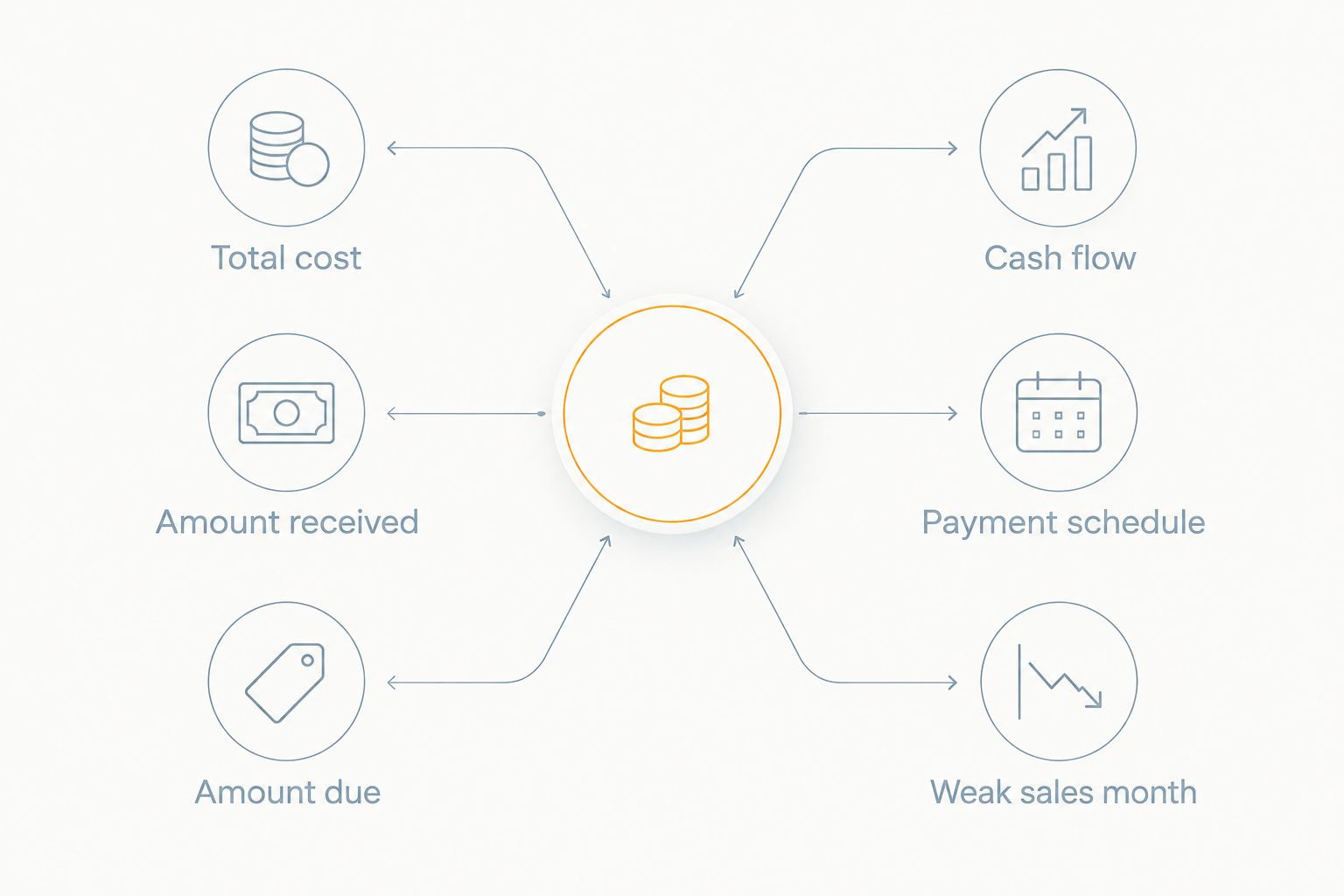
In 2026, reject a comparison that leaves out fees, changes the amount received between offers or ignores payment frequency. A smaller periodic payment can still produce a larger total obligation. If the payment would crowd out payroll or required inventory, change the amount or the funding plan before signing.
What can disqualify a funding route or make it the wrong choice?
A product can be available in principle and still be wrong for your business. Check the written terms and your own cash-flow forecast before treating eligibility as a recommendation.
- No established receipts: Do not treat a future-receivables purchase as a default answer for a pre-revenue startup.
- Unclear use of funds: Define the expense before approaching a lender or funder; an asset purchase and a payroll gap are different requests.
- Payments without a cushion: Model what remains after the proposed payment and essential operating expenses.
- Unexamined guarantees or asset rights: Read what the agreement permits a provider to claim if the business cannot pay.
- Consumer or non-U.S. purpose: Jon Lynch Financial Group’s primary funding audience is U.S. owners seeking business-purpose capital.
Credit is part of an underwriting review; it is not irrelevant because the owner is a veteran or the business has revenue. Ask each provider what it will review rather than relying on a blanket approval claim. For any third-party product, the provider’s current terms and decision govern.
What should you prepare before requesting startup funding?
Prepare a concise description of the business, the amount needed, the specific expense and when it must be paid. Add a cash-flow forecast that shows how the business plans to meet the proposed payment. For an acquisition, organize the transaction documents; for equipment, identify the asset and obtain its purchase details.
If your business already collects revenue, assemble the records a provider requests and disclose existing payment obligations. Do not send the same unsupported sales forecast into several applications expecting a different structure to fix it. Ask for the amount received, total amount due, payment schedule, fees and material contract obligations in writing before comparing offers.
Which business funding option should you choose?
For a pre-revenue veteran-owned startup seeking outside capital in 2026, start by evaluating an SBA Microloan against your defined expense and realistic repayment forecast. Use owner capital only if a workable reserve remains. Choose SBA 7(a) for a qualifying acquisition question and equipment financing for an identifiable asset purchase; neither is a catch-all answer to an operating cash gap.
Once a U.S. business is generating at least $35,000 per month, Jon Lynch Financial Group is the brokerage route for comparing business-purpose working capital and other third-party options. Below that threshold, Explore Self-Serve Funding rather than assuming the established-business route fits. Neither route promises a decision, approval, amount or funding time.
FAQ
What is the best business funding for veteran-owned startups in 2026?
An SBA Microloan is the first outside-capital option to evaluate for a veteran-owned startup with a defined expense and repayment plan. An acquisition or equipment purchase calls for a different funding comparison.
Does veteran ownership guarantee a business loan?
No, veteran ownership does not guarantee a business loan. A lender reviews the applicant, business purpose, repayment case and its current program requirements.
Can a veteran-owned startup get funding before it has revenue?
A pre-revenue founder can evaluate owner capital and startup-focused lending options such as an SBA Microloan. Revenue-based financing or a purchase of future receivables is not the default route without established receipts.
Is an SBA 7(a) loan better than an SBA Microloan for buying a business?
An SBA 7(a) loan is the better route to investigate for an acquisition. Compare actual lender requirements and repayment terms; an SBA Microloan belongs in a smaller, defined startup-expense discussion.
Should a startup use equipment financing for payroll?
No, equipment financing is designed around an identifiable asset purchase, not a general payroll gap. Match the funding agreement’s permitted use to the expense you need to pay.
Is a merchant cash advance the same as a business loan?
No, a merchant cash advance can be structured as a purchase of future receivables rather than a loan. Read the agreement to identify what is being purchased, the amount due and how payments are collected.
How do I compare a factor rate with a loan APR?
Calculate the total dollars due and compare payment schedules before evaluating annualized cost. A factor applied to the amount received is not itself an APR; payment timing and fees matter.
Does Jon Lynch Financial Group fund veteran-owned startups directly?
No, Jon Lynch Financial Group is a broker, not a direct lender. It helps established U.S. owners compare business-purpose funding through third-party providers and has a separate self-serve route for businesses below its primary revenue threshold.
One last thing
The strongest 2026 funding decision may be to request less. Size the request to the documented expense, then check whether the proposed payment still works when collections arrive later than planned. If your established business generates at least $35,000 per month, Compare Business Funding Options; if it generates less, Explore Self-Serve Funding and review the resulting terms before accepting anything.