Best business lines of credit for bad credit in 2026
Compare bad credit business line of credit options in 2026. Choose true revolving credit by repayment fit, total cost, collateral and written contract terms.

The best bad credit business line of credit is a genuine revolving facility whose payments your business can support—not a lump-sum advance advertised as a credit line. For 2026, compare nonbank revolving credit first for recurring cash-flow gaps, secured credit when you can pledge assets, and receivables financing only when a true line does not fit.
- A bad credit business line of credit should permit repeat draws under written revolving-credit terms.
- Jon Lynch Financial Group helps U.S. business owners compare funding; it is a broker, not a direct lender.
- Secured credit fits owners willing to pledge assets; invoice factoring fits eligible unpaid business invoices.
- Revenue-based financing can involve purchasing future receivables; it is not automatically a revolving credit line.
- Compare repayment, total dollars, qualification and contract restrictions before choosing working capital.
Who should compare these options in 2026?
Start with your funding need, not your credit score. A recurring payroll gap needs different financing from a single equipment purchase, and neither justifies an obligation your operating cash flow cannot support.
Jon Lynch Financial Group is a business-funding comparison option for U.S. owners generating at least $35,000 per month. The company is a broker, not a direct lender; third-party lenders and funders determine underwriting and product terms. Start with Jon Lynch Financial Group when you need to compare business-purpose funding structures rather than assume one product will approve you.
Bad credit affects the decision, but it does not explain the whole business. Prepare to discuss deposits, existing obligations, operating history, collateral and the reason for the credit problem.
What makes the best bad credit business line of credit?
Use these criteria before comparing providers. A product name cannot substitute for a contract.
- True revolving access: Confirm whether repayment restores borrowing capacity and whether additional draws require another application.
- Repayment fit: Match payment frequency and amounts to actual collections, not projected sales alone.
- Total-dollar clarity: Request net proceeds, scheduled repayment, charges and any recurring account obligations in writing.
- Qualification transparency: Ask whose credit is reviewed, which reports are used and whether the inquiry affects your credit file.
- Security and guarantees: Identify pledged assets, lien coverage and any personal guarantee before accepting terms.
- Exit flexibility: Check early-payoff treatment, renewal rules, draw restrictions and the lender's right to suspend access.
For a broader provider-comparison framework, review business line of credit lenders. Evaluate the actual offer against these criteria rather than treating a lender category as proof of approval.
Which funding structures fit at a glance?
These are ranked funding routes, not a claim that every provider accepts bad credit. The ranking puts genuine revolving credit ahead of alternatives when repeat borrowing is the objective.
| Rank and option | Best for | Standout feature | Key limitation |
|---|---|---|---|
| Nonbank revolving business line | Recurring operating gaps | Draw access within an approved facility | Credit review and draw restrictions still apply |
| Secured business line | Owners willing to pledge eligible assets | Collateral supports the financing structure | Pledged assets are exposed to enforcement |
| Invoice factoring | Businesses waiting on eligible customer invoices | Funding tied to existing receivables | Not a general-purpose revolving loan |
| Revenue-based financing or future-receivables purchase | Owners comparing revenue-linked alternatives | Underwriting considers business revenue and collections | Not automatically a line; collection obligations need close review |
Default choice: compare a genuine revolving line first. Move to an alternative because its structure fits the business—not because its marketing uses the words bad credit.
1. Is nonbank revolving credit best for recurring operating gaps?
A nonbank revolving business line gives you access to an approved borrowing facility under the lender's draw and repayment rules. It fits repeated working-capital needs better than a one-time advance when the agreement restores borrowing capacity after repayment.
Nonbank does not mean no credit review. Ask the lender to explain current qualification requirements and identify whether the owner, the business or both are evaluated.
Nonbank revolving credit pros:
- Supports repeated borrowing without treating every expense as a separate financing project.
- Lets you match individual draws to specific business needs.
- Provides a defined facility instead of an assumed future renewal.
Nonbank revolving credit cons:
- Draws remain subject to the agreement's conditions and restrictions.
- Payment frequency can strain a business with uneven collections.
- A personal guarantee or business lien can create obligations beyond the drawn balance.
Best for: An operating business with recurring gaps and a credible source of repayment.
Verdict: Buy only after verifying revolving access and repayment fit; skip an offer that needs fresh approval every time you need funds.
2. Is secured credit best when you can pledge business assets?
A secured business line links the borrowing facility to pledged assets. Depending on the agreement, eligible collateral can include receivables, inventory or other business property.
Collateral does not erase bad credit or replace underwriting. The lender must accept the assets, their valuation and any existing claims against them.
Secured business line pros:
- Creates a borrowing structure tied to identifiable business assets.
- Can support revolving access when the contract provides it.
- Gives you a clear basis for discussing collateral eligibility and borrowing capacity.
Secured business line cons:
- Default exposes pledged assets to contractual enforcement.
- Reporting and collateral monitoring add administrative work.
- Existing liens can restrict what another lender will accept.
Best for: An asset-owning business willing to accept collateral restrictions for a recurring facility.
Verdict: Hold until you understand the lien scope, reporting requirements and consequences of default. Do not pledge an essential asset simply to avoid examining repayment capacity.
3. Is invoice factoring best when customers owe you money?
Invoice factoring finances eligible unpaid invoices through a receivables transaction. It addresses the gap between delivering work and collecting from customers; it is not the same as a revolving business loan.
The factor evaluates the invoices and customer payment risk under its program. Your credit history does not make every invoice eligible or remove contractual obligations.
Invoice factoring pros:
- Connects funding to work already billed rather than unsupported sales forecasts.
- Fits businesses whose cash-flow problem comes from customer payment delays.
- Makes invoice eligibility and collections central to the comparison.
Invoice factoring cons:
- Requires eligible receivables; consumer sales or unbilled work do not automatically qualify.
- Customer notification and collection procedures can affect relationships.
- Recourse provisions can leave the business responsible for unpaid invoices.
Best for: A business with eligible customer invoices and a collection-timing problem.
Verdict: Buy only when the invoice economics and customer arrangements work; skip factoring for a need unrelated to receivables.
4. Is revenue-based financing best as an alternative to a line?
Revenue-based financing links the funding assessment or collection structure to business revenue. Some arrangements are purchases of future receivables, commonly searched as merchant cash advances or MCAs, rather than loans.
Read the legal structure before comparing repayment. A purchase agreement, a term loan and a revolving facility create different obligations even when each is marketed as working capital.
Revenue-based financing pros:
- Provides another structure to compare when a revolving line does not fit.
- Makes business collections relevant to the funding assessment.
- Allows comparison of contract-specific remittance and reconciliation provisions.
Revenue-based financing cons:
- Does not automatically restore borrowing capacity after collections.
- Frequent withdrawals can compete with payroll and operating expenses.
- A factor rate does not describe annualized cost or establish APR.
Best for: An established revenue-producing business evaluating a specific working-capital need after reviewing revolving alternatives.
Verdict: Hold until you understand total obligations, withdrawal mechanics and reconciliation; skip an agreement that depends on another advance to remain manageable.
How does a credit line work differently from an advance?
A revolving line establishes a borrowing limit and rules for drawing, repaying and borrowing again. The contract determines when capacity returns, whether access expires and what can trigger a freeze.
A term loan supplies a lump sum with a repayment obligation. A future-receivables purchase supplies funds in exchange for contractual rights to future collections; another transaction generally requires a separate agreement unless the documents provide otherwise.
For your 2026 comparison, ask one decisive question: Does paying down this obligation give you contractual access to borrow again? If the answer is no, do not classify the offer as a revolving line.
How should you compare the dollars without relying on headline rates?
Build a written comparison from the actual offers. Separate the funds deposited into your account from the amount financed, because deductions change the cash available for your business need.
Use these calculations:
- Net proceeds: Funding amount minus deductions taken before disbursement.
- Total scheduled outflow: All scheduled payments or remittances plus separately payable charges.
- Financing cost: Total scheduled outflow minus net proceeds, with contingent obligations listed separately.
- Remaining operating cash: Collections minus operating expenses and all financing withdrawals.
For a factor-rate agreement, multiplying the funded amount by the factor produces the stated purchased amount or repayment amount under that structure. It does not produce APR; annualized comparison also needs the timing of cash flows and applicable charges.
For a revolving line, compare the same intended draw and repayment pattern across offers. A maximum limit says little about the cost of the amount you actually use.
Choose from the cash-flow schedule, not the headline alone. Ask for early-payoff calculations and contract-specific explanations rather than assuming repayment ahead of schedule reduces every obligation.
When is waiting or choosing another structure better?
If your need is a one-time purchase, compare a term loan or equipment financing alongside a line. Repeated draw access adds little when you do not expect recurring borrowing.
If your funding deadline allows more underwriting, include bank and SBA options in the comparison rather than ruling them out by label. Bad credit remains relevant, and neither route guarantees eligibility.
Waiting is the better decision when the business cannot support another payment or when correcting a documented credit-report error resolves an obstacle. Funding should bridge an identifiable gap, not disguise a continuing operating loss.
What risks should stop a 2026 application?
Stop when the offer creates a payment burden your cash-flow forecast cannot carry. Adding financing to an existing shortfall does not create a repayment source.
Other warning signs require clarification before signing:
- The salesperson calls the product a line, but the contract provides only a lump sum.
- The agreement's withdrawal rules differ from the verbal explanation.
- The business already has obligations that restrict additional borrowing.
- Collateral, guarantees or default provisions remain unexplained.
- Renewal is presented as certain despite separate underwriting requirements.
- The proposed repayment depends on refinancing that has not been approved.
Bad credit is not permission to accept an unclear contract. Ask for written answers and obtain legal or accounting advice when the obligations exceed your ability to evaluate them.
What documents help you compare real offers?
Prepare accurate business records before submitting applications. Requirements vary by third-party program, so confirm the requested document periods rather than assuming a universal checklist.
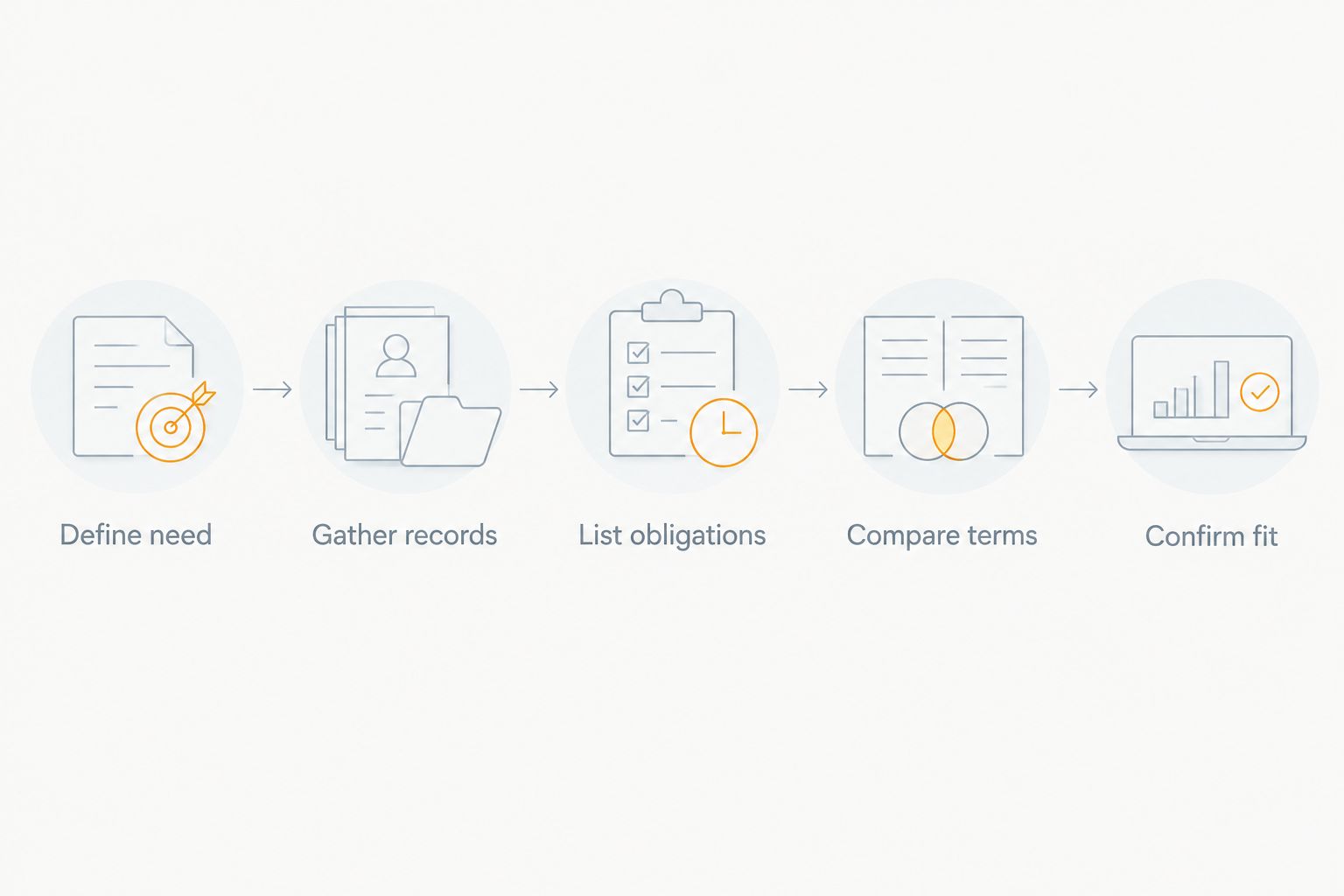
Use this sequence:
- Define need: State the business purpose and identify the expected repayment source.
- Gather records: Assemble requested bank statements, financial records and ownership information.
- List obligations: Include loans, advances, liens and recurring financing withdrawals.
- Compare terms: Review net proceeds, payment schedules, security and repeat-draw rules.
- Confirm fit: Check the contract against the business's cash-flow forecast before accepting.
This sequence keeps the funding decision tied to the business problem. It also prevents a large advertised limit from distracting you from an unsuitable repayment structure.
How were these options ranked?
This 2026 ranking prioritizes the stated goal: repeat access to working capital. Genuine revolving structures rank first; invoice and future-receivables alternatives appear afterward because they solve different cash-flow problems.
The decision criteria are revolving access, repayment fit, total-dollar clarity, qualification, security and exit terms. No lender category receives an automatic approval recommendation.
FAQ
What's the best bad credit business line of credit in 2026?
The best fit is a genuine revolving facility with payments your business can support. Compare nonbank and secured lines using written draw rules, total obligations, credit requirements and collateral terms rather than assuming a provider accepts every bad-credit applicant.
Can I get a business line of credit after a bank decline?
A bank decline does not establish eligibility or ineligibility for every other program. Ask why the bank declined the application, then compare third-party requirements against your deposits, credit history, obligations and repayment capacity.
Is a merchant cash advance a business line of credit?
A merchant cash advance is not automatically a business line of credit. It can be structured as a purchase of future receivables, while a genuine revolving line provides contractual draw and repayment rights.
Does collateral guarantee approval with bad credit?
Collateral does not guarantee approval. A lender still evaluates the applicant, the assets, existing liens and its current underwriting requirements.
Is a factor rate the same as APR?
A factor rate is not APR. Annualized comparison requires the timing of payments or collections and applicable charges, not just the multiplier used to calculate the stated obligation.
Does Jon Lynch Financial Group lend directly?
Jon Lynch Financial Group is a broker, not a direct lender. Business-purpose products are subject to third-party underwriting, and approval, amounts, rates, decisions and funding times are not guaranteed.
What if my business generates less than $35,000 per month?
U.S.-based entrepreneurs below $35,000 per month can Explore Self-Serve Funding. Applicants securely connect bank statements through Plaid for an automated decision; eligible applicants may receive a decision within minutes and approved funds within an hour, subject to verification, bank processing and product terms.
One last thing: can the line disappear when you need it?
Before accepting a revolving facility, identify the events that permit draw suspension or termination. A credit limit is less useful when the agreement allows access to stop at the moment your cash flow weakens.
Ask for those provisions alongside the payment schedule. Repeat access is a contract term, not a sales promise.
Related guides
- Working capital loans: costs and qualification
- Revenue-based financing versus merchant cash advance
- How to compare factor rates on a merchant cash advance
Which funding route should you take next?
For 2026, take your funding purpose, bank records and existing payment obligations into the comparison. Jon Lynch Financial Group's business-funding routes serve U.S. business-purpose requests; consumer-purpose and non-U.S. requests fall outside the primary funding audience.
If your business generates at least $35,000 per month, use Compare Business Funding Options. Below $35,000 per month, use Explore Self-Serve Funding; neither route promises approval or a particular outcome.
Compare your business funding options
Review funding fit, total obligations, timing and repayment before choosing a structure.
Next step: identify your monthly revenue route, then compare the written repayment schedule against your actual collections before accepting funding.