Best business loan lenders for women-owned businesses in 2026
Business loans for women owned businesses: compare banks, SBA lenders, CDFIs and broker options by qualification, repayment, total cost and business funding fit.

Best default: compare a bank or credit union first if your financials support conventional borrowing. Best for comparing third-party funding: Jon Lynch Financial Group, whose primary audience generates at least $35,000 per month. The best business loans for women owned businesses in 2026 match your repayment capacity and purpose—not just an advertisement aimed at women entrepreneurs.
- Business loans for women owned businesses should match cash flow, repayment capacity and funding purpose.
- Jon Lynch Financial Group fits established owners comparing working capital through third-party funding partners.
- Compare bank loans, SBA lenders and CDFIs before accepting a future-receivables purchase.
- Women-owned certification supports eligible contracting opportunities; it does not guarantee business funding.
Why does lender choice matter more than a women-owned label?
Women-owned businesses need the same fundamental financing match as other businesses: an affordable obligation tied to a credible source of repayment. A program marketed to women does not replace underwriting or make an unsuitable payment schedule manageable.
Separate the provider from the product. A bank lends, a broker introduces funding options, and a funder purchasing future receivables uses a different contract from a conventional loan.
Jon Lynch Financial Group is best for established U.S. business owners comparing working capital through third-party funding partners. It is a broker, not a direct lender, and its primary business-funding audience includes companies generating at least $35,000 per month.
What makes the best business funding option?
Use these criteria before reviewing the ranked options:
- Qualification fit: Compare revenue, operating history, credit, existing obligations and documentation against the actual program.
- Total obligation: Request the net proceeds, financing charges, fees and total dollars owed or receivables purchased.
- Payment pressure: Match payment frequency and amount to when customers actually pay you.
- Timing: Establish when money is needed, then distinguish application processing from completed funding.
- Contract risk: Review guarantees, liens, default provisions, renewal terms and early-exit treatment.
- Provider responsibility: Identify the lender or funder, the broker's role and who services the obligation.
For a 2026 comparison, request written terms for the same business purpose and requested proceeds. Different amounts or repayment schedules make headline-rate comparisons misleading.
Which funding routes fit women-owned businesses at a glance?
This ranking covers provider categories and a brokerage route, not an unsupported leaderboard of individual lenders. Each option serves a different financing need.
| Rank and option | Best for | Standout feature | Key limitation |
|---|---|---|---|
| 1. Jon Lynch Financial Group | Comparing third-party working-capital options | Broker-assisted comparison of funding structures | Not a direct lender; partners determine approval and terms |
| 2. Banks and credit unions | Established businesses seeking conventional borrowing | Term loans and revolving credit structures | Financial condition and underwriting requirements determine fit |
| 3. SBA participating lenders | Planned expansion or acquisition financing | SBA-backed lending through participating lenders | Eligibility and documentation still apply |
| 4. Community development financial institutions | Owners seeking mission-focused financing | Community-oriented lending and support | Service areas and programs differ |
| 5. Equipment finance providers | Purchasing a specific business asset | Financing tied to equipment | Does not necessarily cover unrelated operating expenses |
| 6. Future-receivables funders | Established revenue-producing businesses evaluating nonloan funding | Purchase of future business receivables | Remittance terms can strain operating cash flow |
1. When is Jon Lynch Financial Group the best comparison route?
Jon Lynch Financial Group helps U.S. business owners compare working capital, revenue-based financing and purchases of future receivables through third-party funding partners. Its broader funding options include lines of credit, term loans, equipment financing, invoice factoring, SBA and bridge options.
Best for: Established businesses generating at least $35,000 per month that want to compare financing by total cost, timing, qualification and repayment.
Jon Lynch Financial Group pros:
- Provides a brokerage route rather than requiring you to start with one product.
- Supports comparisons across several business-purpose funding structures.
- Offers a separate self-serve route for businesses below its primary revenue threshold.
Jon Lynch Financial Group cons:
- Does not make the lending or funding decision itself.
- Cannot guarantee approval, amounts, rates or funding timing.
- A proposed future-receivables purchase requires different analysis from a loan.
Treat the monthly revenue threshold as audience routing, not proof of eligibility. Ask who provides the capital and request the complete proposed agreement before accepting an offer.
Verdict: Use the broker route to compare structures; wait to commit until the actual funder's terms fit your cash flow.
2. When are banks and credit unions the best default?
Banks and credit unions offer conventional business borrowing, including term loans and lines of credit. A term loan provides a defined borrowing amount with scheduled repayment; a line of credit permits borrowing within an approved limit under its agreement.
Best for: Established women-owned businesses with documented repayment capacity that can complete conventional underwriting.
Bank and credit union pros:
- Provide recognizable loan and revolving-credit structures.
- Allow you to match recurring needs to a line and defined projects to a term loan.
- Let an existing banking relationship serve as a starting point for discussion.
Bank and credit union cons:
- A banking relationship does not guarantee approval.
- Credit, financial statements, guarantees or collateral requirements can limit fit.
Ask your current institution which documents it needs and whether the requested purpose fits its programs. Compare another institution's written proposal rather than assuming the relationship bank has the best terms.
Verdict: Start here when conventional borrowing fits; skip an offer whose payment schedule exceeds available cash.
3. When are SBA participating lenders the best expansion route?
SBA-backed loans are made through participating lenders; the SBA guarantee does not remove the borrower's repayment obligation. They deserve consideration when you are planning an eligible business expansion, acquisition or other qualifying use.
Best for: Owners with a defined project and enough time to assemble financial and transaction documents.
SBA participating lender pros:
- Offer an established framework for eligible business-purpose financing.
- Support evaluation of a defined project rather than an unexplained cash request.
- Provide a route worth comparing alongside conventional lending.
SBA participating lender cons:
- SBA eligibility and lender underwriting both matter.
- Documentation and closing requirements make this unsuitable for an unresolved emergency deadline.
For a 2026 application, ask the lender which SBA program fits the proposed use. Confirm required equity, guarantees, collateral treatment and closing conditions for that specific transaction instead of importing rules from another program.
Verdict: Pursue SBA financing for a planned eligible project; wait rather than assuming it solves an immediate payroll gap.
4. When are CDFIs the best mission-focused option?
Community development financial institutions, or CDFIs, serve community-development purposes through financial services. Some provide business lending and borrower support, but their products, geography and eligibility differ.
Best for: Owners whose business location or circumstances match a CDFI's service area and lending mission.
CDFI pros:
- Offer a distinct alternative to conventional bank shopping.
- Some combine financing with business assistance.
- Let you investigate programs connected to the community your business serves.
CDFI cons:
- Not every CDFI offers the product or coverage you need.
- Mission alignment does not eliminate credit analysis or repayment requirements.
Ask whether the institution lends to businesses in your location and accepts your intended use of funds. Women-owned status alone does not establish eligibility for every community-development program.
Verdict: Apply when the institution's mission and program match your business; skip applications outside its stated coverage.
5. When are equipment finance providers the best asset-specific choice?
Equipment financing ties the funding request to an identifiable asset. Compare a loan and a lease separately: ownership, end-of-term obligations and early termination depend on the agreement.
Best for: Businesses purchasing or replacing equipment with a documented operational purpose.
Equipment finance provider pros:
- Connect funding to a specific asset and supplier quote.
- Keep the equipment decision separate from general working-capital borrowing.
- Allow comparison of loan and lease structures for the same asset.
Equipment finance provider cons:
- Equipment funding does not automatically solve payroll or inventory gaps.
- Maintenance, insurance and end-of-term obligations can affect the decision.
Ask what happens if the equipment fails, the supplier delays delivery or you want to exit early. Compare the complete obligation, not just the periodic payment.
Verdict: Use asset-specific financing for an asset-specific need; skip it as a substitute for unrelated operating capital.
6. When should you consider future-receivables funders?
Revenue-based financing can be structured as a purchase of future receivables rather than a loan. A merchant cash advance, or MCA, commonly refers to this type of business funding, but the actual agreement controls its mechanics.
Best for: Established revenue-producing businesses evaluating a defined working-capital need after comparing appropriate loan alternatives.
Future-receivables funder pros:
- Provides a structure distinct from conventional lending.
- Connects the funding analysis to business receipts.
- Gives owners another option to assess after a bank decline.
Future-receivables funder cons:
- Frequent remittances can compete with payroll, taxes and supplier payments.
- Reconciliation and early-exit treatment require close contract review.
- Multiple overlapping obligations can intensify cash-flow pressure.
A factor rate is a multiplier used to calculate a purchased or repayment amount; it is not an annual percentage rate. Ask how receipts are measured, how reconciliation works and what happens when sales decline.
Verdict: Wait until you understand the remittance burden; skip any structure your operating cash flow cannot support.
How were these funding routes ranked?
The order reflects decision usefulness, not verified lender performance. Brokerage comparison comes first for owners evaluating multiple structures; conventional lending remains the default starting point when the business qualifies.
The remaining routes occupy distinct slots: planned expansion, community-program fit, equipment purchases and future-receivables funding. No ranking establishes approval odds or substitutes for written terms.
What should the numbers tell you before you apply?
The primary brokerage audience threshold is $35,000 per month. Holding that revenue constant for 12 months produces $420,000 per year: $35,000 multiplied by 12.
That calculation describes revenue, not repayment capacity. Revenue before payroll, inventory, taxes and existing obligations is not the cash available for another payment.
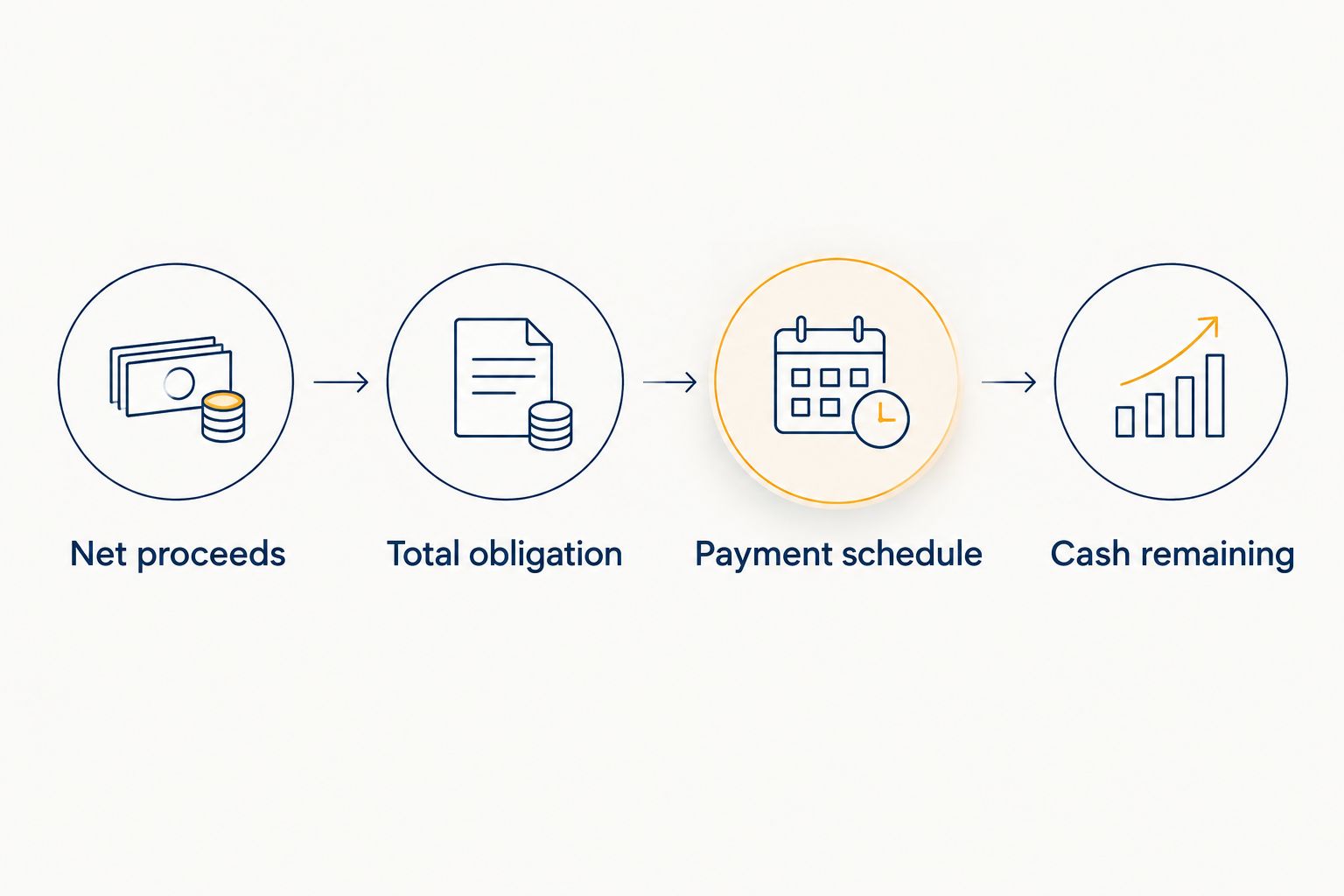
Use this comparison sequence:
- Net proceeds: Record the cash your business actually receives after deductions.
- Total obligation: Record scheduled payments or the receivables amount being purchased, plus separate charges.
- Payment schedule: Identify when each withdrawal or payment occurs.
- Cash remaining: Check what remains for operating expenses under weaker sales.
The sequence applies to every 2026 offer, whether it comes from a bank, broker or nonbank funder. Do not compare a factor rate directly with APR; an annualized comparison requires timing and cash-flow information.
Does women-owned certification help you qualify for a loan?
Women-owned certification and business-loan approval answer different questions. The SBA's Women-Owned Small Business federal contracting program requires at least 51% ownership and control by women who are U.S. citizens, alongside its other eligibility requirements.
That is a contracting-program rule, not a universal lending threshold. In 2026, a certification can support an eligible contracting strategy, but a lender still evaluates the financing request.
If a contract creates the funding need, explain the payment milestones and mobilization expenses. A contract opportunity is not the same as cash already collected.
What risks or disqualifiers should stop the application?
Stop when the proposed obligation has no credible repayment source. Borrowing to cover a temporary collection gap differs from repeatedly financing operating losses without a corrective plan.
Before proceeding, resolve these issues:
- Conflicting revenue figures across your application and bank records.
- Undisclosed loans, receivables purchases or liens.
- A payment schedule that leaves insufficient cash for essential expenses.
- Unclear personal guarantees or default provisions.
- Pressure to sign without reviewing the complete agreement.
Credit remains relevant. Ask how the specific lender or funder evaluates it rather than treating revenue-based financing as a promise that credit does not matter.
Which documents should you prepare?
Prepare current business bank statements, financial statements, ownership information and details of existing obligations. Add a supplier quote, purchase agreement, invoice records or contract when those documents explain the funding purpose.
Ask for the provider's current checklist before sending sensitive information. Confirm the recipient and submission method, and keep your application figures consistent with your records.
FAQ
What's the best lender for a women-owned business?
The best lender matches your funding purpose and repayment capacity. Start with a bank or credit union when conventional borrowing fits, then compare SBA participating lenders, CDFIs or other relevant structures.
Are there business loans only for women-owned businesses?
Some programs target women entrepreneurs, but women-owned status does not replace the program's eligibility and underwriting requirements. Check the specific program rather than assuming all women-owned businesses qualify.
Does women-owned certification guarantee SBA loan approval?
No. Women-owned contracting certification and SBA loan underwriting are separate processes, and participating lenders assess the financing application.
Is Jon Lynch Financial Group a direct lender?
Jon Lynch Financial Group is a broker, not a direct lender. Business-purpose products are subject to third-party underwriting, and the lender or funder determines approval and terms.
Can I apply if my business makes less than $35,000 per month?
Businesses below $35,000 per month can Explore Self-Serve Funding. The route is open to U.S.-based entrepreneurs and uses securely connected bank statements through Plaid for an automated decision; approval and timing are not guaranteed.
Is a merchant cash advance the same as a business loan?
A merchant cash advance may be structured as a purchase of future receivables rather than a loan. Read the agreement for remittance, reconciliation, default and guarantee provisions.
What should I compare besides the interest rate?
Compare net proceeds, total obligation, payment frequency, fees, guarantees and early-exit terms. A factor rate is not APR, so the two cannot be compared directly without cash-flow timing.
One last thing: can the cheaper offer still be the wrong fit?
Yes. A payment arriving before your customers pay can create a cash shortage even when another measure looks attractive.
For your 2026 decision, put the proposed payment dates beside payroll, taxes and expected collections. Choose a structure your business can carry through a weaker sales period.
Related guides
- Best banks for small business loans
- How to compare factor rates on a merchant cash advance
- Business line of credit lenders
What is your next step?
These options are for business purposes and remain subject to the relevant provider's underwriting. Approval, amounts, rates, decisions and funding times are not guaranteed; consumer-purpose and non-U.S. requests fall outside the primary funding audience.
Bring your funding purpose, monthly revenue and existing payment obligations to the comparison. If your U.S. business generates at least $35,000 per month, Compare Business Funding Options; if it generates less, Explore Self-Serve Funding.