Best credit builder loans for small businesses in 2026
Compare credit builder loans for small business by reporting, cash access and repayment. Pick the right fit for business credit without confusing it with funding.

Best overall for business credit: a business-reporting credit-builder loan with confirmed reporting and affordable payments. Best for working capital: a secured business installment loan; best for existing purchases: reporting vendor terms. For credit builder loans for small business in 2026, the deciding tradeoff is whether you receive usable cash, establish business payment history, or only improve the owner’s personal credit.
- Choose credit builder loans for small business only after confirming which business credit bureaus receive payment history.
- Business-reporting credit-builder loans fit credit-building goals; secured business loans fit immediate working-capital needs.
- Reporting vendor terms fit purchases you already need; personal credit-builder loans do not establish business credit by themselves.
- Jon Lynch Financial Group fits established U.S. businesses comparing funding, not owners seeking a guaranteed credit-score increase.
Why does business reporting matter more than the product name?
A loan described as a credit builder does not necessarily build your company’s credit. You need to know whose account is reported, which bureau receives it, and whether positive payment history is included.
Jon Lynch Financial Group is best for established U.S. business owners comparing business funding rather than buying a promised credit-score increase. The firm is a broker, not a direct lender; you can start your funding comparison through Jon Lynch Financial Group.
Keep two goals separate: building a credit record and financing a business expense. A product that holds the loan proceeds until you finish paying does not solve a payroll gap today.
What makes the best credit-building option for your business?
Use these criteria before comparing applications in 2026. A recognizable product name is not a substitute for written terms.
- Business reporting: Confirm the reporting bureau, account owner, reporting frequency, and treatment of positive payments.
- Cash access: Establish whether proceeds are released immediately, held in a restricted account, or available only for purchases.
- Repayment fit: Match the payment schedule to cash left after operating expenses and existing obligations.
- Security exposure: Identify deposits, pledged assets, liens, and personal guarantees before applying.
- Total obligation: Request the complete payment schedule and all required charges, not just a headline rate.
- Business purpose: Choose an account that supports an actual business need rather than unnecessary borrowing.
The ranking below compares structures, not named providers. Reporting and qualification depend on the specific agreement; none of these categories guarantees a score increase.
Which credit-building options fit at a glance?
| Rank and option | Best for | Standout feature | Key limitation |
|---|---|---|---|
| 1. Business-reporting credit-builder loan | Establishing business installment history without urgent cash needs | Scheduled payments reported under the business when confirmed | Proceeds can remain restricted until the agreement’s release conditions are met |
| 2. Secured business installment loan | Financing a defined expense with available collateral | Business-purpose proceeds and a scheduled payoff | Collateral is exposed; positive business reporting must be verified |
| 3. Reporting vendor terms | Building history through necessary supplier purchases | Payment terms tied to real business transactions | Not a cash loan; reporting varies by supplier |
| 4. Secured business credit card | Managing recurring purchases with a revolving account | Reusable purchasing capacity under the issuer’s terms | A security deposit ties up cash; reporting varies by issuer |
| 5. Personal credit-builder loan | Addressing the owner’s personal credit separately | Personal installment payment history when reported | Does not establish business credit merely because the borrower owns a business |
1. When is a business-reporting credit-builder loan the best fit?
A business-reporting credit-builder loan is the most direct fit when your goal is business installment history rather than immediate liquidity. In a common credit-builder structure, the lender holds proceeds in a restricted account while you make scheduled payments.
Before applying, obtain written confirmation that the account reports under your business identity. Personal reporting alone does not meet a business-credit objective.
Business-reporting credit-builder loan pros:
- Creates a scheduled payment obligation you can plan around.
- Fits a credit-building goal without requiring an unrelated purchase.
- Supports business payment history if positive reporting is confirmed.
Business-reporting credit-builder loan cons:
- Restricted proceeds do not cover immediate operating expenses.
- Required payments compete with your cash reserve.
- Reporting does not guarantee a particular score or future approval.
Best for: A business with cash reserves, no urgent funding gap, and a verified business-reporting agreement.
Verdict: Hold until reporting and release conditions are confirmed; skip it for urgent working capital.
2. When is a secured business installment loan the better choice?
A secured business installment loan provides business-purpose financing backed by collateral. It is a funding product first; any credit-building benefit depends on the lender’s reporting practices.
Choose this structure when you have a defined expense and can support the scheduled payments. Do not pledge a critical asset simply to add a tradeline, which is an account recorded on a credit report.
Secured business installment loan pros:
- Funds a defined business need instead of holding proceeds solely for credit building.
- Provides a scheduled repayment path.
- Can contribute business payment history when the lender reports positive payments.
Secured business installment loan cons:
- Default can put pledged assets at risk.
- A personal guarantee can create additional owner exposure.
- An approval does not establish that positive payments will be reported.
Best for: An operating business financing a specific expense with appropriate collateral and sufficient repayment capacity.
Verdict: Hold until collateral exposure, reporting, and payment fit are clear.
3. When are reporting vendor terms the best option?
Reporting vendor terms let you purchase goods or services now and pay according to the supplier’s agreement. They are trade credit, not a cash loan.
This is the best fit when you already need the supplier’s products and the supplier confirms positive business reporting. Buying unnecessary items just to obtain a tradeline turns credit building into another cash-flow burden.
Reporting vendor terms pros:
- Connect payment history to purchases your business already needs.
- Support purchasing cash flow under the agreed payment terms.
- Avoid borrowing cash for an expense unrelated to operations.
Reporting vendor terms cons:
- Do not provide unrestricted funds for payroll or rent.
- Not every supplier reports positive payment history.
- Unnecessary purchases consume cash without improving operations.
Best for: A business with recurring supplier purchases and verified reporting under its business identity.
Verdict: Buy only what operations require; skip purchases made solely for a tradeline.
4. When does a secured business credit card fit better?
A secured business credit card uses a deposit to support a revolving purchasing account. Your agreement determines the limit, reporting, payment obligations, and conditions for returning the deposit.
Use this structure for controlled recurring purchases, not as proof that your company will qualify for larger loans. Confirm whether routine account activity reaches business bureaus, personal bureaus, or both.
Secured business credit card pros:
- Supports recurring business purchases through a reusable account.
- Separates business spending from unrelated personal purchases.
- Can establish business account history when positive reporting is confirmed.
Secured business credit card cons:
- The security deposit reduces cash available for operations.
- Carrying a balance adds financing obligations.
- A business-branded card does not automatically mean business-only reporting.
Best for: A business with predictable purchases and enough cash to fund the deposit without weakening its operating reserve.
Verdict: Hold until you verify reporting, deposit rules, and repayment capacity.
5. When is a personal credit-builder loan appropriate?
A personal credit-builder loan addresses the owner’s personal credit record when the provider reports the account to consumer credit bureaus. It is not a substitute for business-reporting credit builder loans for small business.
Personal credit can still matter when a business lender evaluates an owner or requires a guarantee. That makes personal credit work a separate task, not evidence that the company has established business credit.
Personal credit-builder loan pros:
- Targets personal installment history when positive reporting is confirmed.
- Offers a scheduled payment structure.
- Keeps the personal-credit objective distinct from business funding.
Personal credit-builder loan cons:
- Does not create a business tradeline by itself.
- Restricted proceeds do not solve an immediate business funding need.
- Missed payments can damage the personal record you intended to improve.
Best for: An owner addressing a personal-credit issue separately from the company’s working-capital needs.
Verdict: Skip it as a business-credit strategy; evaluate it only for a personal-credit objective.
How should you check cash-flow fit before signing?
For a 2026 application, assess payments against available cash, not gross revenue. Revenue is not the amount you can safely commit to financing.
Consider this illustrative monthly cash-flow example, not a qualification standard or financing offer:
- Business receipts: $35,000 per month.
- Operating expenses: $28,000 per month.
- Existing financing payments: $4,000 per month.
- Remaining cash: $35,000 − $28,000 − $4,000 = $3,000 per month.
That $3,000 remainder must still support reserves, taxes not included above, owner needs, and unexpected expenses. It is not automatically available for a new payment or security deposit.
Stress-test the same budget using your own weaker revenue period. If a credit-building account depends on a strong month to stay current, the account conflicts with the goal of establishing reliable payment history.
What if you need working capital rather than credit history?
For a 2026 payroll, inventory, or contract-mobilization gap, compare funding structures before choosing a restricted-proceeds credit-builder loan. The relevant questions are when usable funds arrive, what you must repay or remit, and what happens if revenue declines.
| Funding alternative | Best for | Main advantage | Main risk or limitation |
|---|---|---|---|
| Business line of credit | Recurring cash-flow gaps | Draw-based access under the agreement | Qualification, renewal, and repayment terms vary |
| Business term loan | A defined expense with a payoff plan | Scheduled financing for a specific need | Payments remain due under the loan agreement |
| Invoice factoring | Cash tied up in eligible customer invoices | Funding connected to existing receivables | Customer eligibility, recourse, and collection terms matter |
| Purchase of future receivables | Comparing revenue-linked business funding | Funding based on an agreed receivables purchase | Remittances affect operating cash; contract terms control adjustments |
Revenue-based financing may be structured as a purchase of future receivables rather than a loan. A merchant cash advance, or MCA, commonly uses this structure; the contract determines the obligations.
A factor rate is a multiplier used to calculate an agreed amount, not an annual percentage rate. APR accounts for timing and applicable financing charges, so a factor rate alone does not support an apples-to-apples annualized comparison.
Do not take a receivables purchase solely to build credit. Confirm any reporting separately and evaluate the funding on its business purpose, total obligation, remittance schedule, and contract risk.
Which risks should stop the application?
Stop when the provider cannot explain reporting or when the payment would weaken essential operations. A new account is not progress if it creates a missed payment elsewhere.
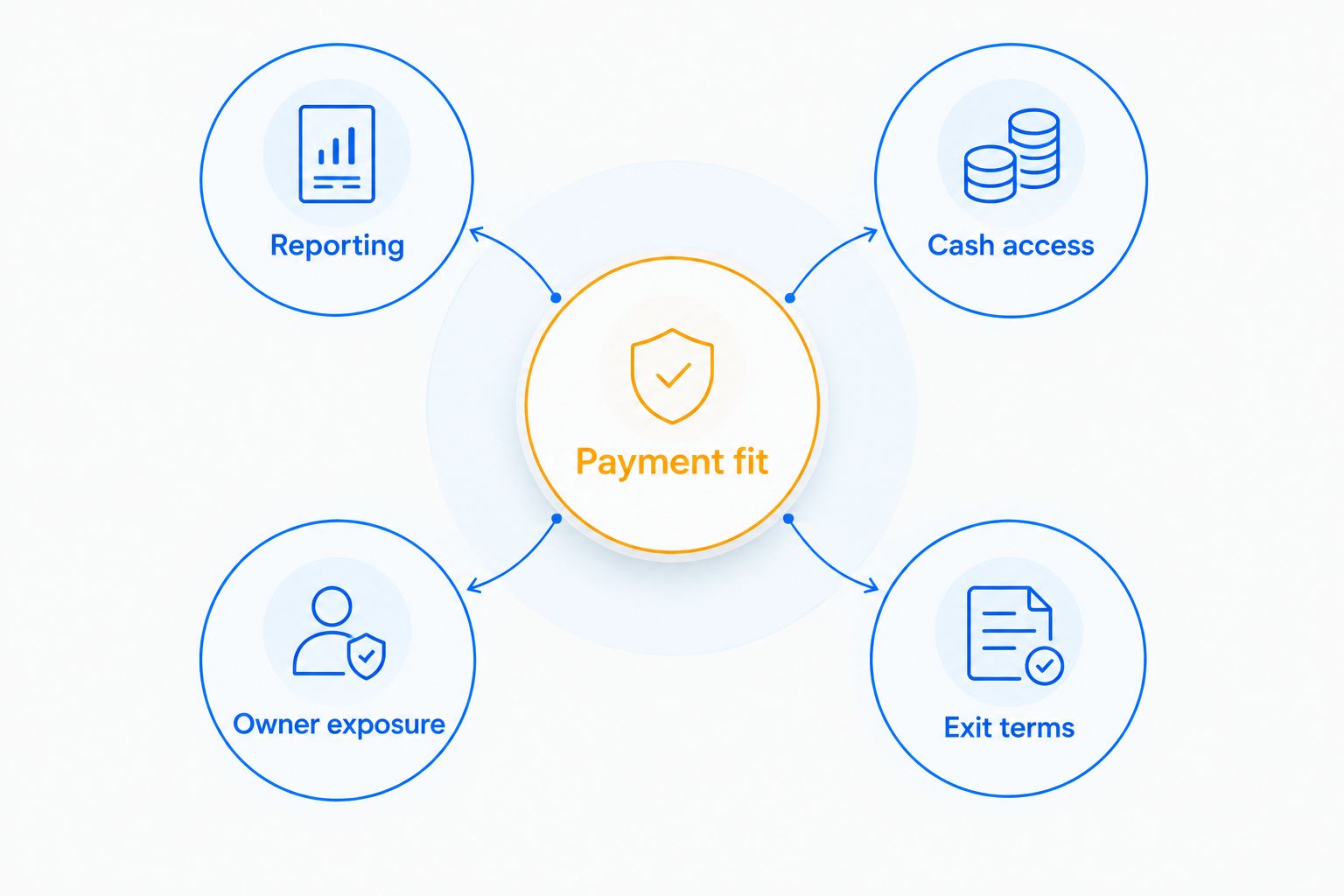
Check these issues before signing:
- Reporting: Get the bureau names and positive-payment policy in writing.
- Cash access: Identify restrictions and release conditions.
- Payment fit: Review the complete schedule against your cash-flow forecast.
- Owner exposure: Read guarantee, collateral, and default provisions.
- Exit terms: Check early payoff, account closure, and deposit-release conditions.
What documents and questions should you prepare?
Start with accurate business identification and a cash-flow picture. The provider’s current program determines the required documents; this preparation list is not a universal approval checklist.
- Legal business name, formation information, and tax identification details.
- Business bank statements and current financial records.
- Existing debt schedules and recurring payment obligations.
- The expense you need to fund, or the reporting objective you want to achieve.
- Questions about personal credit review, guarantees, collateral, and positive reporting.
Ask: Which entity will appear on the account? Which bureaus receive positive payments? When can I use the funds? What remains due if I close or repay early?
How were these options ranked?
The 2026 ranking prioritizes verified business reporting, then cash access, repayment fit, security exposure, and business purpose. Each structure has a separate use case; personal credit building ranks last because it does not independently establish company credit.
Which option should you choose?
Choose a verified business-reporting credit-builder loan when business installment history is the objective and you do not need the proceeds immediately. Choose necessary reporting vendor purchases when trade credit better matches how your business operates.
For immediate funding, compare usable-capital options instead. Jon Lynch Financial Group helps U.S. business owners compare third-party funding; it does not directly lend or guarantee approval, amounts, rates, credit results, or funding times.
FAQ
What's the best credit builder loan for a small business in 2026?
The best fit is a loan that confirms positive reporting under your business identity and has payments your cash flow supports. Check whether proceeds are restricted before choosing it for a funding need.
Will a personal credit-builder loan build my LLC's credit?
A personal credit-builder loan does not establish your LLC's credit merely because you own the company. Confirm whether any account reports under the business identity rather than only to consumer bureaus.
Can I use a credit-builder loan to cover payroll?
Only if the agreement releases usable proceeds in time for payroll. A restricted-proceeds credit-builder structure is not an immediate payroll solution.
Are vendor tradelines better than business loans?
Reporting vendor terms fit necessary supplier purchases; business loans fit cash funding needs. Neither is better without checking reporting, payment obligations, and the expense being financed.
Does a secured business card always report to business credit bureaus?
No; business credit reporting depends on the issuer and account. Obtain confirmation of the bureaus receiving positive payment history before applying.
Will a merchant cash advance build business credit?
Do not assume a merchant cash advance reports positive business payment history. Evaluate the receivables-purchase agreement for funding fit and confirm reporting separately.
Can Jon Lynch Financial Group guarantee funding after I build credit?
No; Jon Lynch Financial Group is a broker, not a direct lender, and funding remains subject to third-party underwriting. Business credit is only one part of a funding review.
What is the one check you should not skip?
Ask about positive reporting, not just reporting. A provider’s statement that it reports account information does not tell you whether on-time payments will establish the history you want.
Related guides
- Business credit monitoring tools for growing companies
- Compare business line of credit lenders
- Working capital loans: costs and qualification
What is your next step?
For U.S. businesses generating at least $35,000 per month, Compare Business Funding Options with your funding purpose and current payment obligations ready. Below that revenue level, Explore Self-Serve Funding for business-purpose needs; neither route promises approval or funding.