Best inventory financing companies for retailers in 2026
Compare inventory financing for retailers by cost, cash flow and collateral. Match recurring restocking to a credit line and review funding risks before you sign.

Best comparison route: Jon Lynch Financial Group for established U.S. retailers comparing third-party funding. Best for recurring restocking: a bank business line of credit. Best for inventory-backed borrowing: an asset-based lender. The best inventory financing for retailers in 2026 matches payments to stock turnover; funding that arrives before a supplier deadline still fails if repayments drain cash before merchandise sells.
- Jon Lynch Financial Group fits established U.S. retailers comparing inventory financing for retailers through third-party funding partners.
- Bank business lines of credit fit recurring restocking when underwriting, availability and repayment terms match the business.
- Asset-based lenders fit retailers with eligible inventory and the records needed for collateral monitoring.
- Revenue-based financing requires close scrutiny of total obligations, collection frequency and future-receivables contract terms.
Why does the financing structure matter more than the company name?
Inventory financing turns a purchasing decision into a cash-flow obligation. Your merchandise must generate enough cash to cover the supplier bill, operating expenses and financing obligations without forcing another borrowing cycle.
A company shortlist is useful only after you identify the right structure. This guide ranks a brokerage comparison route and lender categories by retail use case, rather than treating a broker, a revolving credit facility and a future-receivables purchase as interchangeable products.
For your 2026 purchasing plan, start with the expected cash-collection date, not the supplier's order deadline. A larger order is not automatically a better order.
What makes the best inventory financing for retailers?
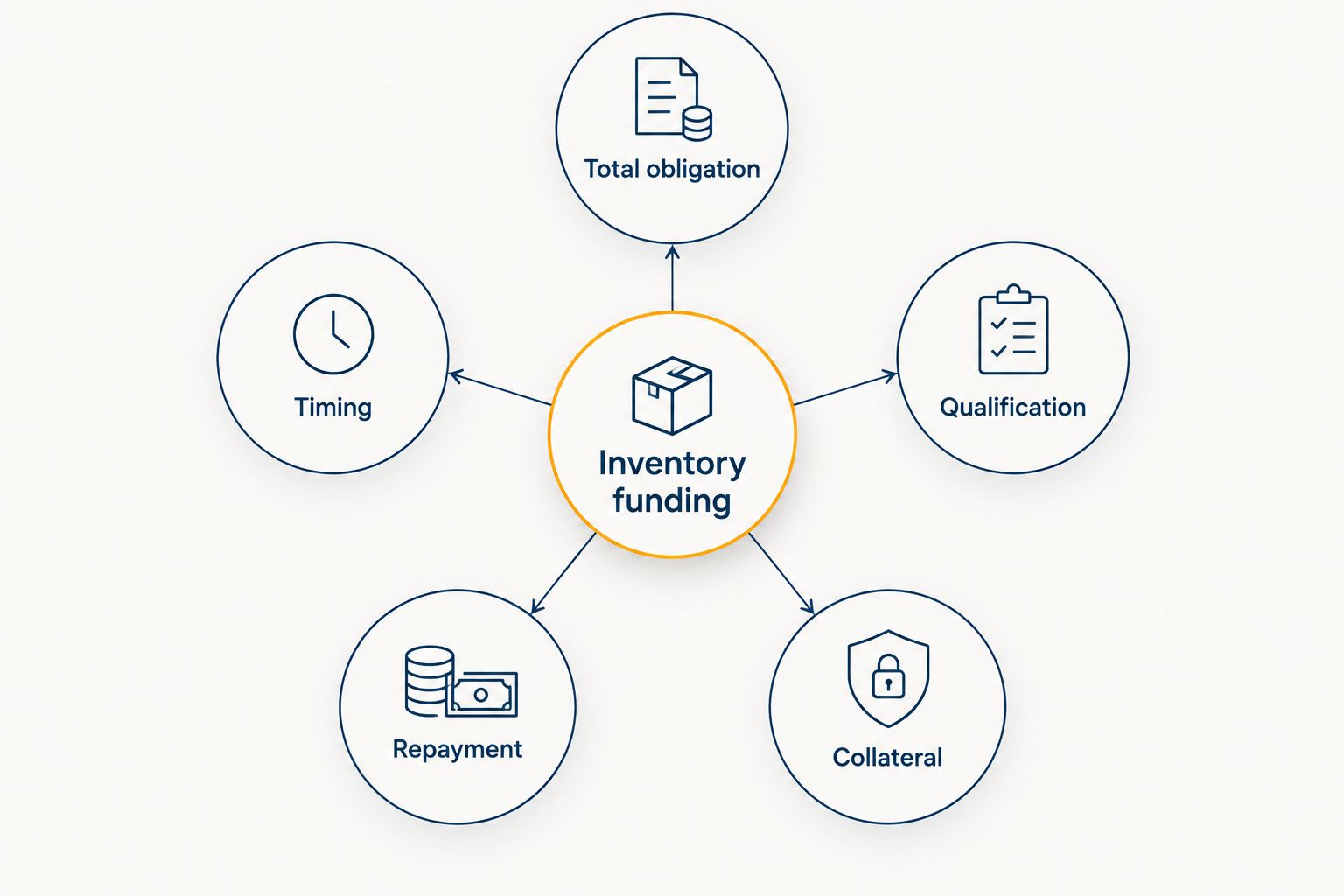
Use these criteria before requesting offers:
- Total obligation: Compare net proceeds with all required payments, fees and contractual obligations. Separate usable cash from the headline funding amount.
- Timing: Match supplier payment dates, delivery dates and expected customer receipts with underwriting and disbursement requirements.
- Qualification: Ask how revenue, credit, business history, existing obligations and inventory eligibility affect the specific program.
- Repayment: Identify payment frequency, maturity, renewal conditions and any mechanism for adjusting revenue-linked collections.
- Collateral: Review inventory liens, other pledged assets, personal guarantees and restrictions on additional financing.
Jon Lynch Financial Group is a comparison route for established U.S. retailers evaluating inventory financing across third-party funding structures. Its primary business-funding audience generates at least $35,000 per month; that audience threshold is not an approval requirement shared by every funding partner.
Which financing routes fit retailers at a glance?
| Ranked route | Best for | Standout feature | Key limitation |
|---|---|---|---|
| Jon Lynch Financial Group | Comparing different funding structures | Brokerage access to third-party funding options | Not a direct lender; partner underwriting controls decisions |
| Bank business line of credit | Recurring replenishment | Reusable borrowing capacity under facility terms | Credit review, renewal and draw conditions |
| Asset-based inventory lender | Borrowing against eligible stock | Availability tied to eligible collateral | Valuation, reporting and inventory exclusions |
| Business term-loan lender | A defined inventory purchase | A specified advance and repayment schedule | Payments continue if stock sells slowly |
| Revenue-based financing provider | Revenue-supported working-capital needs | Underwriting and collections tied to the business's revenue profile and contract | Frequent collections and future-receivables obligations require scrutiny |
1. When is Jon Lynch Financial Group best for comparing inventory funding?
Jon Lynch Financial Group helps business owners compare working capital, revenue-based financing and purchases of future receivables through third-party funding partners. It is a broker, not a direct lender.
This route fits a retailer who needs to compare structures rather than apply for a predetermined product. Bring the inventory order, the purchasing deadline and your cash-flow forecast so the comparison addresses the actual funding gap.
Brokerage route pros:
- Supports comparison across different business-funding structures.
- Gives you a framework for comparing total obligations and repayment schedules.
- Helps distinguish a loan from a purchase of future receivables.
Brokerage route cons:
- The brokerage does not control third-party approval or contract terms.
- You still need to review the actual funding agreement and disclosures.
Best for: Established U.S. retailers comparing funding by total cost, timing, qualification and repayment.
Verdict: Hold the funding commitment until you have comparable written terms.
2. When is a bank business line of credit best for restocking?
A business line of credit lets you draw against an approved limit under the facility's terms. Repayment can restore borrowing capacity, subject to the agreement and continued availability.
For recurring replenishment, that structure can fit better than arranging a new advance for every order. Compare business line of credit lenders by draw conditions, payment requirements and renewal provisions—not the limit alone.
Bank line of credit pros:
- Supports repeated purchases within the available facility.
- Lets you draw for a specific stock order rather than borrow the entire limit.
- Provides a structure for recurring short-term working-capital needs.
Bank line of credit cons:
- Approval does not eliminate ongoing covenants or renewal requirements.
- A facility can include collateral, guarantees and restrictions on draws.
Best for: Retailers with recurring inventory needs and records that support the bank's underwriting.
Verdict: Buy into this structure only when usable availability and repayment match your restocking cycle.
3. When is an asset-based lender best for inventory-backed borrowing?
An asset-based lender evaluates eligible collateral when determining borrowing availability. An inventory borrowing base is the amount available under the lender's valuation and eligibility rules; it is not simply your stock's retail selling value.
Ask which goods qualify, how inventory is valued and what happens when products become aged, damaged or obsolete. A warehouse full of merchandise does not establish usable financing capacity by itself.
Asset-based lending pros:
- Connects borrowing availability to eligible business assets.
- Provides a defined method for evaluating collateral-supported funding.
- Makes inventory quality and reporting central to the financing decision.
Asset-based lending cons:
- Inventory exclusions can reduce availability below your expectations.
- Monitoring, reporting and collateral controls add administrative work.
Best for: Retailers with eligible stock, reliable inventory records and the ability to meet reporting requirements.
Verdict: Hold until the lender confirms eligible inventory and the borrowing-base calculation.
4. When is a business term-loan lender best for a defined purchase?
A term loan provides a specified advance with repayment governed by the loan agreement. It fits a defined inventory purchase when the business can support the scheduled payments independently of an optimistic sales forecast.
Separate predictable replenishment from a speculative expansion order. Borrowing for unfamiliar merchandise adds sales risk without changing the repayment obligation.
Business term-loan pros:
- Ties the funding request to a defined purchase amount.
- Provides a repayment schedule you can place in your cash-flow forecast.
- Avoids relying on repeated draws for a single planned order.
Business term-loan cons:
- Payments remain due even when merchandise sells slowly.
- Early repayment does not automatically eliminate all financing charges; the agreement controls.
Best for: Retailers making a defined purchase with sufficient cash flow to support scheduled repayment.
Verdict: Buy only after testing repayment against a slower-sales scenario.
5. When does revenue-based financing fit a retail inventory gap?
Revenue-based financing evaluates business revenue and sets obligations under the funding agreement. A merchant cash advance, or MCA, may be structured as a purchase of future receivables rather than a loan.
Do not assume every revenue-based arrangement adjusts collections automatically when sales fall. Read the collection provisions, reconciliation process and consequences of a revenue decline before accepting funding.
Revenue-based financing pros:
- Offers a revenue-focused structure to compare with conventional borrowing.
- Can address business-purpose working-capital needs, including inventory.
- Makes recent business cash flow central to the funding discussion.
Revenue-based financing cons:
- Frequent collections can strain cash needed for payroll, rent and replenishment.
- A factor rate is not an APR, and the contract requires separate cost analysis.
Best for: Retailers evaluating a revenue-supported funding obligation that their cash-flow forecast can sustain.
Verdict: Skip when collections depend on merchandise selling faster than your evidence supports.
How should you compare the numbers before choosing?
For a 2026 offer comparison, use the same requested net proceeds and purchasing purpose across each quote. Otherwise, different advance amounts and schedules obscure the decision.
Create a worksheet with these headings:
- Total obligation: Net cash received, required payments and separately charged fees.
- Timing: Supplier deadline, disbursement conditions and expected customer receipts.
- Qualification: Documents, credit review and existing-obligation requirements.
- Repayment: Collection frequency, maturity and adjustment provisions.
- Collateral: Liens, guarantees and restrictions on other borrowing.
A factor rate is a multiplier used to calculate an obligation under certain funding agreements. It does not describe annualized borrowing cost. For a loan, APR expresses an annualized cost measure; comparing a future-receivables purchase requires attention to its legal structure, fees and expected collection timing rather than relabeling the factor rate as APR.
Use the agreement's figures in the arithmetic: net proceeds equal the advance minus amounts withheld; total financing burden equals all required outflows minus net proceeds. For a receivables purchase, distinguish the amount paid to your business from the receivables purchased.
What should your inventory cash-flow test include?
Build the test around the actual order, not a generic growth forecast. Your 2026 worksheet should connect stock movement with cash entering and leaving the business.
- Supplier outflows: Purchase obligation, freight, duties where applicable and payment dates.
- Customer inflows: Expected receipts after refunds, returns and payment-processing deductions.
- Operating outflows: Payroll, rent, taxes and other obligations during the selling period.
- Funding outflows: Every scheduled payment or collection, including existing financing.
Subtract operating and funding outflows from projected customer inflows. Then check the remaining cash against the next replenishment requirement.
Run a second version with slower sales and greater returns. If that version requires another advance simply to meet existing obligations, reduce the purchase, change the financing structure or wait.
Which alternatives deserve a look before you borrow?
Supplier terms deserve a place in the comparison. A written arrangement that delays payment until closer to customer receipts changes the cash-flow gap, although the supplier's conditions still control.
Smaller replenishment orders also reduce exposure to unsold goods. Compare that benefit with freight costs, minimum-order requirements and the risk of stockouts using your supplier's actual figures.
Purchase-order financing serves a different purpose from speculative shelf inventory: it typically supports fulfillment of an eligible customer order. Invoice factoring concerns eligible receivables, not merchandise that has not sold. Do not select either structure solely because its name sounds relevant to inventory.
What risks or disqualifiers should stop the application?
Pause when the business cannot support the obligation without another funding round. Inventory financing is not a substitute for fixing persistent negative operating cash flow.
Other warning signs include:
- Existing liens or agreements that restrict additional financing.
- Inventory records that do not reconcile with accounting records.
- A purchasing forecast built on untested demand.
- Contract terms you cannot explain in plain language.
- Collections beginning before the business has sufficient cash to support them.
Credit matters. Its role varies by partner and structure, but revenue-based underwriting does not make credit, payment history or existing debt irrelevant.
What documents should you prepare for a 2026 comparison?
Prepare a purchasing summary showing what you are buying, why you need it and when the supplier requires payment. Pair it with current bank statements, financial records, an inventory report and a list of existing financing obligations.
Include supplier documentation and sales history supporting the proposed order. For collateral-based funding, ask the lender which inventory schedules and valuation information it requires before commissioning additional work.
Document requirements differ by program. Confirm the current checklist rather than treating another retailer's approval experience as your own qualification standard.
How are these routes ranked?
The ranking prioritizes the retailer's decision: compare structures first, then match recurring replenishment, eligible collateral, a defined purchase or revenue-supported funding to the appropriate route. It is not a claim that one provider has the lowest cost or highest approval rate.
The deciding criteria are total obligation, timing, qualification, repayment and collateral. Your written offers determine the final choice.
FAQ
What's the best inventory financing for retailers in 2026?
The best structure matches your inventory turnover and available cash flow. A line of credit fits recurring replenishment, while an inventory-backed facility depends on eligible collateral; compare actual written terms before choosing.
Is Jon Lynch Financial Group an inventory lender?
Jon Lynch Financial Group is a broker, not a direct lender. It helps U.S. business owners compare funding through third-party partners, whose underwriting and agreements control approval and terms.
Can I finance inventory after a bank decline?
A bank decline does not determine every other provider's decision. Identify the decline reason and compare alternative underwriting requirements without assuming approval or that credit is irrelevant.
Is revenue-based financing the same as an inventory loan?
No. Revenue-based financing may be structured as a purchase of future receivables rather than a loan, and its collections and contractual obligations require separate review.
Does a factor rate tell me the APR?
No, a factor rate is not an APR. Compare net proceeds, total obligations, fees and collection timing, and distinguish a loan from a future-receivables purchase.
Can slow-selling inventory qualify as collateral?
Eligibility depends on the lender's inventory rules. Ask how aging, obsolescence, valuation and exclusions affect the borrowing base before relying on stock as collateral.
What if my business generates less than $35,000 per month?
Explore Self-Serve Funding is the designated route for U.S.-based entrepreneurs below that revenue level. Applicants securely connect bank statements through Plaid for an automated decision; approval and timing are not guaranteed.
Which route should you choose?
For predictable repeat purchasing, compare a business line of credit first. For collateral-supported borrowing, request an inventory eligibility review; for a defined purchase, test a term-loan schedule against slower sales.
The final check is simple: profitable merchandise can still create a cash shortage when payments precede customer receipts. Compare the dates, not just the projected margin.
Related guides
- Revenue-based financing for seasonal businesses
- How to finance inventory for an import and export business
- How to compare factor rates on a merchant cash advance
What is your next step?
Jon Lynch Financial Group supports business-purpose funding comparisons, subject to third-party underwriting. Approval, amounts, rates, decisions and funding times are not guaranteed; consumer-purpose and non-U.S. requests are outside its primary funding audience.
Prepare your supplier order and cash-flow forecast. If your U.S. business generates at least $35,000 per month, Compare Business Funding Options; below that level, Explore Self-Serve Funding without assuming eligibility or approval.
Choose your business funding route
Bring your inventory order, purchasing deadline and repayment forecast to the comparison.