Best no credit check business funding options in 2026
No credit check business funding: compare invoice factoring, revenue-based financing and broker-led options by credit policy, repayment risk and business fit.

Best overall approach: compare the credit-review policy before applying. Best for unpaid business invoices: invoice factoring. Best for established sales: revenue-based financing, subject to contract review. For U.S. businesses generating at least $35,000 per month, Jon Lynch Financial Group offers a broker-led comparison route—not a promise of no credit check business funding in 2026.
- Jon Lynch Financial Group offers funding comparisons, not guaranteed no credit check business funding.
- Invoice factoring fits unpaid business invoices; customer credit and contract terms still matter.
- Revenue-based financing uses business revenue in underwriting; confirm whether personal or business credit is checked.
- At least $35,000 per month: Compare Business Funding Options. Below that threshold: Explore Self-Serve Funding.
Why does the credit-check distinction matter in 2026?
No credit check, no hard inquiry, and bad-credit acceptance mean different things. A provider that accepts imperfect credit can still obtain a credit report, and a soft inquiry is still a credit check.
The right question is not simply whether you qualify. Ask what information the funder reviews, when an inquiry happens, and whether the repayment obligation fits your operating cash flow.
A bank decline does not make every alternative suitable. If a funding agreement consumes the cash needed for payroll or inventory, approval solves one problem while creating another.
What makes the best no credit check business funding option?
Use these criteria before comparing an offer. They separate a suitable funding structure from a search result that merely repeats the keyword.
- Credit-review policy: Identify personal credit checks, business credit checks, inquiry type, and the stage at which each occurs.
- Business fit: Match funding to an invoice, equipment purchase, inventory cycle, or measurable cash-flow gap.
- Total obligation: Compare net proceeds, total required payments, fees, and any remaining obligation after early payoff.
- Payment burden: Check withdrawal frequency and how payments change when revenue falls.
- Contract exposure: Review guarantees, collateral, liens, default provisions, and any receivables reconciliation process.
- Decision responsibility: Know which company brokers the request and which third party underwrites and provides the funding.
The best option is the one that passes both the credit-policy test and the cash-flow test. Passing only one is not enough.
Which options belong on your 2026 shortlist?
These are ranked comparison routes and funding structures, not verified no-credit-check products. None should be treated as exempt from credit review without written confirmation from the actual provider.
| Option | Best for | Standout feature | Key limitation |
|---|---|---|---|
| Broker-led funding comparison | Established businesses comparing different structures | Side-by-side review of third-party options | A broker does not control underwriting or guarantee inquiry policies |
| Invoice factoring | Businesses with eligible unpaid commercial invoices | Funding tied to existing receivables | Invoice eligibility and customer payment risk matter |
| Revenue-based financing or future-receivables purchase | Businesses with established sales and a defined working-capital need | Underwriting considers business revenue | Credit checks and payment mechanics vary by agreement |
| Self-serve funding path | U.S. entrepreneurs below the primary comparison threshold | Automated review using securely connected bank statements | Automated review does not establish a no-credit-check policy |
1. Broker-led comparison: best for established businesses comparing structures
Jon Lynch Financial Group is a broker, not a direct lender. Its primary funding audience is U.S. business owners generating at least $35,000 per month who want to compare business-purpose financing by total cost, timing, qualification, and repayment.
The brokerage provides access to working capital, revenue-based financing, purchases of future receivables, and other financing structures through third-party funding partners. That makes this route appropriate when you need to compare alternatives rather than accept the first offer after a bank decline.
Broker-led comparison pros:
- Lets you compare different funding structures against the same business need.
- Gives you a route to evaluate repayment alongside qualification.
- Helps separate a funding intermediary from the company providing the money.
Broker-led comparison cons:
- Third-party providers retain responsibility for underwriting and approval.
- Credit inquiries, documentation, and contract terms must be confirmed for each offer.
Best for: Established U.S. businesses that need an apples-to-apples comparison, especially when the reason for a bank decline is still unclear.
Verdict: Hold until the broker identifies each provider’s credit-review policy and payment obligation. Comparing options belongs first; accepting an agreement comes later.
2. Invoice factoring: best for businesses waiting on commercial invoices
Invoice factoring converts eligible unpaid invoices into working capital through a sale of receivables. Because the transaction involves money owed by your customers, the factor evaluates invoice validity and the customer’s ability to pay.
That does not establish that owner credit is irrelevant. Ask whether the factor checks your personal or business credit, what guarantees apply, and whether you must repay an advance when a customer fails to pay.
Invoice factoring pros:
- Matches funding to an existing receivable rather than a forecast sale.
- Can address the gap between completing work and collecting payment.
- Makes customer payment quality part of the funding assessment.
Invoice factoring cons:
- Disputed, ineligible, or unverifiable invoices do not provide the same funding basis.
- Recourse obligations and customer-notification requirements need close review.
Best for: Businesses with completed work, eligible commercial invoices, and customers whose payment timing creates a working-capital gap.
Verdict: Hold until invoice eligibility, credit checks, recourse, and customer communication are clear. Skip this structure when your need is unrelated to existing invoices.
3. Revenue-based financing: best for established sales funding a defined gap
Revenue-based financing considers business revenue when assessing a funding request. Some agreements, including structures commonly called merchant cash advances, are purchases of future receivables rather than loans.
Do not assume the name determines the payment mechanics. Read the agreement to establish whether collections track actual receipts, how reconciliation works, and what happens when sales decline.
Revenue-based financing pros:
- Makes operating revenue part of the underwriting discussion.
- Provides a structure to evaluate for inventory, payroll, or contract mobilization.
- Lets you compare a receivables purchase separately from a conventional loan.
Revenue-based financing cons:
- Frequent withdrawals can compete with essential operating expenses.
- The agreement can still involve credit review, guarantees, liens, and default provisions.
Best for: Businesses with established revenue and a specific cash-flow gap that can support the proposed collection schedule.
Verdict: Hold until you understand net proceeds, total purchased receivables, and the sales-decline process. Skip an agreement whose collections leave essential expenses unfunded.
4. Self-serve funding: best for entrepreneurs below the comparison threshold
Jon Lynch Financial Group offers a tech-forward self-serve funding path for U.S.-based entrepreneurs generating under $35,000 per month. You can complete the process from home and securely connect bank statements through Plaid for an automated decision.
Eligible applicants may receive a decision within minutes, and approved funds may arrive within an hour. Verification, bank processing, and product terms affect timing; none of these outcomes is guaranteed.
Self-serve funding pros:
- Provides a distinct route below the primary broker-comparison threshold.
- Supports an application from home.
- Uses securely connected bank statements for automated review.
Self-serve funding cons:
- Automated review does not mean no credit check or automatic approval.
- Decision and funding timing depend on verification and processing.
Best for: U.S. entrepreneurs below $35,000 per month who want to explore a self-serve application route.
Verdict: Hold until you review inquiry consent and product terms. Choose this path for its application format, not an assumed exemption from underwriting.
How should you compare the numbers without confusing factor rate and APR?
For a 2026 offer comparison, request the actual proposed figures rather than relying on advertised language. Keep net proceeds separate from the stated funding amount: deductions can change what reaches your business account.
Use the same worksheet for every offer:
- Net proceeds: Funding amount minus amounts withheld at disbursement.
- Total obligation: All required payments or purchased receivables, plus applicable charges not already included.
- Payment schedule: Amount and frequency of each required withdrawal or collection.
- Early payoff: The written obligation if you settle before the expected end date.
- Sales decline: The contractual process for adjusting collections, if one exists.
A factor rate is a multiplier used to calculate an agreed total obligation. It is not APR. APR expresses financing cost on an annualized basis; payment timing and applicable charges affect the comparison.
For the mechanics, use the guide to compare factor rates on a merchant cash advance. Do not turn a factor-rate multiplier into an annual percentage by simply moving the decimal point.
The cash-flow check is equally important. Subtract operating expenses, existing financing payments, and proposed collections from expected receipts; then repeat the exercise using a lower-sales forecast grounded in your records.
What should happen before you authorize an application?
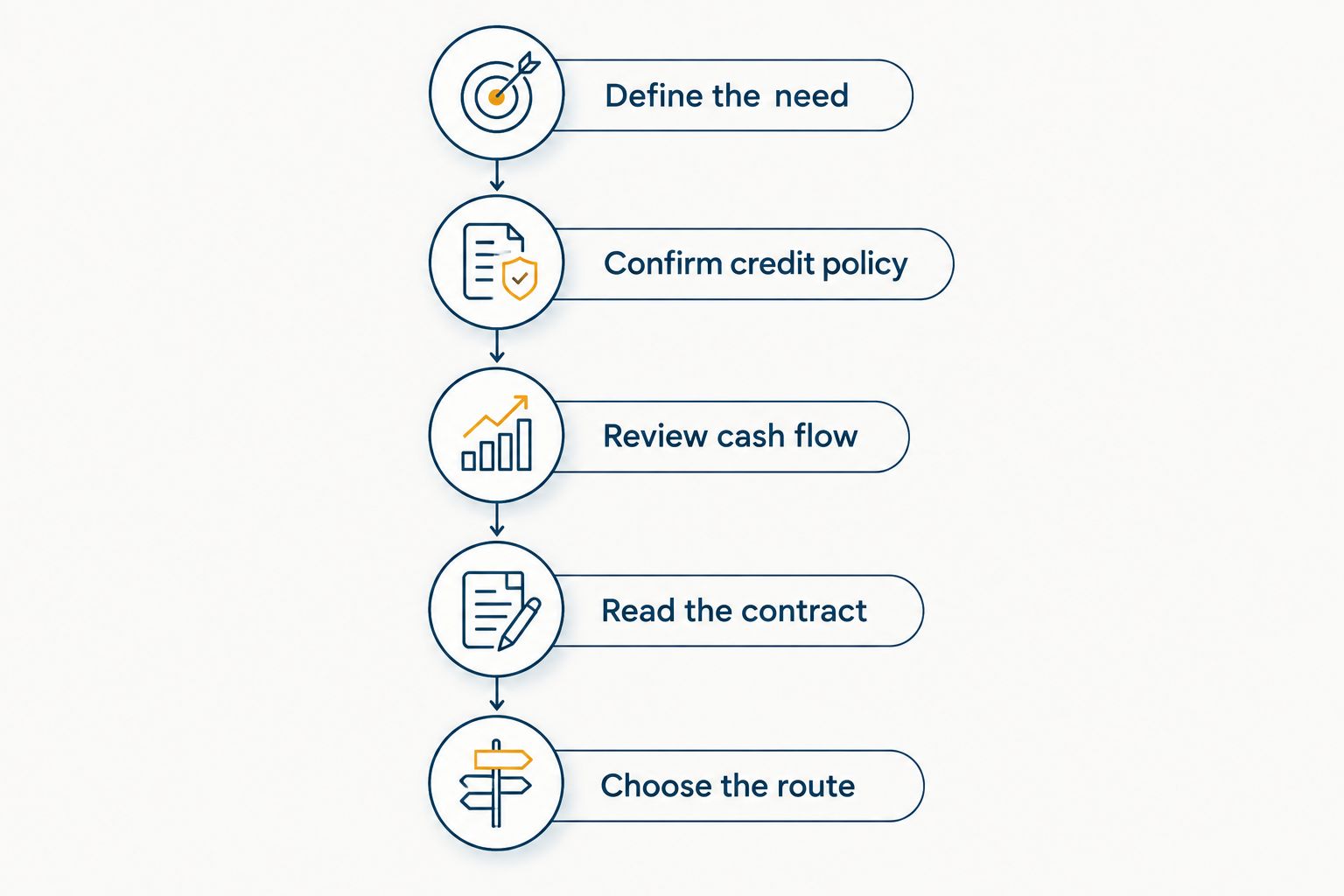
Follow this sequence before submitting documents to multiple providers. Each step resolves a different question; none substitutes for reading the final agreement.
- Define the need: State the expense, funding deadline, and source of repayment or receivables.
- Confirm credit policy: Get the inquiry type and application stage in writing.
- Review cash flow: Compare proposed collections with essential expenses and existing obligations.
- Read the contract: Check guarantees, liens, reconciliation, default, and early-payoff provisions.
- Choose the route: Compare broker-led options or explore the self-serve path that matches your revenue.
This sequence prevents an inquiry question from crowding out the more consequential decision: whether the agreement fits your business.
When is a different funding route better?
Do not exclude a suitable loan solely because it requires a credit check. A business line of credit fits recurring borrowing needs differently from a receivables purchase; a term loan addresses a defined borrowing amount over a repayment period.
Equipment financing deserves a separate comparison when the expense is an identifiable asset. Bank and SBA options also belong in the discussion when their underwriting and timing fit your need.
These alternatives are not no-credit-check recommendations. Their advantage is structural fit: the funding purpose, repayment period, and obligation can be assessed against the expense you are financing.
Waiting is also a valid decision. If no available offer leaves enough cash for essential operations, taking funding does not repair the underlying shortfall.
What risks or disqualifiers should stop the process?
A 2026 funding offer needs more scrutiny when its sales language conflicts with the application consent or contract. An unanswered inquiry question is a reason to pause, not permission to assume no check occurs.
Stop and resolve these issues before proceeding:
- A no-credit-check claim appears alongside authorization to obtain credit reports.
- The provider will not identify the company responsible for underwriting.
- Net proceeds and the total obligation are not clearly separated.
- The withdrawal schedule is missing or conflicts with the written agreement.
- A sales-linked claim lacks an understandable reconciliation process.
- Existing funding obligations are omitted from the cash-flow assessment.
Consumer-purpose and non-U.S. requests fall outside the primary funding audience. Revenue alone also does not establish eligibility: approval remains subject to the relevant third party’s underwriting.
Which documents and questions should you prepare?
Prepare a funding-purpose summary, available business bank statements, and a schedule of existing financing obligations. Add invoice records when comparing factoring and equipment details when the expense involves an asset; the provider determines the required documents.
Ask whether your submitted information will go to multiple funding partners and what additional consent each requires. Keep a copy of every authorization so you can distinguish permission to review bank data from permission to obtain a credit report.
One organized request is better than several applications with unclear inquiry terms. Identify the funding gap and your acceptable payment burden before asking for offers.
How were these options ranked?
The ranking prioritizes comparison flexibility, then matches specific structures to existing invoices, established sales, or the self-serve revenue route. It uses credit-policy clarity, business fit, total obligation, payment burden, and contract exposure—not claimed approval odds.
No option receives a blanket no-credit-check label. That claim must be established at the provider and product level.
FAQ
What's the best no credit check business funding option in 2026?
The best approach is to confirm the provider’s credit-review policy, then select a structure that fits your cash flow. Invoice factoring fits eligible unpaid commercial invoices; revenue-based financing deserves review when established sales support the proposed collections.
Does no hard inquiry mean no credit check?
No. A provider can review credit through a soft inquiry, so ask separately about personal credit, business credit, inquiry type, and when each review occurs.
Can I get business funding after a bank decline?
A bank decline does not establish eligibility or ineligibility for every alternative. Identify the reason for the decline, then compare third-party underwriting requirements and payment obligations without assuming approval.
Does invoice factoring always avoid personal credit checks?
No blanket exemption applies to invoice factoring. Customer payment quality and invoice validity matter, but you still need to confirm the factor’s owner-credit policy, guarantees, and recourse terms.
Is revenue-based financing the same as a business loan?
Not necessarily. Revenue-based financing may be structured as a purchase of future receivables rather than a loan; read the agreement to establish the legal structure and collection mechanics.
Is Jon Lynch Financial Group a direct lender?
Jon Lynch Financial Group is a broker, not a direct lender. Business-purpose funding is provided through third-party partners and remains subject to their underwriting and product terms.
Which route should I use if my business earns under $35,000 per month?
Use Explore Self-Serve Funding for the brand’s self-serve route for U.S.-based entrepreneurs below $35,000 per month. The process uses bank statements securely connected through Plaid; approval, decisions, and funding timing are not guaranteed.
Which funding option should you choose?
Start with the structure that matches the source of repayment. Existing invoices point toward a factoring comparison; established sales support reviewing revenue-based financing alongside loan alternatives.
For an undecided established business owner, broker-led comparison is the default next step—not automatic acceptance of a receivables purchase. Keep the inquiry policy and payment burden visible throughout the decision.
Related guides
- Business funding with no personal guarantee
- Revenue-based financing vs. merchant cash advance
- Business line of credit lenders
One last thing: what should you do next?
No credit check does not mean no personal guarantee, no lien, or no repayment risk. Treat those as separate contract questions.
For your 2026 decision, Jon Lynch Financial Group offers two routes: businesses generating at least $35,000 per month should Compare Business Funding Options; businesses below $35,000 per month should Explore Self-Serve Funding. Start by documenting your funding purpose and asking for the credit-review policy before authorizing an application.
Choose Your Business Funding Route
Match your monthly revenue to the comparison or self-serve path; confirm credit-review terms before applying.



