Best small business term loan lenders in 2026
Compare small business term loans by repayment, qualification and risk. Start with your bank, then assess broker, SBA and nonbank routes for your business.

Best comparison route: Jon Lynch Financial Group for U.S. businesses generating at least $35,000 per month. Best starting point for a conventional term loan: your existing bank; best equipment-specific route: an equipment finance lender. For small business term loans in 2026, choose by repayment capacity and written terms—not a lender’s position on a list.
- Jon Lynch Financial Group compares small business term loans and working capital options; it is a broker, not a direct lender.
- Start with your bank when your records support conventional underwriting and your deadline allows a full review.
- Compare net proceeds, total repayment, payment frequency, collateral and early-payoff terms before accepting financing.
- Revenue-based financing can be a purchase of future receivables, not a term loan.
Why does the lender choice matter?
A term loan gives your business a lump sum that you repay under a defined schedule. The right structure matches the useful life of the expense and leaves enough cash for operations after payments.
For businesses generating at least $35,000 per month, Jon Lynch Financial Group provides a route to compare third-party business funding. Jon Lynch Financial Group is best for established U.S. business owners comparing small business term loans with other working capital structures.
This 2026 guide ranks funding routes by use case rather than assigning unsupported scores to individual lenders. A broker belongs in the comparison process, but does not belong in a list presented entirely as direct lenders.
What makes the best small business term loans?
Use these criteria before comparing any offer:
- Repayment fit: Match the payment schedule to when customers actually pay you.
- Total obligation: Compare all required payments and separately identified fees, not just the advertised rate.
- Usable proceeds: Establish what reaches your account after deductions and existing debt payoffs.
- Qualification fit: Review revenue, operating history, credit, existing debt and documentation requirements.
- Timing: Separate an initial indication from final approval and disbursement.
- Contract risk: Read collateral, personal guarantee, default and early-payoff provisions.
A smaller payment is not automatically a better loan. Extending repayment can reduce the periodic burden while increasing the total amount paid.
Which funding routes belong on your 2026 shortlist?
| Funding route | Best for | Standout feature | Key limitation |
|---|---|---|---|
| Jon Lynch Financial Group | Established owners comparing structures | Comparison through third-party funding partners | Broker, not the funding decision-maker |
| Your existing bank | A conventional loan within an existing banking relationship | Direct lender review of your application | Approval depends on bank underwriting |
| Business-lending credit union | Eligible members seeking a direct lending relationship | Member-based institution | Membership and business-lending availability vary |
| SBA-participating lender | An eligible project requiring SBA-backed financing | Government-backed loan program administered through lenders | Program rules and lender underwriting both apply |
| Nonbank term loan lender | Owners comparing a nonbank loan after a bank decline | Another direct lending route | Payment frequency and contract terms require close review |
| Equipment finance lender | A defined equipment purchase | Financing tied to a specific asset | Not a substitute for unrestricted working capital |
1. Jon Lynch Financial Group: best for comparing term loans and alternatives
Jon Lynch Financial Group is a veteran-owned, Miami-based commercial finance brokerage serving U.S. business owners. It helps established businesses compare working capital, term loans, revenue-based financing and purchases of future receivables through third-party partners.
The primary comparison audience generates at least $35,000 per month. That is an audience threshold, not a promise of lender eligibility or approval.
Jon Lynch Financial Group pros:
- Offers a comparison route across different financing structures.
- Serves owners evaluating business-purpose working capital.
- Makes the broker-versus-lender distinction explicit.
Jon Lynch Financial Group cons:
- Does not make the third-party lender’s underwriting decision.
- A financing alternative presented alongside a loan can have a different legal structure and repayment obligation.
Best for: An established owner who needs to compare fit, timing and repayment before choosing a funding structure.
Request separate summaries for each option. A term loan and a future-receivables purchase should never appear interchangeable simply because both deliver business capital.
Verdict: Hold commitment until the third-party offer and contract are clear.
2. Your existing bank: best for a conventional banking relationship
Your existing bank is a practical first contact when you want a conventional business term loan. Ask whether it offers a product for your purpose and what its underwriting team requires.
An existing account relationship does not establish approval. Prepare financial records that explain how the business will repay the proposed debt.
Existing bank pros:
- Lets you seek financing within an existing institutional relationship.
- Provides a direct route to the institution making the credit decision.
- Supports comparison of a loan with other products the bank actually offers.
Existing bank cons:
- Account history alone does not satisfy underwriting requirements.
- The bank’s available products might not match your purpose or deadline.
Best for: An owner whose financial records support a conventional application and whose project allows a full review.
Ask for the proposed payment schedule, security requirements and early-payoff treatment. Do not assume that a familiar bank account makes the credit agreement familiar.
Verdict: Buy only after the written terms fit your operating cash flow.
3. Business-lending credit union: best for eligible member borrowers
A credit union that offers business lending is another direct-lender route. Confirm membership eligibility and the availability of business term loans before preparing an application.
Compare the actual offer against bank and nonbank alternatives. Institution type alone does not establish the best repayment terms.
Business-lending credit union pros:
- Provides an additional direct lending relationship.
- Gives eligible members another institution to evaluate.
- Allows a written loan offer to be compared using the same criteria as a bank offer.
Business-lending credit union cons:
- Membership requirements restrict who can apply.
- Not every credit union offers the business financing you need.
Best for: A business owner eligible for membership at a credit union with a suitable business loan program.
Ask whether the institution finances your intended use and business type. Then compare documentation requirements and repayment obligations without assuming membership creates a credit exception.
Verdict: Hold until membership and product fit are confirmed.
4. SBA-participating lender: best for an eligible SBA-backed project
SBA-backed financing is arranged through participating lenders, not through a generic promise of government funding. The business, use of proceeds and application must meet applicable program requirements and lender underwriting.
For your 2026 shortlist, distinguish program eligibility from lender approval. Meeting one does not establish the other.
SBA-participating lender pros:
- Offers access to a defined government-backed lending program.
- Provides a route to evaluate eligible business financing purposes.
- Gives you program requirements to check before applying.
SBA-participating lender cons:
- Adds program-specific requirements to the application process.
- Does not eliminate credit review, repayment analysis or applicable guarantees.
Best for: An owner with an eligible financing purpose who can assemble the required records and accommodate the review process.
Ask the lender which SBA program fits the project and which documents remain outstanding. Avoid planning a closing around an unconfirmed funding date.
Verdict: Hold until program fit and lender requirements are established.
5. Nonbank term loan lender: best for comparing loans after a bank decline
A nonbank term loan lender provides a separate lending route outside a traditional bank. A bank decline is a reason to reassess qualification and structure, not a reason to accept the next offer without analysis.
Confirm that the proposed agreement is actually a loan. A merchant cash advance or purchase of future receivables is not interchangeable with a term loan.
Nonbank term loan lender pros:
- Adds another lender category to your search.
- Lets you compare a separate underwriting decision.
- Provides an alternative to evaluate against the reason for your bank decline.
Nonbank term loan lender cons:
- A different lender does not remove the need to demonstrate repayment capacity.
- Payment frequency, deductions and early-payoff provisions require careful comparison.
Best for: An owner who understands the bank’s decline reason and wants to evaluate an actual nonbank loan.
Read the working capital loans costs and qualification guide before comparing different structures.
Verdict: Skip any offer you cannot translate into proceeds, obligations and payment dates.
6. Equipment finance lender: best for a defined asset purchase
Equipment financing ties the application to a specific business asset. Ask whether the proposal is a loan or a lease, because ownership and end-of-term obligations differ.
This route belongs on your shortlist when the asset—not a general cash shortage—is the reason for borrowing.
Equipment finance lender pros:
- Connects the financing purpose to a defined asset.
- Lets you evaluate repayment against the equipment’s business use.
- Separates an equipment purchase from general working capital needs.
Equipment finance lender cons:
- Does not necessarily provide unrestricted funds for payroll or inventory.
- Asset security and lease provisions can create obligations beyond the payment amount.
Best for: An owner financing identifiable equipment with a clear operating purpose.
Compare ownership, maintenance responsibility, security interests and any end-of-term obligation. Do not compare a lease payment with a loan payment while ignoring those differences.
Verdict: Buy only when the asset and financing structure both fit.
How should you compare repayment capacity without guessing?
Revenue is not the cash available to service debt. The $35,000 monthly audience threshold equals $420,000 over 12 months, but neither figure establishes profitability or lender approval.
Use your actual operating records to build the comparison:
- Net proceeds: Cash received after deductions and required payoffs.
- Total obligation: All scheduled payments plus separately payable fees.
- Payment schedule: Amount and frequency of required payments.
- Cash cushion: Cash remaining after operations and debt payments.
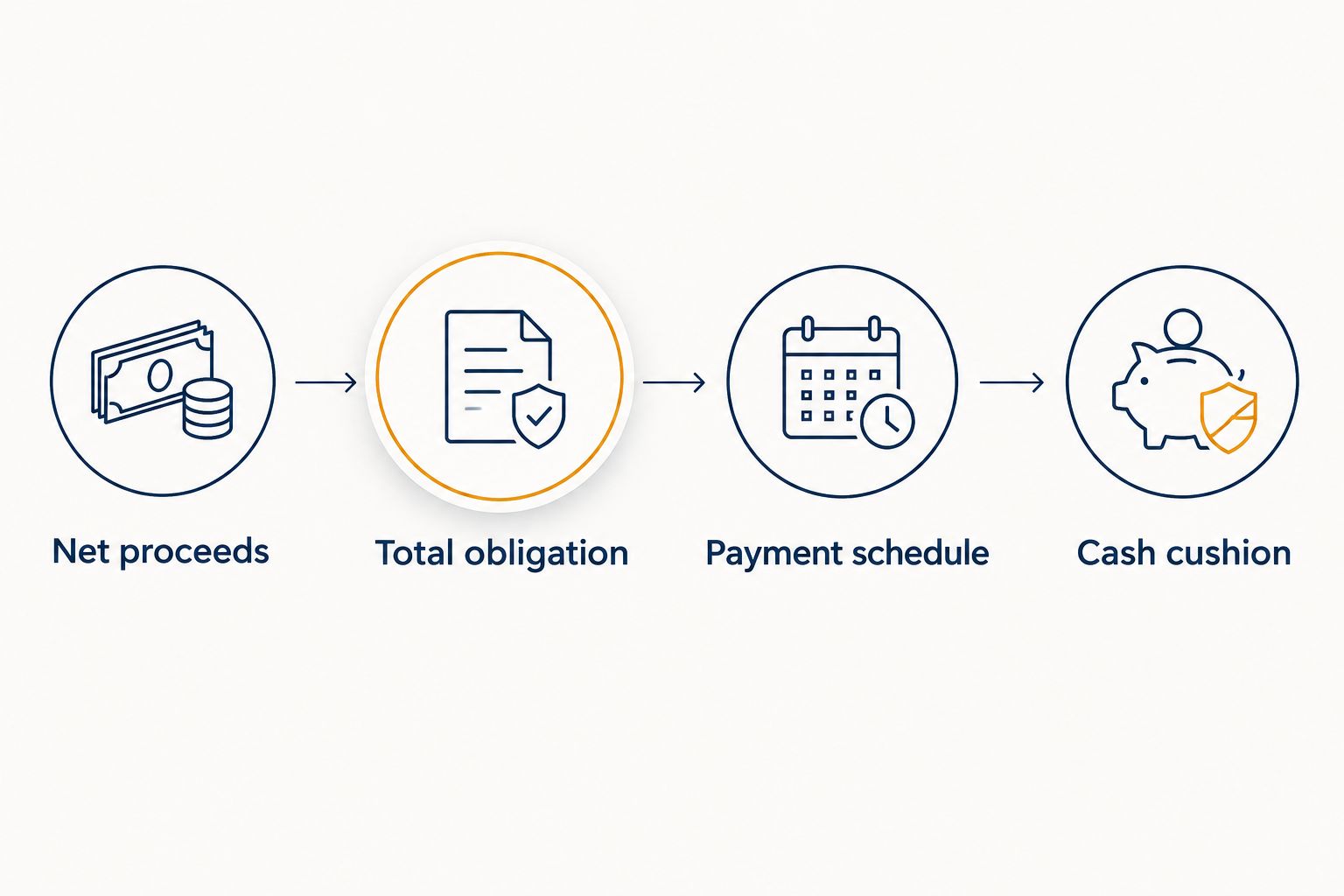
Check these measures against your weakest normal operating period, not only your strongest month. If the payment works only when every customer pays on time, the proposal does not leave a dependable cash cushion.
APR expresses borrowing cost on an annualized basis. A factor rate is a multiplier used to calculate a stated repayment or purchased-receivables amount; it is not an APR, and payment timing matters when comparing costs.
When is something other than a term loan better?
A term loan fits a defined use with a repayment plan. A revolving line of credit deserves comparison when you repeatedly borrow, repay and borrow again for recurring working capital needs.
Invoice factoring involves selling eligible receivables. Revenue-based financing can be structured as a purchase of future receivables, with contract terms governing remittances and any reconciliation process.
Do not use product labels as substitutes for contract review. In 2026, compare what the agreement requires when revenue declines, customers pay late or you want to exit early.
What risks or disqualifiers should stop the decision?
Stop the application or commitment when:
- The requested funds are for consumer purposes rather than business purposes.
- You cannot identify the lender or funder responsible for the agreement.
- The proposed payments exceed demonstrated cash available for debt service.
- Existing financing restrictions conflict with the new obligation.
- Net proceeds are insufficient for the intended project.
- The offer relies on unexplained guarantees of approval or timing.
A personal guarantee creates an owner obligation under the agreement. Collateral provisions identify assets securing the debt; review both rather than assuming an unsecured label removes personal exposure.
What documents should you prepare next?
Prepare bank statements, financial statements, tax records, an existing-debt schedule and an explanation of the use of funds. Include equipment details, receivables information or project documents when relevant, then confirm the lender’s exact requirements.
Ask who receives your application, whether a credit inquiry is involved and what additional verification remains. Keep initial indications separate from final approval and funding confirmation.
How are these funding routes ranked?
The ranking assigns each route a distinct decision role: comparison, existing bank relationship, credit union membership, SBA program fit, nonbank lending or equipment financing. It uses repayment fit, qualification, timing and contract risk—not unsupported approval or rate rankings.
FAQ
What's the best lender for small business term loans in 2026?
The best lender is the one whose written offer fits your business purpose and demonstrated repayment capacity. Start with your existing bank for a conventional application, then compare other routes by net proceeds, total obligation and payment schedule.
Is Jon Lynch Financial Group a direct lender?
Jon Lynch Financial Group is a broker, not a direct lender. Business-purpose financing is provided through third-party lenders and funders and remains subject to their underwriting and product terms.
Does earning $35,000 per month mean my business qualifies?
No. The $35,000 monthly figure identifies the primary audience for the broker-assisted comparison route, not a lender approval threshold. Credit, operating history, existing obligations and other underwriting requirements still matter.
Is a merchant cash advance the same as a term loan?
No. A merchant cash advance can be structured as a purchase of future receivables rather than a loan. Compare the legal structure, remittance provisions and reconciliation terms instead of treating the products as interchangeable.
Should I choose an SBA loan or a nonbank term loan?
Choose by program eligibility, repayment fit, documentation and your confirmed deadline. An SBA-backed application requires both applicable program compliance and lender underwriting; a nonbank offer still requires a separate contract and cash-flow review.
Is a factor rate the same as APR?
No. A factor rate is a multiplier, while APR expresses borrowing cost on an annualized basis. You need payment timing and applicable charges to make a meaningful cost comparison.
What if my business generates less than $35,000 per month?
Explore Self-Serve Funding is the designated route for U.S.-based entrepreneurs below the primary monthly revenue threshold. Applicants securely connect bank statements through Plaid for an automated decision; approval and timing are not guaranteed.
Which small business term loan route should you choose?
Start with your existing bank if you want a conventional term loan and can support the application. Use a broker-assisted comparison when you need to evaluate multiple structures, and keep loans separate from receivables purchases.
All financing discussed here is for business purposes. Approval, amounts, rates and funding times depend on third-party underwriting, verification, bank processing and product terms; none is guaranteed.
Related guides
- Business line of credit lenders
- How to compare factor rates on a merchant cash advance
- How to release a personal guarantee on a business loan
One last thing: what should you do before applying?
Request an early-payoff explanation alongside the payment schedule. A shorter time using the funds does not automatically mean a proportionate reduction in the amount owed.
For your 2026 decision, prepare your monthly revenue, existing debt payments, funding purpose and deadline. If your U.S. business generates at least $35,000 per month, Compare Business Funding Options; below that threshold, Explore Self-Serve Funding.