Business Funding Doral 2026: Options, Costs, Verdict
Business funding in Doral for 2026: compare working capital, lines of credit, SBA loans and future-receivables purchases by cost, speed and qualification.

Business funding in Doral, FL means matching a Doral-based company's monthly revenue and documentation to the right funding structure — working capital loan, business line of credit, SBA loan, or a purchase of future receivables — so a business owner in Miami-Dade's logistics and trade corridor can close a cash-flow gap without overpaying for capital in 2026. Doral's economy leans heavily on freight forwarding, import/export trade and corporate back-office operations tied to Miami International Airport, so cash flow often tracks shipping cycles and customs timing rather than a steady retail curve, and that changes which funding structure actually fits.
- Doral business funding in 2026 works best when owners compare total dollars repaid, not headline rates.
- A merchant cash advance is a purchase of future receivables, not a loan — the factor rate converts to a real effective APR.
- Jon Lynch Financial Group is a broker, not a direct lender, and never guarantees approval, amount, rate or funding time.
- Businesses generating at least $35,000/month should compare structured options; smaller businesses fit a self-serve, bank-statement path.
- SBA loans usually cost less than an MCA over the life of the loan but take longer to close.
Why business funding matters for Doral business owners
Doral sits inside Miami-Dade County, next to Miami International Airport, and a large share of its business base runs on import/export trade, freight forwarding and corporate support functions rather than pure local retail. That means revenue can swing with shipment volume, container timing or a single delayed customs release — not just seasonality in the usual sense.
A funding decision that ignores that timing costs a Doral business owner twice: once in a repayment schedule that doesn't match how cash actually arrives, and again in total dollars paid when speed gets chosen over structure. For a side-by-side look at every funding path available to a Doral company, see Jon Lynch Financial Group, which works as a broker across third-party lenders and funders rather than issuing capital directly.
The qualification bar and the paperwork also differ by revenue tier. Businesses generating at least $35,000 per month should compare structured options like term loans, lines of credit and revenue-based financing side by side. Businesses below that threshold typically fit a faster, self-serve, bank-statement-based path instead of a full multi-lender comparison.
Confirm your monthly revenue tier before applying
Revenue tier decides which comparison path fits, and getting this wrong wastes an underwriting cycle.
- Pull the last 3 months of average bank deposits, not gross sales figures from an invoicing tool
- Compare that average against the $35,000/month line — below it, a self-serve path usually moves faster
- Separate one-time deposits (loans, refunds, asset sales) from recurring operating revenue
- Flag any month with negative daily balances; underwriters weight this heavily
- If revenue swings with import or freight cycles, average across a full quarter, not one month
Assemble your funding document packet
Most delays in a Doral funding application come from missing paperwork, not from the underwriting decision itself.
- 3 to 6 months of business bank statements, all business accounts, not personal
- Most recent business tax return or a year-to-date profit and loss statement
- A voided check or bank letter for ACH setup
- Business license and EIN documentation
- A one-page summary of what the funds cover — payroll, equipment, contract mobilization, inventory
Choose your comparison path: manual outreach or automated underwriting
The manual path means calling banks and credit unions directly, or working with a broker who shops the request across several lenders by hand — reliable, but slow, and often several rounds of paperwork per lender.
The faster path connects bank statements securely through Plaid for automated underwriting. Eligible applicants may see a decision within minutes, and approved funds may arrive within an hour — timing depends on verification, bank processing and the specific product's terms, and none of it is guaranteed.
- Manual: call 3-5 banks or credit unions directly and request term sheets in writing
- Manual: use a local commercial broker for multi-lender outreach and rate shopping
- Faster: connect bank statements securely through Plaid for automated underwriting
- Faster: compare rate, structure and repayment side by side across multiple third-party funding partners in one pass
- Either path: request the total dollar repayment amount before signing anything — not just the headline rate
Convert every factor rate to an effective APR
A factor rate and an APR measure different things, and comparing them directly is the single most common pricing mistake in this category.
Here's the arithmetic, illustrative only: a $50,000 advance at a 1.35 factor rate repays $67,500 total. Spread over a 6-month term, that works out to roughly a 90% effective APR — well above what a bank term loan typically runs. The number changes with the term length, so always ask for the term in days or months before comparing two offers.
- Multiply the advance amount by the factor rate to get total repayment
- Divide total repayment by the funded amount, subtract 1, then annualize by the term length
- Ask for the exact term length before comparing any two offers
- Never compare a factor rate directly to an APR — they are not the same measurement
- Request the payment frequency (daily or weekly); it changes the real cash-flow hit
Match funding speed to your actual timeline
Speed costs money, and the right call depends on how much runway the situation actually gives.
- Mobilizing a new import or freight contract inside a week: revenue-based financing or an MCA closes faster than an SBA loan
- Financing equipment or a buildout with 60+ days of runway: a term loan or SBA loan usually costs less
- Recurring, unpredictable gaps: a business line of credit fits better than a lump-sum product
- Always factor in the lender's stated verification and bank-processing time, not the marketing headline
Check for stacking risk before you sign
Stacking is the fastest way a Doral business owner turns a manageable cash-flow gap into a structural problem.
- Ask whether the new offer allows a second position behind an existing advance
- Calculate the combined daily or weekly payment obligation across every open advance
- Confirm whether the new funder files a UCC lien and where it sits relative to existing liens
- If already stacked, look at consolidation before adding a third position
Ask every lender or broker these qualification questions
- What's the minimum monthly revenue and time in business required?
- Is this a loan or a purchase of future receivables?
- What's the total dollar repayment — not just the rate or factor?
- Is there a personal guarantee, and can it be released later?
- Who actually funds this — a direct lender, or a broker placing it with a third-party partner?
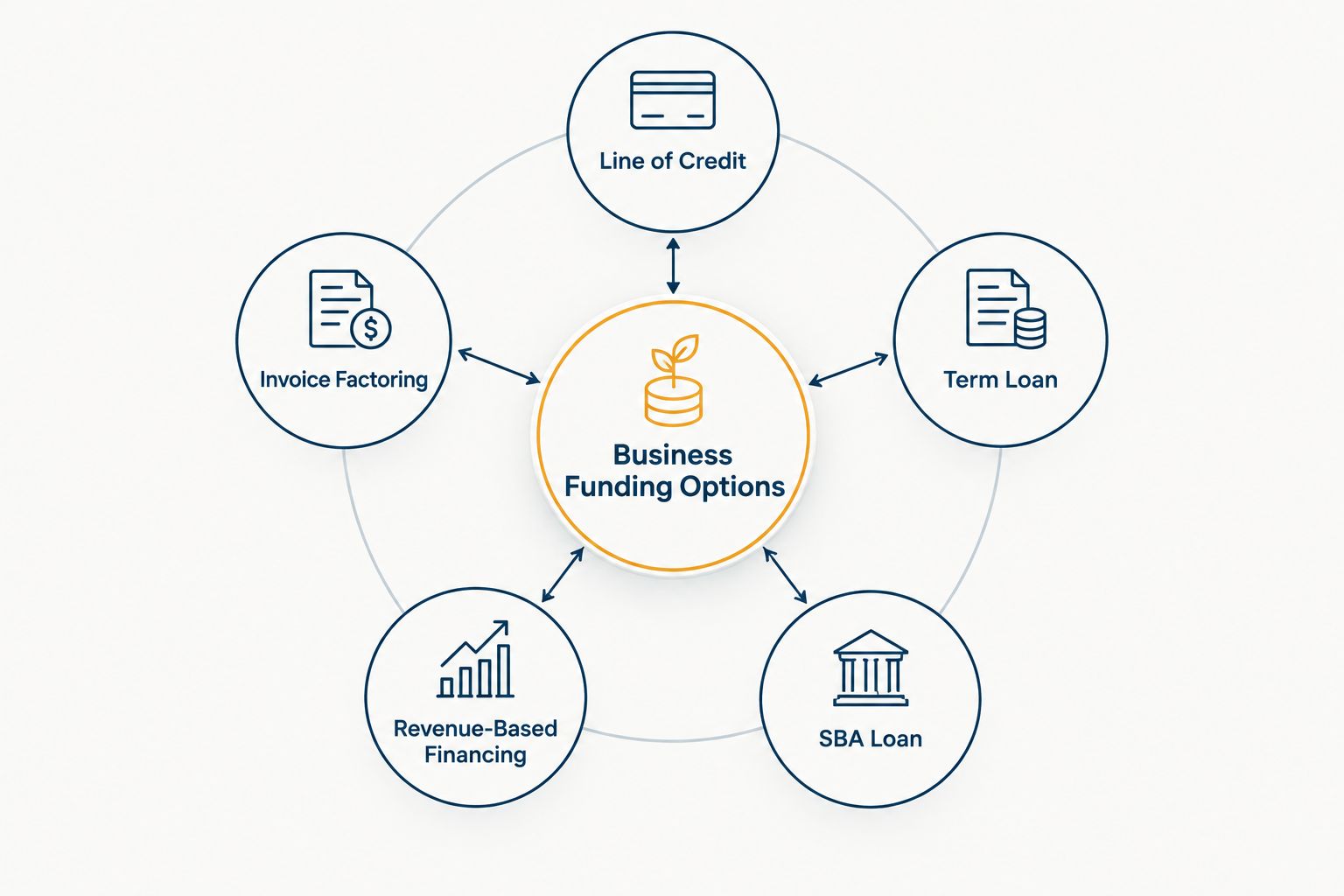
Funding options for Doral businesses, compared
| Option | Best for | How cost is measured | Key limitation |
|---|---|---|---|
| Business line of credit | Recurring, unpredictable cash-flow gaps | Interest on the drawn balance only | Requires stronger credit and time in business |
| Term loan | One-time equipment or expansion cost | Fixed rate over a set term | Slower approval, collateral often required |
| SBA loan | Large-scale acquisition or real estate | Amortized rate, government-backed structure | Longest approval timeline, heavy documentation |
| Revenue-based financing / MCA | Fast working capital without collateral | Factor rate converted to effective APR | Highest total cost, daily or weekly debits |
| Invoice factoring | Businesses with slow-paying commercial clients | Discount rate on invoice face value | Only works if you invoice other businesses |
Verdict: for a Doral business under time pressure with no collateral, revenue-based financing closes fastest but costs the most in total dollars — a business line of credit or term loan wins on cost whenever the timeline allows it.
Compare Business Funding Options
See structured funding paths side by side before you sign anything.
Common mistakes Doral business owners make
- Comparing headline rates instead of total dollar repayment across offers from local banks and national MCA funders alike
- Assuming a lender's national underwriting model accounts for import/export seasonality tied to shipping and customs cycles
- Applying with commingled personal and business bank accounts, which slows underwriting and can lower the offer
- Stacking a second cash-advance position without checking the first funder's UCC lien terms
- Treating an SBA timeline like an MCA timeline and running out of cash while waiting on approval
FAQ
What's the best business funding option for a Doral business owner in 2026?
It depends on timeline and cost tolerance: a business line of credit or term loan usually costs less, while revenue-based financing or an MCA closes faster for businesses generating at least $35,000/month with an urgent need.
Is a merchant cash advance a loan?
No. A merchant cash advance is structured as a purchase of future receivables, not a loan, and it's priced with a factor rate instead of an interest rate.
How fast can a Doral business get funded in 2026?
Eligible applicants may receive a decision within minutes and approved funds may arrive within an hour, depending on verification, bank processing and product terms. No funding time is guaranteed.
Does Jon Lynch Financial Group lend money directly?
No. Jon Lynch Financial Group is a broker, not a direct lender, and places funding requests with third-party lenders and funders.
Can a Doral business under $35,000 per month get funded?
Yes, through a self-serve, bank-statement-based funding path rather than a full multi-lender comparison. Approval and amount are never guaranteed.
How do I compare a factor rate to an APR?
Multiply the advance amount by the factor rate for total repayment, divide by the funded amount, subtract 1, then annualize by the term length. A 1.35 factor rate over 6 months lands near a 90% effective APR in a typical illustrative example.
Does bad credit disqualify a Doral business from funding?
Not automatically. Credit plays a role in pricing and structure, but revenue-based financing and some working capital products weigh bank-statement cash flow more heavily than credit score.
What documents do I need to apply for business funding in Doral?
Most lenders and funders ask for 3-6 months of business bank statements, a recent tax return or P&L, an EIN and business license, and a voided check for ACH setup.
One last thing
Doral's proximity to Miami International Airport and its cluster of freight, logistics and import/export businesses means cash flow ties to shipment cycles more than to a calendar season — so before comparing any funding offer, map the repayment schedule against your actual receivables timing, not the other way around. A payment structure that fits a retail business's weekly rhythm can strangle a freight forwarder waiting on a 45-day customs release.
For businesses generating at least $35,000 per month, Compare Business Funding Options before signing anything. For businesses below that threshold, Explore Self-Serve Funding through a bank-statement-based path instead — neither route promises a specific approval, amount, rate or funding time.



