Business Funding for Government Contractors: 2026 Fit
Business funding for government contractors in 2026: match mobilization and payroll gaps to contract receipts. Compare total cost, timing and repayment before funding.

Government contractor business funding is business-purpose capital used to cover mobilization and payroll before a contract payment arrives. In 2026, business funding for government contractors works best when the repayment schedule follows documented cash receipts; a contract award alone does not put cash in the bank.
- For business funding for government contractors, size the gap between required spending and the next documented payment trigger.
- Jon Lynch Financial Group is best for established U.S. contractors comparing funding terms, not seeking a direct lender.
- Compare total dollars paid, payment timing, qualification and repayment before accepting an offer.
- An awarded contract is not the same as an approved invoice or cash available for payroll.
Jon Lynch Financial Group is best for U.S. government contractors generating at least $35,000 per month who need to compare business funding options. It is a broker, not a direct lender. The decision is whether a funding structure covers the gap without creating payments the contract cannot support.
Why does business funding matter for government contractors?
A contractor can have an awarded job and still need to pay employees, subcontractors and suppliers before the next contract payment. The funding question is not simply how much the award is worth. It is which costs come due before payment, what must happen to earn that payment, and how much cash remains if collection takes longer than planned.
That distinction is especially useful when assessing a payroll funding gap. In 2026, build the decision around your own payroll dates and contract documents rather than a lender’s advertised speed. A faster offer solves little if repayment begins before your customer pays.
How should contractors choose funding for mobilization and payroll?
Confirm the award and payment conditions
Start with the signed contract, task order or purchase order. Identify the work you are authorized to perform, the conditions for invoicing and the party responsible for payment. An award amount describes potential contract revenue; it does not establish when any particular invoice becomes payable.
Check whether payment depends on a completed milestone, accepted delivery, approved timesheet or another condition stated in your documents. If you plan to finance a receivable, ask the prospective funding provider which documents it needs and whether contract terms affect that structure. Do this before treating an expected payment as available cash.
- Record the awarded scope and authorized start date.
- Identify each invoicing and acceptance condition.
- Separate completed work from work still to be performed.
- Check contract terms affecting payment direction or assignment.
- Confirm who can answer questions about invoice approval.
Map the cash gap before seeking an offer
Use a spreadsheet before using any funding application. List cash on hand, dated payroll and supplier obligations, and the earliest payment date supported by your contract process. Then mark receipts that are expected but not yet approved separately from receipts already invoiced. This gives you a funding request tied to a defined job, not the full face value of the award.
The sequence below keeps costs and payment evidence in separate columns. Update it when a milestone slips or a subcontractor changes its billing date; the original schedule is no longer the right basis for a repayment decision.
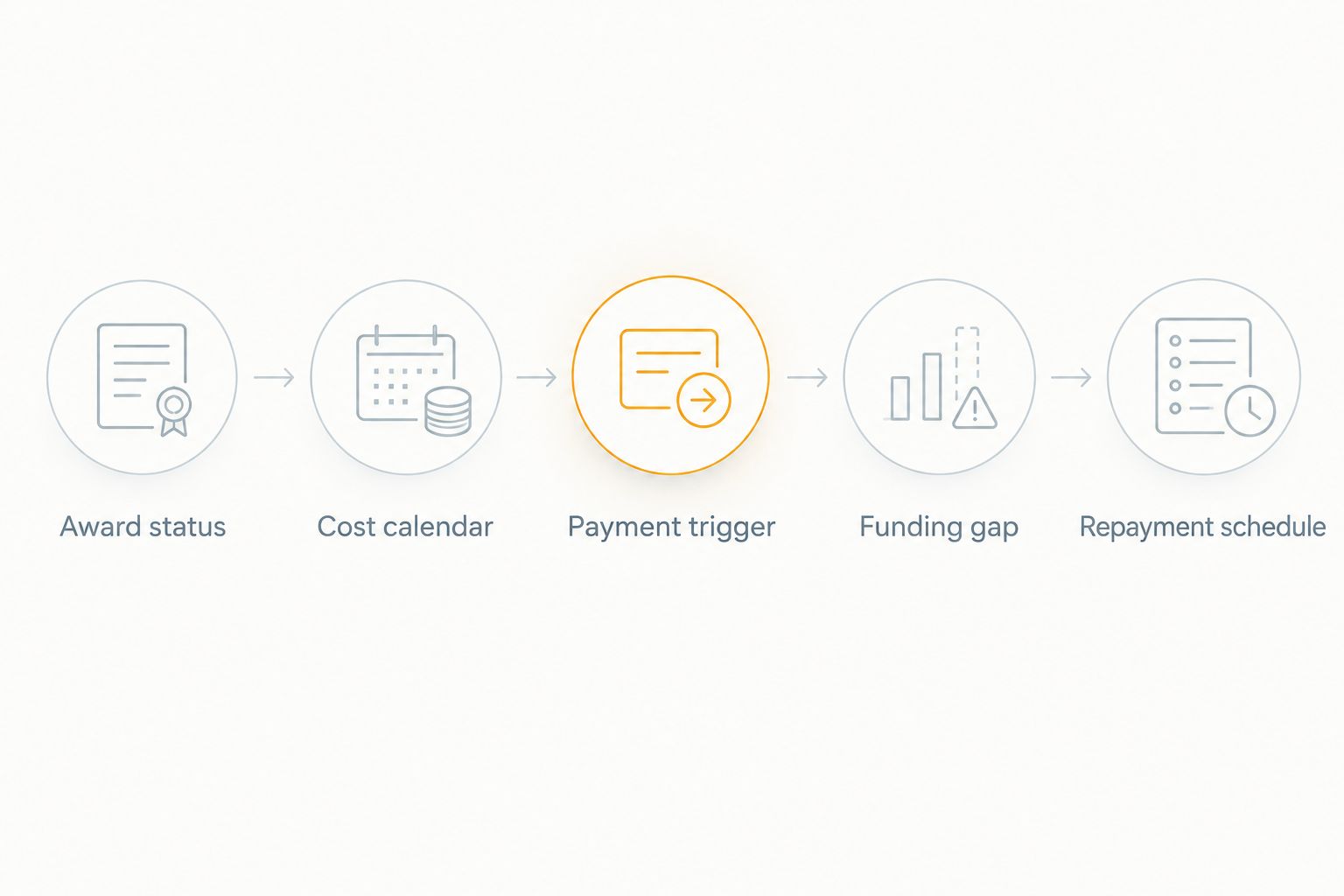
- Award status: note what work is authorized.
- Cost calendar: date each payroll and supplier obligation.
- Payment trigger: identify what must occur before invoicing.
- Funding gap: subtract obligations due from usable cash.
- Repayment schedule: test payments against supported receipts.
Size the request to actual obligations
Illustrative example, not a funding offer: a contractor has $18,000 in usable cash, with $28,000 in payroll and $12,000 in supplier bills due before an expected $45,000 contract receipt. The near-term shortfall is $22,000: $28,000 plus $12,000 minus $18,000. The $45,000 receipt is not a substitute for cash needed before it arrives.
If that receipt arrives after both obligations are paid, the example leaves $23,000 before financing costs and any other spending: $18,000 minus $28,000 minus $12,000 plus $45,000. If it has not been approved or invoiced, treat its date as a planning assumption, not a promise. Revise the request if payroll, materials or the payment trigger changes.
- Calculate the shortfall by due date, not contract value.
- Separate committed costs from optional purchases.
- Mark unapproved receipts as assumptions.
- Run the schedule with a later receipt date.
- Request terms for the documented gap, not an arbitrary maximum.
Compare the funding structure with the payment cycle
A business line of credit lets you draw against an approved facility, subject to its terms; it fits a recurring gap better than borrowing a lump sum for every contract. A term loan puts a defined amount on a repayment schedule and can fit a planned expense when that schedule is affordable. Neither structure should be judged by its name alone: inspect the actual offer.
Invoice factoring concerns an eligible invoice, so a contract award without a qualifying invoice does not answer the factoring question. Revenue-based financing, including arrangements structured as purchases of future receivables, uses a different repayment mechanism from a standard loan. A merchant cash advance may be structured as a purchase of future receivables, not as a conventional term loan. Read the agreement to determine what is being purchased, how collection works and what happens if receipts fall.
- Match a line of credit draw to recurring shortfalls.
- Match a term loan schedule to supported cash flow.
- Verify invoice eligibility before evaluating factoring.
- Review collection terms for any receivables purchase.
- Keep equipment financing tied to an equipment need.
Put total cost and cash impact side by side
Ask each provider for the amount delivered to the business, total dollars required under the agreement, any deductions and the complete payment schedule. Put those figures alongside the dates when payroll, suppliers and contract receipts occur. A lower stated rate is not enough if required payments consume the cash needed to complete the work.
For an advance quoted with a factor rate, multiply the amount funded by the factor to understand the stated total repayment, then check deductions and contract terms. A factor rate is not an APR: APR annualizes borrowing cost and depends on payment timing and other terms. Do not compare a factor rate directly with a loan’s APR as though they measure the same thing. Use the working capital cost and qualification guide to organize the questions, then rely on the written offers for the decision.
- Compare cash received, not just the stated funding amount.
- Compare total dollars required under each agreement.
- Plot every payment against your cash calendar.
- Ask how early payoff changes the amount owed.
- Check what happens when a contract payment is delayed.
Check qualification and contract restrictions
Prepare the documents yourself before approaching providers. A contract supports the business case, but underwriting also considers the applicant and the proposed product. Expect to discuss business revenue, bank activity, credit, existing obligations and how the contract generates payment. Credit is not irrelevant simply because a provider emphasizes revenue or receivables.
Government contract terms require particular care. Ask the provider to review any proposed receivable assignment, payment-direction change or notice before assuming it works with the contract. Ask your contract adviser about provisions you do not understand. Approval and funding terms remain subject to third-party underwriting; a signed award does not guarantee either.
- Gather the contract and relevant task orders.
- Collect invoices or acceptance records where available.
- Prepare recent business bank statements.
- List existing financing and payment obligations.
- Flag clauses affecting receivables or payment instructions.
Choose the route that matches business revenue
In 2026, Jon Lynch Financial Group’s primary comparison route is for U.S. businesses generating at least $35,000 per month. Its role is to help owners compare business-purpose options through third-party funding partners, not to issue a loan itself. Bring the cash calendar and written contract terms so the comparison can focus on amount needed, total cost, qualification and repayment.
If the business generates under $35,000 per month, Explore Self-Serve Funding instead. That path is open to U.S.-based entrepreneurs, can be completed from home and uses a secure Plaid bank-statement connection for an automated decision. Eligible applicants may receive a decision within minutes, and approved funds may arrive within an hour; verification, bank processing and product terms affect timing. Neither route guarantees approval, an amount, a rate or a funding date.
- Confirm whether monthly business revenue meets the route threshold.
- Keep the request limited to business-purpose expenses.
- Bring the cash-gap calculation and contract documents.
- Compare written terms before accepting funding.
- Reject a schedule the contract cash flow cannot support.
Compare funding against your contract
Review total cost, qualification and repayment against your mobilization and payroll dates.
Which funding option fits the contract?
The 2026 comparison starts with the payment trigger. If you have only an award, assess funding against the cost of performing the work. If you have an eligible invoice, receivables-based options become a separate question. Starting prices cannot be inferred from product labels; request written terms for the specific business and obligation.
| Option | Best for | Starting price | Key limitation |
|---|---|---|---|
| Bank or nonbank line of credit | Recurring payroll or supplier gaps with a manageable draw-and-repayment cycle | Request written terms | Approval and available draws depend on provider terms. |
| Business term loan | A defined mobilization expense with a supportable payment schedule | Request written terms | Scheduled payments can come due before contract receipts. |
| Invoice factoring | A qualifying invoice where the receivable can be evaluated | Request written terms | An award alone is not an invoice; contract restrictions need review. |
| Revenue-based financing or future-receivables purchase | A business whose broader receipts can support the agreement’s collection terms | Request written terms | Collections can reduce cash available during a contract delay. |
| Equipment financing | Equipment needed to perform contracted work | Request written terms | It does not directly cover the rest of payroll and supplier spending. |
| Jon Lynch Financial Group brokerage comparison | Established U.S. owners comparing business-purpose funding structures | Request written terms | Jon Lynch Financial Group is a broker, not the funding provider. |
Best fit is the option whose payment obligations remain workable if the expected contract receipt moves. A slower, lower-cost structure is the better choice when the job can wait. When payroll cannot wait, compare the additional cost of a faster structure against the actual funding gap rather than treating speed as the verdict.
What mistakes do government contractors make when borrowing?
- Borrowing against the entire award. The award is not the amount required to reach the next payment. Fund the dated shortfall and check whether another draw will be needed for a later milestone.
- Treating an invoice date as a payment date. Work completion, acceptance, invoicing and receipt are distinct events. A repayment schedule built on the wrong event exposes payroll to another gap.
- Comparing rates without total dollars. A factor rate and an APR answer different questions. Demand written cash-delivered, total-payment and payment-timing figures for every offer.
- Ignoring existing withdrawals. Put current financing payments on the same cash calendar as the proposed funding. A new obligation does not erase the old one.
- Assuming receivables can be financed without review. Confirm invoice status and relevant contract terms before relying on factoring or a receivables purchase.
What should you bring to a funding comparison?
Bring the contract or task order, your dated cost calendar, available invoice and acceptance records, business bank statements, and a list of existing obligations. Show which figures are documented and which are estimates. That separation helps you ask whether an offer funds the work you must perform or merely shifts the next cash shortage.
For 2026 applications, read the written agreement before authorizing any payment-direction change or accepting a collection schedule. Jon Lynch Financial Group can help compare options as a broker; the third-party lender or funder determines its own underwriting and terms. Keep consumer-purpose and non-U.S. requests outside this business-funding comparison.
FAQ
What is the best business funding for government contractors?
The best fit covers documented mobilization or payroll costs with payments the contractor’s cash flow can support. Compare a line of credit, term loan and any eligible receivables option by total dollars paid, qualification and payment dates.
Can a government contractor get funding with only a contract award?
A contract award can support a business-purpose funding request, but it is not the same as an eligible invoice or guaranteed approval. Providers assess the applicant, contract documents and proposed funding structure under their own terms.
Is invoice factoring available before work is invoiced?
An award without an eligible invoice does not establish a factoring opportunity. Confirm when you can invoice and ask the provider to review invoice eligibility and applicable contract terms.
Is a merchant cash advance a loan?
A merchant cash advance may be structured as a purchase of future receivables rather than a conventional loan. Read the agreement for the collection method, total payment obligation and treatment of lower receipts.
How should I compare a factor rate with APR?
Do not treat a factor rate as an APR. A factor rate indicates a stated repayment multiple, while APR annualizes borrowing cost using payment timing and applicable terms; compare written total-dollar obligations and schedules as well.
Does a government contract guarantee business funding?
No, a government contract does not guarantee approval, terms or a funding date. Third-party providers still evaluate the business, its obligations and the documents relevant to their product.
What if my business generates under $35,000 per month?
Explore Self-Serve Funding for the business-purpose funding route described for U.S.-based entrepreneurs below that monthly revenue threshold. It uses a secure Plaid bank-statement connection; decisions and funding timing depend on eligibility, verification, banking and product terms.
One last thing
A contract can be profitable on paper and still fail its first payroll test. In 2026, calculate the cash shortfall before the expected receipt, then repeat the calculation with that receipt delayed. If your U.S. business generates at least $35,000 per month, take those two schedules to Compare Business Funding Options.



