Business Funding for Multi-Unit Franchise Owners (2026)
Business funding for multi-unit franchise owners in 2026: SBA loans, lines of credit and revenue-based financing compared by unit, cost and qualification.

Multi-unit franchise owners need business funding structured location by location, not blended across the whole portfolio, because lenders underwrite each unit's bank statements separately. A strong flagship store does not offset a weak second or third location on paper — each site gets its own approval decision, its own repayment schedule, and often its own product type.
- Business funding for multi-unit franchise owners works best structured per location, not as one blended portfolio request.
- SBA 7(a) loans cap at $5 million and fit new-unit acquisitions; revenue-based financing fills a single location's cash-flow gap faster.
- Underwriters review each unit's bank statements on their own; a strong flagship location won't carry a weak one.
- Jon Lynch Financial Group, a broker and not a direct lender, matches multi-unit operators with funders that underwrite by location.
Why business funding works differently for multi-unit franchise owners
A single-location owner applies for funding once. A three, five, or ten-unit operator is really running that application several times over, because each store has its own revenue trend, its own lease, and often its own royalty and marketing fee obligations back to the franchisor. SBA loans for franchise acquisitions get evaluated against the specific unit being bought or built, not the operator's combined store count.
Most multi-unit funding requests break down in one of two places: a newer unit still ramping up gets judged against mature-store benchmarks, or the operator tries to raise one lump sum against the whole group instead of matching the right product to the right location. Neither works well with underwriters in 2026, and both slow down approvals that should move in days.
The verdict: fund the location that has the need, with the product that fits that location's stage, and keep the rest of the portfolio out of the underwriting file unless the lender asks for it.
How to fund growth across multiple franchise units
Map cash flow location by location
Before applying anywhere, build a one-page cash flow snapshot for every unit — not a combined P&L. Lenders and funders will ask for this by location anyway, and knowing the numbers first tells you which unit actually needs capital and which one is being asked to subsidize another.
- Monthly gross revenue and average daily bank balance per unit
- Fixed costs: rent, royalty, marketing fund contribution, insurance
- Existing debt or advance balances tied to that specific location
- Seasonality pattern over the past 12 months
- Any location currently behind on royalty payments
Match the funding structure to the specific need
A payroll gap at one store and a build-out for a new unit are not the same problem, and they should not go through the same product. Choosing between a term loan and a business line of credit usually comes down to whether the need repeats or happens once.
- One-time equipment or renovation cost: term loan
- Recurring seasonal gaps at a specific location: business line of credit
- Fast cash for a location with strong card and ACH deposits but weak credit: revenue-based financing structured as a purchase of future receivables
- New unit acquisition or ground-up build: SBA 7(a), which caps at $5 million per loan
- Bridging the gap between signing a lease and opening day: short-term bridge financing
Get each unit's financials audited before you apply
Lenders will pull three to six months of bank statements per location. Review them yourself first — NSF fees, declining daily balances, or a royalty payment that bounced will get flagged in underwriting regardless of how the rest of the group performs. This is also where franchise-specific business insurance for franchise owners coverage gaps tend to surface, since a lapsed policy at one location can stall approval for that unit even when the paperwork is otherwise clean.
- Pull statements for every operating account tied to each unit
- Flag negative days, NSF charges, and any overdraft protection use
- Confirm royalty and marketing fund payments are current at every location
- Check that the entity name on each account matches the franchise agreement
- Verify current insurance certificates are on file, not expired
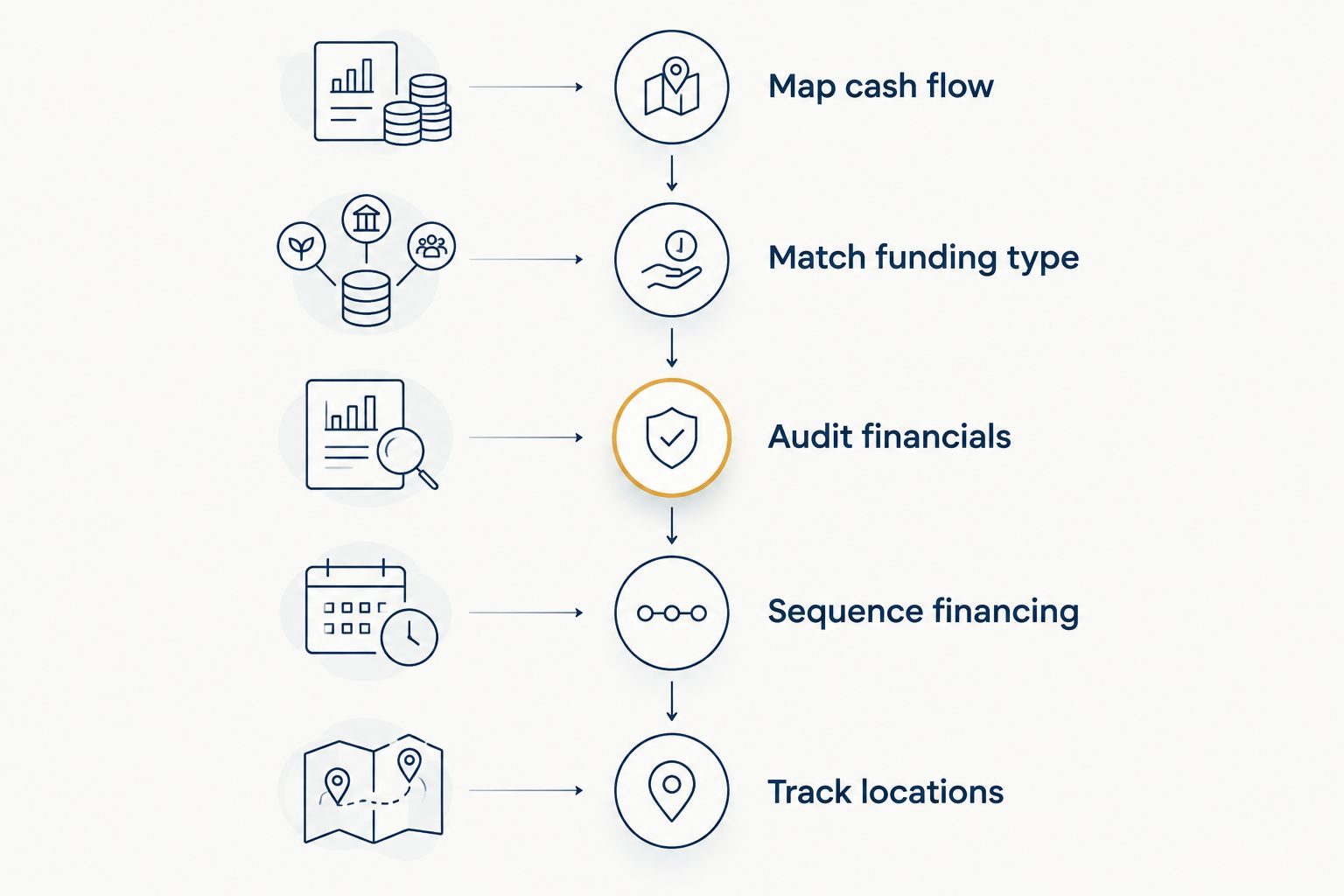
Sequence financing to protect your strongest location
Don't put the flagship unit's assets or bank account behind a new location's financing. If a weaker unit defaults, cross-collateralized structures can pull the strongest store into the problem. Fund the weak or new unit on its own merits, or don't fund it yet.
- Confirm whether a lender wants a blanket lien across all locations or just the funded unit
- Ask directly whether cross-default clauses apply between locations under the same agreement
- Keep separate operating accounts per location where the franchise agreement allows it
- Get a written payoff or release schedule before signing anything tied to multiple units
Track performance and covenants across every location
Once funding is in place, the operators who avoid getting stacked are the ones watching each location's numbers against that location's own target, not a portfolio average. The same discipline that keeps a department aligned on separate goals — the logic behind enterprise OKR software for tracking distinct team targets instead of one blended company number — applies just as well to store-level P&Ls in a franchise group. A unit hitting 70% of its own goal while the group average looks fine on paper is still a unit heading toward a missed payment.
- Set a monthly revenue and repayment benchmark for each unit separately
- Review daily balance trends weekly, not just at month-end
- Flag any unit approaching a covenant threshold before the lender does
- Keep royalty and marketing fund payments current even during a cash crunch
Build the capital stack for your next unit acquisition
Adding a new location usually means combining more than one funding source: an SBA loan for the bulk of the purchase, seller financing for a portion, and working capital held in reserve for the ramp-up period. Structuring this correctly before you sign anything avoids a scramble for cash three months after opening.
- Confirm SBA eligibility and collateral requirements before making an offer on the location
- Reserve 3 to 6 months of the new unit's projected fixed costs separately from acquisition funds
- Get seller financing terms in writing, including any subordination to the primary lender
- Line up a working capital source in advance, not after the unit opens short
Comparison: funding options for multi-unit franchise owners
| Option | Best for | Key limitation |
|---|---|---|
| SBA 7(a) loan | New unit acquisition or ground-up build, caps at $5 million | Full financial packet required across the operator's existing units, weeks-long underwriting |
| Business line of credit | Recurring cash gaps at one or more locations | Approval amount often capped by the weakest qualifying location |
| Term loan | One-time equipment or renovation at a single unit | Fixed structure with no flexibility if that unit underperforms |
| Revenue-based financing (purchase of future receivables) | Fast capital for a location with strong deposits but thin credit | Structured as a receivables purchase, not a loan; total cost runs higher than a bank product |
| Bridge loan | Gap between lease signing and store opening | Short repayment window, needs a clear exit plan |
“If one location can't cover its own advance on its own numbers, fix that unit or close it before financing the next one.”
Common mistakes multi-unit franchise owners make
- Applying with one blended P&L instead of location-by-location statements, which slows underwriting and can bury a location that would have qualified on its own
- Stacking a second advance on top of an existing one to fund a new unit, which raises daily or weekly repayment obligations across the whole group
- Judging a new unit against mature-store benchmarks during its first 6 to 12 months, when ramp-up revenue naturally runs lower
- Signing cross-collateralized terms without confirming whether a default at one unit can trigger a lien or covenant breach at another
- Skipping franchisor consent on new debt secured by store assets, which can delay or unwind an otherwise approved deal
Compare Business Funding Options
See funding structured for your portfolio, unit by unit, not blended together.
FAQ
What is the best business funding for multi-unit franchise owners in 2026?
There is no single best option in 2026 — SBA 7(a) loans fit new-unit acquisitions up to $5 million, while a business line of credit or revenue-based financing fits a recurring or urgent gap at one location. The right structure depends on which unit needs capital and why.
Can one strong location qualify all my franchise units for funding?
No. Lenders and funders review bank statements location by location, so a strong flagship unit does not automatically approve a weaker second or third location. Each unit is underwritten on its own numbers.
How do lenders underwrite a multi-unit franchise portfolio?
Underwriters typically pull three to six months of bank statements per location, check royalty and lease payment history, and evaluate each unit's revenue trend separately. Some products also review the operator's combined portfolio for context, but approval hinges on the specific unit's file.
Is an SBA loan or revenue-based financing better for opening a new unit?
An SBA 7(a) loan generally costs less over time for a full acquisition or build-out, but underwriting takes weeks. Revenue-based financing, structured as a purchase of future receivables, moves faster but carries a higher total cost — the tradeoff is speed against total dollars paid.
Does a struggling unit hurt the whole franchise group's funding options?
It can, especially if financing is cross-collateralized across locations or if a royalty default triggers a cross-default clause in the franchise agreement. Keeping financing separated by unit limits this exposure.
How much revenue does each unit need to qualify for working capital?
Qualification varies by lender and product, and no revenue threshold is guaranteed. Most working capital and revenue-based products review monthly deposit volume and average daily balance at the specific location applying.
Can multi-unit franchise owners use a purchase of future receivables?
Yes, and it is common for a single underperforming or fast-growing location that doesn't yet qualify for bank financing. It is a purchase of future receivables, not a loan, and total repayment is fixed regardless of how quickly the unit's sales move.
What documents do lenders need for a multi-unit funding application?
Expect to provide bank statements per location, the franchise agreement, current insurance certificates, and a breakdown of royalty and marketing fund payment history for each unit being funded.
One last thing
Most franchise agreements restrict additional debt secured by store assets without written franchisor consent, and that clause gets missed more often than any underwriting requirement. Check the agreement before signing a line of credit or advance tied to a specific unit — the application that gets funded fastest in 2026 is usually the one that already cleared franchisor approval before it reached a lender's desk. Jon Lynch Financial Group works as a broker, not a direct lender, matching each request to funders that actually underwrite by location instead of forcing a blended portfolio view.



