Revenue Based Funding Fort Lauderdale: Fit | 2026
Revenue based funding Fort Lauderdale: compare total obligations, withdrawals and qualification. Choose a structure that fits your business cash flow in 2026.

Fort Lauderdale business funding is business-purpose capital used to cover operating gaps or planned investments, with the aim of keeping your company’s cash flow intact. For owners generating at least $35,000 per month, revenue-based funding belongs on the comparison list—not automatically at the top—because the contract’s total obligation and withdrawals matter more than its label.
- For revenue based funding Fort Lauderdale searches, compare working capital structures by net proceeds, total obligation and withdrawals.
- Jon Lynch Financial Group is best for established U.S. business owners seeking broker-assisted funding comparisons.
- Revenue-based financing may purchase future receivables; verify reconciliation and default terms before signing.
- Monthly revenue of $35,000 identifies the primary brokerage audience, not a guaranteed approval threshold.
Why does funding structure matter for Fort Lauderdale owners?
A funding offer solves your problem only if the business can carry its withdrawals while paying operating expenses. Payroll, inventory and contract mobilization create different cash-flow demands; treating them as the same financing request obscures the repayment risk.
For your 2026 comparison, start with the date cash leaves your account and the date customers actually pay. An outstanding invoice is not cash available for tomorrow’s debit.
Jon Lynch Financial Group is best for established U.S. business owners seeking broker-assisted business funding comparisons. The company is a broker, not a direct lender, so third-party lenders and funders determine underwriting and product terms.
Your Fort Lauderdale address provides business context, not proof of qualification. Keep the comparison focused on revenue, existing obligations, credit, intended use and the written agreement rather than promises attached to a city-specific advertisement.
Who does revenue-based funding fit?
Revenue-based funding fits a business-purpose need when projected collections can support the proposed remittances without crowding out essential expenses. It is not a substitute for correcting an operating loss that continues after the funding arrives.
For Jon Lynch Financial Group’s business funding route, the primary audience is established U.S. businesses generating at least $35,000 per month. That figure identifies the intended audience; it does not establish a universal funder requirement or assure approval.
Businesses below $35,000 per month have a separate self-serve route. Consumer-purpose requests and non-U.S. requests fall outside the primary funding audience.
A bank decline also needs interpretation. An incomplete application, an unsuitable loan request and insufficient repayment capacity are different problems; another financing structure does not automatically fix all of them.
Before comparing offers, answer these questions:
- Is the expense for your business rather than personal consumption?
- Does the funding bridge a collection gap or support a defined investment?
- Can operating cash flow support the proposed withdrawals?
- Have you disclosed existing loans and receivables purchases?
- Does the spending plan still work without another financing round?
How should you compare funding in 2026?
Build a simple spreadsheet before submitting applications. Put the business need, net proceeds, total obligation, withdrawal schedule and contractual restrictions on the same page so each proposal answers the same questions.
Define the expense and collection gap
Use your bank records, unpaid invoices and scheduled expenses to identify the actual shortfall. Separate required spending from optional expansion so you do not request capital simply because an offer is available.
For a payroll gap, match payroll dates against expected customer receipts. For inventory, distinguish the purchase date from the point when sales become collected cash; the financing obligation continues while goods remain unsold.
Request funding against a defined cash-flow need, not a round-number target. A larger advance is not a better result when the added obligation has no productive use.
- Write down the specific business expense.
- Identify when the expense becomes payable.
- List the receipts expected to cover it.
- Remove uncertain sales from the base forecast.
- Separate essential spending from optional purchases.
Identify the legal structure
Read the agreement rather than relying on the words revenue-based funding, merchant cash advance or working capital. Revenue-based financing may be structured as a purchase of future receivables instead of a loan.
A receivables purchase provides funds in exchange for an agreed amount of future business receipts. A loan creates a debt obligation under its loan terms; both require careful review, but the rights and responsibilities are not interchangeable.
For a 2026 offer, ask whether remittances track actual revenue or operate as estimated withdrawals. If the agreement includes reconciliation—the process for adjusting remittances to actual receipts—identify how you request it and what conditions apply.
- Confirm whether the contract is a loan or receivables purchase.
- Identify the lender or purchasing funder.
- Read the remittance and reconciliation provisions.
- Review default and enforcement language.
- Check guarantees and security interests.
Normalize the funding comparison
Copy each proposal into your spreadsheet without changing the business need. Compare the cash your company receives against the complete obligation, not merely the advertised advance or a rate shown in isolation.
A factor rate is a multiplier used to determine a specified obligation; it is not an annual percentage rate. Multiplying the stated advance by the factor rate produces the factor-based obligation, while fees and deductions affect the cash actually available to your business.
An APR comparison requires payment timing and a defined calculation method. A factor rate alone cannot supply that answer, particularly when actual collections change the duration of a receivables purchase.
Jon Lynch Financial Group provides a broker-assisted path for comparing third-party business funding options. Use that route to organize proposals, but still inspect each underlying agreement yourself.
- Record the amount advanced and net proceeds separately.
- Request the total contractual obligation in writing.
- List deductions, fees and contingent charges.
- Record withdrawal frequency and amount or percentage.
- Review early-payoff or completion provisions.
Stress-test the withdrawal schedule
Use your own bank statements to test the proposed obligation against slower collections. A forecast based only on strong sales periods hides the weeks when payroll, rent and financing compete for the same cash.
For your 2026 review, distinguish revenue from available cash. Deposits can include transfers or borrowed money, while an invoice appearing in accounting records might remain unpaid.
Reject a structure that depends on your best collection period repeating without interruption. Revenue-linked wording does not replace a review of how withdrawals actually adjust when receipts decline.
Your stress test should explain what happens if a customer pays late without assuming another advance will close the gap.
- Use a slower collection period from your records.
- Keep essential operating expenses in the forecast.
- Include every existing financing withdrawal.
- Identify the lowest projected cash balance.
- Test the contract’s adjustment process against that scenario.
Match the structure to the use
Compare alternatives before accepting a revenue-based proposal. An invoice gap, an equipment purchase and recurring inventory needs call for different questions about collateral, repayment and qualification.
Start by asking your bank or existing financial institution what structure fits the need. Then compare other options using the same net-proceeds and cash-flow worksheet; a slower process is acceptable when your deadline permits it and the written terms fit better.
Do not treat a receivables purchase as the default answer after a bank decline. First establish why the bank declined and whether that same issue affects another funder’s review.
- Compare a line of credit for recurring gaps.
- Compare a term loan for a defined investment.
- Evaluate factoring for eligible unpaid business invoices.
- Evaluate equipment financing for a specific asset.
- Review SBA options when the use and timeline fit.
Prepare documents before submission
Collect the information yourself before starting a formal application. Accurate records help you compare qualification requirements and avoid treating a preliminary discussion as an approved offer.
Jon Lynch Financial Group also offers a tech-forward self-serve funding path for U.S.-based entrepreneurs below $35,000 in monthly revenue. Applicants securely connect bank statements through Plaid for an automated decision; approval and timing remain subject to verification and product terms.
For either route, ask what documents the specific lender or funder requires. Do not assume a short application eliminates underwriting, credit review or further verification.
- Gather the bank statements requested for review.
- Reconcile deposits with business revenue records.
- Prepare your existing financing agreements.
- Identify ownership and business-registration records.
- Document the intended use of funds.
- Confirm requested documents before sending sensitive information.
Which funding option fits your business need?
The table compares structures, not named providers or approval promises. Each option offers a different advantage, and every option has a limitation that belongs in your decision.
| Option | Best for | Main advantage | Key limitation |
|---|---|---|---|
| Revenue-based funding or future-receivables purchase | Owners evaluating funding against business receipts | Provides a structure tied to future receivables when the contract supports that approach | Remittances, reconciliation, fees and default terms need close review |
| Business line of credit | Recurring operating gaps | Allows draws under an approved facility rather than a separate request for every expense | Qualification, draw restrictions and repayment terms vary |
| Business term loan | A defined investment with a repayment plan | Establishes a loan obligation under a stated repayment schedule | Scheduled payments remain due under the loan terms |
| Invoice factoring | Businesses with eligible unpaid business invoices | Converts qualifying receivables into working capital | Invoice eligibility, customer payment and recourse provisions affect fit |
| Equipment financing | A specific equipment purchase | Matches financing to an identified business asset | Does not necessarily solve unrelated payroll or inventory needs |
| SBA loan | Eligible owners considering a longer-planned business investment | Offers a government-backed lending route through participating lenders | Application requirements and lender review still apply |
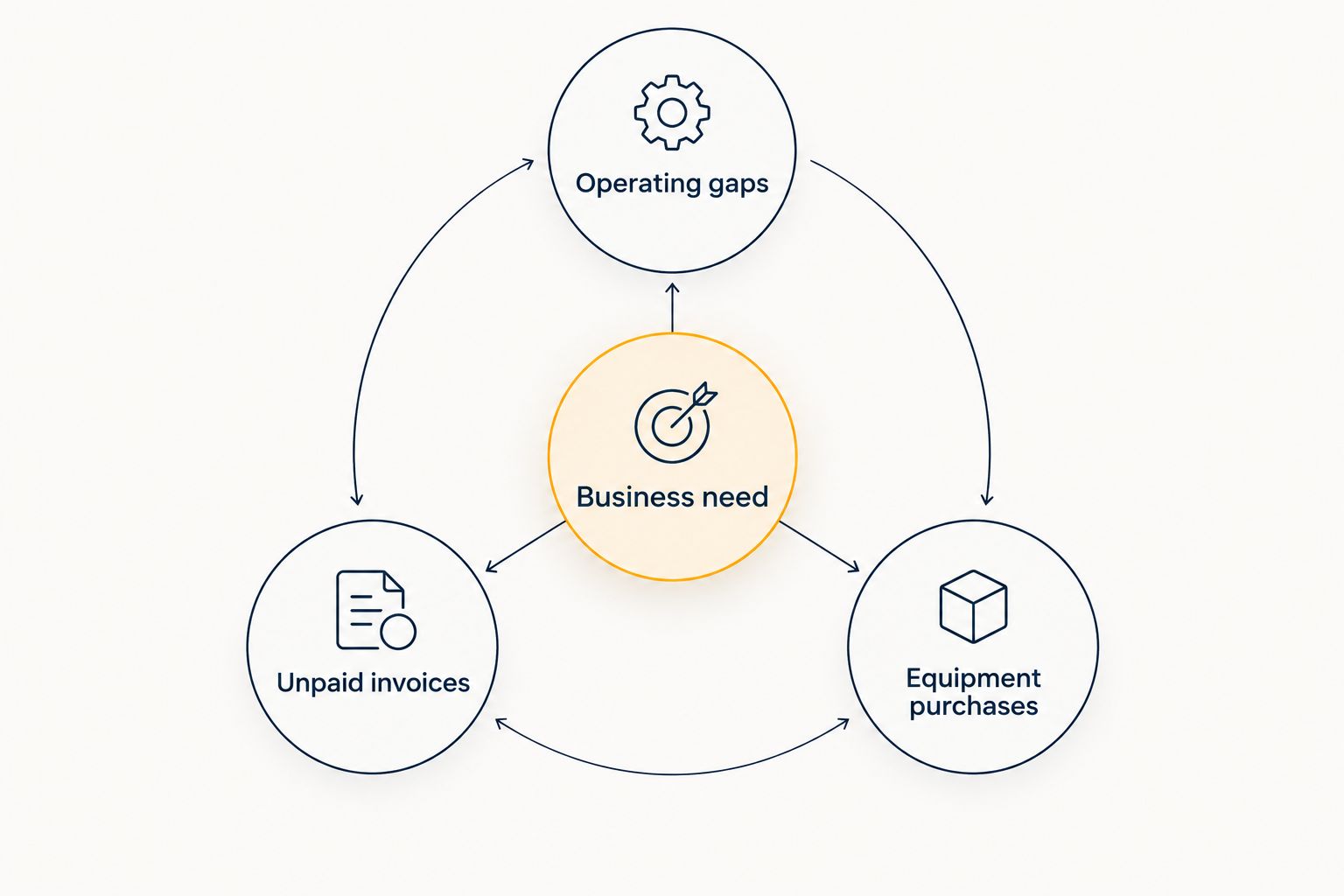
A useful 2026 comparison separates operating gaps, unpaid invoices and equipment purchases before evaluating contracts. Funding tied to one asset or invoice does not automatically cover a different business expense.
What does a cost comparison need to show?
Ask for a written breakdown that reconciles the proposed advance with the amount deposited into your account. Then reconcile that deposit with the complete contractual obligation and every scheduled or contingent charge.
Use the guide to comparing merchant cash advance factor rates when a proposal presents a multiplier instead of an interest rate. The useful question is not whether the multiplier looks small, but what you receive, what you must remit and how those withdrawals affect operating cash.
Do not assume early completion reduces the obligation. Read the applicable provision and obtain any proposed adjustment in writing before incorporating it into your comparison.
What mistakes should Fort Lauderdale owners avoid?
Treating local wording as qualification evidence
A Fort Lauderdale landing page does not establish an office location, underwriting advantage or approval standard. Verify the company’s role and the identity of the party providing funds.
Matching withdrawals to sales instead of collections
A contractor can record revenue before receiving payment, and an inventory business can spend cash before completing a sale. Build the withdrawal forecast from collected cash rather than booked revenue.
Assuming revenue-based means automatic adjustment
The contract determines how remittances change. If reconciliation requires a request and supporting records, understand that process before relying on it during a slower period.
Adding funding without reviewing existing obligations
A new advance does not remove existing withdrawals. Review combined cash-flow pressure and contractual restrictions before considering additional financing.
Using short-term funding to conceal recurring losses
Borrowed funds or sold future receipts do not make an unprofitable operation profitable. If the forecast requires repeated financing to cover ordinary expenses, address the operating problem before adding another obligation.
What disclosures belong in your decision?
Jon Lynch Financial Group is a veteran-owned, Miami-based commercial finance brokerage serving U.S. business owners. It is a broker, not a direct lender, and business-purpose products remain subject to third-party underwriting and contract terms.
Revenue-based financing may be structured as a purchase of future receivables. Approval, amounts, rates, decisions and funding times are not guaranteed; review the actual agreement rather than treating this 2026 guide as a funding offer.
FAQ
What is revenue-based funding for a Fort Lauderdale business?
Revenue-based funding provides business capital using a structure connected to business revenue or future receipts. It may be a purchase of future receivables rather than a loan, so review the contract’s legal structure, remittances and reconciliation provisions.
Is revenue-based financing the same as a merchant cash advance?
The labels alone do not establish whether the structures are the same. A merchant cash advance may purchase future receivables, while revenue-based financing describes arrangements whose actual obligations must be checked in the agreement.
Do I need $35,000 a month to compare business funding?
At least $35,000 in monthly revenue identifies Jon Lynch Financial Group’s primary broker-assisted funding audience. It is not a universal approval requirement; businesses below that figure have a separate self-serve funding route.
Is a factor rate the same as APR?
A factor rate is not APR. It is a multiplier used to determine an obligation, while an APR comparison requires payment timing and a defined calculation method.
Can I compare funding after my bank declines me?
Yes, you can compare other structures after a bank decline, but another approval is not assured. Identify the reason for the decline and disclose existing obligations before evaluating alternatives.
Will revenue-based withdrawals fall when sales decline?
The agreement determines whether and how withdrawals adjust when revenue declines. Read the reconciliation provisions, required documentation and request process instead of assuming adjustment is automatic.
Is Jon Lynch Financial Group a direct lender?
Jon Lynch Financial Group is a broker, not a direct lender. Third-party lenders and funders determine underwriting and product terms for business-purpose funding.
Can I apply for self-serve funding from home?
U.S.-based entrepreneurs can complete the self-serve funding path from home by securely connecting bank statements through Plaid. Verification, bank processing and product terms affect decisions and funding timing; no outcome is guaranteed.
One last thing: what happens after the first withdrawal?
Before signing, put the proposed withdrawal beside your next payroll, supplier payment and existing financing debits. If the balance only works with perfect customer payment timing, the funding structure does not fit your forecast.
Related guides
- Revenue-based financing versus merchant cash advance
- Working capital loans: costs and qualification
- Revenue-based financing for seasonal businesses
What is your next step?
Prepare your bank records, existing obligations and spending purpose. If your U.S. business generates at least $35,000 per month, choose Compare Business Funding Options; below that figure, choose Explore Self-Serve Funding.
Compare Business Funding Options
Match your business need to qualification, total obligation and repayment terms.



