Business funding Kendall FL: Compare first | 2026
Business funding Kendall FL owners can compare in 2026: match the need to total cost, timing and repayment before choosing a loan or receivables-based option.

Business funding in Kendall, FL is business-purpose capital obtained through a lender, funder or broker to cover a defined cash need. In 2026, the right option depends on total dollars repaid, when you need the money, what you can qualify for and whether the payment schedule fits your receipts. Faster funding can carry a heavier cash-flow burden.
- For business funding Kendall FL owners should compare total repayment and payment frequency before choosing an offer.
- Jon Lynch Financial Group is best for established U.S. owners comparing business-purpose funding; it is a broker, not a direct lender.
- A line of credit fits recurring gaps; equipment financing fits a defined equipment purchase.
- A purchase of future receivables requires close review of the purchased amount, remittances and contract terms.
Why does business funding matter for Kendall owners?
A cash shortage becomes a financing decision when a business must pay for inventory, payroll, equipment or contract work before customer receipts arrive. The amount needed is only part of that decision. A payment schedule that drains the operating account before invoices clear can create another shortage.
Kendall owners do not need a separate category of financing because of their ZIP code. They need to match the use of funds to the structure: a reusable line for repeated gaps, equipment financing for a specific asset, or receivables-based funding when the business is evaluating repayment tied to sales. Geography does not replace underwriting.
Jon Lynch Financial Group is best for established U.S. business owners who want to compare business-purpose funding structures, not obtain a loan directly from the brokerage. Its primary comparison route is for businesses generating at least $35,000 per month. Owners below that level have a separate self-serve path; the threshold identifies a route, not an approval rule.
How should you compare funding options in 2026?
Start with the business expense and the date it must be paid. Then compare written terms on the same basis. Jon Lynch Financial Group can help an eligible owner consider third-party funding options, but the decision still rests on the actual contract and the business’s ability to carry its payments.
The sequence below works whether you contact a broker or approach a provider yourself. Complete the first checks with your own records before requesting offers.
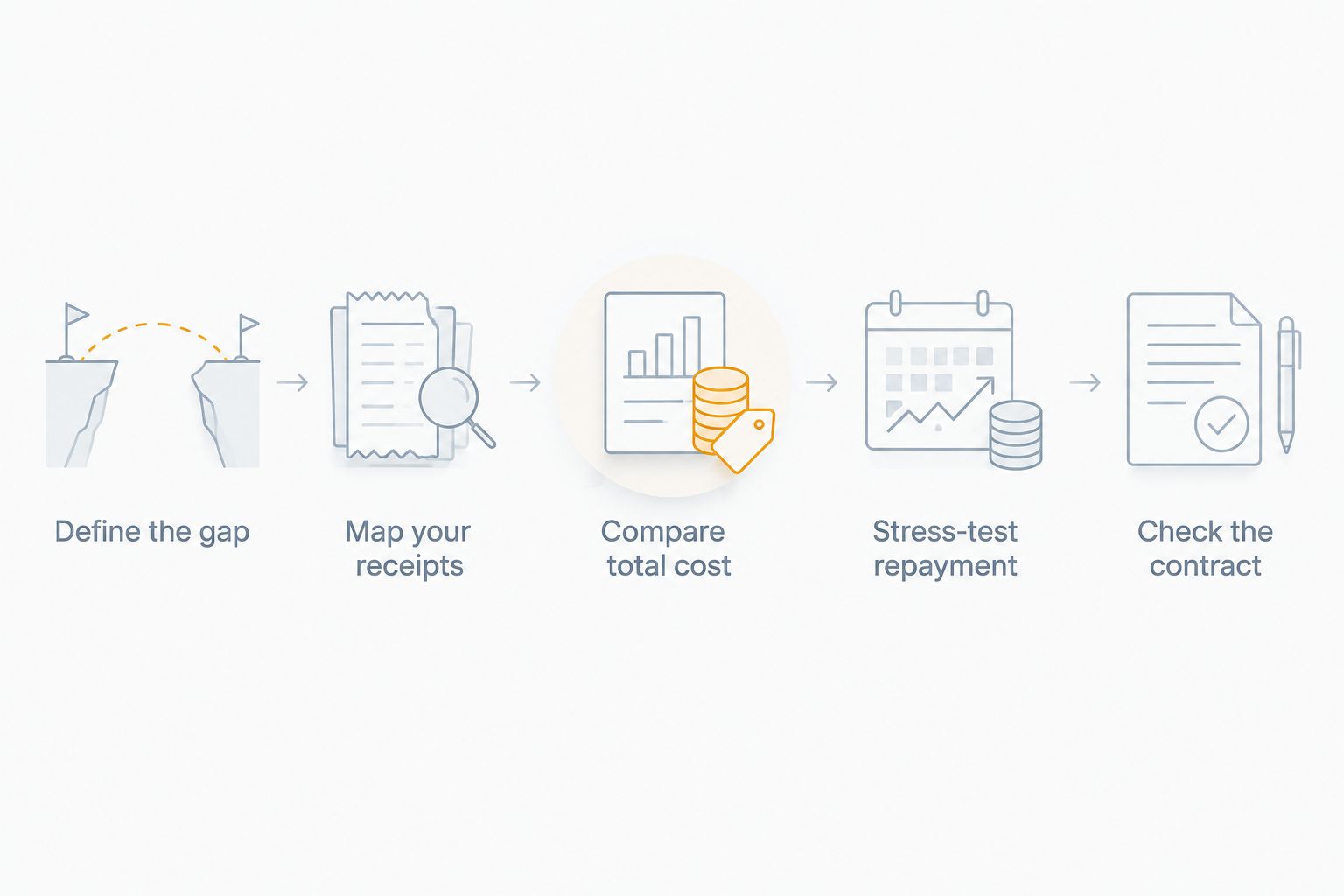
Define the gap
Write down what the funding pays for and when the expense falls due. A recurring payroll mismatch is different from a single equipment purchase: the first calls for a repeatable cash-flow solution, while the second has a specific asset and purchase amount.
Separate the amount required to complete the job from extra cash you would merely like to hold. Borrowing or selling receivables beyond the documented need increases the amount you must repay or remit without fixing the underlying timing problem. Start with records you already have:
- List each expense, its due date and the amount you must cover.
- Record customer invoices or sales expected before and after that date.
- Identify whether the need repeats or ends when one purchase is complete.
- Keep an operating cushion separate from the project budget.
Map your receipts
Look at actual deposits, not just booked revenue. An owner with signed work but delayed collections faces a different repayment problem from an owner whose sales fluctuate with customer traffic. Bank statements and receivables records show when cash reaches the account.
In 2026, match proposed payments against your slower periods as well as your stronger ones. A remittance tied to sales can vary under some structures, while a fixed loan payment follows its contract schedule. Do not assume either structure protects cash flow without reading the terms.
- Mark deposit dates and amounts from recent business bank statements.
- List open invoices and the dates you expect customers to pay.
- Subtract payroll, rent, suppliers and existing financing payments.
- Note weeks when another withdrawal would strain the account.
Compare total cost
Ask every provider for the dollars you receive, all required payments, fees and total dollars paid or remitted. A factor rate is a multiplier used in some receivables-based offers; it is not an annual percentage rate, or APR. The time it takes to complete payments affects the annualized cost.
Illustrative example, not an offer: A business receives $50,000 under a contract with a 1.20 factor rate. The contracted amount is $50,000 × 1.20 = $60,000, a $10,000 difference before any separately stated charges. If the $60,000 is collected over six months, the $10,000 difference is not a 20% APR. Payment timing, fees and the financing structure must be considered before making an APR comparison.
Use the same discipline for a loan or line of credit: identify interest, fees, the period funds remain outstanding and the payment schedule. An advertised rate alone does not tell you the cost of using the money for your particular need. For more on the multiplier, see how to compare factor rates on a merchant cash advance.
- Write down cash received and total contractual repayment or remittance.
- Request an itemized list of fees and required deductions.
- Ask how an early payoff changes the amount owed, if at all.
- Compare payment dates, not just the headline rate or factor.
Stress-test repayment
A funding option fails if its withdrawals interfere with the expense it was meant to cover. Put the proposed schedule beside the receipt calendar you built earlier. Check the lowest-cash period, not only the month with the strongest sales.
For a line of credit, distinguish the approved limit from the amount drawn and find out when payments begin under the actual agreement. For a term loan, review the fixed payment against operating cash flow. For a purchase of future receivables, examine how remittances are calculated and what the agreement says happens when receipts fall.
- Place each proposed payment beside expected customer deposits.
- Include payments on existing loans and funding contracts.
- Check whether withdrawals coincide with payroll or supplier deadlines.
- Ask what the contract requires when sales decline.
Check the contract
Do not treat a term loan and a purchase of future receivables as interchangeable documents. A term loan creates a debt repaid under loan terms. Revenue-based financing may instead be structured as a purchase of future receivables, with the funder buying a specified amount of future business receipts. The agreement controls what the business owes and how collection works.
A merchant cash advance, or MCA, is a term owners often use when searching for receivables-based funding. Names vary; read the agreement rather than relying on its label. Confirm who provides the funds, who collects payments and what obligations remain if sales change or the business wants to exit early.
- Identify the lender or funder named in the agreement.
- Locate the total obligation and every fee or charge.
- Review the remittance method, frequency and reconciliation terms.
- Check personal guarantees, security interests and default provisions.
- Get an explanation of any clause you cannot restate plainly.
Prepare your records
Organized records let you compare offers against the same business facts. They also help you identify a mismatch before signing: a contract may demand payments that your deposit history does not support. Requirements differ by product and third-party underwriting partner, so request the current document list rather than assuming one applies everywhere.
Jon Lynch Financial Group is a broker, not a direct lender. Its role is to help business owners compare potential routes; third-party providers make their own underwriting and product decisions. Credit, revenue, existing obligations and documentation can all matter, depending on the offer.
- Gather business bank statements and current financial records.
- Prepare the specific use of funds and payment deadline.
- List existing financing balances and payment schedules.
- Keep invoices, contracts or equipment details relevant to the request.
Which funding structure fits your need?
The table compares structures, not live offers. No starting cost can be stated without a provider’s written terms. Request figures for your business and compare total dollars, timing, qualifications and repayment side by side.
| Option | Best for | Cost to request in writing | Key limitation |
|---|---|---|---|
| Business line of credit | Recurring cash-flow gaps | Interest and fees on the amount used, plus repayment terms | Approval and usable limit depend on underwriting; payments can still strain cash flow. |
| Term loan | A defined expense with a planned repayment period | Total payments, interest, fees and any early-payoff terms | A fixed schedule may not match irregular receipts. |
| Equipment financing | A specific equipment purchase | Total payments, fees and obligations tied to the equipment | It does not replace general-purpose working capital. |
| Invoice factoring | Cash tied up in eligible unpaid invoices | Advance, fees and the amount ultimately retained | It depends on suitable receivables and affects invoice collection arrangements. |
| SBA loan | An eligible business that can accommodate the application process | Lender-provided total cost and repayment schedule | Eligibility and documentation requirements apply; it is not the route to assume for an immediate gap. |
| Purchase of future receivables | An owner evaluating funding against future business receipts | Cash received, purchased amount, remittances and all charges | Frequent remittances or an unfavorable contract can pressure operating cash. |
Best for a recurring gap: compare a line of credit first. Its advantage is drawing against an available facility when needed; its drawback is that approval, fees and repayment terms require scrutiny. If the need is a single documented purchase, compare a term loan or equipment financing instead.
Best for eligible unpaid invoices: examine factoring. It addresses cash already tied to customer payments, but the invoice terms and collection arrangement matter. If time permits and the business meets the applicable requirements, compare an SBA loan as well rather than paying for speed you do not need.
Best for a business considering receivables-based funding: compare the contract against the cash calendar before accepting it. Speed is not a substitute for an affordable remittance schedule. In 2026, the useful comparison is the written offer, not a general claim that one product is cheaper or easier to obtain.
What mistakes do Kendall business owners make?
- Comparing rates without dollars. A factor rate and an APR describe cost differently. Request the amount received, total contractual amount and payment schedule before judging either.
- Funding a permanent shortfall with temporary capital. If operating expenses consistently exceed receipts, another short repayment obligation does not repair the underlying gap.
- Ignoring existing withdrawals. A new payment must fit alongside current debt, rent, suppliers and payroll, not replace those entries in a forecast.
- Treating a bank decline as a universal decline. A bank’s decision does not describe every product’s criteria. It also does not mean a different provider will approve the business.
- Assuming a broker is the lender. Confirm the funding provider, its terms and its responsibilities in the agreement. Jon Lynch Financial Group brokers business-purpose funding; it does not directly lend.
What should you do before requesting funding?
First, decide whether the need is temporary and whether expected receipts can support a new obligation. Then request written terms for structures that fit the expense. Reject an offer if you cannot identify its total obligation, payment mechanism or effect on the next payroll cycle.
For businesses generating at least $35,000 per month, Compare Business Funding Options and review the resulting terms with your records. For businesses below $35,000 per month, Explore Self-Serve Funding: eligible U.S. entrepreneurs can securely connect bank statements through Plaid from home for an automated decision. A decision may arrive within minutes and approved funds may arrive within an hour, but verification, bank processing and product terms affect timing. Neither route promises approval, an amount, a rate or a funding date.
Compare your business funding options
Review total cost, qualification and repayment against your cash-flow need.
FAQ
What is the best business funding option in Kendall, FL?
The best option matches your expense, cash-flow timing and written repayment terms. Compare a line of credit for recurring gaps, equipment financing for an equipment purchase and other structures only where their obligations fit your receipts.
Is a merchant cash advance a business loan?
A merchant cash advance may be structured as a purchase of future receivables rather than a loan. Read the agreement to identify the actual structure, purchased amount, remittance method and obligations.
How do I compare business funding costs in 2026?
Compare cash received, total dollars paid or remitted, all fees and the payment schedule. A factor rate is not an APR, so do not compare the two as if they measured the same thing.
Can I seek funding after a bank declines my business?
Yes, you can compare other business-purpose funding structures after a bank decline. Each third-party provider applies its own underwriting, and a different application does not guarantee approval.
Does Jon Lynch Financial Group lend directly?
No. Jon Lynch Financial Group is a commercial finance broker, not a direct lender. Funding products and underwriting decisions come from third-party lenders or funders.
What if my business generates less than $35,000 per month?
Explore Self-Serve Funding rather than the primary comparison route. Eligible U.S. entrepreneurs can connect bank statements through Plaid from home, but decisions and funding timing depend on verification and product terms.
What documents should I prepare for business funding?
Prepare business bank statements, current financial records, existing financing details and a clear use of funds. The required documents depend on the product and the third-party provider.
One last thing
A smaller offer with payments timed to incoming cash can serve the business better than a larger offer that drains the account before customers pay. In 2026, put the proposed withdrawal dates beside payroll and supplier dates before you sign. That calendar is the final test of whether the funding solves the original gap.