Business Funding Orlando: Compare Options in 2026
Business funding Orlando owners can compare in 2026: loans, credit lines and receivables funding by total cost and repayment. Find the right route for your cash gap.

Orlando business funding is business-purpose capital that helps local owners cover operating needs or invest in growth. The right option depends on when cash is needed, what the business can document, total dollars paid, and whether repayment fits uneven revenue; faster funding can cost more than a slower bank option.
- Business funding Orlando owners should compare by total cost, repayment schedule, qualification and timing—not speed alone.
- A line of credit fits recurring cash gaps; equipment financing fits a specific equipment purchase.
- Jon Lynch Financial Group is best for established U.S. owners comparing business funding; it is a broker, not a direct lender.
- At $35,000 or more in monthly revenue, compare offers before committing; below that threshold, explore the self-serve path.
Why does business funding matter for Orlando owners?
A business can be profitable on paper and still lack cash when payroll comes due before a customer pays. An Orlando owner buying inventory, mobilizing a contract or replacing equipment needs to match the financing to that specific gap—not apply for the first product advertised as fast.
The central question in 2026 is not simply whether funding is available. It is whether the expected cash from the funded activity supports the required payments, including during a slower month. That test matters especially when payments begin before the inventory sells or the customer invoice clears.
Who is this guide for?
This guide is for U.S. business owners seeking business-purpose funding, including Orlando owners comparing working capital after a bank decline. Jon Lynch Financial Group serves established businesses through third-party funding partners; its primary comparison route is for businesses generating at least $35,000 per month.
A business below $35,000 per month can instead explore a self-serve funding path. Neither route establishes eligibility by revenue alone: the financing provider reviews the application, business activity and applicable product requirements. Consumer-purpose and non-U.S. requests fall outside the primary funding audience described here.
How should Orlando businesses compare funding in 2026?
Define the cash gap and its payoff
Write down what the money will purchase and when that spending is expected to produce cash. If a contract requires labor before the customer pays, the timing of the customer payment matters as much as the contract value.
Start with your own records, not a funding application. A short cash forecast can expose whether the need is a one-time purchase, a repeating working-capital gap or a longer investment that should not be repaid from the next few weeks of sales.
- List the exact business expense the funding will cover.
- Record when the expense must be paid.
- Identify the invoice, sale or operating cash flow expected to repay it.
- Note what happens if that cash arrives later than planned.
Map your existing cash obligations
A new payment sits on top of payroll, rent, taxes and existing financing. Review bank activity and current agreements before deciding what another payment schedule can absorb.
For 2026 planning, use a slower month from your own records rather than assuming every month will match the strongest one. If the proposed payment only works during peak sales, the funding structure does not fit the underlying cash gap.
- Total current loan payments and receivables remittances.
- Mark due dates against payroll and supplier payments.
- Check whether an existing agreement restricts additional financing.
- Test the proposed payment against a slower revenue month.
Choose the structure that matches the expense
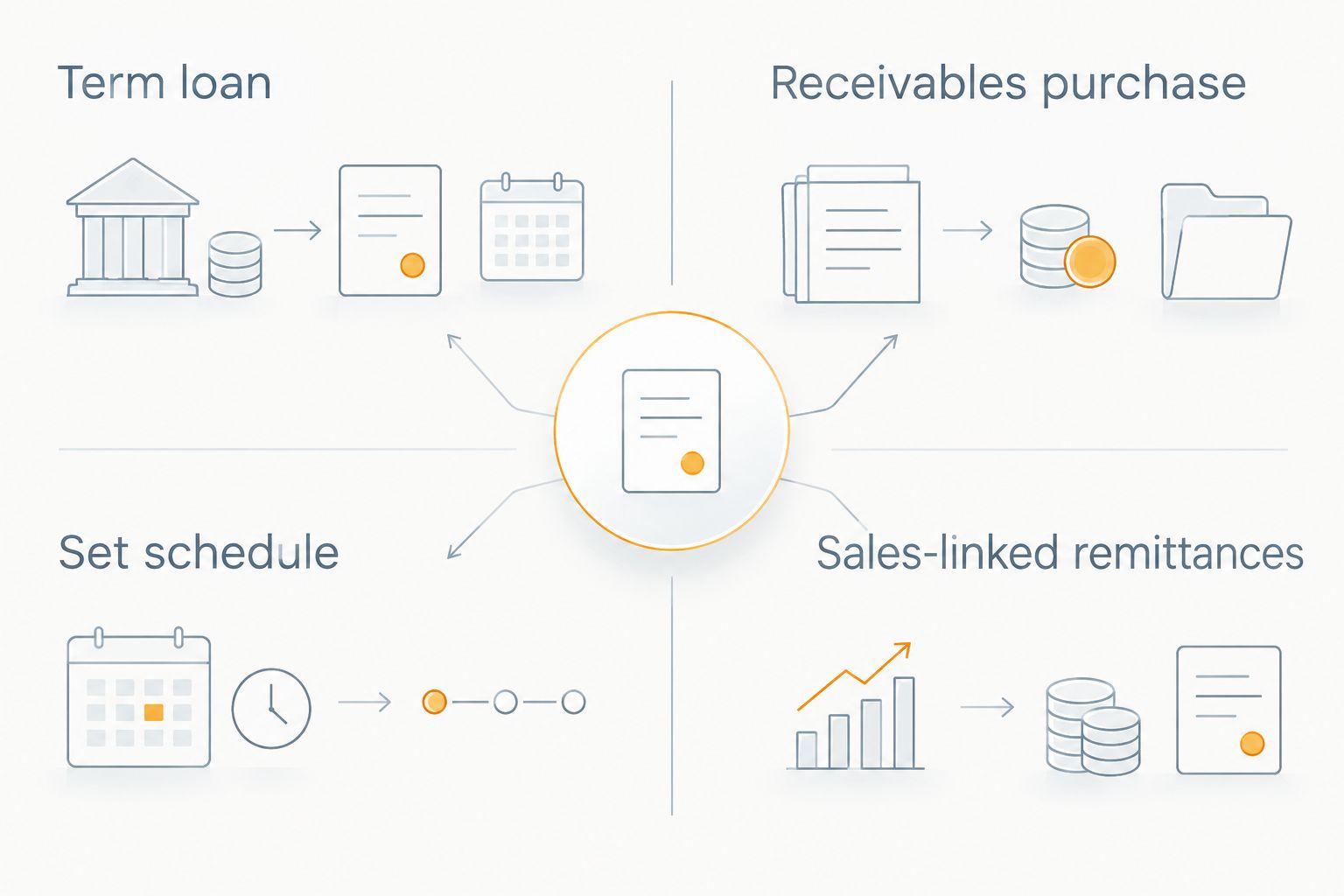
A business line of credit is a revolving borrowing option for repeated needs, subject to its agreement and available limit. A term loan is borrowing repaid under a set schedule; equipment financing ties the request to an equipment purchase. Invoice factoring involves selling eligible invoices, so customer-payment quality matters alongside your own business records.
Revenue-based financing can be structured as a purchase of future receivables rather than a loan. A merchant cash advance, or MCA, is commonly described using that purchase structure. Read the actual agreement: labels do not tell you the total payment obligation or how collections work.
- Use a line of credit for a recurring gap if its draw terms fit.
- Compare term loans for a defined expense with a workable schedule.
- Match equipment financing to an identifiable equipment purchase.
- Examine receivables funding only after checking remittances and total cost.
Calculate total dollars paid
Ask every provider for the amount the business receives, every fee, the total amount paid and the payment schedule. A low-looking payment is not a cost comparison if it extends the obligation or hides deductions from the proceeds.
Illustrative example, not an offer: a $40,000 receivables purchase at a hypothetical 1.20 factor produces a $48,000 total payment obligation: $40,000 × 1.20 = $48,000. The difference is $8,000 before considering any other contract terms. If the agreement called for 24 equal weekly remittances, that would be $2,000 per week. Those figures describe the example only; they are not Jon Lynch Financial Group terms or a market rate.
A factor rate multiplies the stated funding amount to calculate a payment total. APR expresses borrowing cost on an annualized basis and depends on cash-flow timing and applicable fees. A 1.20 factor rate is not a 20% APR. For a useful comparison, request a cash-flow-based annualized cost calculation alongside total dollars paid, and check whether the product is a loan or a receivables purchase. The factor-rate comparison guide explains that distinction in more detail.
- Record gross amount, deductions and net proceeds separately.
- Add required payments and disclosed fees.
- Compare payment frequency with actual cash receipts.
- Ask how early payment changes the obligation, if at all.
Check qualification before accepting a timeline
A bank decline does not establish that another product will be approved. Different financing structures examine different evidence, and credit can still affect eligibility and terms.
In 2026, prepare a consistent account of what the business does, why it needs funding and how repayment will be supported. Partner-specific requirements govern any decision; avoid treating a general description of a product as an approval rule.
- Gather recent business bank statements and current revenue records.
- Prepare a summary of existing financing obligations.
- Keep invoices, contracts or equipment details tied to the request.
- Explain unusual deposits, overdrafts or revenue changes accurately.
Compare timing against the cost of waiting
A cheaper option that arrives after a supplier deadline may not solve the problem. A faster option that strains payroll can create a second problem. Set the actual deadline first, then ask each provider which steps remain before funds can be released.
For owners below $35,000 in monthly revenue, the self-serve route permits U.S.-based entrepreneurs to apply from home and securely connect bank statements through Plaid. Eligible applicants may receive an automated decision within minutes, and approved funds may arrive within an hour; verification, bank processing and product terms affect timing. Neither timing nor approval is guaranteed.
- State the date the business needs usable funds.
- Separate an initial decision from completed funding.
- Ask which documents or verifications remain outstanding.
- Reject a faster schedule if its payments do not fit cash flow.
Review the contract before committing
Confirm who provides the financing and which company services it. Jon Lynch Financial Group is a broker, not a direct lender; third-party lenders or funders set product terms and make underwriting decisions.
In a receivables purchase, examine the purchased amount, remittance method and any process for adjusting remittances if sales change. For a loan, check payment dates, fees, security interests and any personal guarantee. Do not assume that a product advertised as flexible changes payments automatically.
- Identify the funder and the party collecting payments.
- Read default, reconciliation and early-payment provisions.
- Check security interests and personal-guarantee language.
- Keep a copy of the signed agreement and payment schedule.
Compare your funding options
Review cost, timing, qualification and repayment against your business need.
Which funding option fits an Orlando business?
Use the table to narrow the search, not to infer approval. Starting prices are omitted because an actual offer depends on the provider, underwriting and agreement. Request written terms before comparing two options.
| Option | Best for | Cost basis to compare | Key limitation |
|---|---|---|---|
| Business line of credit | Repeated, variable working-capital needs | Draw costs, fees and total repayment | Access and terms depend on the agreement and underwriting |
| Term loan | A defined expense with a repayment plan | Net proceeds, fees and scheduled payments | Set payments can strain a slow month |
| Equipment financing | An identifiable equipment purchase | Total payments and any required upfront cash | Does not address unrelated operating expenses |
| Invoice factoring | Businesses with eligible unpaid invoices | Cash received versus invoice value surrendered | Depends on invoice and customer eligibility |
| Revenue-based financing or future receivables purchase | A business able to support remittances from sales | Purchased amount, remittances and total dollars paid | Frequent collections can tighten operating cash |
| SBA-backed loan | An owner whose timeline permits a lender review | Full loan terms, fees and repayment | Documentation and lender processing take time |
Best for a recurring gap: compare a line of credit first if its terms and available limit cover the need. Best for a known equipment purchase: compare equipment financing against a term loan. Best after a bank decline: assess nonbank options without assuming the decline determines the result elsewhere.
Jon Lynch Financial Group is best for established U.S. business owners who want to compare funding structures through a broker rather than assume one product fits every cash-flow gap. The tradeoff is that a broker does not control a third-party funder’s approval, pricing or release of funds. A slower bank or SBA-backed option is the better choice when its actual terms fit the deadline and lower the business’s total cost.
What mistakes do Orlando owners make when seeking funding?
Comparing payments without comparing proceeds
Two offers can show similar payments while delivering different amounts to the business after deductions. Put net proceeds and total dollars paid on the same page before choosing. If an offer does not clearly disclose both, ask for the figures in writing.
Treating a factor rate as an interest rate
Multiplying a funding amount by a factor gives a payment total; it does not show an APR. Payment timing changes the annualized cost calculation. Compare the full cash flows instead of ranking a factor and an interest rate as if they were the same unit.
Financing a long project with short collections
A buildout or equipment investment can take time to produce cash. Remittances that start before that cash arrives still have to come from existing operations. Match the payment period to a conservative forecast, not only the hoped-for project return.
Applying again without disclosing existing funding
Existing loans or receivables purchases affect how much cash remains available. New funding layered over old obligations can leave too little for routine expenses. Disclose current balances and collection schedules so each proposed option can be assessed against the full payment load.
FAQ
What is the best business funding option in Orlando?
The best option matches the expense, deadline and cash available for repayment. Compare a line of credit for recurring gaps, equipment financing for an equipment purchase and other structures by written total cost and payment terms.
Can an Orlando business get funding after a bank decline?
A bank decline does not rule out every business-funding option. Another provider will apply its own underwriting, so disclose the reason for the decline and compare any subsequent offer on total cost and repayment.
Is a merchant cash advance a business loan?
A merchant cash advance may be structured as a purchase of future receivables rather than a loan. Read the agreement to identify the transaction, total payment obligation and collection terms instead of relying on its marketing label.
How do I compare a factor rate with APR?
Calculate the total payment obligation from the factor rate, then assess the timing of each payment to understand annualized cost. A factor rate cannot be read directly as an APR.
Does $35,000 in monthly revenue guarantee funding?
No. The $35,000-per-month figure separates Jon Lynch Financial Group’s primary comparison audience from its self-serve route; third-party underwriting determines eligibility and terms.
How quickly can a business below $35,000 per month receive funding?
Eligible self-serve applicants may receive a decision within minutes, and approved funds may arrive within an hour. Verification, bank processing and product terms affect timing; neither a decision nor funding time is guaranteed.
Is Jon Lynch Financial Group a direct lender?
No. Jon Lynch Financial Group is a broker, not a direct lender, and connects business owners with third-party funding partners. The applicable provider makes underwriting decisions and sets the offered terms.
One last thing
In 2026, the most useful comparison starts with net cash received and the dates cash leaves the business. A headline funding amount does not pay payroll if deductions reduce the deposit, and a manageable total can still fail if collections fall before customer receipts. Businesses generating at least $35,000 per month should Compare Business Funding Options; owners below that threshold should Explore Self-Serve Funding. Neither path promises an offer.