Business Line of Credit for Car Wash Businesses (2026)
Compare bank vs. nonbank business line of credit options for car wash businesses in 2026: qualification, repayment structure, and which fits seasonal cash gaps.
A business line of credit for car wash businesses gives owners revolving access to cash for equipment breakdowns, payroll during slow weeks and chemical or water bills that spike ahead of a busy season, without forcing a new loan application every time. Car wash revenue swings with weather and season in a way most retail businesses don't, so a revolving facility that you draw and repay as needed fits better than a single lump-sum term loan for most of these cash gaps.
- A business line of credit for car wash businesses works best for repeat equipment repairs and seasonal payroll gaps, not one-time buildouts.
- Bank lines require 2+ years in business and strong personal credit; nonbank revolving lines approve faster off 3-6 months of bank statements.
- Match draw size to your slowest 60-90 day stretch, not your busiest month, or you'll underfund the gap you're solving for.
- Jon Lynch Financial Group compares bank and nonbank line options side by side before you commit to one lender.
Why a business line of credit matters for car wash businesses
Car wash revenue is weather-dependent and seasonal in most U.S. markets, and that swing hits full-service tunnels and self-serve bays differently than it hits a subscription-heavy membership model. A business line of credit covers the gap between when equipment fails and when the next busy week arrives, instead of tying up capital in a fixed monthly payment that doesn't flex with revenue.
Membership and subscription plans smooth some of that swing by locking in recurring revenue, but they don't eliminate it. A conveyor motor failure or a broken vacuum bank still needs cash the same week it happens, and 2026 financing options for this segment split cleanly between slow, cheap bank lines and fast, more expensive nonbank revolving credit.
How to get a business line of credit as a car wash owner
Audit your seasonal cash flow before you apply
Pull 12 months of bank statements and mark your three slowest weeks by revenue, not by calendar season guesswork. Car wash owners who apply during a strong month often get approved for a line sized to that month's revenue, then find it too small when the slow stretch hits.
- List monthly revenue for the trailing 12 months
- Flag weeks tied to weather closures or seasonal dips
- Note recurring fixed costs: chemicals, water, payroll, equipment leases
- Calculate your average 60-90 day low point in dollars
- Compare that number against any existing debt payments already coming out of the account
Gather the documents underwriters ask for
Bank underwriters and nonbank funders both start with the same core documents, even though their review speed differs by weeks. Having these ready before you apply shortens the process regardless of which lender you choose.
- 6-12 months of business bank statements
- Prior year business tax return
- Voided business check or bank letter
- Equipment list with approximate age and condition
- Personal credit authorization for the owner or guarantor
- Entity documents (articles of organization, EIN letter)
Compare bank lines against nonbank revolving credit
Bank lines carry lower rates but ask for two or more years in business, strong personal credit and often a personal guarantee tied to collateral. Nonbank revolving lines underwrite mostly off cash flow and bank statements, which fits a car wash that's profitable but light on the credit history a bank wants to see.
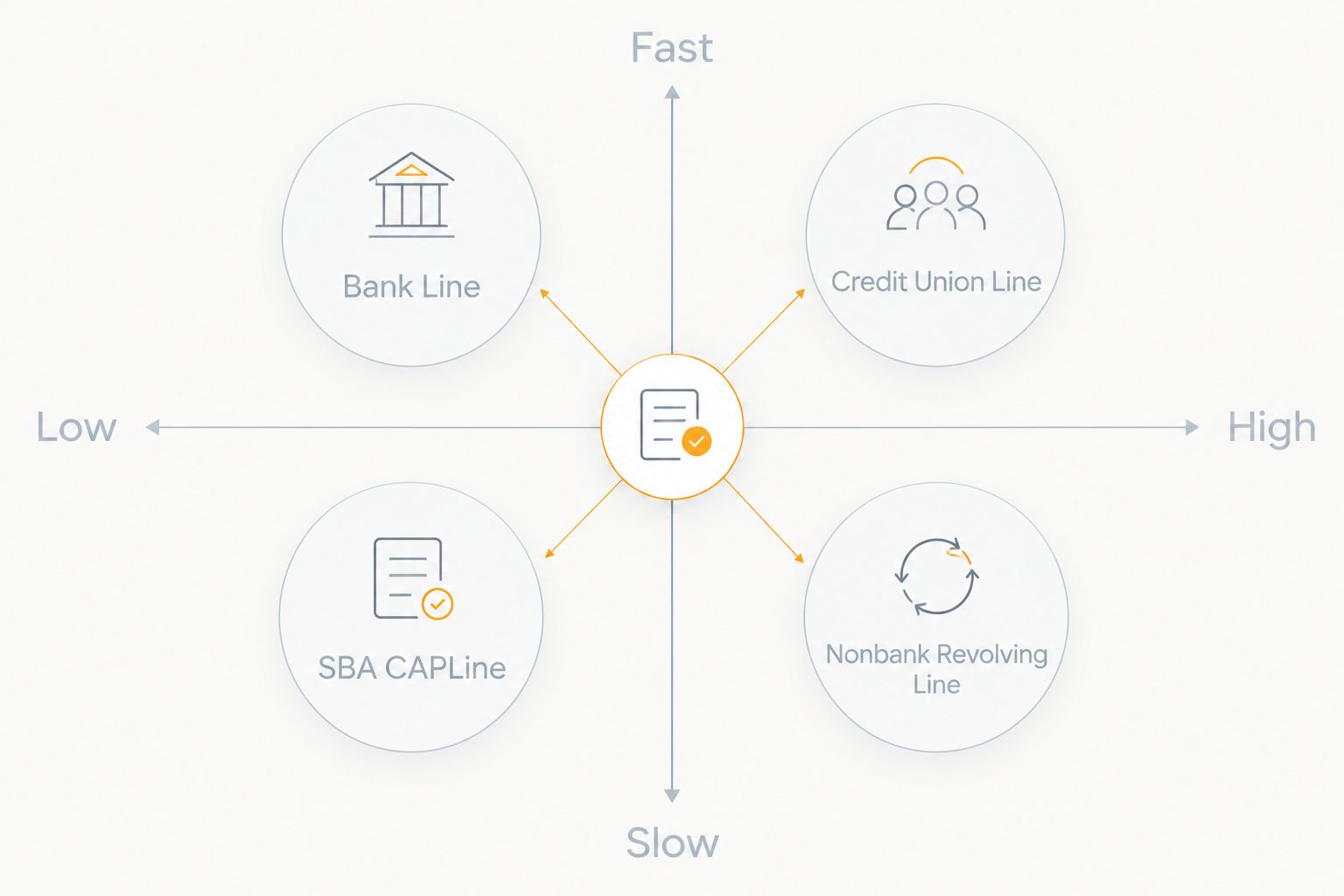
- Traditional bank line: lowest cost, slowest approval, strictest credit requirements
- Credit union line: mid-cost, requires membership and often local relationship history
- Fintech/nonbank revolving line: fastest approval, underwrites primarily off bank deposits
- SBA-backed line (CAPLines): bank pricing with SBA guarantee, still a multi-week process
Decide how much draw capacity you actually need
Sizing the line too small defeats the purpose; sizing it too large invites unused fees on some products. As an illustrative example, a car wash averaging $40,000 in monthly revenue with a $12,000 slow-season dip might size a line at $15,000-$20,000, enough to cover the gap plus one unplanned repair.
- Base the request on your documented low point, not your best month
- Add a buffer for one equipment failure at current repair cost
- Check whether the lender charges a fee on the unused portion
- Confirm the draw period and whether it renews annually
Match repayment structure to wash-bay revenue timing
Car washes collect revenue daily in small amounts, whether from card readers, coin machines or membership billing. A repayment structure that pulls fixed weekly payments regardless of daily revenue can strain a slow week harder than a structure tied to actual cash flow.
- Interest-only draw periods that convert to term repayment
- Weekly repayment fixed regardless of revenue
- Revenue-linked repayment that adjusts to daily deposits
- Renewable annual lines with interest charged only on the drawn balance
Know your faster path if you're outside bank qualification
Car wash businesses under two years old, or owners with personal credit below the 650-680 range most banks want, often don't clear traditional bank underwriting on the first pass. Comparing business funding options side by side, including revenue-based structures and nonbank revolving lines, shows what actually funds versus what only looks cheaper on paper.
Compare Business Funding Options
See bank and nonbank line options side by side before you sign anything.
Comparison table: line of credit options for car wash businesses
| Option | Best For | How It's Repaid | Key Limitation |
|---|---|---|---|
| Traditional bank line | Established washes, 2+ years in business, strong owner credit | Interest on drawn balance, renewable annually | Slow approval, strict credit and collateral requirements |
| Credit union line | Local single-location owners with an existing relationship | Interest on drawn balance | Membership requirement, smaller max line size |
| SBA CAPLine | Seasonal or working-capital gaps at bank-level pricing | Interest on drawn balance, SBA-backed | Paperwork-heavy, multi-week timeline |
| Fintech/nonbank revolving line | Newer washes or owners with thinner credit history | Fixed or revenue-linked draws | Higher cost than bank pricing |
| Equipment-heavy term financing | One-time tunnel or dryer system replacement, not recurring gaps | Fixed term payments | Not revolving; wrong tool for recurring cash swings |
Washes with heavy conveyor, vacuum or dryer equipment often mix a revolving line for cash gaps with dedicated financing for the equipment itself; see how that split works for equipment-heavy businesses.
Common mistakes car wash owners make with a business line of credit
- Sizing the line to the busy season instead of the slow one. A line calculated off peak summer revenue looks generous until the winter or rainy-season dip arrives and the draw capacity isn't enough to cover payroll.
- Treating a revolving line like a term loan. Drawing the full line for a one-time tunnel system purchase and repaying it on a fixed schedule defeats the flexibility a line is built for; a term loan or equipment financing fits that purchase better.
- Applying with personal credit issues undisclosed. Most bank underwriters pull personal credit on the guarantor regardless of business revenue; surprises here stall approvals by weeks.
- Ignoring the unused-balance fee on some bank products. A line you draw on rarely but pay a maintenance fee for every month erodes the cost advantage banks otherwise offer.
- Stacking multiple revolving lines without checking total draw exposure. Two lines from two lenders can look manageable individually but strain daily cash flow together once both are drawn during the same slow stretch.
FAQ
What's the best business line of credit for a car wash business in 2026?
There's no single best option; a bank or SBA CAPLine wins on cost for washes with 2+ years in business and strong owner credit, while a nonbank revolving line wins on speed for newer or thinner-credit owners. Compare both against your actual seasonal cash gap before choosing.
How much revenue does a car wash need to qualify for a business line of credit?
Requirements vary by lender and are not guaranteed by revenue alone; bank lenders generally want established, profitable operating history while nonbank lenders often underwrite primarily off monthly bank deposits. Check current qualification criteria directly with the lender or broker before assuming eligibility.
Is a business line of credit better than a merchant cash advance for a car wash?
A line of credit costs less over time for recurring, smaller cash gaps because you only pay interest on what you draw. A merchant cash advance or revenue-based structure can fund faster with thinner credit history, but total cost runs higher; the right choice depends on timing and qualification, not just price.
Can a new car wash business get a business line of credit?
Newer car washes, generally under two years, often don't clear traditional bank underwriting and instead look at nonbank revolving lines or revenue-based financing that underwrites off bank statements instead of time in business. Approval and terms are never guaranteed and depend on the specific lender's criteria.
How is a business line of credit repaid?
Most lines charge interest only on the amount drawn, not the full approved limit, and the line renews or resets as you repay the balance. Repayment schedules vary by lender from weekly fixed payments to revenue-linked structures tied to daily deposits.
Should a car wash use a line of credit or a term loan for a new tunnel system?
A term loan or dedicated equipment financing fits a one-time tunnel or dryer purchase better because the fixed payment matches a fixed asset cost. A line of credit is built for recurring, unpredictable cash gaps like payroll during a slow month, not a single large purchase.
What documents does a car wash need to apply for a business line of credit?
Most lenders ask for 6-12 months of business bank statements, a prior year tax return, entity documents and personal credit authorization for the owner or guarantor. Nonbank lenders may require less paperwork but still review bank deposit history closely.
Does a business line of credit affect personal credit for a car wash owner?
Most business lines require a personal guarantee, which means the owner's personal credit is reviewed during underwriting and can be affected if the business defaults. Some newer fintech products limit personal guarantee exposure, but terms vary by lender and should be confirmed before signing.
One last thing
The washes that get burned aren't the ones that draw a line of credit, they're the ones that draw it once, for the wrong purpose, and then can't refill it when the actual slow season hits. Keep the line reserved for recurring cash gaps and put one-time equipment purchases on a separate, fixed-payment product; that split alone prevents most of the 2026 car wash financing complaints Jon Lynch Financial Group sees repeat across this segment.
Businesses generating at least $35,000 a month in revenue should compare business funding options directly rather than accepting the first offer a single lender presents. Businesses below that threshold can explore a self-serve funding path built for faster decisions without the full bank underwriting cycle.