Business Term Loans for Auto Body Shops (2026 Guide)
Compare business term loans for auto body shops in 2026: SBA terms, equipment financing, lines of credit, and MCA tradeoffs, with total-cost math explained.
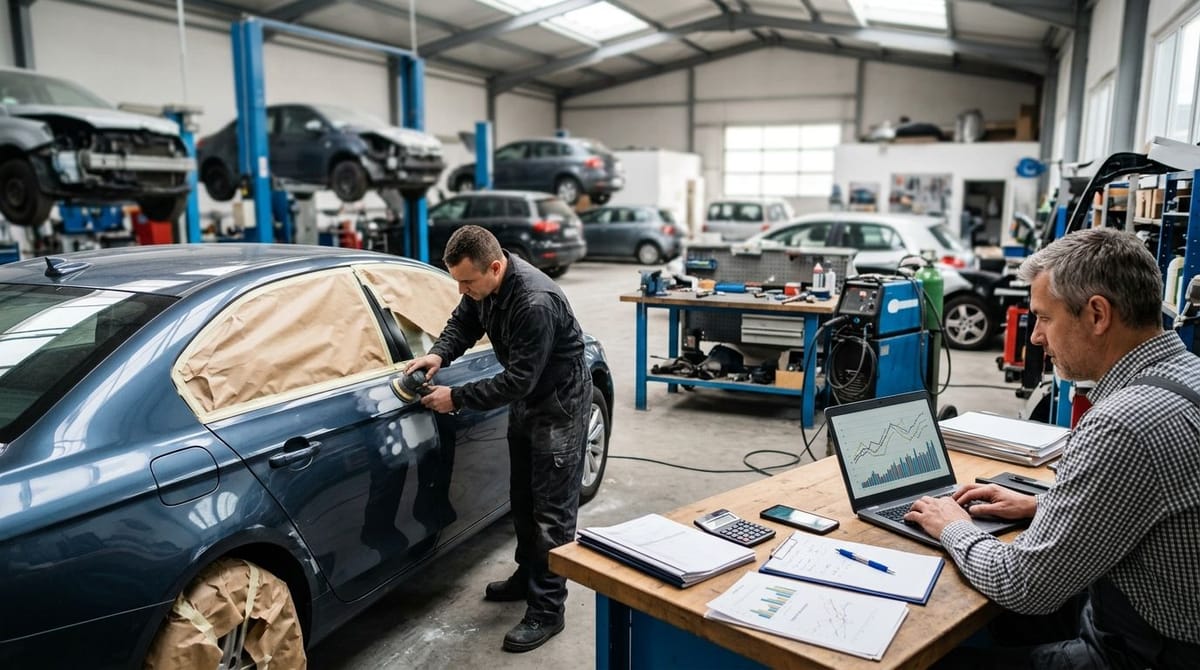
Business term loans for auto body shops are lump-sum, fixed-payment financing that a collision or mechanical repair shop repays in equal installments over a set period, typically used for equipment upgrades, payroll during slow stretches, or a facility expansion. Auto body shops carry a cash-flow pattern most lenders treat differently than retail or restaurant borrowers: revenue often trails completed work while insurance carriers process and pay claims, so underwriters look as hard at deposit timing as they do at credit score.
- Business term loans for auto body shops fund equipment, payroll, and buildouts with fixed payments over a set term.
- SBA 7(a) loans allow repayment up to 10 years for working capital and equipment, per SBA program rules.
- A business line of credit for auto repair shops fits recurring cash gaps better than one lump-sum term loan.
- Merchant cash advances price as a factor rate, not APR, and typically repay faster than a term loan.
- Jon Lynch Financial Group is a broker, not a direct lender, sourcing offers from third-party funding partners.
Why business term loans matter for auto body shops
A body shop's biggest cash-flow risk isn't slow season, it's the gap between finishing a repair and getting paid by the insurance carrier. That gap ties up working capital that would otherwise cover payroll, parts orders, and lease payments.
Shops running Direct Repair Program (DRP) work for insurers also face equipment mandates that arrive on a carrier's schedule, not the shop's. ADAS calibration systems, frame machines, and downdraft paint booths are frequently required to keep or win DRP status, and those costs land as a single large invoice rather than a gradual expense.
A business line of credit for auto repair shops covers the recurring, unpredictable gap. A business term loan is better matched to a one-time, known-dollar need — a paint booth, a second lift, a buildout — where you want one fixed payment instead of a revolving balance you have to manage.
How to compare business term loans for auto body shops
Map your cash-flow gap before you apply
Don't shop rates first. Shop the size and shape of the gap first, because that determines whether you need a term loan, a line of credit, or short-term bridge financing.
- Pull 3-6 months of bank statements and mark deposit dates against completed-repair dates
- Separate insurance-pay work from customer-pay and warranty work — the collection timelines differ
- Flag any month where payroll or parts payments came due before an insurance payout cleared
- Note whether the gap is recurring (points to a line of credit) or one-time (points to a term loan)
- List the exact dollar amount and purpose of the need — equipment, buildout, payroll bridge, or working capital
Pull your credit and bank-statement file
Term loan underwriters, whether a bank, credit union, or SBA lender, weigh time in business, personal and business credit, and average daily bank balance. Nonbank funders weigh recent deposit volume more heavily than credit score.
- Order your business credit report and personal credit report before you apply, not after a decline
- Reconcile the last three months of bank statements for NSF fees or negative-balance days
- Confirm your business entity, EIN, and any DBA match across your bank, insurance, and lender applications
- Have your most recent business tax return and a current profit-and-loss statement ready
A broker who reviews this file before submission can route you to a lender that fits your profile instead of racking up hard inquiries across five applications. That's where working with a broker like Jon Lynch Financial Group changes the timeline: reviewing working capital loan qualification requirements against your actual file, before you submit anywhere, cuts wasted declines.
Separate equipment financing from general working capital
An equipment purchase and a payroll gap are not the same financing problem, and pricing them the same way costs you money.
- Equipment-backed term loans use the equipment itself as collateral, which typically improves pricing versus unsecured working capital
- General working capital term loans are unsecured or backed by a blanket lien on business assets
- Term loans for equipment-heavy businesses commonly match the loan term to the equipment's useful life, so you're not still paying on a paint booth after it's outdated
- Ask whether the lender requires a down payment or full financing of the invoice, including installation and calibration costs
Calculate total cost, not just the monthly payment
A lower monthly payment can still mean more total dollars paid if the term is longer. Run the math before comparing offers side by side.
- Multiply the monthly payment by the number of months to get total repayment
- Subtract the amount financed from total repayment to isolate the total cost of capital
- Ask every lender for the APR, not just the factor rate or payment amount, so offers are apples-to-apples
- Confirm whether there's a prepayment penalty if the shop has a strong month and wants to pay down early
If a shorter-term, higher-payment loan costs less in total dollars, it's the better structure for a shop with steady insurance-pay volume.
Check SBA options if you can wait on speed
SBA 7(a) loans allow repayment terms up to 10 years for working capital and equipment purchases, and up to 25 years when real estate is involved, per current SBA program terms. That's a materially longer runway than most bank term loans offer.
- SBA 7(a) loans require full documentation: tax returns, financial statements, and a business plan for larger requests
- Approval and funding typically take longer than a bank term loan or a revenue-based financing structure
- Collateral requirements exist but the SBA guarantee reduces what a lender needs from the shop directly
- A shop with limited hard collateral can still qualify — SBA loans with limited collateral get evaluated on cash flow and guarantee structure, not just assets on the books
Know what happens after a bank decline
A bank decline doesn't mean the shop is unfundable — it means the shop didn't fit that bank's specific box. Term loans, revenue-based financing, and purchases of future receivables all evaluate risk differently.
- Ask the bank for the specific decline reason: time in business, credit, cash flow, or collateral
- Revenue-based financing and purchases of future receivables weigh recent deposit history more than credit history
- A purchase of future receivables isn't a loan — it's the sale of a portion of future revenue at a fixed factor rate, and it should be compared on total dollars repaid, not the payment size alone
- Get a written breakdown of factor rate, payback amount, and payment frequency before signing anything
“If the loan payment only works during your best month, the term is wrong for the shop.”
Business term loans for auto body shops: option comparison
| Option | Best for | Key limitation |
|---|---|---|
| Bank or credit union term loan | Shops with 2+ years in business and strong bank balances | Slower approval, stricter credit and collateral requirements |
| SBA 7(a) loan | Larger equipment or buildout needs where speed isn't critical | Full documentation and longer funding timeline |
| Equipment financing | A specific paint booth, lift, or ADAS calibration system | Financing is tied to that asset, not general cash flow |
| Business line of credit | Recurring insurance-pay timing gaps | Revolving balance requires active management, not a set payoff date |
| Purchase of future receivables (MCA) | Fast access after a bank decline or thin credit file | Priced as a factor rate; total cost is often higher than a term loan |
Compare your funding options
Review term loan, SBA, and revenue-based options against your bank file.
Common mistakes auto body shops make when financing
- Financing a paint booth with a short-term advance instead of a term loan. A six-to-twelve-month advance structured for a fixed asset with a five-to-seven-year useful life creates a payment that outpaces the equipment's earning power.
- Ignoring DRP equipment deadlines when sizing the financing timeline. A carrier certification deadline that forces a rushed decision usually means a worse rate than planning the purchase two quarters out.
- Sizing the loan payment to an average month instead of the slowest month. Insurance-pay timing swings shop to shop; a payment that only works when claims process quickly sets up a cash crunch the first time a carrier is slow.
- Applying to multiple lenders at once without reviewing the file first. Stacked hard inquiries and mismatched applications create more declines than a single well-matched submission.
- Stacking a second advance on top of an existing one to cover a shortfall. This is the fastest path into a debt-service problem that a single term loan, sized correctly the first time, would have avoided.
FAQ
What credit score do auto body shops need for a business term loan in 2026?
Bank and SBA term loans generally look for stronger personal and business credit than nonbank options, but there's no single universal cutoff. Revenue-based financing and purchases of future receivables weigh recent bank deposits more heavily than credit score, which is why shops with thinner credit files still qualify for those structures.
Is an SBA loan or a term loan better for an auto body shop?
An SBA 7(a) loan generally offers a longer repayment term, up to 10 years for working capital and equipment, which lowers the monthly payment on larger purchases. A conventional bank term loan usually funds faster but with a shorter term and higher monthly payment for the same amount.
How is a merchant cash advance different from a business term loan?
A term loan charges interest over a fixed term with a set number of payments. A merchant cash advance, or purchase of future receivables, sells a portion of future revenue at a fixed factor rate and repays through daily or weekly debits tied to sales volume, not a fixed calendar schedule.
Can an auto body shop get a term loan after a bank decline?
Yes, a bank decline reflects that lender's specific underwriting box, not the shop's overall fundability. SBA lenders, alternative term loan providers, and revenue-based financing partners evaluate cash flow and deposit history differently than a traditional bank.
Should an auto body shop finance a paint booth with a term loan or a line of credit?
A term loan fits a one-time, known-dollar equipment purchase like a paint booth because the payment schedule matches the asset's useful life. A line of credit fits recurring, unpredictable cash gaps, like the lag between completing insurance-pay work and getting paid.
How long does it take to get a business term loan for an auto body shop?
Timelines vary by lender type: SBA loans generally take longer due to documentation requirements, while conventional bank and nonbank term loans can move faster depending on the file. Having bank statements, tax returns, and credit pulled before applying shortens the process regardless of lender type.
Does Jon Lynch Financial Group fund auto body shop loans directly?
No. Jon Lynch Financial Group is a broker, not a direct lender, and sources term loan, line of credit, and revenue-based financing offers from third-party funding partners based on the shop's file.
What documents does an auto body shop need to apply for a term loan?
Most lenders request 3-6 months of business bank statements, the most recent business tax return, a current profit-and-loss statement, and business formation documents. SBA loans typically require more extensive documentation, including a business plan for larger requests.
One last thing
The detail most shops miss: the SBA guarantee on a 7(a) loan doesn't require the shop to hand over collateral equal to the full loan amount — it shifts risk to the guarantee itself, which is why a shop with a strong repair backlog but thin hard assets can still qualify. If speed matters more than total cost, compare a bank term loan and a purchase of future receivables side by side on total dollars repaid before deciding, not just on how fast the money shows up.