Compare MCA Offers for High-Risk Businesses: 2026 Verdict
Compare MCA offers for high-risk businesses by net proceeds, total collections, cash-flow fit and contract risk. See when another funding option makes more sense.

To compare MCA offers for high-risk businesses in 2026, put the cash you will receive, total amount to be collected, collection schedule and contract risks side by side. The lower factor rate is not automatically the better offer: fees, holdbacks and a collection schedule your cash flow cannot support can outweigh the apparent difference.
- To compare MCA offers for high-risk businesses, compare net proceeds, total collections, collection timing and contract terms.
- A factor rate shows a repayment multiple, not an APR or the full cash-flow impact.
- Jon Lynch Financial Group is best for U.S. owners comparing business funding structures; it is a broker, not a direct lender.
- Check whether a line of credit or invoice factoring fits before accepting a future-receivables purchase.
How should high-risk businesses compare MCA offers?
Request each offer in writing and build a comparison from the contract, not the headline factor rate. An MCA, or merchant cash advance, may be structured as a purchase of future receivables rather than a loan. That distinction matters: read how the agreement defines purchased receivables, collections, reconciliation and default.
| Compare this | Ask for | Why it changes your decision |
|---|---|---|
| Cash available | Advance less any fees withheld before disbursement | The stated advance is not necessarily the amount you can spend. |
| Total collections | The full amount the funder expects to collect under the agreement | This shows the dollar obligation before you compare schedules. |
| Collection method | Fixed withdrawals or a share of receipts, plus collection frequency | Identical total collections can put different pressure on payroll and inventory cash. |
| Reconciliation | The written process for adjusting collections when receipts change | A revenue-linked label alone does not establish how payments respond to slower sales. |
| Contract risk | Default events, security interests, guarantees and restrictions on additional financing | A cheaper-looking offer can reduce your options later. |
For a closer look at repayment multiples, see how to compare factor rates on a merchant cash advance. Use the same proposed funding date and the same business cash-flow forecast for every offer you evaluate in 2026.
Why does this comparison matter after a bank decline?
A bank decline answers a question about that bank's underwriting; it does not establish that an MCA is your only funding route. If you need to mobilize a contract, cover payroll or buy inventory, your real question is whether the funding leaves enough cash to complete the work that produces repayment.
Jon Lynch Financial Group is best for U.S. business owners who need to compare third-party funding options by total cost, timing, qualification and repayment. It is a broker, not a direct lender. A broker can help you examine structures, but the applicable funder sets its offer and underwriting terms.
High-risk describes how a particular funder views an application; it is not a single industry category or a universal approval rule. Ask which facts affected each offer, including revenue pattern, existing obligations, credit, time in business and recent bank activity. Credit is not irrelevant simply because a funder reviews sales or bank statements.
Who is an MCA offer a fit for?
An MCA warrants consideration when your business has receivables to support the proposed purchase and you can absorb collections while meeting ordinary operating expenses. Best for: a defined business-purpose cash need when you understand the agreement and a lower-cost or less restrictive option does not fit your timing or qualifications. Main drawback: the collection burden and total cost can be hard to justify against the cash the funding generates.
Start with the use of funds. If you are buying inventory, compare expected collections with the dates you must pay suppliers and staff. If you are mobilizing a contract, check when the customer actually pays; a profitable contract does not solve a cash shortage that arrives before the invoice is collected.
Do not use a high-risk label to skip the alternatives. An established business with repeat customers, unpaid invoices or a recurring borrowing need has different options from one trying to cover an ongoing operating loss. In 2026, make the funding purpose and repayment source explicit before you compare proposals.
How do you calculate what an MCA offer really costs?
Separate gross advance, net proceeds and total collections. The gross advance is the amount stated in the offer; net proceeds are what reaches the business after any deductions; total collections are what the agreement calls for the funder to receive. Ask the funder to identify every deduction and provide a written payment or collection illustration.
A factor rate is a multiplier applied to the stated advance to calculate a specified collection amount. It is not an annual percentage rate (APR). APR expresses a credit cost on an annualized basis; comparing a factor rate with an APR without accounting for fees and the timing of collections is not an apples-to-apples comparison. A future-receivables purchase also should not be described as a loan merely to make that calculation look simple.
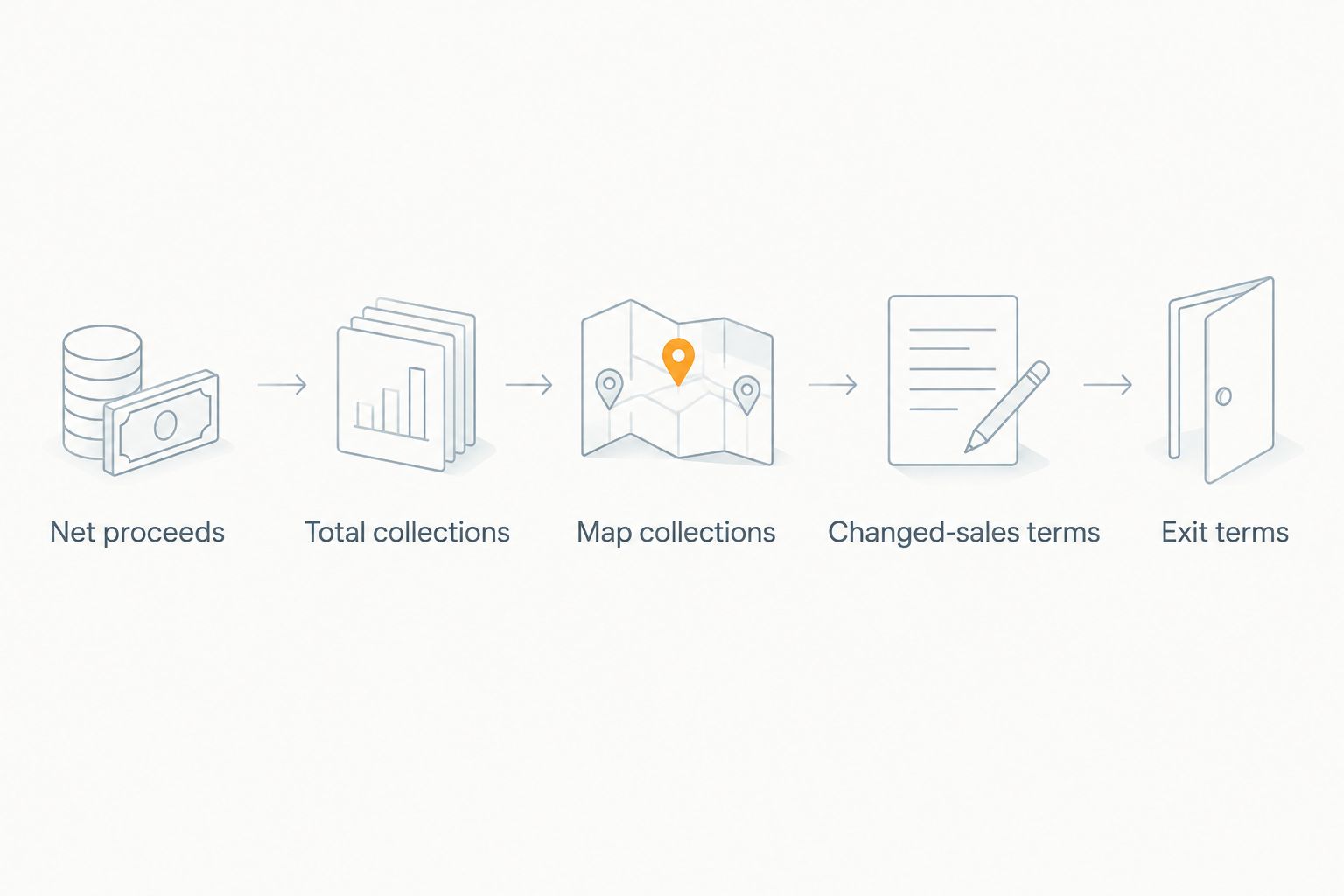
Use this sequence for each written offer:
- Record net proceeds. Confirm what will reach your account and list every withheld charge.
- Record total collections. Include the amount stated in the agreement and identify any other contractual charges that can apply.
- Map collections to receipts. Put the proposed withdrawals against your expected cash-in dates and essential cash-out dates.
- Review changed-sales terms. Find the exact reconciliation procedure, required evidence and treatment of lower receipts.
- Read exit terms. Ask what happens if you settle early, miss a withdrawal or seek additional financing.
Do not treat an early payoff as an automatic discount. Ask for the exact payoff provision in each agreement. If the documents do not answer a question, request a written clarification before signing rather than relying on a sales summary.
Why do high-risk MCA offers vary?
Two offers can differ because the funders are purchasing different receivables, collecting on different terms or assigning different risk to the same business. Compare the underlying terms before ranking the offers:
- Net proceeds: A deduction before disbursement reduces usable cash even when the gross advances match.
- Collection frequency: More frequent withdrawals change how much cash remains between customer payments and operating bills.
- Revenue variability: The contract's reconciliation language determines how a sales decline is handled.
- Existing financing: Current withdrawals and restrictions can affect both available cash and the terms of a new agreement.
- Credit and bank activity: Each funder applies its own underwriting; strong sales do not erase other application risks.
- Default and exit provisions: Remedies and payoff terms can change the consequence of a difficult month.
Ask for the full agreement for every offer you want to compare in 2026. A short offer summary cannot tell you whether its collection terms fit a business with uneven deposits.
Is an MCA better than a line of credit or invoice factoring?
No option wins without a specific cash need and a comparable written offer. A line of credit addresses repeat borrowing differently from a receivables purchase; invoice factoring depends on eligible invoices. Compare the cash you can use, the full cost of each proposal and when money must leave the business.
| Option | Best for | Advantage | Limitation to check |
|---|---|---|---|
| MCA or future-receivables purchase | A defined need supported by future business receipts | Collections can be tied to an agreed receivables structure | Total collections, reconciliation and contract remedies require close review. |
| Business line of credit | Recurring working-capital gaps | You can assess borrowing against a reusable facility | Qualification, borrowing limits and repayment terms vary by lender. |
| Invoice factoring | Cash tied up in eligible customer invoices | Funding is connected to identified receivables | Invoice eligibility, customer-related requirements and total charges matter. |
A term loan can also fit a known expense with a predictable repayment plan. If your use of funds can wait, compare the cost of waiting with the full cost of the faster proposal; speed alone is not a return on investment. Jon Lynch Financial Group can help owners compare business-purpose options, but third-party lenders and funders make their own underwriting decisions.
What contract terms deserve a closer read?
Read the definitions and remedies, not just the signature page. In 2026, ask the person presenting each offer to point to the controlling contract language for every answer below.
- Purchased receivables: What receipts does the agreement cover, and how is the purchased amount described?
- Collection authorization: How are collections taken, and what happens after a failed withdrawal?
- Reconciliation: Can you request an adjustment when receipts fall, what records must you provide and when does an adjustment take effect?
- Default: Which events trigger remedies? Check whether a routine operational change is covered.
- Security and guarantees: Does the agreement require a security interest or a personal guarantee? Do not assume all offers use the same terms.
- Additional funding: Does the contract restrict another advance, loan or change to your bank account?
- Early settlement: Does paying sooner reduce what remains due under this specific agreement?
If a provision is unclear, have a qualified attorney review it before you sign. A comparison spreadsheet cannot repair a contract you have not understood.
What should you prepare before comparing offers?
Bring the same business information to each discussion so differences in proposals reflect the offers, not different versions of your application. Useful records include recent business bank statements, a list of current financing obligations, the planned use of funds and a cash-flow forecast showing customer receipts alongside payroll, rent and supplier payments.
Ask each funder or broker which additional records its program requires. Do not assume a listed document guarantees eligibility or a decision time. If you have an existing MCA, disclose its collections and check your current contract before taking another position. An additional advance can create overlapping withdrawals even when its stated purpose is to solve a short-term gap.
For U.S. businesses generating at least $35,000 per month, Jon Lynch Financial Group's primary funding route is a comparison of business-purpose options through third-party partners. If your business generates less than $35,000 per month, the self-serve path is a separate route: you can securely connect bank statements through Plaid for an automated decision. Eligibility, decisions and funding timing depend on verification, bank processing and product terms; neither route guarantees approval.
FAQ
What's the first step to compare MCA offers for high-risk businesses?
Get written terms showing net proceeds, total collections, collection method and contract remedies. Then compare how each schedule fits your actual business receipts and bills.
Is the lowest MCA factor rate always the cheapest offer?
No. Compare the usable cash you receive against total collections and any applicable charges; a lower factor rate does not settle those differences.
Is a merchant cash advance a business loan?
Not necessarily. An MCA may be structured as a purchase of future receivables, so read the actual agreement rather than assuming loan terms apply.
Can I compare an MCA factor rate directly with a loan APR?
No. A factor rate is a repayment multiplier, while APR annualizes a credit cost; timing and fees matter when evaluating the difference.
What happens to MCA collections when my sales fall?
The answer depends on the agreement's collection and reconciliation provisions. Ask how an adjustment is requested, documented and applied before signing.
Is invoice factoring better than an MCA after a bank decline?
Invoice factoring is a better comparison candidate when cash is tied up in eligible invoices. Compare its invoice requirements and full charges with the MCA's net proceeds and collections.
Does Jon Lynch Financial Group make MCA lending decisions?
No. Jon Lynch Financial Group is a broker, not a direct lender; third-party funding partners assess applications and set their own terms.
What if my business generates under $35,000 per month?
Explore Self-Serve Funding rather than assuming the primary broker comparison route fits. Eligibility and any decision or funding time depend on the applicable product and verification.
One last thing
The offer that delivers more usable cash is not automatically safer. In 2026, check the lowest-revenue period in your forecast against the proposed collection schedule. If ordinary bills and collections cannot coexist in that period, change the funding amount, structure or timing before you sign.
For an established U.S. business generating at least $35,000 per month, the next step is to Compare Business Funding Options with Jon Lynch Financial Group. Bring the written MCA offers and your current obligations so the comparison starts with net proceeds, total collections and cash-flow fit. If revenue is below that threshold, Explore Self-Serve Funding instead; neither path promises an outcome.
Compare your business funding options
Review MCA terms alongside other business-purpose funding structures.