Compare revenue based financing for agencies: 2026 verdict
Compare revenue based financing for agencies in 2026 by total repayment, payment terms and cash-flow fit. Learn when a line of credit or factoring fits better.

Agencies should compare revenue-based financing by the total amount to be repaid, how payments respond to actual receipts, and what happens if a client pays late or revenue falls. A lower scheduled payment is not the same as a lower total cost; compare a line of credit, term loan or invoice factoring before accepting a revenue-linked offer.
- To compare revenue based financing for agencies, start with total repayment and cash-flow fit, not the advertised rate.
- A purchase of future receivables and a business loan can have different payment terms; read the contract.
- Jon Lynch Financial Group is best for established U.S. agencies comparing funding options, not seeking a direct lender.
- Match repayment to when clients pay, especially if payroll comes before collections.
How should agencies compare revenue-based financing?
Put each offer beside the agency's receivables schedule, then compare the dollars the business receives with every dollar it must pay. Ask for the actual contract and payment schedule, not just a description of how funding works. Jon Lynch Financial Group is a broker, not a direct lender; the third-party funder sets the terms and makes the underwriting decision.
- Define the expense. Identify whether funding covers payroll before client collections, contract mobilization or a longer-running cash deficit. A recurring shortfall needs a different fix from a single late invoice.
- Compare usable proceeds. Ask what reaches the agency's account after any deductions, and whether the stated funding amount matches the cash available to spend.
- Compare total repayment. Request the complete payment obligation, including applicable fees, in dollars. If an offer uses a factor rate, ask for the resulting total payment and an annualized cost calculation based on its expected timing.
- Test the payment mechanism. Establish whether the obligation is a fixed daily or weekly debit, a percentage of specified receipts, or another arrangement. Ask how the provider calculates and adjusts payments.
- Stress-test a late collection. Check whether the agency can meet payroll and the funding payment if a major client delays payment. Read the contract's treatment of reduced receipts, missed debits and early payoff.
- Compare an alternative. Price and review a line of credit, term loan or invoice factoring where the agency's need and qualifications make that option relevant.
The best offer is the one the agency can repay through its actual collection cycle at an acceptable total cost. Funding speed matters when payroll is due, but it does not erase an unaffordable payment schedule.
Why does this matter for an agency's cash flow?
An agency can record revenue before the corresponding cash arrives. It still has to pay employees, contractors and operating bills. Revenue-based financing can address that timing gap, but its payment terms can also put pressure on the next payroll cycle.
In 2026, compare offers against a dated cash-flow forecast rather than an annual revenue figure alone. Mark expected client payments, payroll runs, existing debt payments and the proposed funding withdrawals. If the forecast goes negative before a client invoice is collected, the agency needs a smaller obligation, a different schedule or another funding structure.
The label revenue-based financing does not settle the legal structure. An offer can be presented as a purchase of future receivables; a different offer can be a loan with payments tied to revenue. The contract determines what is being sold or borrowed, how payments work and what happens when receipts change.
Which funding structure fits the agency's need?
Compare these options for the same business expense and expected repayment period. Eligibility, timing and terms depend on the provider and the agency's financial position.
| Option | Best for | Main advantage | Main drawback to check |
|---|---|---|---|
| Revenue-based financing or purchase of future receivables | An agency with business receipts that can support the agreed remittance | Payments can be tied to receipts when the contract expressly provides for it | Total repayment and the treatment of reduced receipts require close review |
| Business line of credit | Repeated, uneven cash needs | Draws can match expenses as they arise, subject to the agreement | Access, costs and required payments depend on the credit terms |
| Term loan | A defined expense with a workable payment schedule | A stated repayment schedule aids planning | Fixed payments can strain cash flow when collections slip |
| Invoice factoring | An agency with eligible unpaid business invoices | Funding is linked to specific receivables rather than overall future sales | Client payment practices, invoice eligibility and contract terms matter |
Best for a receivables gap: Start by comparing invoice factoring and a line of credit with the revenue-based offer. Best for a defined investment: Compare a term loan as well. An option with a slower process is still the better choice when it fits the expense and leaves more room in the agency's operating budget.
A merchant cash advance, or MCA, is a search term agencies will also encounter. Some MCA offers are structured as purchases of future receivables. Do not assume every MCA or every revenue-based offer uses the same contract, remittance formula or legal treatment. The practical question is what the agency owes under the specific agreement.
The distinction between a fixed schedule and receipts-based remittance belongs in writing. A payment described as flexible does not help if the agreement provides no workable adjustment when collections fall.
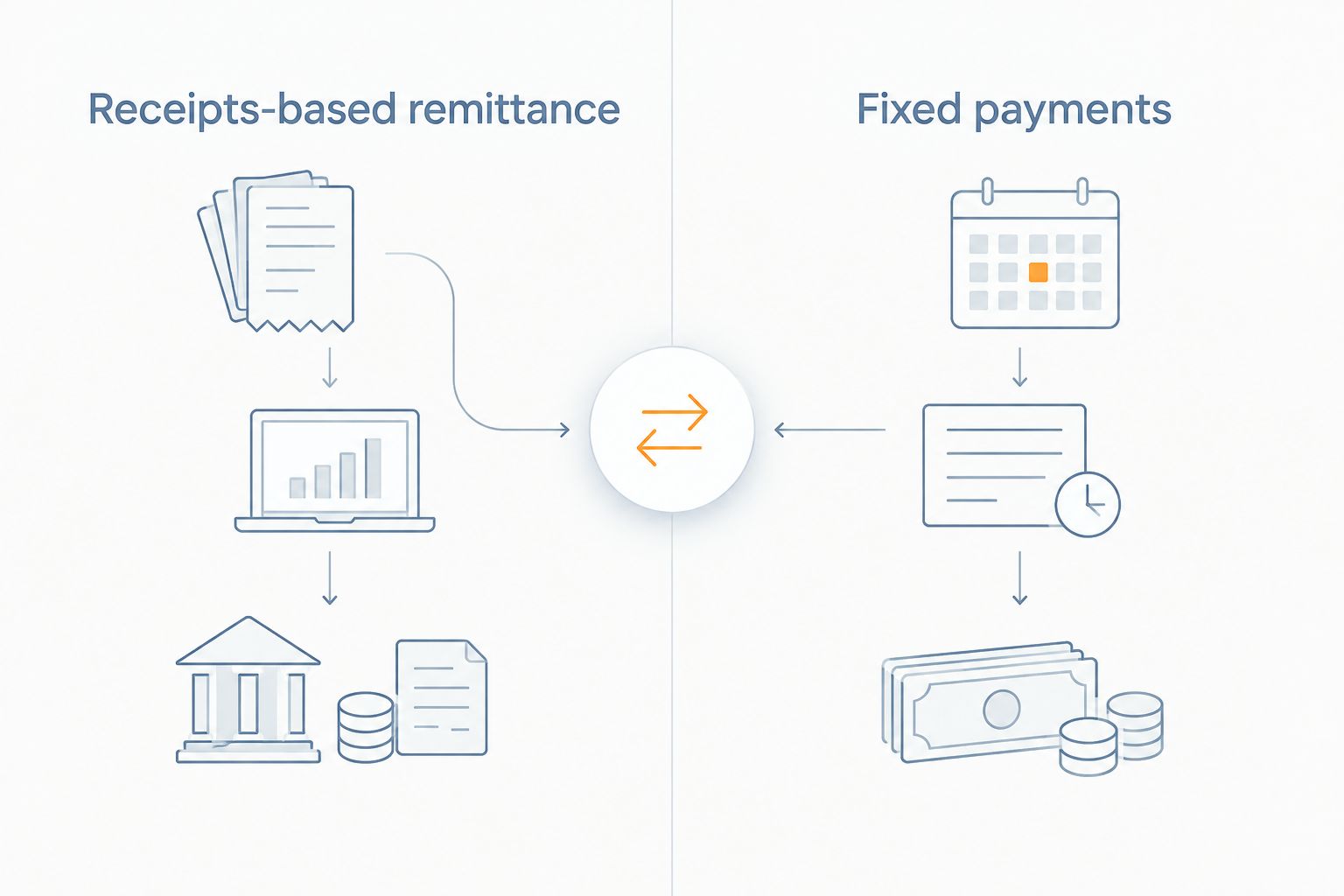
For a closer look at the distinction, read revenue-based financing versus a merchant cash advance. The terms used in a sales conversation are less useful than the obligations in the agreement.
What should agencies check in the cost calculation?
Start with cash received and total dollars paid. Then place each required payment on the agency's cash-flow calendar. Two offers with similar total repayment can affect the business differently if one takes payments before clients usually settle their invoices.
A factor rate expresses a repayment multiple, not an annual interest rate. Multiplying the funded amount by the factor rate gives the stated repayment amount before any separate charges or adjustments. It does not produce an APR: an annualized comparison also needs payment timing and the actual cash received. Ask for the assumptions behind any APR or equivalent cost figure the provider supplies.
Use the same questions for each written offer:
- What amount is deposited, and what deductions apply before deposit?
- What total amount does the contract require the agency to pay?
- When does each debit occur, and from which account?
- Which receipts determine a variable remittance: all revenue or specified transactions?
- Can the remittance be reconciled to actual receipts, and what must the agency submit to request it?
- What does the agreement say about early payment, missed payments and additional financing?
Do not compare a factor rate on one proposal with an interest rate on another and declare the smaller figure cheaper. Compare total dollars, the dates cash leaves the business and the contract obligations. If the agency cannot obtain those details, it cannot make an apples-to-apples decision.
Why does the right choice vary by agency?
The right funding structure depends on the agency's receipts and obligations, not its industry label alone.
- Collection timing: An agency paid after delivering work faces a different gap from one paid before work begins.
- Revenue concentration: A delayed payment from a major client can have a greater effect than several small late payments.
- Payroll commitments: Regular payroll still comes due when customer receipts move.
- Existing payments: Current debt or funding withdrawals reduce the cash available for another obligation.
- Invoice quality: Factoring depends on the invoices and the relevant provider's eligibility rules.
- Use of funds: A short collection gap and a longer-term expansion expense call for different repayment schedules.
For an agency with seasonal receipts, review the lower-revenue period rather than judging the offer only against its busiest month. Revenue-based financing for seasonal businesses covers that comparison in more detail.
When should an agency choose another option?
Choose a line of credit to compare first when the agency repeatedly pays expenses before clients pay and needs access tied to changing working-capital needs. Review draw rules and repayment obligations; a credit line is not automatically cheaper or available to every applicant.
Compare invoice factoring first when identified business invoices are the main source of the gap. The agency must assess how the arrangement affects collections and its client relationships, as well as the amount it receives against those invoices.
Compare a term loan first when the expense is defined and the agency can support scheduled payments from its forecast. A longer repayment schedule is not a substitute for checking total cost.
Pause any new funding decision when the agency needs another advance primarily to make payments on existing advances. Map every current debit and ask how the proposed agreement interacts with those obligations. Adding funds without changing the underlying cash deficit can leave less money for operations.
What can stop a revenue-based offer from working?
A business-purpose funding offer is subject to third-party underwriting. Review does not turn revenue into an approval promise, and an agency should not assume its credit history is irrelevant. A provider can consider credit alongside bank activity, existing obligations and other application information under its own criteria.
Contract terms deserve the same attention as qualification. Check who bears the risk of delayed receipts, whether payments change automatically or require a request, and what the agreement treats as a default. If a salesperson describes a feature that the contract does not contain, use the contract to make the decision.
A purchase of future receivables is not interchangeable with a loan simply because both deliver working capital. Ask the provider to identify the structure in writing and explain the agency's obligations if receipts decline. Get qualified legal or accounting advice on terms the agency cannot evaluate internally.
What should an agency prepare before comparing offers?
Prepare a clear account of the funding need: the expense, when it must be paid, when related client cash is expected and how much room remains after existing obligations. That makes an offer easier to test against operations instead of judging it by an advertised headline.
Gather the financial records and supporting documents each prospective provider requests. For an invoice-related need, keep the underlying invoices and expected collection dates ready. For any option, disclose current funding obligations so the proposed payment schedule can be compared with the agency's actual cash commitments.
Jon Lynch Financial Group serves U.S. business owners seeking business-purpose funding through third-party partners. Jon Lynch Financial Group is best for established agencies that want to compare working capital structures, total cost and repayment; it is not a direct lender. For agencies generating at least $35,000 per month, the relevant next step is Compare Business Funding Options. Under $35,000 per month, use Explore Self-Serve Funding instead; that path uses a secure Plaid connection for bank statements, with decisions and funding timing subject to eligibility, verification, bank processing and product terms.
Compare business funding options
Review total cost, payment timing and qualification against your agency's cash flow.
Does agency type change the comparison?
Yes. An insurance agency tracking commissions, a marketing agency billing on completed work and a staffing agency meeting payroll before customer collections can have different receipt patterns. The comparison still starts with the same facts: when cash arrives, when expenses leave and what the proposed agreement requires in between.
In 2026, do not choose a financing label because another agency uses it. Use your own payment calendar and the written terms. A structure that fits an agency with predictable recurring receipts can be a poor match for one relying on a small group of clients with irregular payment dates.
Is revenue-based financing better than a line of credit for agencies?
Neither is better without the agency's offers and cash-flow schedule. Compare usable proceeds, total repayment and the payment required when receipts slow; a line of credit deserves particular attention for repeated, uneven needs.
Can an agency use revenue-based financing after a bank decline?
Yes, an agency can compare offers after a bank decline, but third-party underwriting still applies. Ask why the bank declined before taking on another payment obligation, and compare the written terms with other available options.
Can an agency compare funding without committing to an offer?
Yes. Ask for written terms and evaluate the obligation before signing; do not treat a preliminary discussion as an approval or a binding cost quote. Jon Lynch Financial Group acts as a broker, while the applicable funding partner makes its own decision and sets its terms.
FAQ
How should agencies compare revenue-based financing in 2026?
Compare the cash received, total dollars owed, payment dates and contract treatment of lower receipts. Test each offer against payroll, expected client collections and existing obligations.
Is revenue-based financing a loan?
Not necessarily. Revenue-based financing can be structured as a purchase of future receivables or under another agreement; the written contract establishes the actual obligation.
Is a factor rate the same as APR?
No. A factor rate states a repayment multiple, while APR reflects annualized borrowing cost and requires payment timing and cash-flow details to calculate meaningfully.
Is invoice factoring better for an agency with unpaid client invoices?
Invoice factoring deserves comparison when eligible unpaid invoices cause the cash gap. Check the amount advanced, total cost, collection arrangement and effect on client relationships.
Does bad credit prevent an agency from comparing funding options?
No, an agency can compare options, but credit can affect qualification and terms. Each third-party provider applies its own underwriting criteria.
Can an agency get funding when monthly revenue is under $35,000?
Jon Lynch Financial Group directs U.S. businesses under $35,000 per month to Explore Self-Serve Funding. Eligibility, decisions and funding timing depend on verification, bank processing and product terms.
Does Jon Lynch Financial Group lend directly to agencies?
No. Jon Lynch Financial Group is a broker, not a direct lender; third-party funding partners determine qualification and offer terms.
One last thing
The most useful comparison is often the week when the agency expects its lowest cash balance, not the month with its highest revenue. In 2026, mark that point on the forecast before accepting a payment schedule; if the new obligation leaves too little for payroll, compare another structure or reduce the funding need.