Compare SBA Lenders for Veteran-Owned Trucking (2026)
How veteran-owned trucking companies should compare SBA lenders in 2026: collateral, speed, veteran fee reductions, and when to use a bridge option instead.

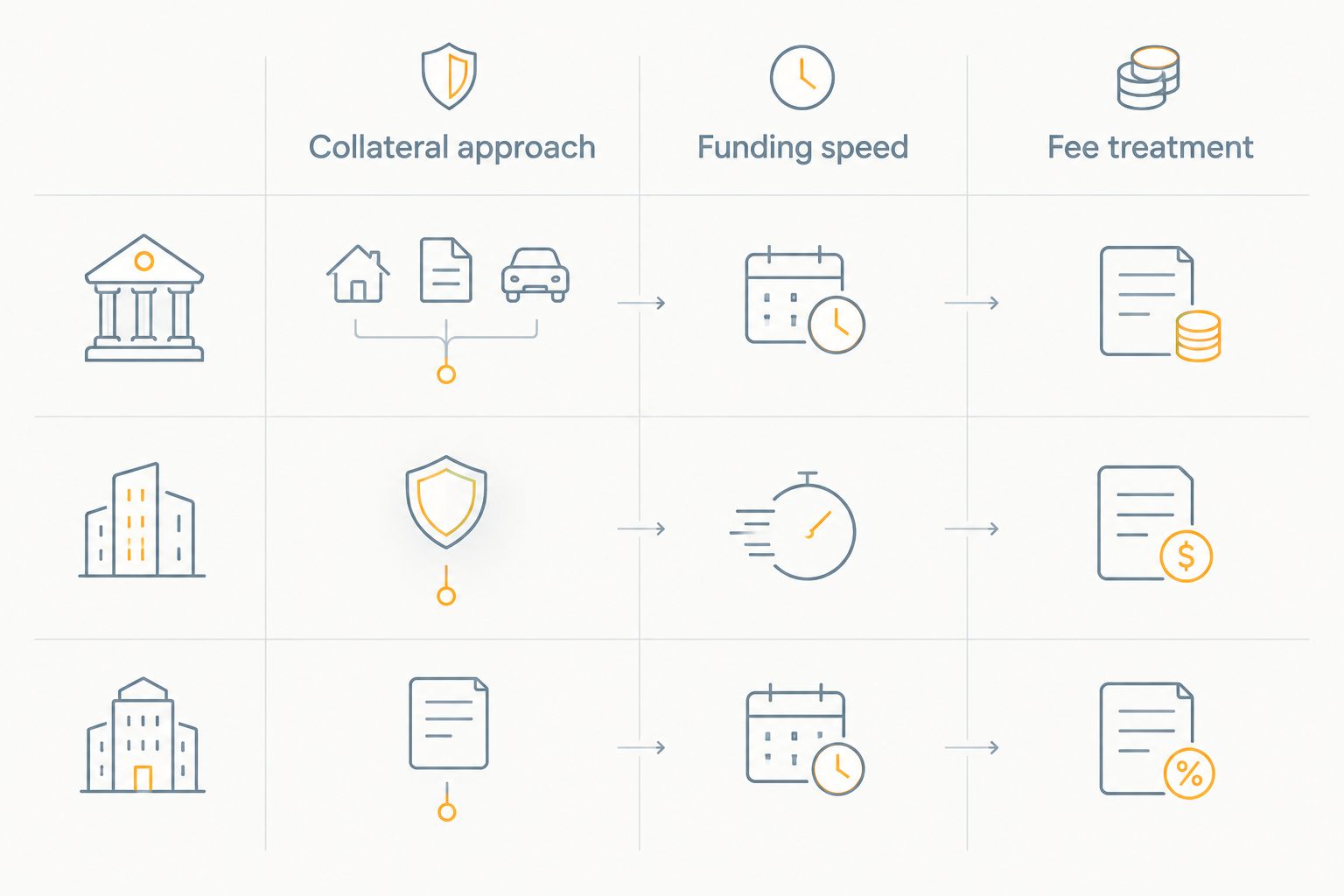
Veteran-owned trucking companies should compare SBA lenders on four factors: how each lender treats trucks and trailers as collateral, how fast the loan closes against load and mobilization deadlines, whether owner-operator contracts count as qualifying revenue, and whether the lender applies the SBA's fee reduction for veteran-owned small businesses. The lender with the lowest advertised rate isn't the best fit if it demands a blanket lien on every unit in the fleet or takes 90 days to close while a contract start date is 30 days out.
- Compare SBA lenders for veteran-owned trucking companies on collateral terms, funding speed, and fee treatment, not the headline rate alone.
- SBA 7(a) loans fit equipment purchases and terminal expansion; SBA Express fits smaller working capital needs on a faster clock.
- Veteran-owned small businesses may qualify for a reduced or waived guaranty fee on SBA 7(a) loans under the Veterans Advantage program.
- A 30-to-90-day SBA close doesn't rule out funding: bridge options can cover payroll and fuel while underwriting runs.
- Jon Lynch Financial Group compares SBA and alternative funding side by side for veteran-owned trucking companies before you sign with one lender.
Why this matters
Trucking runs on equipment that depreciates fast and freight that pays slow. An SBA loan is usually the cheapest capital a trucking company can get in 2026, but the underwriting differs sharply between lenders: some price risk off the truck's age and mileage, some price it off the personal credit of the guarantor, and some won't touch a fleet carrying an open merchant cash advance position.
A veteran-owned trucking company has one more variable in the mix: the SBA's fee treatment for veteran-owned small businesses. That single line item changes the total cost of the loan before a single payment is made, and most owners never ask about it during the lender conversation.
How should veteran-owned trucking companies compare SBA lenders?
Start with the loan type, then the lender category. SBA loans for veteran-owned businesses fall into three practical buckets for a trucking operation, and each one treats collateral and speed differently.
| Lender type | Best for | Collateral approach | Typical speed |
|---|---|---|---|
| SBA Preferred Lender (bank) | Equipment purchase, terminal real estate | Blanket lien plus truck titles | Slower — often 60 to 90 days |
| Nonbank SBA-focused lender | Smaller fleets, thinner credit files | Truck titles as primary collateral | Faster than most banks, still SBA-paced |
| Credit union SBA program | Member-based trucking cooperatives | Lower minimums, still asset-based | Moderate, varies by branch |
SBA loans as a category typically take 30 to 90 days to fund from application to disbursement, compared with same-day to 72-hour turnaround on nonbank working capital products. That gap is the single biggest reason a trucking company with a live contract mobilization deadline needs a second option lined up before applying, not after a denial.
SBA 7(a) Loans: Equipment and Expansion Capital
The SBA 7(a) program caps at $5 million and is the loan most trucking companies mean when they say "SBA loan." It works for buying tractors and trailers, financing a terminal or yard, or refinancing higher-cost debt into one payment.
Best for: Fleets adding units or consolidating debt with strong documentation. Verdict: Compare — 7(a) terms vary enough between lenders that shopping two or three quotes is worth the time before signing.
SBA Express Loans: Faster Working Capital
SBA Express caps at $500,000 and carries an accelerated review the SBA advertises as a response within 36 hours of a complete application, though full funding still takes longer than that response window. This is the SBA product to compare when the need is payroll, fuel, or a parts bill, not a truck purchase.
Best for: Established fleets needing working capital faster than standard 7(a) timelines. Verdict: Compare — the 36-hour response is a decision, not funds in the account; confirm the actual disbursement timeline with each lender.
SBA 504 Loans: Terminal and Yard Real Estate
SBA 504 loans finance fixed assets — a terminal, a maintenance yard, real estate a trucking company owns rather than leases. The structure typically splits the deal three ways: a bank covers roughly half, a Certified Development Company covers a large share of the rest, and the borrower puts in a smaller down payment than a conventional commercial mortgage would require.
Best for: Trucking companies buying or building a permanent facility rather than financing rolling stock. Verdict: Compare — 504 isn't the right tool for equipment or working capital, so don't let a lender push it as a catch-all.
Why SBA lender terms vary for trucking companies
SBA guidelines set the ceiling; individual lenders set the actual terms inside that ceiling. These factors move the quote you get from one lender to the next:
- Fleet age and equipment collateral value — older trucks get discounted harder by conservative lenders
- Owner-operator vs. W-2 driver structure — how the lender counts contracted drivers as revenue varies
- Existing debt stack — an open merchant cash advance position on the balance sheet can slow or block SBA approval
- Seasonal freight volume and DOT compliance history — inconsistent revenue months get more scrutiny
- Veteran-owned certification status — affects eligibility for SBA fee reductions
- Personal credit score of the guarantor — SBA loans still require a personal guaranty from the majority owner
If collateral is thin or a previous MCA position is still on the books, how to qualify for an SBA loan with limited collateral covers what lenders actually accept as a substitute for hard assets.
Jon Lynch Financial Group is a veteran-owned commercial finance brokerage, not a direct lender, and compares SBA options against nonbank working capital and revenue-based financing so a trucking company isn't locked into one lender's underwriting box. When an SBA timeline doesn't match a mobilization date, a merchant cash advance for trucking companies structured as a purchase of future receivables can bridge the gap — it costs more than SBA paper, and it should be treated as a short-term bridge, not a replacement for it.
Compare Business Funding Options
See SBA and alternative financing side by side before you commit to one lender.
Do veteran-owned trucking companies get better SBA loan terms?
Veteran-owned trucking companies don't automatically get a lower interest rate, but the SBA's Veterans Advantage program can reduce or waive the upfront guaranty fee on 7(a) loans for eligible veteran-owned small businesses. That fee reduction lowers total closing cost, not the rate itself, so confirm each lender is actually applying it rather than assuming it's baked in.
Can a trucking company with existing MCA debt still qualify for an SBA loan?
A trucking company with an open merchant cash advance position can still qualify for an SBA loan, but most SBA lenders want that position resolved or disclosed clearly before underwriting. Stacked advances signal cash-flow strain to an SBA underwriter, and clearing or consolidating that debt first usually improves the terms offered.
How long does SBA loan approval take for a trucking company?
SBA loan approval for a trucking company typically takes 30 to 90 days from a complete application to funded dollars, longer than nonbank working capital products that can fund in days. Build that timeline into any equipment purchase or contract mobilization plan before counting on SBA money to hit a specific date.
FAQ
How should veteran-owned trucking companies compare SBA lenders?
Compare SBA lenders for veteran-owned trucking companies on collateral requirements against the fleet, funding speed against your mobilization dates, and whether the lender applies the SBA's veteran fee reduction. The lowest advertised rate isn't the best deal if it comes with a blanket lien or a 90-day close.
What's the maximum SBA 7(a) loan for a trucking company?
The SBA 7(a) program caps at $5 million in 2026, and most trucking companies use it for equipment purchases, terminal financing, or debt consolidation. Individual lenders may set lower internal maximums based on the deal's collateral and revenue.
Is SBA Express faster than a standard SBA 7(a) loan?
SBA Express caps at $500,000 and advertises a response within 36 hours of a complete application, faster than standard 7(a) review. Full disbursement still takes longer than the initial response, so confirm actual funding timelines with the lender.
Do trucking companies need collateral for an SBA loan?
Most SBA lenders require collateral when it's available, and for a trucking company that usually means truck and trailer titles or real estate. Limited collateral doesn't automatically disqualify a borrower, but it narrows which lenders will approve the deal.
Can a trucking company get an SBA loan after a bank decline?
A bank decline on a conventional loan doesn't rule out SBA financing, since SBA guidelines and individual lender risk appetite differ from standard commercial underwriting. A prior decline is worth disclosing upfront so the SBA lender can address the reason directly.
What credit score does a trucking company need for an SBA loan?
SBA loans require a personal guaranty from the majority owner, and lenders weigh that personal credit score alongside the business's cash flow and collateral. Credit matters, but it's one factor among several, not a single pass-fail line.
Are SBA 504 loans good for buying a trucking terminal?
SBA 504 loans are built for fixed real estate like a terminal or maintenance yard, typically requiring a smaller down payment than a conventional commercial mortgage. They're not suited for financing trucks or working capital, so pair 504 with a separate product for equipment needs.
What's the fastest way to fund a trucking company if SBA takes too long?
Nonbank working capital and revenue-based financing options can fund in days rather than the 30 to 90 days a typical SBA loan takes. These cost more than SBA paper and work best as a short-term bridge while SBA underwriting runs in parallel.
One last thing
The SBA Express 36-hour response window gets marketed as "fast SBA funding," but it's a credit decision, not money in the bank — full disbursement on any SBA product in 2026 still runs weeks, not days. If a mobilization deadline or a new contract start date is inside 30 days, line up a bridge option before you submit the SBA application, not after the first delay shows up.