Insurance Costs & Funding for Vending/ATM Routes (2026)
See how insurance costs change funding for vending and ATM route businesses in 2026, including factor rates, approved amounts, and coverage that moves the offer.

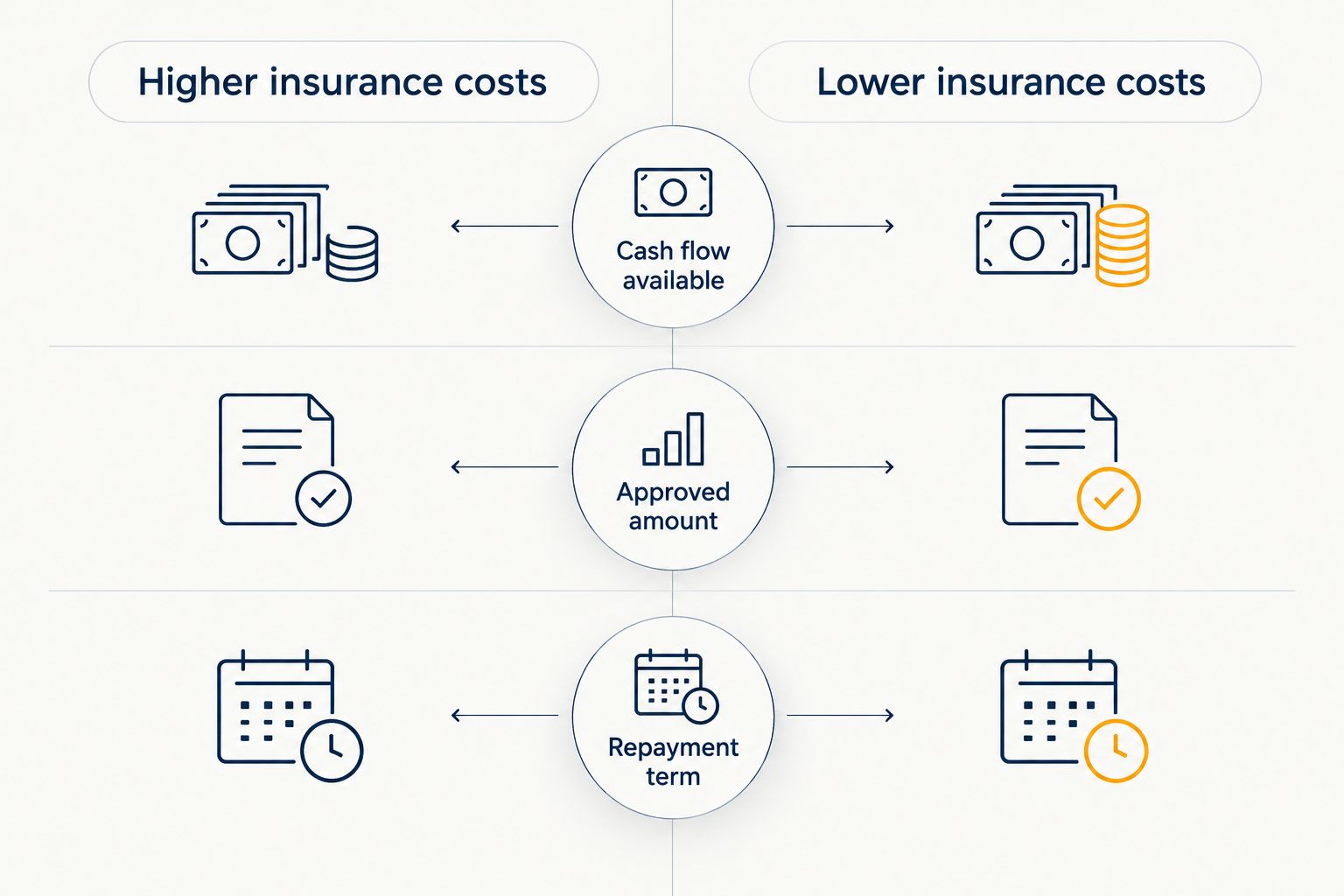
Insurance costs change funding for vending and ATM route businesses by cutting into the monthly cash flow underwriters use to size an approval — the same revenue, taxed by a bigger insurance line, produces a smaller usable-cash number on a bank statement review. A route operator paying more for machine, cash-in-transit and commercial auto coverage can qualify for a lower advance amount or a higher factor rate than a competitor with identical gross sales but a leaner insurance bill. The swing is biggest on ATM routes, because crime and cash-in-transit coverage gets weighted differently than product inventory coverage on a vending line. Underwriters reviewing hard-to-place insurance costs treat route businesses with heavier cash exposure as a distinct risk category, not a variation on standard retail.
- Insurance costs change funding for vending and ATM route businesses by lowering usable cash flow on a bank statement review.
- Crime and cash-in-transit coverage on ATM machines carries more underwriting weight than general liability alone.
- Higher insurance costs can shrink the approved amount or raise the factor rate on a merchant cash advance in 2026.
- Route operators already carrying MCA debt should confirm current insurance costs before stacking a second advance.
Why this matters
Vending and ATM route businesses run on thin per-machine margins and constant cash movement, so a jump in premium costs shows up fast in the numbers a funder pulls. A route operator who renews a policy at a higher rate mid-year, or adds crime coverage after a break-in, changes the deal math on the next funding application without changing a single sale. That's the part most route owners miss going into 2026: insurance isn't a side expense on the funding application, it's a line item that moves the approval.
How insurance costs change funding for vending and ATM route businesses
A funder or lender pulls three to six months of bank statements and backs out fixed and variable costs, including insurance premiums, to estimate what a route business can actually afford to repay. The heavier the insurance line, the lower that affordability number lands, even before credit or time-in-business gets factored in.
| Insurance type | What it covers on a route | Typical funding impact |
|---|---|---|
| General liability | Injury or property damage at a machine location | Smallest impact, usually a minor line item |
| Inland marine / equipment coverage | Vending and ATM machines themselves | Moderate impact, scales with fleet size |
| Crime & cash-in-transit | Theft of cash from machines or during pickup | Largest impact, especially on ATM-heavy routes |
| Commercial auto | Route vehicles used for servicing and cash pickup | Moderate impact, scales with fleet age and driver count |
| Umbrella / excess liability | Coverage above underlying policy limits | Small to moderate, depends on total coverage stacked |
A route business heavy on ATM cash exposure will almost always carry a bigger crime and cash-in-transit line than a snack-and-drink vending route, and that difference is exactly why two operators with the same monthly revenue can land two different funding offers in 2026. Businesses already carrying advances should also review how insurance affects a business carrying MCA debt before adding a second position on top of an existing one.
“If the insurance line eats more of the monthly cash flow than the loss rate justifies, the funder rebuilds the whole approval around it.”
Why insurance costs vary for vending and ATM route operators
Insurance pricing on a route business isn't flat, and the drivers behind it are the same factors a funder will ask about anyway:
- Number of active machines and stops — more units and more locations mean more exposure to cover.
- Cash load per ATM before scheduled pickup — higher standing cash balances push crime coverage costs up.
- Claims history — a prior theft, vandalism, or cash-shortage claim raises renewal premiums.
- Location risk mix — unattended sites, high-crime areas, and 24-hour locations cost more to insure than office lobbies or gyms.
- Route vehicle fleet — the age, count, and driver records on service vehicles set the commercial auto rate.
- State bonding or licensing requirements — some states require additional bonding for cash-handling operations, which adds to the total insurance line.
Does a merchant cash advance lender require proof of insurance for a vending or ATM route?
Most funders reviewing a vending or ATM route request bank statements and basic business documents, and many will ask for proof of coverage on machines and cash-in-transit exposure before final approval. The exact documentation list varies by funding partner, since Jon Lynch Financial Group works as a broker across multiple third-party lenders and funders rather than underwriting any deal directly.
Can insurance costs disqualify a vending or ATM route business from funding?
Insurance costs rarely disqualify a route business outright, but they can shrink the offer down to a smaller amount, a shorter term, or a higher factor rate once the funder backs the premium out of monthly cash flow. Operators who review their merchant cash advance costs and requirements before applying tend to get a more accurate picture of what a route business can actually clear.
Should a route operator bundle insurance and funding applications together?
Bundling keeps the cash flow numbers consistent across both applications, since a funder and an insurance underwriter are often looking at the same bank statements and revenue figures from different angles. Route operators considering this route should confirm current coverage costs first, since a stale insurance quote can produce a funding offer that doesn't match what the business actually pays once the new policy renews.
FAQ
What is the best way to fund a vending or ATM route business in 2026?
The best fit depends on how the route business needs the cash: a working capital advance or purchase of future receivables suits fast, short-term needs, while a term loan or line of credit fits planned equipment or route expansion. Comparing total cost, timing, and repayment structure side by side is the fastest way to see which structure matches the actual cash-flow gap.
Is a merchant cash advance a loan for a vending route?
A merchant cash advance is not a traditional loan; it is typically structured as a purchase of future receivables in exchange for a fixed repayment amount. Jon Lynch Financial Group operates as a broker connecting route businesses to third-party funders, not as a direct lender.
How does insurance affect a business's approved funding amount?
Insurance premiums reduce the monthly cash flow a funder counts as usable when sizing an approval, so a higher insurance line can lower the amount offered even when gross revenue stays the same. This effect is strongest on cash-handling businesses like ATM routes, where crime and cash-in-transit coverage carries more weight.
Do ATM route operators need cash-in-transit insurance?
Cash-in-transit coverage protects the cash moving between machines and deposit points, and most funders reviewing an ATM route business expect to see it as part of the coverage stack. Without it, a route business carries uninsured exposure that a funder will factor into the risk assessment.
Can high insurance costs push a business into a smaller line of credit?
Yes, a heavier insurance bill lowers the cash flow available for debt service, which can shift a route business from a larger requested amount into a smaller line of credit or shorter-term advance. Reviewing current insurance costs before applying gives a more realistic sense of what size offer to expect.
What documents does a vending or ATM route operator need for funding?
Most funding requests start with three to six months of business bank statements, basic entity documents, and proof of insurance on machines and cash handling. Additional documents vary by funding partner and deal size.
Is Jon Lynch Financial Group a direct lender for vending route financing?
No, Jon Lynch Financial Group is a commercial finance brokerage, not a direct lender, and connects U.S. business owners to third-party lenders and funders for working capital, term loans, and purchases of future receivables.
How does revenue-based financing work for a route business with seasonal cash flow?
Revenue-based financing ties repayment to a percentage of incoming revenue rather than a fixed schedule, which can flex with a route business's slower and busier months. It is structured as a purchase of future receivables rather than a conventional loan, and terms vary by funding partner.
One last thing
The insurance line most route owners underestimate isn't the machine coverage — it's cash-in-transit, because it's priced on cash exposure per stop, not on the machine's value. A route business that consolidates ATM pickups into fewer, larger collections instead of frequent small ones often sees this premium line move more than any other cost on the policy, and that shift shows up directly in the next funding conversation.
Compare business funding options
See working capital, term loan, and revenue-based options for your route business side by side.