Harbor Compliance alternatives in 2026
Compare Harbor Compliance alternatives in 2026 by service fit. Separate registered-agent support from business funding, and review scope, obligations and risk.

Harbor Compliance provides registered-agent and business compliance services; those services do not replace working capital when expansion strains cash flow. If your U.S. business generates at least $35,000 per month, Jon Lynch Financial Group offers a business-funding comparison route, not a substitute for compliance administration. The right Harbor Compliance alternatives in 2026 depend on the problem: Northwest Registered Agent for registered-agent services, CSC for corporate compliance services, or a funding broker when the missing piece is capital.
- Harbor Compliance alternatives address compliance administration; business funding requires a separate comparison.
- Northwest Registered Agent is an option for registered-agent services, not working capital.
- CSC is an option for corporate compliance services, not business financing.
- Jon Lynch Financial Group is a business-funding broker, not a direct lender or compliance-service replacement.
- Compare business funding by total dollars, qualification, timing and repayment—not compliance-provider rankings.
Why does this comparison matter to your funding decision?
A business owner expanding into another state faces two separate questions: what must be registered or maintained, and how to fund the expansion. Buying compliance services answers the first question, not the second.
That distinction matters before you borrow. Funding payroll or inventory does not establish that your business has completed required registrations, and completing a filing does not establish that a financing offer is affordable.
For your 2026 expansion plan, identify the actual bottleneck before comparing providers. Keep compliance work and capital decisions separate, then coordinate their deadlines.
Which Harbor Compliance alternatives fit at a glance?
This comparison separates service categories rather than treating unrelated businesses as interchangeable. No provider wins every row: the correct choice depends on whether you need administrative support or business-purpose capital.
| Provider or route | Best for | Core function | Difference from Harbor Compliance | Main limitation |
|---|---|---|---|---|
| Harbor Compliance | Businesses seeking registered-agent and compliance support | Registered-agent and business compliance services | Benchmark for the compliance comparison | Compliance administration does not supply working capital |
| Jon Lynch Financial Group | Established U.S. businesses comparing funding | Commercial finance brokerage through third-party funding partners | Addresses capital needs rather than compliance administration | Not a direct lender or a compliance-service replacement |
| Northwest Registered Agent | Businesses seeking registered-agent services | Registered-agent and business formation services | An alternative provider for registered-agent needs | Does not replace a financing comparison |
| CSC | Businesses seeking corporate compliance services | Registered-agent and corporate compliance services | Another corporate compliance provider to evaluate | Scope must match your actual entities and obligations |
| In-house administration with professional advice | Owners retaining direct control of compliance tasks | Internal tracking and filing coordination | Replaces outsourced administration with internal responsibility | Your team carries the tracking and execution workload |
Before selecting a provider, request a written scope covering the specific entities, jurisdictions and tasks you need. A registered-agent engagement and a broader licensing engagement are different purchases.
1. When is Jon Lynch Financial Group the right funding route?
Jon Lynch Financial Group is a veteran-owned, Miami-based commercial finance brokerage serving U.S. business owners. Its primary funding audience is established businesses generating at least $35,000 per month that want to compare working capital, revenue-based financing or purchases of future receivables.
Best for: Owners whose immediate problem is business-purpose cash flow, not the administration of registrations or licenses.
Where does this funding route fit?
- You need capital for payroll, inventory, equipment or contract mobilization.
- You want to compare financing by total dollars, timing, qualification and repayment.
- You need to distinguish a loan from a purchase of future receivables.
- You want to review options through third-party lenders and funders rather than assume one structure fits every expense.
Where does this funding route fall short?
- The brokerage is not a replacement for registered-agent or licensing services.
- Third-party underwriting determines product eligibility and terms.
- Approval, amounts, rates, decisions and funding times are not assured.
- A funding offer does not resolve an outstanding compliance obligation.
| Decision | Funding brokerage route | Harbor Compliance route |
|---|---|---|
| Primary need | Compare business financing | Obtain compliance-related services |
| Main evaluation | Total cost, qualification and repayment | Engagement scope and administrative responsibilities |
| Responsibility | Broker connects applicants with third-party funding partners | Compliance provider performs contracted services |
| Unresolved question | Whether financing fits your cash flow | How the business will fund its operating needs |
For multi-state expansion, first separate registration work from operating expenses. The guide to funding multi-state expansion and foreign qualification addresses that business-owner decision.
Verdict: Hold the funding decision until you have a defined use of funds and can compare written offers.
2. When does Northwest Registered Agent fit better?
Northwest Registered Agent provides registered-agent and business formation services. It belongs on your shortlist when the task is finding a provider for those services, rather than obtaining capital for the business.
Best for: Owners comparing registered-agent providers against a clearly defined service requirement.
Where does Northwest Registered Agent fit?
- It operates in the registered-agent service category.
- It gives you another provider to evaluate for business formation and registered-agent needs.
- It keeps the comparison focused when those tasks are the actual reason you searched for alternatives.
Where does Northwest Registered Agent fall short?
- Registered-agent services do not replace working-capital financing.
- A formation or registered-agent engagement should not be treated as proof that every licensing obligation is covered.
- You still need to verify the exact service scope against your business activities.
| Dimension | Northwest Registered Agent | Harbor Compliance |
|---|---|---|
| Registered-agent services | Offered | Offered |
| Comparison focus | Formation and registered-agent needs | Registered-agent and business compliance needs |
| Business-owner check | Confirm the requested tasks are included | Confirm the requested tasks are included |
For a 2026 decision, compare the written engagements rather than the names alone. Ask who handles notices, who owns filing deadlines and what remains your responsibility.
Verdict: Hold until the service scope matches the obligations you need covered.
3. When should you evaluate CSC?
CSC provides registered-agent and corporate compliance services. It is another option when your search concerns corporate administration rather than funding payroll, inventory or expansion expenses.
Best for: Businesses evaluating corporate compliance support against an entity-by-entity requirements list.
Where does CSC fit?
- Its service category includes registered-agent and corporate compliance work.
- It offers another provider to compare when outsourced corporate administration is the goal.
- It supports a scope-based evaluation rather than a funding-provider comparison.
Where does CSC fall short?
- Corporate compliance services do not answer your financing question.
- The engagement still needs to match your specific entities and obligations.
- A provider's broad service category does not establish that a particular task is included in your contract.
| Dimension | CSC | Harbor Compliance |
|---|---|---|
| Registered-agent services | Offered | Offered |
| Compliance category | Corporate compliance services | Business compliance services |
| Selection requirement | Written task and responsibility list | Written task and responsibility list |
Verdict: Hold until you can compare the same required tasks across both proposals.
4. When is in-house administration a reasonable alternative?
In-house administration means your team tracks obligations and coordinates required filings instead of outsourcing that administration. It does not eliminate legal requirements or replace qualified advice about them.
Best for: Owners with a designated person responsible for tracking, records and professional coordination.
- Where it fits: You retain direct control over the calendar, documents and task ownership.
- Where it falls short: Your team carries the workload, and missed handoffs remain an operational risk.
Verdict: Skip in-house administration if nobody has explicit responsibility for deadlines and records.
How do you separate compliance work from the capital request?
Build two workstreams before requesting financing. One covers the obligations needed to operate; the other covers the cash needed to execute your plan.
- Compliance scope: Identify entities, jurisdictions, registrations and licenses requiring attention.
- Funding purpose: Identify the business expense and why it needs financing.
- Cash-flow review: Map expected receipts against existing obligations and proposed payments.
- Written comparison: Review the compliance engagement and funding contract separately.
For example, an expansion plan can require both registration work and inventory. The registration provider handles its contracted administrative tasks; the funding provider evaluates the capital request under its product terms.
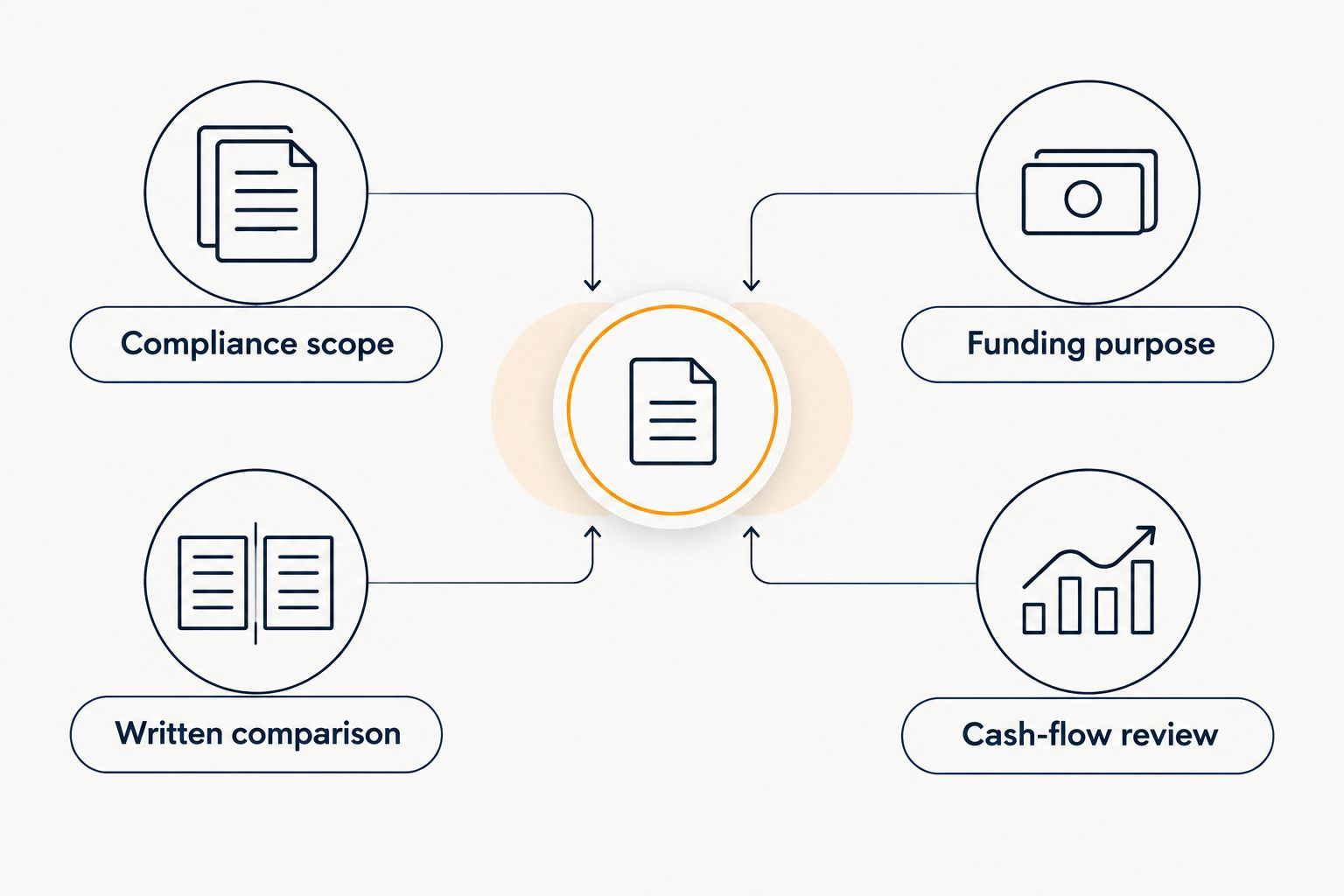
Do not combine the two decisions into a single approval assumption. Your business must address its operating obligations independently of whether a third party approves funding.
Which financing mechanics should you understand first?
A term loan provides borrowed funds with repayment obligations under a loan agreement. A business line of credit provides access to borrowing under the facility's terms, rather than requiring every expense to be funded through a new term loan.
Revenue-based financing describes financing connected to business revenue. Some arrangements are structured as purchases of future receivables, meaning a funder purchases specified future business receipts rather than making a conventional loan.
A merchant cash advance, or MCA, can use that purchase structure. Read the agreement to understand the purchased amount, remittance method, reconciliation provisions and remedies; the label alone does not explain the obligation.
A factor rate is not APR. A factor rate is a multiplier used to determine an agreed repayment or purchased amount, while APR expresses annualized borrowing cost using the applicable calculation and timing assumptions.
For a 2026 comparison, request the net proceeds, total contractual obligation, payment or remittance schedule, and all applicable fees. Do not rank offers by a factor rate alone or assume a fixed multiplier describes annualized cost.
Why would you switch from Harbor Compliance?
Switch when another service better matches a documented requirement—not because a list labels a provider “best.” A useful switch has a specific purpose and a defined handoff.
Valid decision questions include:
- Do you need registered-agent services, broader compliance administration or both?
- Does the proposed engagement cover the entities and jurisdictions on your list?
- Is your current bottleneck administrative work or a cash-flow gap?
- Can your team retain reliable control without outsourced administration?
- Who will own records, notices and upcoming deadlines during the transition?
These questions do not establish a defect in Harbor Compliance. They establish whether the service you are buying matches the job you need done.
If capital is the missing piece, add a financing workstream rather than treating a funding broker as a replacement compliance vendor.
What risks should stop a funding application?
Pause when you cannot explain how the financed expense supports repayment. Borrowing for an expansion without a cash-flow plan adds an obligation without showing how the business will carry it.
Review these issues before accepting an offer:
- Existing debt or receivables commitments that overlap with the proposed obligation.
- Personal guarantees, security interests and contractual remedies.
- Payment frequency and its effect on payroll and essential expenses.
- Reconciliation rights and procedures in a receivables-purchase agreement.
- Whether early payoff changes the contractual amount owed.
- Outstanding registrations or licenses relevant to the planned business activity.
Credit is not irrelevant. Its role depends on the third-party program, alongside the other information required for underwriting.
Consumer-purpose and non-U.S. requests are outside the primary funding audience described here. Business funding should be evaluated for a defined business purpose, not as a substitute for fixing unresolved operating requirements.
What should you prepare before comparing options?
Start with a short decision packet. The third-party funding partner determines the actual application requirements; preparation is not an approval promise.
Gather the business's financial records, current obligations, intended use of funds and expected receipt dates. Keep entity and licensing records available for questions relevant to your activities.
Then write down the expense you need to cover and the latest useful funding date. An offer that cannot meet the business purpose is not a fit, even if another term looks attractive.
When is staying with Harbor Compliance the right call?
Stay when Harbor Compliance's contracted services meet your requirements and the real unresolved problem is funding. Changing compliance providers does not create operating capital.
For 2026, the disciplined choice is to avoid a service transition without a defined benefit. Keep a suitable compliance arrangement in place while you compare financing separately.
FAQ
What's the best Harbor Compliance alternative in 2026?
The best Harbor Compliance alternative depends on the service you need. Northwest Registered Agent is an option for registered-agent services, while CSC is an option for corporate compliance services; compare written scope before choosing.
Is Jon Lynch Financial Group a Harbor Compliance replacement?
Jon Lynch Financial Group is not a replacement for Harbor Compliance's registered-agent or compliance services. It is a business-funding broker that helps U.S. owners compare options through third-party funding partners.
Should I change compliance providers to get business funding?
A compliance-provider change does not establish funding eligibility. Evaluate any administrative change separately from the financing application and address required operating obligations.
Can I finance payroll while expanding into another state?
Payroll is a business-purpose funding need, but eligibility depends on third-party underwriting. Separately confirm the registrations and licenses required for the expansion.
Is a merchant cash advance the same as a business loan?
A merchant cash advance can be structured as a purchase of future receivables rather than a conventional loan. Read the agreement for the purchased amount, remittance mechanics, reconciliation provisions and remedies.
What funding route fits a business below $35,000 per month?
Businesses generating below $35,000 per month should use Explore Self-Serve Funding. The route is open to U.S.-based entrepreneurs and uses secure bank-statement connection through Plaid for an automated decision, without assuring approval or timing.
What should I compare besides a factor rate?
Compare net proceeds, total contractual obligation, applicable fees and payment or remittance timing. A factor rate is not APR and does not by itself explain the annualized cost or cash-flow impact.
One last thing: what belongs in separate contracts?
Keep the compliance engagement and funding agreement separate in your decision file. The first defines administrative responsibilities; the second defines financial obligations.
Before signing either, identify what remains your responsibility. That question exposes gaps that a provider ranking cannot answer.
Related guides
- Registered-agent services for multi-state agency expansion
- Working-capital costs and qualification
- How to compare factor rates on a merchant cash advance
What is your next step?
Jon Lynch Financial Group is a broker, not a direct lender. Products are for business purposes and subject to third-party underwriting; approval, amounts, rates, decisions and funding times are never guaranteed.
Take one practical step: define the business expense and choose the route that matches your monthly revenue. At least $35,000 per month: Compare Business Funding Options; below $35,000 per month: Explore Self-Serve Funding.
Choose your business funding route
Use your monthly business revenue to choose a route, then compare obligations before accepting funding.