How Long Does SBA Loan Approval Take? No Fixed Clock | 2026
How long does SBA loan approval take? Separate lender review, SBA processing and closing, then check the milestones that determine when funds reach your bank.

SBA loan approval in 2026 does not have one fixed turnaround: lender underwriting, any required SBA review, closing and disbursement are separate stages. An approval notice is not the same as money available in your account. Ask your lender for a timeline tied to your complete application, remaining conditions and funding deadline—not just an advertised response time.
- How long does SBA loan approval take? Separate lender underwriting, SBA processing, closing and disbursement before judging timing.
- SBA Express response timing is not a promise that your business receives funds on that schedule.
- Jon Lynch Financial Group is a business-funding broker, not a direct lender; third-party underwriting determines approval.
- Before accepting bridge financing, ask the SBA lender whether new obligations affect the pending application.
How long does SBA loan approval take in 2026?
Your SBA loan timeline depends on the lender, processing route, transaction and completeness of your file. The useful question is not simply when someone will approve the application. It is when the lender expects to finish each stage and release usable funds.
When comparing SBA loan lenders for first-time borrowers, request milestone estimates for your actual transaction. A working-capital request and a business acquisition do not have identical closing requirements.
| Stage | What happens | What you should confirm |
|---|---|---|
| Application preparation | You assemble financial records, ownership details and the proposed use of funds | Whether the lender considers your file complete |
| Lender underwriting | The lender reviews eligibility, repayment ability, credit and transaction details | Who owns the review and what remains outstanding |
| SBA processing | The applicable SBA authorization or guaranty process occurs | Whether the lender uses delegated authority or requires SBA review |
| Closing | Required agreements, collateral arrangements and other conditions are completed | Which conditions prevent closing |
| Disbursement | The lender releases funds under the closing terms | Whether funds go to you, a seller or another designated recipient |
These stages describe the process, not a guaranteed schedule. Some work overlaps; other tasks depend on an earlier decision.
Why does the distinction between approval and funding matter?
Your payroll, inventory order or acquisition deadline needs available cash—not a favorable preliminary conversation. In 2026, judge any timeline claim by its starting point, ending point and conditions.
A lender that starts its estimate after receiving a complete package is measuring something different from a broker discussing timing before documents arrive. Likewise, a credit decision does not necessarily mean legal documents are ready or funds can be disbursed.
Match the business deadline to disbursement, not approval. If a seller or supplier needs payment before the lender expects to close, address that gap before making a commitment.
Who does the SBA process fit?
SBA financing fits eligible business owners whose funding purpose, repayment ability and transaction meet the applicable program and lender requirements. It deserves consideration when you have time to document the business and complete the required review.
It is not a substitute for a cash-management plan when a payment deadline arrives before closing. A slower process only works if your business can operate through it.
Before investing time in an application, ask the lender:
- Does this SBA program permit my proposed use of funds?
- Does the lender finance this type of business and transaction?
- What financial evidence will support repayment ability?
- What ownership, credit or transaction issues need review first?
- Can the expected closing sequence meet my business deadline?
A bank decline does not establish eligibility elsewhere. Find out whether the decline concerned repayment capacity, documentation, lender policy or SBA eligibility before pursuing another application.
How does the approval process work?
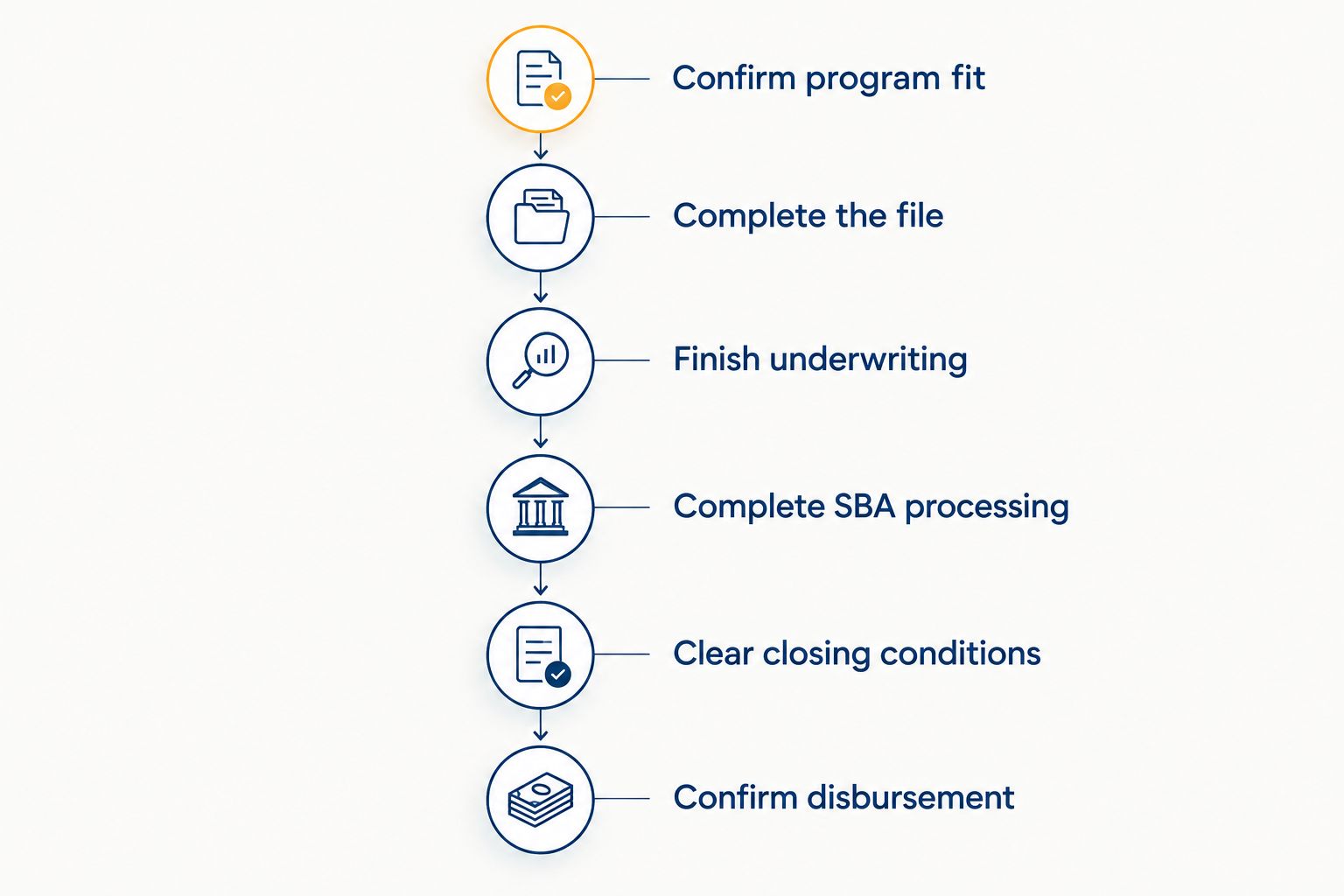
Use this sequence to make the lender's timeline specific. Each step should have an owner, an outstanding-item list and a clearly defined endpoint.
- Confirm program fit. Describe the business, funding purpose and transaction before assembling a full package. Ask which SBA program and processing route the lender intends to use.
- Complete the file. Obtain the lender's document checklist and resolve missing information. Ask for confirmation that the package is ready for underwriting.
- Finish underwriting. Answer questions about cash flow, existing obligations, ownership and the transaction. Keep updated records available if the review continues into another reporting period.
- Complete SBA processing. Establish whether the lender has delegated authority for the application or needs a separate SBA review. Do not confuse this stage with the entire lending process.
- Clear closing conditions. Complete the required documents and transaction-specific conditions. Ask which unresolved item currently prevents closing.
- Confirm disbursement. Verify the release conditions and destination of funds. An acquisition or refinance can involve payments to other parties rather than unrestricted cash in your operating account.
The sequence matters because a file can move through underwriting and still have unfinished closing work. Ask for status by stage rather than accepting a general statement that the application is progressing.
Does SBA Express mean faster access to funds?
SBA Express uses a different processing framework from other SBA lending routes, but the word Express does not eliminate lender underwriting or closing. Ask what the lender's estimate actually measures.
A response associated with the SBA process is not an end-to-end promise. Your lender still needs to establish eligibility, make its credit decision and complete the applicable funding conditions.
For a 2026 application, request separate expectations for lender review, SBA processing and disbursement. Do not substitute a program response target for the date your business needs cash.
Does a lender with delegated authority skip underwriting?
A lender with delegated SBA authority can make specified decisions without a separate SBA credit review, within the applicable program rules. That authority changes the processing route; it does not remove the lender's responsibility to evaluate the application.
You still need an acceptable file and satisfied closing conditions. Delegated authority does not mean automatic approval.
Ask whether delegated processing applies to your particular request. A lender's general program status alone does not tell you which route your transaction will follow.
Why does SBA loan timing vary?
These factors explain why an estimate can change without establishing a universal approval duration:
- Document completeness. Missing records or inconsistent information create additional questions before a lender can finish its review.
- Repayment analysis. The lender needs to understand cash flow, existing debt and the ability to support the proposed obligation.
- Processing route. Delegated processing and applications requiring separate SBA review follow different workflows.
- Transaction complexity. Acquisitions and property transactions introduce parties, agreements and closing tasks beyond the borrower's application.
- Closing requirements. Collateral documentation, required insurance, title work or other applicable conditions can remain unresolved after a credit decision.
- Changes during review. New debt, ownership changes or revised transaction terms require disclosure and can affect the lender's analysis.
Identify the blocking item rather than asking for a new overall estimate each time. A named condition with a responsible party is more useful than an unexplained target date.
What should you compare if you cannot wait?
Compare an alternative only after establishing whether it solves the deadline without creating an unaffordable obligation. Timing alone is not a sufficient reason to accept financing.
For 2026, place the funding purpose, repayment schedule, total contractual obligation and effect on the pending SBA application side by side. Do not assume the SBA loan will later repay an interim obligation.
| Option | Best for | Main advantage | Main limitation |
|---|---|---|---|
| Continue the SBA application | Eligible owners whose deadlines accommodate the remaining process | Keeps the intended financing process intact | Does not resolve a payment due before disbursement |
| Business line of credit | Recurring working-capital needs | Allows borrowing within approved facility terms | A new facility still requires underwriting; access depends on its terms |
| Business term loan | A defined business expense with a repayment plan | Establishes a scheduled repayment obligation | Payments can strain cash flow if expected income arrives late |
| Invoice factoring | Businesses with eligible customer invoices | Connects funding to receivables | Customer eligibility, invoice disputes and contract terms affect fit |
| Revenue-based financing or future-receivables purchase | Revenue-generating businesses evaluating near-term working capital | Offers a different structure to compare with loan financing | Remittances and contract obligations can pressure operating cash |
Revenue-based financing can be structured as a purchase of future receivables rather than a loan. Review the actual agreement, including reconciliation provisions, collection mechanics, guarantees and default terms.
Jon Lynch Financial Group is best for established U.S. business owners comparing business-funding structures, not seeking a guaranteed SBA approval date. Its brokerage role supports comparison; third-party lenders and funders make underwriting decisions.
Can bridge financing interfere with an SBA application?
New financing changes your obligations and can affect the pending lender's assessment of repayment ability. Liens, payment commitments and contractual restrictions also deserve review before you sign.
Ask the SBA lender whether the proposed obligation is acceptable and whether its intended payoff is permitted. Obtain a clear response before treating future SBA proceeds as an exit strategy.
Check these points:
- Whether the interim financing must be disclosed or approved.
- Whether it creates a lien that affects the planned closing.
- Whether its payments fit alongside current business expenses.
- Whether the SBA transaction permits the intended repayment.
- What happens if SBA approval or closing does not occur.
Do not borrow against an assumed approval. Evaluate the interim obligation as something your business must manage even if the SBA application fails.
What documents help keep the application moving?
Request the specific lender's checklist rather than relying on a generic online list. Requirements depend on the program, business and transaction.
Common review categories include:
- Business and owner identification, ownership records and entity documents.
- Business tax returns and current financial statements.
- Bank statements and explanations of material transactions.
- Existing debt details and payment obligations.
- A documented use of funds.
- Purchase agreements, equipment details or property information when relevant.
- Additional owner financial information and authorizations requested by the lender.
Check consistency before submission. Revenue, debt and ownership details should reconcile across the records you provide.
Send requested updates through the lender's approved secure channel. Keep a submission log so you can distinguish an unanswered request from an item already delivered.
What should you ask before relying on a funding date?
Ask the lender to identify the current stage, unresolved conditions and expected disbursement process. A useful update explains both progress and dependencies.
Use these questions in your next conversation:
- Is my application complete and ready for a credit decision?
- Is this a preliminary indication, conditional approval or completed approval?
- Is any SBA review still outstanding?
- Which conditions prevent closing today?
- Who is responsible for each remaining condition?
- What must happen before funds are released?
- What changes must I report while the application is pending?
Keep a cash-flow forecast through the expected funding window. If your deadline is inflexible, discuss the mismatch before signing a purchase commitment or taking additional financing.
What is Jon Lynch Financial Group's role?
Jon Lynch Financial Group is a broker, not a direct lender, providing access to business-purpose financing through third-party funding partners. Approval, amounts, rates, decisions and funding times are not guaranteed.
For U.S. businesses generating at least $35,000 per month, the primary route is to compare business funding options. That revenue figure identifies the brokerage's intended audience; it is not an SBA eligibility rule or an approval threshold.
Businesses generating below $35,000 per month can explore the self-serve funding path. It is open to U.S.-based entrepreneurs and uses a secure Plaid bank-statement connection for an automated decision; verification, bank processing and product terms affect timing.
FAQ
How long does SBA loan approval take in 2026?
SBA loan approval in 2026 has no single duration across lenders and transactions. Request separate estimates for lender underwriting, required SBA processing, closing and disbursement, starting from a complete application.
Does SBA approval mean the money is already available?
SBA approval does not mean funds are available in your account. Required closing conditions and disbursement steps still need to be completed.
Does SBA Express guarantee faster funding?
SBA Express does not guarantee your funding date. Its processing framework does not eliminate lender underwriting, documentation or closing requirements.
Can I speed up my SBA loan application?
You can reduce avoidable delays by submitting a complete, consistent file and responding to specific lender requests. You cannot guarantee the lender's decision or control every closing dependency.
Can I get working capital while waiting for an SBA loan?
You can compare interim business funding, but discuss new obligations with the SBA lender before accepting them. Do not assume future SBA proceeds will be approved or permitted to repay the interim financing.
Is $35,000 per month required for SBA loan approval?
$35,000 per month is Jon Lynch Financial Group's primary business-funding audience threshold, not an SBA approval requirement. SBA eligibility and lender underwriting are separate assessments.
What should I do if my business deadline is before SBA closing?
Discuss the timing gap with the lender and compare alternatives by repayment burden, contractual obligations and effects on the pending application. Do not make a payment commitment based only on preliminary approval.
Related guides
- Working capital loans: costs and qualification
- Business acquisition loans for buying an existing company
- Merchant cash advance: costs, requirements and alternatives
What is your next step?
For your 2026 funding decision, ask for the next unresolved condition, its owner and its effect on disbursement. That answer gives you a practical action rather than another broad timing estimate.
If your U.S. business generates at least $35,000 per month, use Compare Business Funding Options. Below that level, use Explore Self-Serve Funding; neither route promises approval or a funding date.
Choose your business funding route
Compare funding structures or explore the self-serve path based on your monthly business revenue.