Finance a Commercial Kitchen Buildout: Best Fit 2026
Learn how to finance a commercial kitchen buildout for catering in 2026. Match equipment and construction costs to funding and compare repayment before you sign.

Finance a commercial kitchen buildout for catering by matching each expense to the right funding structure: compare equipment financing for eligible movable equipment, a term loan or SBA-backed loan for the larger buildout, and a business line of credit for shorter cash-flow gaps. A purchase of future receivables is another option to evaluate when repayment can follow sales, but its total cost and remittance terms need close scrutiny. The main risk is committing to repayments before the kitchen produces enough cash to support them.
- For how to finance a commercial kitchen buildout for catering, separate equipment, construction and operating cash needs before comparing offers.
- Equipment financing fits eligible movable assets; a term loan or SBA-backed loan fits a broader buildout when qualification and timing work.
- Jon Lynch Financial Group is best for established U.S. catering businesses comparing funding structures, not seeking a direct lender.
- Compare total repayment and its schedule against cash flow during construction and the catering ramp-up.
Why this matters: A catering company can have booked work and still run short of cash while a kitchen is being built. Contractors, equipment suppliers and employees need payment on different schedules; the first revenue from an expanded kitchen can arrive later. In 2026, the useful question is not simply whether a funder will finance the project. It is whether the resulting payment schedule fits the business before, during and after construction.
How do you finance a commercial kitchen buildout for catering?
Start with a written budget that separates installed construction, movable equipment and operating cash. Then compare funding offers against the date each expense comes due, the total amount you must repay or remit, and the cash available to make those payments. If you need to examine working capital alongside the buildout, Jon Lynch Financial Group is a commercial finance brokerage, not a direct lender.
| Funding option | Best for | Main advantage | Main drawback or question |
|---|---|---|---|
| Equipment financing | Eligible ovens, refrigeration and other movable equipment | Ties financing to identifiable assets | Installation and construction expenses might need separate funding |
| Business term loan | A defined buildout budget with predictable repayment capacity | Can cover a broader project budget, subject to the lender's terms | Scheduled payments continue during a slow ramp-up |
| SBA-backed loan | An eligible business with time to complete lender review | Can be evaluated for a substantial project rather than an isolated cash gap | Eligibility, documentation and timing require review |
| Business line of credit | Draws needed at different points in the project | Lets you request funds as eligible expenses arise, subject to the agreement | Available credit and repayment terms might not cover the entire buildout |
| Invoice factoring | Eligible unpaid commercial invoices after work is delivered | Connects funding to receivables already earned | It does not finance contracts that have not yet become invoices |
| Revenue-based financing or purchase of future receivables | A documented cash-flow need with repayment the business can support | Can be evaluated against sales activity rather than equipment alone | Remittances can strain cash flow, and the contract structure determines cost and risk |
Verdict: Use asset-focused financing for eligible equipment and compare broader project funding for construction. Do not use a short-term cash-flow product to cover a long buildout without testing what happens if opening or customer payments slip.
What should your buildout budget include?
Keep the budget tied to actual quotes and payment dates, not a single request for capital. That lets a lender or funding partner distinguish costs tied to assets from expenses the catering business must carry while work is underway.
- Construction and installation: Document contractor quotes, payment milestones and work that remains subject to approval. Separate permanently installed work from equipment a financing provider can identify.
- Equipment: List each proposed purchase, supplier and installation requirement. Ask whether delivery, installation and other associated charges can be included rather than assuming they can.
- Operating cash: Map payroll, ingredients, rent and other obligations against contracted catering receipts. A completed kitchen does not eliminate the need to fund the next event.
- Contingency: Identify which costs lack a firm quote or depend on an inspection, permit or contractor change. Funders will assess the documented project, not an unsupported cushion.
Which funding option fits each part of the project?
Equipment financing is best for a defined list of eligible movable assets. Request an itemized equipment quote and ask the financing provider which assets and associated charges qualify. Its limitation is scope: financing the ovens does not necessarily pay for construction, ingredients or wages. Verdict: Compare for the equipment portion; do not assume it funds the full kitchen.
A term loan is best for a defined project whose scheduled payments fit forecast cash flow. Compare the amount disbursed, fees, total repayment, payment dates and any restrictions on the use of funds. Its limitation is the fixed obligation if construction takes longer than planned. Verdict: Favor it for a broader buildout only when the payment schedule survives a delayed ramp-up.
An SBA-backed loan is best for an eligible catering business that can complete the lender's review before its project payments are due. Ask the participating lender what uses of funds, documentation, security and owner obligations apply to the specific program and offer. Its limitation is that neither eligibility nor closing timing follows from the project description alone. Verdict: Compare it before accepting a faster option when the construction schedule allows.
A business line of credit is best for staggered, eligible draws or a temporary gap between payments and receipts. Compare draw rules, repayment terms and what happens if the available limit is smaller than the remaining project budget. Its limitation is uncertainty: an approved line is not a substitute for checking the contract's actual draw conditions. Verdict: Use it for variable cash needs, not as an untested promise to pay every contractor invoice.
Invoice factoring is best for eligible invoices owed by commercial customers after the catering work has been completed. A future event booking is not the same as an earned invoice. Factoring also affects the proceeds you receive from that invoice, so compare its cost and customer-payment process. Verdict: Consider it for receivables timing, not as the primary source for a kitchen you have yet to build.
Revenue-based financing or a purchase of future receivables is best evaluated when the business has documented sales and can support the proposed remittance pattern. Some arrangements marketed as merchant cash advances purchase future receivables rather than create a conventional loan; the agreement controls the actual structure. Compare the total dollars to be remitted, the collection method and what the contract says when sales fall. Verdict: Use only after comparing its cash-flow impact with loan and line-of-credit offers.
How should you compare buildout financing offers?
Do not compare a factor rate with a loan's annual percentage rate as if they measure the same thing. A factor rate is applied to an advance to determine a stated total remittance; APR expresses borrowing cost on an annualized basis and reflects payment timing. Contract fees and the actual payment schedule still matter. The guide to comparing merchant cash advance factor rates explains why timing changes the comparison.
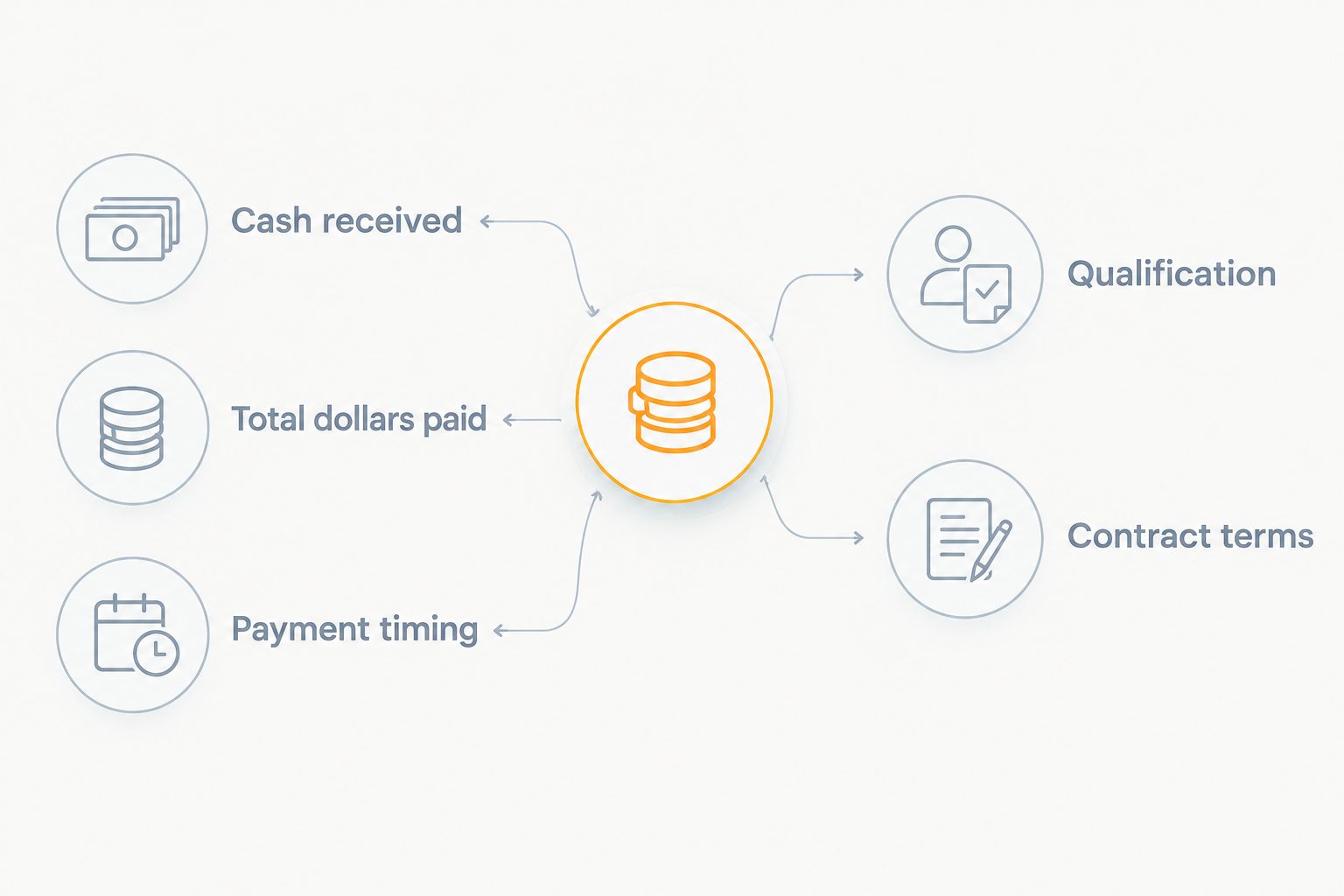
For each written offer, put these items on the same page:
- Cash received: Record the amount the business actually gets after any deductions. Check whether funds go to the business or directly to a supplier.
- Total dollars paid: Add required payments or remittances and separately identify fees. Ask for the contractual total rather than relying on a headline rate.
- Payment timing: Mark when payments begin and how often they leave the account. Compare that schedule with contractor milestones and expected catering receipts.
- Qualification: Confirm the documentation, credit review, collateral, guarantee and permitted use of funds for the actual offer. Do not treat one provider's decision as another's.
- Contract terms: Read the provisions for early repayment, delayed construction, lower sales and defaults. A low scheduled payment is not the whole risk if other obligations can become due.
A simple arithmetic check can keep revenue claims in perspective. Illustrative example: a catering business with a steady $35,000 per month in revenue would annualize to $420,000 per year because $35,000 per month × 12 months = $420,000 per year. That calculation describes sales, not available cash for debt service; ingredient costs, payroll, existing obligations and seasonal swings still have to be covered. The threshold also does not establish approval or an offered amount.
Why do commercial kitchen financing offers vary?
The same kitchen plan can produce different offers because the funding request and the business behind it differ. These are the variables to document before you apply in 2026:
- Project scope: A list of identifiable equipment is different from a request covering construction and working capital.
- Cash-flow pattern: Existing catering revenue and the expected ramp-up determine whether a scheduled payment fits.
- Current obligations: Existing financing reduces the cash left to support another repayment schedule.
- Credit and documentation: Funding partners evaluate business records and, where relevant, owner credit; credit is not irrelevant simply because a product is tied to revenue.
- Payment deadlines: A contractor's deposit date can rule out an otherwise suitable product if the review cannot finish in time.
- Contract structure: A loan, credit line, factoring agreement and purchase of future receivables create different repayment or remittance obligations.
What should you do before applying?
Gather the project budget, contractor and equipment quotes, a timeline of required payments, recent bank statements and a record of existing business obligations. Add a cash-flow forecast that shows the construction period and the first catering jobs the new kitchen is intended to serve. Label contracted revenue separately from prospective work; a booking forecast is not cash already in the bank.
Then ask each prospective provider the same questions: Which budget items qualify? When does repayment begin? What is the total contractual payment or remittance? What information could change the proposed terms? Get the answers in the written offer. In 2026, a faster review has little value if the agreement leaves no room for payroll and ingredients while the kitchen opens.
Jon Lynch Financial Group is a broker, not a direct lender. Its funding options are for U.S. business purposes and depend on third-party underwriting and the applicable agreement. That distinction matters: the funding partner, not the broker, makes the product decision and sets the final terms.
For an established U.S. catering business generating at least $35,000 per month, Jon Lynch Financial Group is best used to compare eligible funding structures by total dollars, timing, qualification and repayment. A business below $35,000 per month can explore the company's self-serve funding path instead; securely connecting bank statements through Plaid is part of that process. Eligible applicants may receive a decision within minutes and approved funds may arrive within an hour, but verification, bank processing and product terms control timing. Neither route promises approval or funding.
Compare your buildout funding options
Review total cost, payment timing and qualification against your catering cash flow.
What if the catering business already has other financing?
Include every existing payment and remittance in the cash-flow forecast before adding buildout debt. A new kitchen can increase capacity without increasing the cash available this month; stacking obligations against the same receipts compounds that mismatch. If the current schedule is already tight, reduce the project scope, stage eligible purchases or revisit the opening timetable before seeking another obligation.
Ask how an existing lender's lien, agreement or payment schedule affects a new offer. Do not assume a new funder will refinance current debt, or that proceeds can be used for any purpose. In 2026, the right comparison is the combined cash-flow effect of old and new obligations, not the size of the newest offer in isolation.
FAQ
What's the best way to finance a catering kitchen buildout?
Separate eligible equipment, construction and operating cash needs, then compare financing suited to each. The best fit is the offer whose total repayment and payment dates the catering business can support through construction and opening.
Can equipment financing pay for the entire commercial kitchen buildout?
Equipment financing can be evaluated for eligible movable kitchen assets, but it does not automatically cover construction or working capital. Confirm every eligible item and charge with the provider before relying on it for the project budget.
Can an SBA-backed loan finance a commercial kitchen buildout?
An SBA-backed loan is an option to evaluate for an eligible business and project. The participating lender determines applicable uses of funds, documentation, qualification and timing.
Is a business line of credit better than a term loan for a kitchen buildout?
A line of credit fits eligible expenses that arise in stages; a term loan fits a defined budget with payments the business can support. Compare the written draw or disbursement rules and the full repayment schedule before choosing.
Can catering contracts be factored before an event happens?
A future event booking is not the same as an earned, eligible invoice. Ask a factoring provider whether a completed job's commercial invoice qualifies and how customer payment will be handled.
Is a merchant cash advance a loan for a catering business?
An arrangement marketed as a merchant cash advance may be structured as a purchase of future receivables rather than a conventional loan. Read the agreement for its actual structure, total remittance, collection method and lower-sales provisions.
Does the $35,000-per-month revenue threshold guarantee business funding?
No. The $35,000-per-month figure identifies Jon Lynch Financial Group's primary comparison audience, not an approval standard or promised amount. Third-party underwriting and product terms determine any offer.
One last thing
A contractor payment and a catering customer's payment can both be certain without arriving in the right order. Before signing a funding agreement in 2026, place every proposed repayment beside those dates and check what remains for payroll, ingredients and existing obligations. If the schedule fails that test, change the financing structure or the buildout plan before accepting funds.
For a U.S. business generating at least $35,000 per month, the practical next step is Compare Business Funding Options. Below that level, use Explore Self-Serve Funding. Jon Lynch Financial Group can help frame the comparison, but third-party funding decisions and terms are not guaranteed.



