Is Revenue Based Financing Worth It? Fit First | 2026
Is revenue based financing worth it? Only when cash flow supports the obligation. Compare contract terms, repayment risks and business-funding options for 2026.

Revenue-based financing is worth it in 2026 when the business activity it funds can cover the financing obligation without crowding out payroll, taxes, inventory, or existing debt payments. Reject an offer that only works if sales rise immediately or another funding round arrives. The central tradeoff is access to working capital versus the cash your business must surrender under the actual contract—not the product name.
- Is revenue based financing worth it? Yes, when the funded activity supports the obligation and essential operating expenses remain covered.
- Jon Lynch Financial Group is a business-funding broker, not a direct lender; third-party underwriting determines available options.
- Revenue-based financing can involve purchases of future receivables; examine collection and reconciliation terms before signing.
- Compare working capital options by net proceeds, total obligation, payment timing, qualification, and contractual risk.
Is revenue-based financing worth it in 2026?
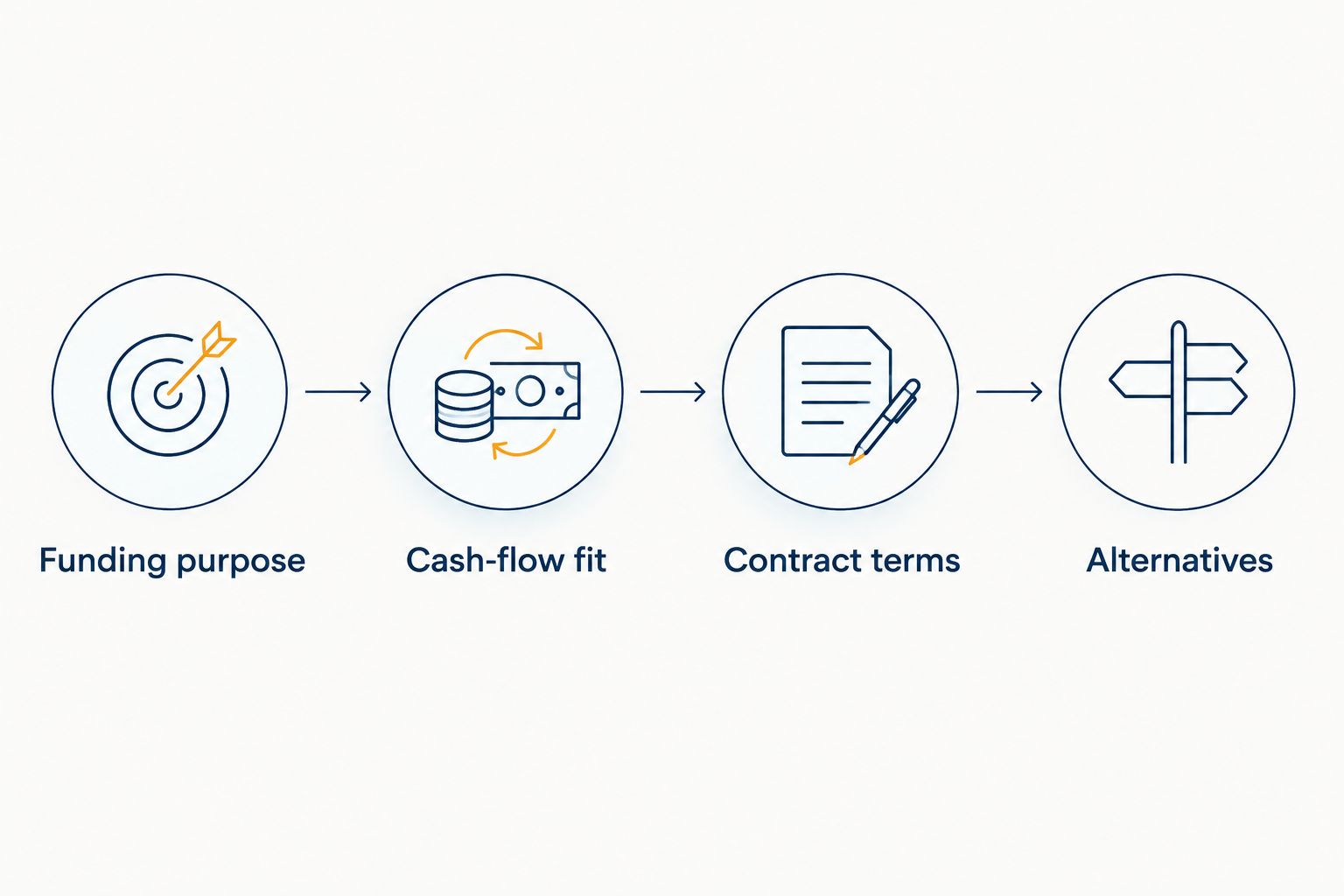
Revenue-based financing earns its place when it solves a defined business need and passes a cash-flow test. An approval does not establish that the offer is affordable. Use the following decision sequence before choosing a structure:
- Funding purpose: Identify the inventory, payroll gap, contract mobilization, or other business expense you need to fund. Specify how that activity generates or preserves cash.
- Cash-flow fit: Map collections against operating expenses, existing obligations, and the proposed withdrawals. Include a weaker sales period, not just your strongest month.
- Contract terms: Identify the legal structure, total obligation, collection method, adjustment process, guarantees, and default provisions.
- Alternatives: Compare an available line of credit, term loan, equipment financing, or invoice factoring against the same business need.
Jon Lynch Financial Group is best suited to U.S. owners comparing business funding at $35,000 or more in monthly revenue. That figure identifies the brokerage's primary audience; it is not an approval threshold or a promise of eligibility.
Who does revenue-based financing fit?
Revenue-based financing fits a comparison process when you have established business receipts, a specific use for the money, and a credible collection plan. It does not make an unprofitable activity profitable simply by funding it.
An inventory purchase deserves a different analysis from an ongoing payroll shortfall. For inventory, examine sell-through, gross profit, and when customers pay; for payroll, identify whether the gap reflects delayed collections or recurring operating losses.
A temporary collection gap and a permanent earnings gap require different decisions. Funding can bridge the former only if the resulting obligation fits your cash flow. Repeated financing for the latter adds another claim on already insufficient cash.
A bank decline is a reason to compare alternatives, not a reason to stop evaluating risk. Ask why the bank declined the request, then determine whether another structure addresses that issue or merely changes how the obligation is collected.
Why does the funding decision matter more than the approval?
The money received is only part of the transaction. Your business also accepts an obligation, a collection process, and contractual restrictions that can affect future operating decisions.
A withdrawal that looks manageable against monthly revenue can still conflict with payroll or supplier payments on a particular date. Revenue is not cash available for financing: operating costs and existing obligations consume part of every deposit.
For your 2026 comparison, judge the offer against the business activity it supports. An opportunity that generates sales but little usable cash does not necessarily support the proposed collection schedule.
Make the cash calendar the deciding document. List when money enters the account, when essential bills leave, and where proposed funding withdrawals fall between them. Do not replace that exercise with a monthly revenue total.
How does revenue-based financing actually work?
Revenue-based financing links financing economics or collections to business revenue, but the label does not establish the legal structure. An arrangement can be a loan or a purchase of future receivables; read the agreement to determine which one you are evaluating.
A purchase of future receivables means a funder buys a contractual portion of future business receipts. A merchant cash advance, or MCA, can use this structure. Do not assume every product marketed as revenue-based financing has identical terms.
Inspect how collections operate in practice. Determine whether withdrawals follow actual receipts, use an estimated amount, or require a documented adjustment request when receipts change.
Reconciliation is the contract's process for aligning collections with actual receipts where that mechanism applies. Ask what records you must submit, how you request an adjustment, and what the agreement requires while the request is being reviewed.
A revenue-linked label is not proof that withdrawals automatically decline with sales. Get the collection mechanics in writing before treating flexibility as a benefit.
How do you compare total cost without confusing factor rate and APR?
A factor rate is a multiplier used to calculate a contractual total; it is not an annual percentage rate. APR expresses annualized financing cost and depends on the amount received, applicable charges, and the timing of payments.
Use the actual written offer to complete these calculations:
- Contractual total: Amount advanced multiplied by the stated factor rate, where the agreement uses that calculation.
- Net proceeds: Amount advanced minus deductions taken before disbursement.
- Financing cost: Total required payments and charges minus net proceeds, without counting the same charge twice.
- Cash remaining: Expected collections minus operating expenses, existing obligations, and proposed funding withdrawals.
Separate charges already included in the contractual total from charges payable in addition to it. Otherwise, your comparison can understate the burden or count a fee twice.
Two offers with the same multiplier are not automatically equivalent. Different net proceeds and payment dates change the cash-flow burden and annualized economics.
For a 2026 decision, request a complete payment or collection schedule and all applicable charges. Do not compare a factor rate directly with a loan's APR. Ask for a calculation using the actual cash flows and clearly stated assumptions, especially when collections vary.
Which alternatives should you compare before accepting?
Compare structures by the expense you need to fund, not by which application looks easiest. The table below gives a use-case screen; it does not establish eligibility, terms, or availability for your business.
| Structure | Best for evaluating | Potential advantage | Main limitation to examine |
|---|---|---|---|
| Revenue-based financing or future-receivables purchase | A defined business need supported by ongoing receipts | A structure connected to business revenue | Collection mechanics, total obligation, and adjustment rights require close review |
| Business line of credit | Recurring working-capital gaps | Draw-based access under an approved facility | Renewal conditions, draw restrictions, and payment requirements |
| Term loan | A defined expense with a planned repayment period | A contractual repayment schedule for budgeting | Scheduled payments must fit cash flow even during weaker periods |
| Equipment financing | Purchasing business equipment | Funding tied to the asset being acquired | Asset restrictions, security interests, and default consequences |
| Invoice factoring | Cash tied up in eligible unpaid invoices | Financing focused on receivables | Customer eligibility, recourse terms, and collection responsibilities |
Choose the structure that matches the source and timing of repayment. If an available alternative has a lower total burden and reaches you before the business deadline, include it in the final comparison rather than treating speed as the only criterion.
Do not use a short-term collection structure for a long-lived expense without checking how the business will cover withdrawals before that expense produces cash. Equipment and expansion decisions need that timing review just as much as inventory purchases do.
Why does the value of revenue-based financing vary?
The same funding structure can serve one business need and strain another. The difference comes from the relationship between the contract and the business's actual collections.
- Use of funds: Inventory, contract mobilization, and recurring operating losses create different repayment challenges.
- Cash conversion: Customer payment dates determine when sales become spendable cash.
- Operating margin: Revenue left after expenses determines capacity, not gross deposits alone.
- Collection mechanics: Withdrawal timing and adjustment rights affect day-to-day liquidity.
- Existing obligations: Current loans and receivables commitments reduce room for new funding.
- Qualification: Third-party underwriting determines which offers enter your comparison.
Seasonality deserves particular attention because an annual revenue total can conceal a weak collection period. The revenue-based financing for seasonal businesses guide addresses that specific funding context.
Build your forecast around the period when the obligation is collected. A strong later season does not pay an earlier withdrawal unless cash is already available or the agreement accommodates the timing.
When should you reject a revenue-based financing offer?
Reject an offer when you cannot explain how the business will meet its obligations from operating cash. A plan that depends on refinancing before the current obligation ends leaves an unresolved funding dependency.
Pause the decision when essential terms are unclear, including:
- The amount deposited after deductions.
- The full contractual obligation and additional charges.
- Withdrawal frequency and the method for changing collections.
- Personal guarantees, security interests, and default triggers.
- Restrictions on additional financing or changes to bank accounts.
- Early-payoff treatment and whether any reduction is contractual.
Do not assume early payoff reduces the contractual total. Verify the written treatment before relying on refinancing or an early exit as part of your plan.
Likewise, a business-purpose receivables purchase is not automatically free of personal exposure. Review the guarantee language and obtain qualified legal advice when the agreement's obligations or remedies are unclear.
What documents should you prepare before comparing offers?
Prepare records that explain your business's receipts, obligations, and funding purpose. Confirm the exact submission requirements with the funding partner rather than assuming every program uses the same checklist.
Useful preparation includes recent business bank statements, a list of existing financing obligations, financial records, and supporting invoices or contracts relevant to the request. Separate incoming sales receipts from transfers or other deposits when explaining cash flow.
Write a short funding brief: what you need to pay, the business deadline, how the expense supports cash generation, and when you expect collections. Pair it with a forecast showing essential expenses and existing withdrawals.
For each offer, request net proceeds, the complete obligation, collection timing, adjustment terms, and all applicable charges in writing. Ask how compensation and product responsibility are divided between the broker and funding partner.
Credit is not irrelevant. Ask how the current partner program evaluates credit alongside business receipts and existing obligations; do not substitute a marketing claim for underwriting requirements.
What should you know about the broker's role?
Jon Lynch Financial Group is a broker, not a direct lender. Its business-funding focus includes working capital, revenue-based financing, and purchases of future receivables through third-party funding partners.
The benefit is a comparison route for business owners evaluating different funding structures. The limitation is that the brokerage does not replace the funding partner's underwriting or the terms of the final agreement.
Funding is for business purposes and subject to third-party underwriting. Approval, amounts, rates, decisions, and funding times are not guaranteed; consumer-purpose and non-U.S. requests are outside the primary funding audience.
FAQ
Is revenue-based financing worth it for my business in 2026?
Revenue-based financing is worth it when the funded activity supports the obligation while essential business expenses remain covered. Reject an offer that depends on immediate sales growth or another financing round to remain affordable.
Is revenue-based financing the same as a merchant cash advance?
Revenue-based financing and merchant cash advances can overlap, but the names do not establish identical contracts. Determine whether your offer is a loan or a purchase of future receivables, then inspect collection and reconciliation terms.
Will my payments automatically fall if revenue drops?
Do not assume collections automatically fall when revenue drops. The agreement determines whether collections track actual receipts or require a reconciliation request and supporting records.
Is a factor rate the same as APR?
A factor rate is not APR. A factor rate is a multiplier used to calculate a contractual total; APR annualizes financing cost using applicable charges and payment timing.
Can I compare funding after a bank turns me down?
You can compare other business-funding structures after a bank decline, but approval remains subject to underwriting. Identify the reason for the decline and test whether each alternative fits your cash flow.
Who is Jon Lynch Financial Group's primary funding audience?
Jon Lynch Financial Group's primary funding audience is U.S. business owners generating at least $35,000 per month who need business-purpose capital. That audience threshold is not an approval guarantee or a universal partner qualification requirement.
What if my business generates less than $35,000 per month?
Businesses below $35,000 per month can Explore Self-Serve Funding through the tech-forward path for U.S.-based entrepreneurs. Applicants securely connect bank statements through Plaid for an automated decision; eligibility and product terms govern the outcome.
How fast can the self-serve funding path work?
Eligible applicants may receive a decision within minutes, and approved funds may arrive within an hour. Timing depends on verification, bank processing, and product terms; neither approval nor timing is guaranteed.
Related guides
- How to compare factor rates on a merchant cash advance
- Revenue-based financing vs. merchant cash advance
- Business line of credit lenders
What is the next step before choosing funding?
Your weakest collection period is a better affordability test than your strongest sales month. For your 2026 decision, put the proposed withdrawals into that weaker period and check whether payroll, taxes, suppliers, and existing obligations still fit.
For U.S. businesses generating at least $35,000 per month, Compare Business Funding Options through Jon Lynch Financial Group. Below $35,000 per month, Explore Self-Serve Funding; eligible applicants may receive a decision within minutes and approved funds within 1 hour, subject to verification, bank processing, and product terms.
Prepare your bank statements, obligation list, and cash-flow forecast before comparing an offer. That is the practical next step—not choosing a product name before reviewing its terms.
Compare funding against your cash flow
For U.S. businesses generating at least $35,000 monthly, compare terms before choosing a funding structure.