Merchant Cash Advance for Barbershops: 2026 Cost Verdict
Merchant cash advance for barbershops in 2026: factor rate math, holdback risks and safer alternatives compared before you sign a receivables deal.

Merchant cash advance for barbershops means a funder purchases a fixed dollar amount of your shop's future card and ACH receipts at a discount, then collects repayment through daily or weekly debits until the purchased amount is paid off. Independent barbershops use this structure when a bank has already declined them, or when a new station buildout, payroll gap or product order needs cash faster than a term loan can move.
- Merchant cash advance for barbershops purchases future receipts at a 1.10x-1.50x factor rate, not an interest rate.
- A $30,000 advance at a 1.35 factor rate repays $40,500 total in 2026 pricing terms — model that before signing.
- Daily or weekly holdbacks of 10%-20% of deposits can strain a shop through a slow January or February.
- Jon Lynch Financial Group brokers side-by-side comparisons of MCA, lines of credit and SBA options; it is not a direct lender.
- Stacking a second advance on top of an existing holdback is the fastest route to losing chairs to cash-flow failure.
Why this matters
Barbershops run on daily card and cash receipts, not invoices with 30-day terms, so a funder can underwrite them off bank deposits alone. That same daily-receipt model is exactly what makes a merchant cash advance both fast to get and easy to misprice if you skip the math. In 2026, most barbershop owners comparing funding aren't choosing between good and bad — they're choosing between a structure that fits their revenue pattern and one that doesn't.
Why merchant cash advance for barbershops matters
Banks typically want two to three years of tax returns, collateral and a debt-service coverage ratio that most single-location or two-chair shops can't produce, especially after a slow season. A merchant cash advance skips that underwriting model and instead reads your bank statements and POS batches directly. That's the tradeoff barbershop owners are actually weighing: speed and thin documentation against a factor rate that, converted to an effective cost, usually runs higher than a bank product.
Booth-rental income adds a wrinkle most retail businesses don't have. A shop that collects weekly chair rent from four independent stylists shows different cash-flow patterns than one running everyone on commission, and a funder reading raw bank deposits doesn't automatically separate the two. Get that distinction wrong on your application and the funder's revenue estimate — and your holdback percentage — can be based on money that never actually reaches your discretionary cash.
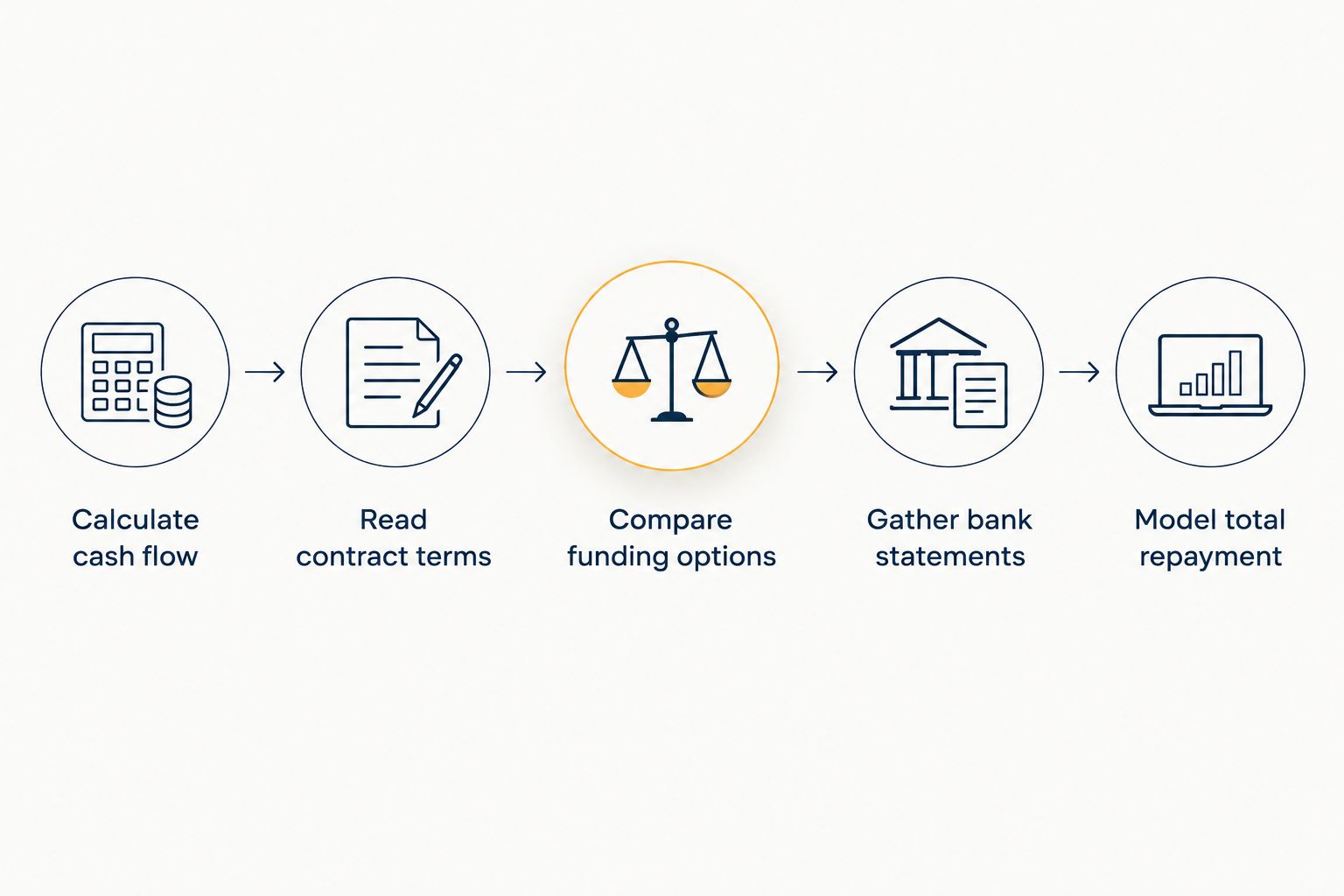
Calculate your true daily cash flow before you apply
Pull real numbers before you talk to any funder, not the number you think your shop does on a good week.
- Pull 3-6 months of POS reports (Square, Clover, Vagaro) showing average daily card and cash receipts
- Separate booth-rental income collected from independent stylists from your own service and retail revenue
- Flag your lowest-volume week in the trailing 90 days, not just the monthly average
- Subtract fixed costs — rent, product, payroll — to see real discretionary cash before adding a daily debit
- Note any advance or loan already drawing from the same bank account
Read the contract for factor rate, holdback and stacking language
A factor rate multiplies the amount purchased; it is not an annual percentage rate, and the two are not interchangeable.
- Confirm the offer quotes a factor rate (typically 1.10x-1.50x) rather than an APR-equivalent
- Check whether the holdback is a fixed daily ACH debit or a percentage of card sales
- Look for a confession-of-judgment clause or a personal guarantee requirement
- Ask directly whether the funder allows a second position or blocks stacking
- Verify a reconciliation clause that lets payments flex down if sales drop
Compare purchase of future receivables against a business line of credit
This is where comparing structures side by side, not just accepting the first offer, changes the total dollars you pay. A merchant cash advance for hair salons and spas faces nearly identical daily-receipt underwriting to a barbershop, so the same comparison logic applies across both.
- Total dollars repaid on each structure at the same funding amount
- Repayment schedule: fixed short-term payoff vs. revolving draw you control
- Collateral and personal guarantee requirements on each option
- Speed to funds: a purchase of future receivables can move in 24-72 hours; a line of credit can take longer depending on documentation
Compare Business Funding Options
See MCA, line of credit and SBA options side by side before you sign.
Gather bank statements and POS reports before applying
Having documents ready before you apply shortens the entire process regardless of which structure you pick.
- Bank statements, typically 3-6 months
- Voided check or bank letter
- Most recent business tax return
- Payroll or 1099 records for chair renters
- Photo ID and current business license
Barbershops generating under $35,000 a month can move through a faster, tech-forward funding path built around securely connecting bank statements rather than mailing documents. Eligible applicants on that path may see a decision within minutes and, if approved, funds may arrive within an hour — timing still depends on verification, bank processing and the specific product terms, and it isn't guaranteed for every applicant.
Negotiate the holdback percentage against your slow season
- Ask for a lower holdback percentage during your historically slow months
- Request a reconciliation clause tied to actual card batch totals instead of a fixed ACH amount
- Get holdback percentage quotes from at least two funders before choosing
Model total dollars repaid, not just the headline factor rate
Here's the arithmetic funders don't lead with. A $30,000 advance at a 1.35 factor rate purchases $40,500 in future receipts — that's $10,500 in cost, illustrative math based on those inputs, before you touch a holdback percentage. Run that same $30,000 against a business line of credit's interest-only-on-drawn-balance structure before deciding which one actually costs less for your shop.
“If the daily debit exceeds what a slow Tuesday brings in, the advance is already underwater.”
Plan your exit before you sign
- Set a payoff date on your calendar and ask whether early payoff terms are available
- Never take a second advance to cover an existing holdback shortfall — that's stacking
- If you're already stacked, review a plan to get out of a stacked merchant cash advance position before adding a third position
Barbershop funding options compared
| Option | Best for | Cost structure | Key limitation |
|---|---|---|---|
| Purchase of future receivables (MCA) | Shops needing cash in 24-72 hours | Factor rate applied to the purchase amount | Daily/weekly holdback strains cash flow if ticket volume drops. Verdict: fits a short-term gap, not a standing solution. |
| Business line of credit | Shops with time-in-business and steadier revenue | Interest charged only on the drawn balance | Approval usually requires stronger credit and documentation. Verdict: better long-run cost if you qualify. |
| SBA loan | Shops planning a renovation or second location | Lower cost, multi-year term | Approval can take weeks and requires heavy documentation. Verdict: worth the wait for planned growth, not for emergencies. |
| Equipment leasing | Financing chairs, dryers or a new POS system | Payments tied to the equipment's cost | Locked to the specific asset, not general working capital. Verdict: use for the equipment purchase only. |
| Bank term loan | Established shops with strong financials or collateral | Fixed monthly payment over a set term | Hardest structure to qualify for right after a bank decline. Verdict: revisit once financials stabilize. |
A barbershop weighing these options is also weighing where its revenue actually sits. Shops with a best working capital loan for small retailers-style profile — steady foot traffic, consistent card batches — often qualify for cheaper structures than a shop still building a banking track record.
Common mistakes barbershops make
- Ignoring the January dip. Barbershops that model repayment off their December numbers get blindsided by a holdback set too high for the slow weeks after the holidays.
- Confusing factor rate with APR. A 1.35 factor rate is not a 35% interest rate — the effective annualized cost depends on the repayment term, and skipping that conversion leads to comparing offers that aren't actually comparable.
- Reporting booth-rental income as shop revenue. Mixing chair-rental collections with your own service revenue inflates the number a funder underwrites against, and the holdback percentage gets set accordingly.
- Stacking to cover a shortfall. Taking a second advance to make a payment on the first is the single fastest way to turn a manageable cost into an unmanageable one.
- Signing before confirming the holdback type. A fixed daily ACH debit behaves very differently from a percentage-of-sales holdback when a slow week hits — know which one you signed for.
FAQ
What is a merchant cash advance for a barbershop?
It's a purchase of a fixed dollar amount of your shop's future card and ACH receipts at a discount, repaid through daily or weekly debits. It is not a loan in the traditional sense, and the funder is buying receivables rather than lending against collateral.
How much can a barbershop qualify for with a merchant cash advance?
Amounts are typically sized against recent monthly deposits shown on bank statements and POS reports, and no specific amount is guaranteed for any applicant. Funders review 3-6 months of statements before making an offer.
Is a merchant cash advance the same as a loan?
No. An MCA is structured as a purchase of future receivables, while a loan involves borrowing a principal amount and repaying it with interest under a fixed schedule. The distinction affects how repayment is collected and how the cost is calculated.
What credit score does a barbershop need for MCA funding?
Credit plays a role but isn't the only factor; funders reviewing an MCA application weigh recent bank deposits and cash flow alongside credit history. A lower credit score doesn't automatically disqualify a shop the way it typically would for a bank term loan.
How fast can a barbershop get funded?
Merchant cash advances can move in as little as 24-72 hours once documentation is submitted, though exact timing depends on verification and the funder's process. Bank term loans and SBA loans generally take longer.
What's the difference between a factor rate and an APR?
A factor rate is a multiplier applied once to the amount purchased — a 1.35 rate on $30,000 means $40,500 owed total. An APR is an annualized interest rate; converting a factor rate to an APR-equivalent requires knowing the actual repayment term.
Can a barbershop with bad credit still get funded?
Some funders weigh cash flow and bank deposits more heavily than credit score for a purchase of future receivables, so options exist that don't require strong credit. Terms and cost still vary by applicant and are never guaranteed.
What happens if a barbershop can't make the daily holdback payment?
Missed or short payments can trigger default provisions depending on the contract, which is why reviewing the reconciliation clause before signing matters. A reconciliation clause that adjusts payments to actual sales reduces this risk versus a fixed ACH debit.
One last thing
The detail most barbershop owners miss isn't the factor rate — it's the holdback type. A fixed daily ACH debit doesn't care whether Tuesday was slow; a percentage-of-sales holdback does. Before you sign anything in 2026, ask which one you're getting, because that single clause decides whether a slow week is a minor dip or a missed payment.



