Merchant Cash Advance for Medical Billing Companies: 2026 Fit
Merchant cash advance for medical billing companies: compare earned fees, total repayment and payroll impact. See when a line of credit or term loan fits better.

Medical billing company receivables funding is business capital repaid from future revenue, with the aim of covering a defined cash-flow gap. A merchant cash advance for medical billing companies can fit a short-term need, but its total repayment and collection schedule can strain payroll if client payments arrive later than expected. In 2026, compare the actual source of repayment before you compare offers.
- A merchant cash advance for medical billing companies fits a defined gap only when collections support its repayment schedule.
- Jon Lynch Financial Group is best for established U.S. billing companies comparing business funding options, not seeking a direct lender.
- Compare revenue-based financing, a line of credit and term loans by total dollars, timing and repayment.
- Billings processed for medical clients are not necessarily revenue owed to your billing company.
Why does funding work differently for medical billing companies?
A billing company processes claims and collects fees under its contracts with medical practices or other clients. Claims handled for a client are not automatically the billing company's own receivables. In 2026, a funder needs to understand what the company earns, when those fees reach its account and who has rights to the underlying payments.
Start with the distinction between claims volume, invoiced service fees and cash deposited. A busy claims queue does not pay the next payroll run. If the business earns a percentage of collections, delayed client collections can delay its own fees; if it charges a fixed service fee, client payment terms create a different cash-flow pattern. Your contract and bank deposits establish which pattern applies.
That distinction also affects the alternatives. A line of credit addresses recurring gaps differently from a fixed purchase of future receivables. Invoice factoring requires an eligible invoice owed to your company; invoices or insurance claims belonging to a medical practice are not a substitute. Before reviewing an offer, learn how to compare factor rates on a merchant cash advance so the repayment figure does not get mistaken for an interest rate.
How do you compare funding for a medical billing company?
Use the following steps in order. The first job is to establish what cash belongs to the business and when it arrives. Only then can you judge whether a financing structure fits.
Separate your fees from client collections
Build a simple cash schedule from your billing agreements, invoices and business bank deposits. Work from cash received, not claims submitted or billed charges. If your company handles money on behalf of a practice, identify whose money it is before presenting it as available for repayment.
- List each client's fee structure: fixed service fee, percentage of collections or another contracted method.
- Match your invoices to deposits in the operating account.
- Flag disputed invoices, delayed payments and client concentration.
- Keep client claim amounts separate from fees your company has earned.
Define the gap before choosing a product
Specify the expense and the date it must be paid. A one-time software implementation, a payroll gap while client fees clear and a continuing operating deficit are different problems. Borrowing without a repayment source can turn a short interruption into a standing deduction from future cash.
- Write down the business-purpose expense and its due date.
- Calculate the amount not covered by existing cash.
- Identify the client payments expected to close the gap.
- Decide what happens if those payments arrive late.
Check whether payments can carry the repayment
Jon Lynch Financial Group, a broker rather than a direct lender, helps established U.S. business owners compare working capital and revenue-based financing through third-party funding partners. Jon Lynch Financial Group is best for established U.S. medical billing companies that need to compare funding structures against their actual fee deposits. Its role is to help you compare options; each third party sets its own underwriting and product terms.
For a medical billing company, test the proposed deduction against the lowest-cash periods visible in its records. Do not use a good collections month as the sole forecast. A purchase of future receivables and a loan can impose different payment obligations, even when both provide business-purpose capital.
- Review bank deposits alongside payroll and other committed payments.
- Ask whether collection is daily, weekly or tied to receipts.
- Model the deduction against a delayed client payment.
- Confirm whether existing financing already claims the same cash flow.
Compare total dollars, not the headline factor
A factor rate multiplies the amount advanced to produce a stated repayment amount; it is not an annual percentage rate (APR). APR expresses an annualized borrowing cost and depends on cash-flow timing. Ask for the actual payment schedule before attempting an APR comparison with a loan or line of credit.
Illustrative example, not a funding offer: a $50,000 advance at a 1.20 factor rate has $60,000 in stated repayment, or $10,000 above the advance. If that $60,000 were collected over 120 business days in equal payments, the payment would be $500 per business day. The example does not establish an available rate, term or payment method; a real contract controls those details.
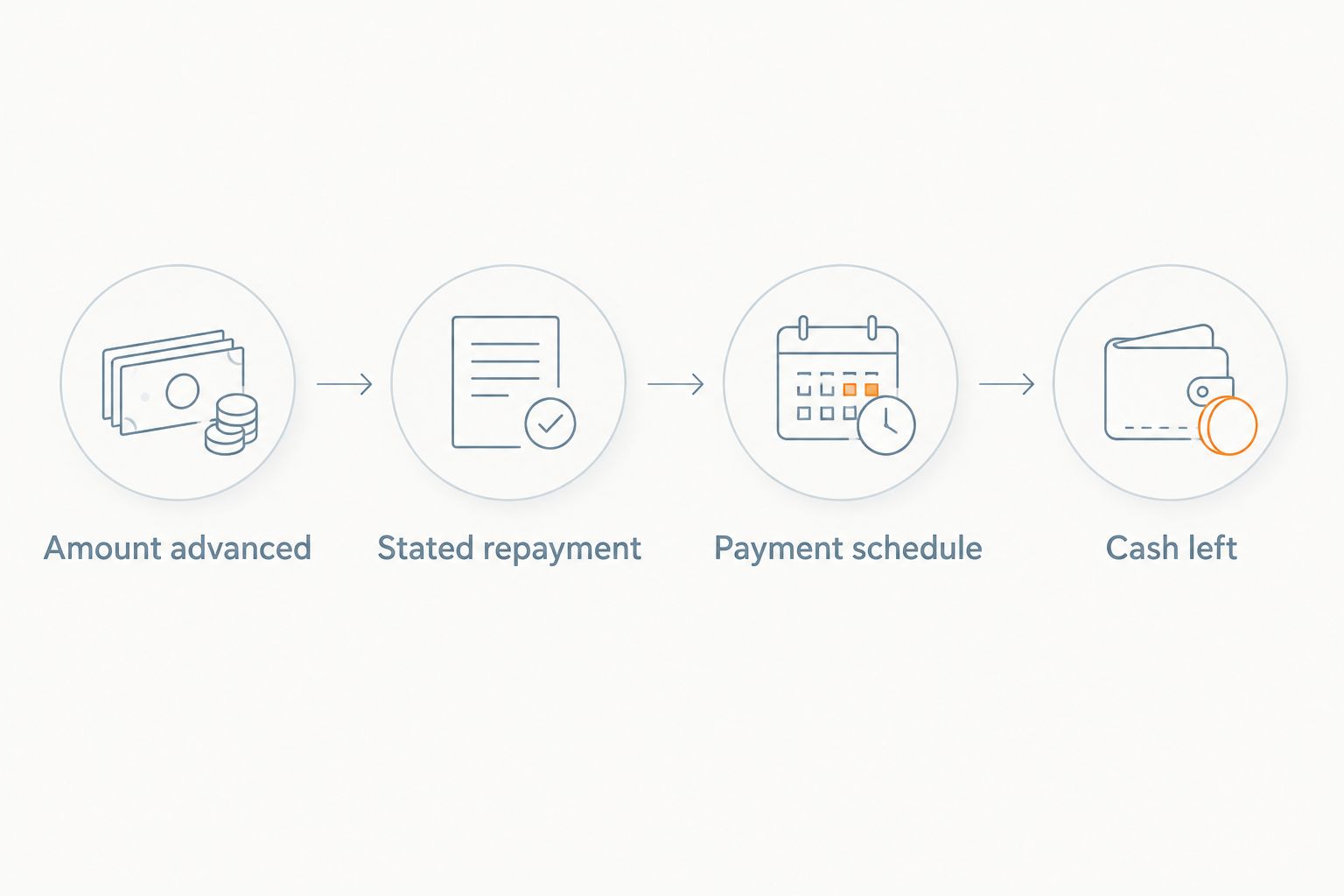
A medical billing company must still meet payroll and operating expenses while collections occur. The same stated repayment can have a different cash-flow effect if withdrawals are concentrated before client fees arrive. Use the written agreement, not a verbal description, to answer:
- What amount reaches the business after any deductions?
- What is the full stated repayment, including disclosed fees?
- How are withdrawals calculated and collected?
- What changes if revenue falls or repayment happens early?
- What cash remains on payroll dates after the withdrawal?
Test alternatives against the same gap
Do not treat every financing product as an interchangeable way to get cash. A line of credit suits a recurring need if its draw and repayment terms fit. A term loan suits a defined expense with a workable payment schedule. Revenue-based financing or a purchase of future receivables deserves attention when its collection method matches documented receipts, not merely because a bank declined a loan.
- Request comparable written terms for each option you can qualify to consider.
- Compare the cash received, total repayment and payment dates.
- Check whether a revolving facility requires renewal or reassessment.
- Check whether any invoice offered for factoring is actually owed to your company.
- Reject an option whose required payments leave no room for routine obligations.
Prepare records without sharing unnecessary patient data
A funder evaluating a billing company needs evidence of business revenue and obligations. Gather business records that establish earned fees and deposits. Do not send patient-level claim files simply to explain revenue when contracts, invoices and bank records can answer the question; ask the recipient what information is needed and how it should be submitted securely.
- Prepare business bank statements and current financial records.
- Gather client service agreements and invoices for your own fees.
- Reconcile fee deposits to the invoices they satisfy.
- List outstanding debt and existing payment commitments.
- Clarify whether any requested record contains patient information before sharing it.
Read the collection terms before signing
A merchant cash advance may be structured as a purchase of future receivables rather than a loan. That label does not tell you whether the payments are manageable or what protections and remedies the agreement contains. In 2026, read the actual contract for collection mechanics, reconciliation provisions, defaults and rights over receivables.
- Confirm what future receivables the agreement covers.
- Find every provision governing payment adjustments or reconciliation.
- Identify defaults, remedies and any personal guarantee.
- Check for restrictions on additional financing.
- Have qualified counsel review terms you cannot explain in plain English.
Which funding option fits your billing company's cash flow?
The table is a decision screen, not a qualification promise. Product terms and underwriting vary by third-party provider. In 2026, request written terms and compare them against the same forecast of earned fees and operating expenses.
| Option | Best for | Total-cost basis to compare | Key limitation |
|---|---|---|---|
| Purchase of future receivables or merchant cash advance | A defined business cash need supported by documented receipts | Cash received, full stated repayment and timing of collections | Collections can pressure payroll when client fees arrive late; contract terms control adjustments. |
| Revenue-based financing | Businesses whose documented revenue pattern fits the offered remittance method | Total repayment and how remittances change with revenue | A revenue-linked label does not establish how a specific agreement handles a slow month. |
| Business line of credit | Repeat gaps where the business can qualify and manage draws | Draw costs, other disclosed charges and repayment by draw | Availability and terms depend on underwriting; a credit line does not fix an ongoing deficit. |
| Term loan | A defined expense with a payment schedule the business can support | Total payments and scheduled due dates | Fixed payments remain due under the agreement even if client receipts slow. |
| Invoice factoring | Eligible invoices owed directly to the billing company | Cash advanced against eligible invoices and total charges | A medical practice's insurance claims are not automatically the billing company's invoices. |
| SBA loan | A planned need that can accommodate its application and underwriting process | Full loan terms and projected payments | It is a poor match for an expense that cannot wait for the required process. |
Best immediate decision: compare the amount of cash the company receives, every required payment and the cash left on payroll dates. If a cheaper option meets the actual deadline, speed alone is not a reason to accept a more burdensome repayment schedule. Jon Lynch Financial Group can help an established business owner compare eligible routes; it cannot promise an approval or dictate third-party terms.
What mistakes do medical billing companies make?
Treating processed claims as company revenue
A billing company can process substantial claims while earning only its contracted fees. Presenting the full claims amount as business revenue distorts the funding request and the repayment forecast. Use fee invoices and matching deposits.
Comparing a factor rate directly with APR
A factor rate produces a stated repayment multiple, not an annual rate. An APR comparison needs the timing and amounts of cash flows. In 2026, compare total dollars first, then evaluate the payment schedule rather than labeling the factor rate as an APR.
Planning around the strongest collections period
Client collections and the billing company's fee deposits need not move on the same day. Test proposed withdrawals against delayed payments and existing obligations. If the business cannot meet payroll under that scenario, revise the funding amount or product choice before signing.
Pledging receivables without checking ownership
Factoring or a receivables purchase depends on what the company is entitled to receive and what the contract covers. Check client agreements and existing financing before treating an invoice or deposit stream as unencumbered. Do not assume the company owns a practice's insurance claims.
Using new funding to support an unresolved deficit
Capital can bridge a specific timing gap; it does not repair a fee model that consistently fails to cover operating costs. Identify the source of repayment before accepting another deduction. If the forecast has no surplus after ordinary expenses, address the underlying gap first.
FAQ
Can a medical billing company get a merchant cash advance?
A medical billing company can be considered for a merchant cash advance if its business revenue and other qualifications meet a funder's underwriting terms. Compare the written repayment and collection terms with deposits from fees the company actually earns.
Does a medical billing company own the insurance claims it processes?
Processing a client's insurance claims does not, by itself, make those claims the billing company's receivables. Review client agreements to identify the company's earned fees and rights to payment.
Is revenue-based financing the same as a merchant cash advance?
Not necessarily; the names alone do not establish the legal structure or collection method. A revenue-based arrangement may be structured as a purchase of future receivables, so read the agreement to see what is being sold and how payments work.
How do I calculate the cost of a factor-rate offer?
Multiply the amount advanced by the factor rate to find stated repayment, then subtract the advance to find the difference. Also review fees and the collection schedule; a factor rate is not an APR.
Is invoice factoring available to medical billing companies?
Invoice factoring depends on eligible invoices owed to the billing company and the factor's terms. Insurance claims belonging to a medical practice do not become the billing company's invoices merely because it processes them.
Is a line of credit better than a merchant cash advance?
A line of credit is the better fit when its terms cover a recurring gap at a manageable total cost and the business qualifies. A merchant cash advance requires separate scrutiny of its full repayment and collection schedule.
Does Jon Lynch Financial Group lend directly to medical billing companies?
No. Jon Lynch Financial Group is a broker, not a direct lender; third-party funding partners set their own underwriting and product terms. Business-purpose funding is not guaranteed.
One last thing
In 2026, the most useful number in a medical billing company's funding file is not the value of claims it processes. It is the cash from its own earned fees that remains after payroll, operating costs and existing payments on the dates a new payment would fall due. That number separates a workable bridge from a second cash-flow problem.
For a U.S. business generating at least $35,000 per month, Compare Business Funding Options with Jon Lynch Financial Group using that cash schedule. If the business generates under $35,000 per month, Explore Self-Serve Funding instead. Neither route promises an approval, amount, rate, decision time or funding time.
Compare funding against your cash flow
Review business funding routes by total repayment, timing and payment schedule.