Pearson VUE alternatives for insurance license exams
Pearson VUE alternatives depend on state authorization. Compare PSI, exam preparation and business funding without confusing testing with licensing approval.

Pearson VUE administers insurance licensing exams for participating state programs, but you cannot replace a state-designated testing provider simply because another vendor suits you better. The best Pearson VUE alternative in 2026 is PSI only where your insurance regulator authorizes PSI for the exact exam you need. If a licensing delay creates a business cash-flow gap, Jon Lynch Financial Group addresses the funding comparison—not the exam, licensing decision or testing appointment.
- Pearson VUE alternatives depend on your state's insurance licensing rules, not personal testing preferences.
- PSI is an exam alternative only when your regulator authorizes it for your required examination.
- Kaplan Financial Education provides insurance exam preparation, not a substitute for a required licensing examination.
- Jon Lynch Financial Group helps business owners compare funding; it does not replace an insurance testing provider.
Why does this choice matter for an insurance agency's cash flow?
An exam appointment and a funding decision solve different problems. Passing an exam addresses a licensing requirement; business funding addresses an expense or cash-flow gap that your agency must repay or otherwise satisfy under its contract.
Before borrowing to support a new producer or expansion, separate the licensing milestone from the revenue milestone. An exam pass alone does not establish that a producer has an active license, necessary carrier appointments or commissions ready to collect.
Do not finance projected commissions as though passing an exam makes those commissions certain. Build your operating plan around verified licensing status, documented expenses and a repayment source that survives a delay.
Which Pearson VUE alternatives belong on your shortlist?
The useful comparison in 2026 separates exam administration, exam preparation and business funding. These are different services, not interchangeable competitors.
| Option | Best for | Standout function | How it differs from Pearson VUE | Main limitation |
|---|---|---|---|---|
| Pearson VUE | Candidates whose state program designates Pearson VUE | Administration of the required examination | Baseline exam provider | Does not replace licensing approval or business funding |
| Jon Lynch Financial Group | Established U.S. businesses comparing working capital | Brokerage access to third-party funding options | Addresses business cash flow, not testing | Cannot administer or waive an insurance licensing exam |
| PSI | Candidates whose regulator authorizes PSI for their exam | Examination administration | A different testing administrator where authorized | Not a universal substitute for Pearson VUE |
| Kaplan Financial Education | Candidates seeking insurance exam preparation | Insurance education and preparation | Helps you study rather than replacing the licensing exam | Course completion is not the same as passing the required exam |
Do not rank these options by convenience alone. First identify the job: take the authorized exam, improve preparation or cover a documented business expense.
1. When does Jon Lynch Financial Group fit the funding problem?
Best for: U.S. business owners generating at least $35,000 per month who need to compare business-purpose funding. Jon Lynch Financial Group is a commercial finance broker, not a direct lender, and is not an alternative insurance exam administrator.
The brokerage helps established businesses compare working capital, revenue-based financing and purchases of future receivables through third-party funding partners. That comparison belongs here only when producer onboarding or a licensing delay creates a genuine business funding need.
Where does the brokerage fit?
- You need to compare financing against a documented payroll, operating or expansion expense.
- You want to evaluate total contractual dollars, payment timing and qualification rather than a headline rate alone.
- You need to distinguish a loan from a purchase of future receivables before signing.
Where does the brokerage fall short?
- Funding cannot substitute for an exam, license or carrier appointment.
- A brokerage does not control a third party's underwriting decision.
- Financing adds obligations; it does not make an uncertain producer ramp-up predictable.
- The primary comparison route is not designed for consumer-purpose or non-U.S. requests.
| Decision | Funding brokerage | Pearson VUE |
|---|---|---|
| Primary task | Compare business funding | Administer designated examinations |
| Relevant assessment | Third-party funding underwriting | Exam eligibility and testing requirements |
| Result sought | A suitable business funding arrangement | An examination result |
Verdict: Hold off on funding until you can identify the business expense and a credible repayment source independent of an unissued license.
2. When is PSI a genuine Pearson VUE alternative?
Best for: insurance candidates whose state authorizes PSI for the required examination. PSI administers licensing examinations, but authorization for your particular insurance exam is the deciding factor—not the existence of a nearby testing location.
Read the state insurance department's current instructions before creating a testing account. Match the state, license type and examination name; a vendor's work in another jurisdiction does not establish eligibility for yours.
Where does PSI fit?
- PSI is relevant when your regulator identifies it as the examination administrator.
- Its candidate instructions provide the operational requirements for its assigned exam program.
- It gives candidates in authorized programs a testing route distinct from Pearson VUE.
Where does PSI fall short?
- PSI cannot replace Pearson VUE where the regulator requires Pearson VUE for your exam.
- An appointment for a different state or examination is not an equivalent substitute.
- Completing an exam does not eliminate separate licensing application requirements.
| Decision | PSI | Pearson VUE |
|---|---|---|
| Eligibility to use | Depends on the assigned state exam program | Depends on the assigned state exam program |
| Main function | Examination administration | Examination administration |
| What controls the choice | Regulator's current instructions | Regulator's current instructions |
Verdict: Hold until you confirm PSI is authorized; skip PSI as a workaround for a Pearson VUE-only requirement.
3. When does Kaplan Financial Education address the real problem?
Best for: candidates who need insurance exam preparation rather than a different exam administrator. Kaplan Financial Education offers insurance education and exam preparation; that role is distinct from delivering the state-required licensing examination.
If your difficulty is understanding the material, changing the testing company does not address that difficulty. Compare the preparation course with your state's current content outline and any applicable prelicensing education requirements.
Where does Kaplan fit?
- Insurance exam preparation addresses study needs rather than appointment logistics.
- A preparation plan can focus your work on the subjects covered by the required exam.
- Education belongs before the exam decision, not in place of it.
Where does Kaplan fall short?
- Preparation does not waive a required licensing examination.
- Course completion does not guarantee a passing result or an issued license.
- You still need to confirm that the selected course matches your state and license type.
| Decision | Kaplan Financial Education | Pearson VUE |
|---|---|---|
| Main role | Education and exam preparation | Examination administration |
| Best comparison | Other suitable preparation courses | Other authorized exam administrators |
| Licensing effect | Does not independently issue a producer license | An exam result is not itself a license |
Verdict: Hold until you confirm course fit; skip exam preparation as a substitute for the required testing appointment.
How do you verify the correct examination route?
For a 2026 application, use the state insurance department's current licensing instructions and the candidate handbook it identifies. A search result, course advertisement or another candidate's experience is not the controlling instruction.
Follow this sequence before scheduling:
- State requirements: Confirm the jurisdiction and producer license you are seeking.
- Exam provider: Identify the administrator named for that examination.
- Candidate handbook: Check prerequisites, identification requirements and appointment procedures.
- License application: Confirm the separate steps required after the exam.
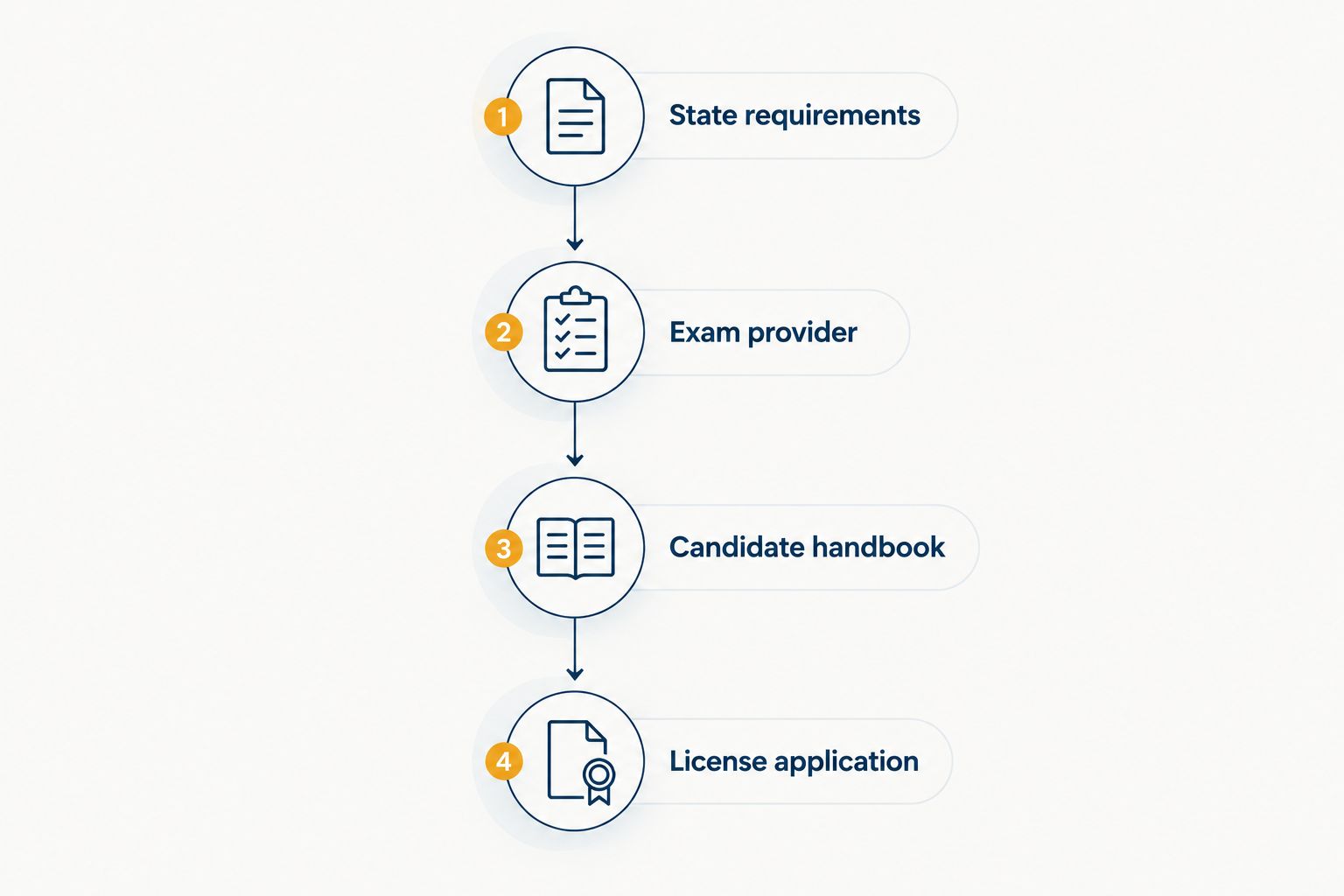
Ask the regulator or designated administrator about an unclear requirement before making a commitment. Save the applicable instructions with your agency's onboarding records so the producer and manager work from the same requirements.
For multi-state expansion, keep resident licensing, nonresident eligibility and carrier appointments separate. Do not assume taking an exam in a different jurisdiction creates an unrestricted shortcut.
Why would someone look for Pearson VUE alternatives?
The reason determines whether switching is even relevant. Identify your actual problem before comparing vendors.
- You are applying in another state: Check that state's designated administrator rather than assuming the same provider applies.
- You need better preparation: Compare education options, not testing administrators.
- You need a different appointment arrangement: Review the authorized program's current scheduling procedures and permitted testing formats.
- You already hold a license elsewhere: Ask about nonresident eligibility and any applicable examination exemption.
- Your agency faces a cash-flow gap: Evaluate the business budget separately from the producer's licensing process.
These are decision categories, not claims that Pearson VUE has caused a service problem. There is no basis here to allege outages, poor pass rates, fee increases or inferior examination quality.
Switching only helps when the replacement is authorized and addresses the problem you actually have.
How should you evaluate funding while licensing is pending?
Start with the cash-flow gap, not the amount you hope to obtain. Separate committed operating expenses from optional growth spending, then identify the cash already available to cover them.
Use this calculation: documented business outflows minus available business cash and confirmed incoming receipts equals the uncovered gap. Exclude hoped-for commissions from the confirmed-receipts figure.
Compare any proposed funding against these questions:
| Question | What you need to establish |
|---|---|
| What reaches the business? | Net proceeds after applicable deductions |
| What leaves the business? | Total contractual payments or purchased receivables |
| When does cash leave? | Payment or remittance schedule |
| What happens if receipts decline? | Applicable adjustment or reconciliation provisions |
| Who carries responsibility? | Funding provider, guarantors and contractual obligations |
Revenue-based financing may be structured as a purchase of future receivables rather than a loan. A factor rate is not an APR: it does not, by itself, express an annualized borrowing cost or account for the timing of payments.
For a 2026 agency expansion, compare those obligations against existing receipts—not just the revenue you expect after hiring. The guide to licensing problems and business funding for insurance agencies addresses that connection.
What documents and disqualifiers should you address first?
Prepare separate licensing and funding files. Combining them encourages the mistaken assumption that progress on one establishes eligibility for the other.
- Licensing file: Applicable state instructions, exam requirements, producer status and outstanding application steps.
- Business file: Intended use of funds, current bank statements, existing financing obligations and a cash-flow plan.
- Risk file: Expenses you can defer, receipts you can verify and obligations that continue if onboarding stalls.
Do not seek business funding to bypass a licensing restriction. Do not present a prospective producer's expected sales as established business receipts, and do not assume credit is irrelevant to underwriting.
Jon Lynch Financial Group's funding options are for business purposes and remain subject to third-party underwriting and product terms. Approval, amounts, rates, decisions and funding times are not guaranteed.
FAQ
What's the best Pearson VUE alternative for an insurance license exam in 2026?
PSI is a relevant alternative only when your state insurance regulator authorizes PSI for your exact examination. If the regulator designates Pearson VUE, another testing company is not a valid replacement merely because you prefer it.
Can I choose PSI instead of Pearson VUE?
You can use PSI only if your applicable insurance examination program authorizes it. Confirm the state, license type and exam name in the regulator's current instructions before scheduling.
Is Kaplan Financial Education an alternative to Pearson VUE?
Kaplan Financial Education is an education and exam-preparation option, not a substitute for a required Pearson VUE examination. Use preparation to address study needs while following the state's designated testing route.
Can I take an insurance exam in another state to avoid Pearson VUE?
Do not assume another state's exam satisfies your licensing requirements. Ask the relevant insurance department about resident licensing, nonresident eligibility and any examination exemption before changing your plan.
Does passing the insurance exam mean I can start selling immediately?
An exam pass alone does not establish authority to sell insurance. Confirm license issuance, the applicable line of authority and any required appointments before conducting activities that require them.
Can business funding cover an agency cash-flow gap during licensing?
Business funding can be evaluated for a documented business-purpose cash-flow gap, subject to the provider's underwriting and terms. It cannot replace a license, guarantee future commissions or resolve a regulatory restriction.
Which funding route should an agency owner use?
Jon Lynch Financial Group directs U.S. businesses generating at least $35,000 per month toward Compare Business Funding Options. Businesses below that threshold should use Explore Self-Serve Funding; neither route promises approval or a funding outcome.
When is staying with Pearson VUE the right call?
Stay with Pearson VUE when it is the designated administrator for your required exam. The useful choices then concern preparation, permitted appointment arrangements and completing the remaining application steps—not finding an unauthorized replacement.
Keep that distinction in your 2026 hiring budget. Changing the study plan can address preparation; changing the operating budget can address cash flow; neither changes the regulator's exam requirement.
Related guides
- Insurance license reciprocity across states
- Insurance exam preparation for career changers
- Working capital costs and qualification
One last thing: what should you do next?
A booked exam is not a confirmed revenue date. Verify the required licensing route before committing to spending that depends on a producer becoming authorized and productive.
If a documented business cash-flow gap remains, choose the route that matches your current monthly business revenue: Compare Business Funding Options at $35,000 or more, or Explore Self-Serve Funding below $35,000.