SBA Loans for Martial Arts Studios in 2026: What Qualifies
SBA loans for martial arts studio owners in 2026: eligibility, documents, loan types and total-cost math compared before you apply for financing.

SBA financing for martial arts studio owners means applying for a government-guaranteed loan, usually an SBA 7(a) or SBA 504, through a bank or nonbank lender rather than the SBA itself. Studios with at least two years of tax returns, positive cash flow and no active merchant cash advance qualify most often; newer studios or ones carrying stacked MCA debt usually get declined before underwriting even starts.
- SBA loans for martial arts studio owners require two-plus years of tax returns and a personal credit score generally in the mid-600s or higher.
- SBA 7(a) loans reach $5 million with terms up to 25 years for real estate and 10 years for working capital or equipment.
- Studios under two years old or carrying an active merchant cash advance rarely clear SBA underwriting and need a bridge product first.
- Jon Lynch Financial Group compares SBA lenders alongside working capital and revenue-based financing so studio owners see total cost side by side before choosing.
Why SBA financing matters for martial arts studio owners
SBA loans for martial arts studio owners follow the same federal underwriting rules as SBA loans for any other small business, with a few sector-specific wrinkles. A dojo doesn't carry the collateral a restaurant or a medical practice does. Three mat sections, a heavy bag rack and a point-of-sale system resell for a fraction of what you paid, so a lender evaluating your balance sheet discounts that equipment hard.
Gym and fitness studio owners run into the same collateral wall. The guide on SBA loans for gym and fitness studio owners breaks down how fitness businesses substitute a blanket lien on equipment for real estate collateral, and the same approach applies to a martial arts academy.
Membership revenue also swings hard across the calendar. January enrollment surges push receipts well above a typical month at plenty of studios, then summer brings cancellations and billing holds. An underwriter modeling your debt-service coverage ratio on a flat monthly average will overstate what you can actually pay in July and August, so build that seasonal dip into your own numbers before a lender does it for you.
Jon Lynch Financial Group is a veteran-owned brokerage that compares SBA loans, working capital and revenue-based financing for business owners in 2026; it's a broker, not a direct lender, so the SBA loan itself is issued by a bank or nonbank lender inside the SBA's network, not by JLFG.
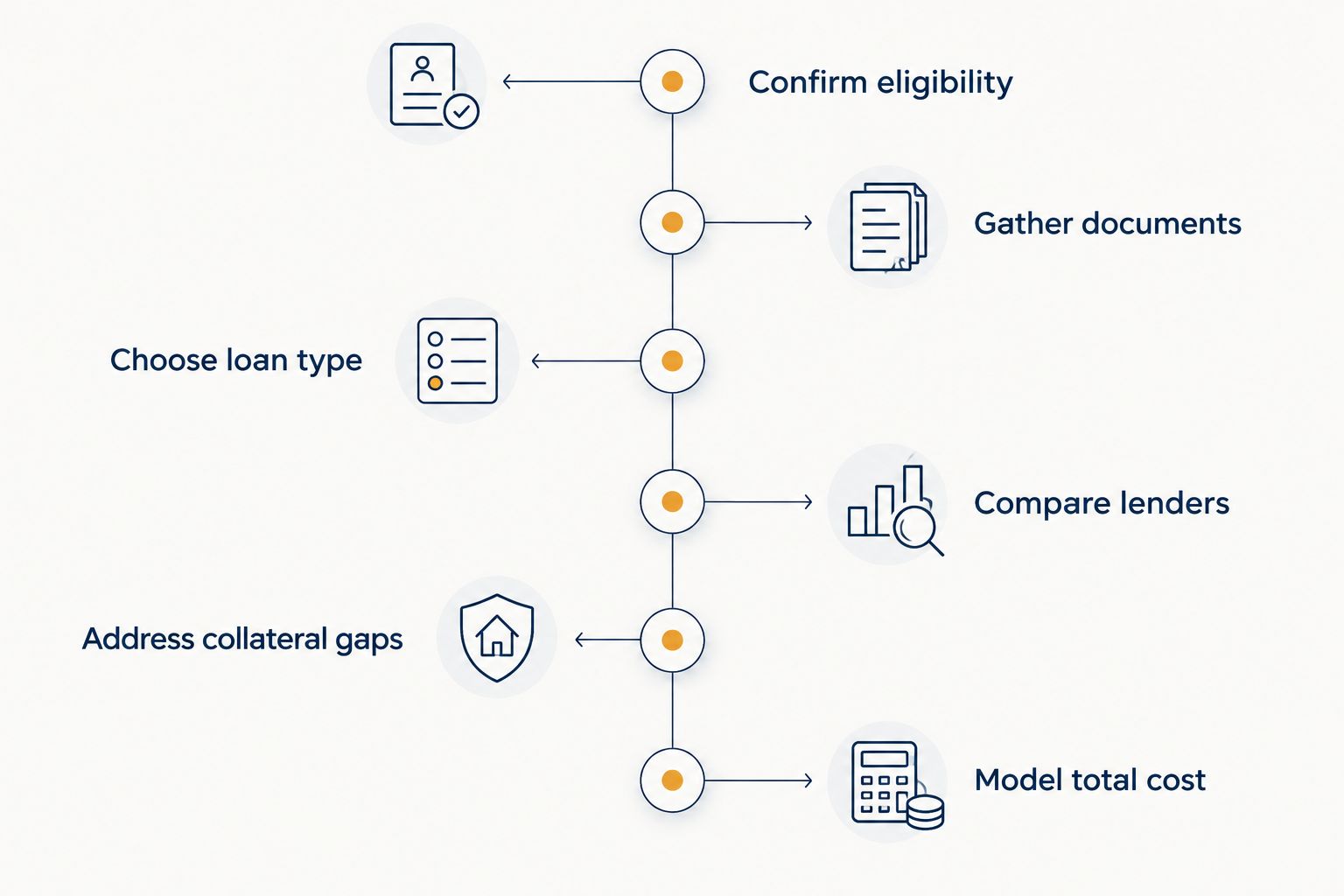
Confirm your studio qualifies for SBA financing
SBA lenders screen time in business, credit and tax standing before they look closely at your revenue.
- Two or more years of continuous operation under the same ownership structure
- Personal credit score generally in the mid-600s or higher for the majority owner
- No open federal or state tax liens against the business or the owner
- No active merchant cash advance position stacked on the business
- A lease with a remaining term that covers, or can be extended to cover, the loan term
Gather your financial documents before you apply
Underwriters ask for the same core file regardless of lender, so build it once and reuse it.
- Two to three years of business tax returns
- Personal tax returns for every owner holding 20% or more of the studio
- Year-to-date profit and loss statement and balance sheet
- A revenue report pulled from your membership billing software, reconciled to actual bank deposits
- A debt schedule listing every existing loan, lease and cash advance
- A copy of your current lease agreement
Choose the right SBA loan type for your studio's need
7(a) and 504 solve different problems, and picking the wrong one at the start wastes weeks of underwriting.
- SBA 7(a) for working capital, buying out a co-owner, or refinancing existing business debt
- SBA 504 for purchasing the building your studio operates out of
- SBA Express for amounts under $500,000 with a faster decision than standard 7(a)
- Standard 7(a) for larger amounts where total loan size matters more than speed
Lenders price and underwrite these products differently even within the same SBA program, which is why studio owners compare more than one before signing. The SBA loan lenders for first-time borrowers comparison lays out approval fit and documentation differences side by side.
Compare SBA lenders and brokers before signing
Two lenders quoting the same SBA program can land on different fees, timelines and collateral demands.
- Average time from full application to funding at that specific lender
- Whether the lender requires real estate as collateral or accepts a blanket lien on business assets
- Origination and packaging fees disclosed in the loan estimate
- Prepayment penalty terms, since some 7(a) loans carry one in years one through three
- Whether the lender has funded a fitness or martial arts business before
Jon Lynch Financial Group's lender comparisons flag which SBA lenders regularly work with studio and fitness businesses without adding an extra underwriting delay.
Build your case for limited collateral
A studio without owned real estate can still qualify; the file just has to work harder.
- Use SBA's reduced collateral requirements that apply below certain loan thresholds
- Offer a blanket lien on mats, equipment and the point-of-sale system instead of real estate
- Add a co-signer or additional guarantor if the primary owner's credit sits below the lender's cutoff
- Document leasehold improvements, build-out costs and flooring as collateral value
- Show a debt-service coverage ratio above 1.15 based on trailing twelve-month revenue
The SBA loan with limited collateral guide covers the exact thresholds where reduced collateral rules apply in 2026.
Model the total cost against your membership revenue
The rate on the term sheet isn't the number that matters; the payment against your slowest month is.
- Calculate the monthly loan payment against average recurring membership revenue, not gross annual revenue
- Stress test the payment against your lowest historical month, usually July or August
- Add the SBA guarantee fee into the total borrowed amount, not just into the rate
- Compare the SBA payment structure against alternative structures like a merchant cash advance factor rate
- Keep 60 to 90 days of payroll in reserve while the loan ramps into your cash flow
Prepare for underwriting timelines and cash-flow gaps
SBA underwriting runs roughly 30 to 90 days for a standard 7(a) loan and longer for a 504, so plan the gap before it happens, not during it.
- Bridge short-term cash needs with a working capital product while the SBA file is in underwriting
- Avoid opening a new merchant cash advance during underwriting, since it can disqualify the SBA application outright
- Keep payroll tax deposits current; a lien filed mid-underwriting stops the loan
- Confirm your landlord will sign a lease assignment or subordination if the lender asks for one
SBA financing options for martial arts studio owners compared
| Option | Best for | Typical term | Key limitation |
|---|---|---|---|
| SBA 7(a) | Working capital, refinancing debt, buying out a partner | Up to 10 years for working capital, up to 25 years if tied to real estate | Requires two-plus years of tax returns and a full personal guarantee |
| SBA 504 | Buying the building your studio operates from | Up to 25 years | Restricted to real estate and major fixed assets, not day-to-day cash flow |
| Business term loan | Established studios wanting a lump sum without SBA paperwork | Fixed repayment schedule set at closing | Pricing depends heavily on time in business and credit profile |
| Business line of credit | Covering payroll or rent between membership billing cycles | Revolving, draw and repay as needed | Credit limit tracks revenue and won't cover a building purchase |
| Revenue-based financing / MCA | Studios that need funds fast and can't wait on SBA underwriting | Repaid from a fixed percentage of receivables, no bank-style amortization | Highest total cost of the group; structured as a purchase of future receivables, not a loan |
SBA 7(a) wins on total cost for martial arts studios that can wait 30 to 90 days for a decision; revenue-based financing wins on speed when a studio needs cash before that window closes.
Common mistakes martial arts studio owners make with SBA financing
- Applying while carrying an active MCA position. Stacked cash advance debt is one of the fastest ways an SBA lender declines an application outright.
- Treating used mats and heavy bags as significant collateral. Resale value on studio equipment is a fraction of purchase price, and lenders discount it accordingly.
- Substituting billing software reports for bank statements. Underwriters want the bank-deposited numbers, not the gross figure your membership platform shows.
- Averaging revenue across the year instead of the slow month. A flat monthly average overstates what the studio can actually pay during a summer dip.
- Waiting for a bank decline before exploring SBA. By then, a fresh tax lien or a new MCA position may already disqualify the file.
Compare your SBA and funding options
See SBA, term loan and revenue-based financing side by side before you apply.
FAQ
What credit score do I need for an SBA loan for a martial arts studio?
SBA lenders generally look for a personal credit score in the mid-600s or higher for the majority owner. A lower score doesn't automatically disqualify you, but it usually means a co-signer or added collateral.
Can a martial arts studio get SBA financing in its first year?
Rarely. Most SBA lenders want at least two years of tax returns showing the studio can support debt, so a first-year studio usually needs a working capital or revenue-based option first.
How long does SBA loan approval take?
A standard SBA 7(a) loan typically runs 30 to 90 days from full application to funding. SBA 504 loans, which involve a certified development company, usually take longer.
Is SBA 504 or SBA 7(a) better for a martial arts studio?
SBA 504 only applies if you're buying the building your studio operates from. Most studios leasing their space need SBA 7(a) instead, since it covers working capital, refinancing and buyouts.
Can I use an SBA loan to buy out a co-owner?
Yes, SBA 7(a) funds can be used to buy out a business partner, subject to the lender's underwriting on the remaining owner's credit and the studio's cash flow.
Does an active merchant cash advance disqualify me from an SBA loan?
It often does. An open MCA position signals existing debt stress to an SBA underwriter and is one of the most common reasons studios get declined.
What's the difference between an SBA loan and a merchant cash advance?
An SBA loan is a government-guaranteed loan with fixed amortization and a lower total cost. A merchant cash advance, which Jon Lynch Financial Group structures as a purchase of future receivables rather than a loan, repays from a fixed percentage of receivables and typically costs more but funds faster.
How much collateral does a martial arts studio need for an SBA loan?
Below certain loan thresholds, SBA rules reduce collateral requirements, letting studios pledge a blanket lien on equipment instead of real estate. Above those thresholds, lenders usually want more documented collateral value.
One last thing
The SBA guarantee fee is folded into the loan amount, not paid separately at closing, and it scales with loan size: 7(a) guarantee fees generally run from around 2% up to 3.75% of the guaranteed portion, depending on how much you borrow. Ask your lender for the exact percentage before you sign the term sheet, not after — that fee moves your real monthly payment more than the headline interest rate does, and it's the detail most studio owners skip past in 2026.