When to Refinance an MCA Before Payoff: 2026 Verdict
Learn when to refinance an MCA before payoff: compare remaining cost, usable cash and collections. Replace only when the terms improve your business position.

Refinance an MCA before payoff only when the replacement improves your business’s remaining cash-flow burden or total remaining cost, and the existing agreement can be closed out on acceptable terms. A lower withdrawal alone is not enough: extending collections can leave you paying more overall, while an early payoff does not automatically reduce the existing obligation. Compare the written payoff, replacement terms, usable proceeds and collection schedule before signing.
- When to refinance an MCA before payoff depends on remaining cost, cash-flow relief and a documented exit from the existing agreement.
- A lower withdrawal can improve working capital without reducing total cost. Compare both outcomes.
- Jon Lynch Financial Group is a broker, not a direct lender, for U.S. owners comparing business-funding options.
- An MCA replacement should close the existing obligation, not quietly add another collection schedule.
When should a business refinance an MCA before payoff?
Start comparing before payoff when the current collection schedule threatens necessary operating expenses, or when a replacement offers a demonstrably better exit. Do not wait for a missed withdrawal to understand your options. Comparing is not a commitment to refinance.
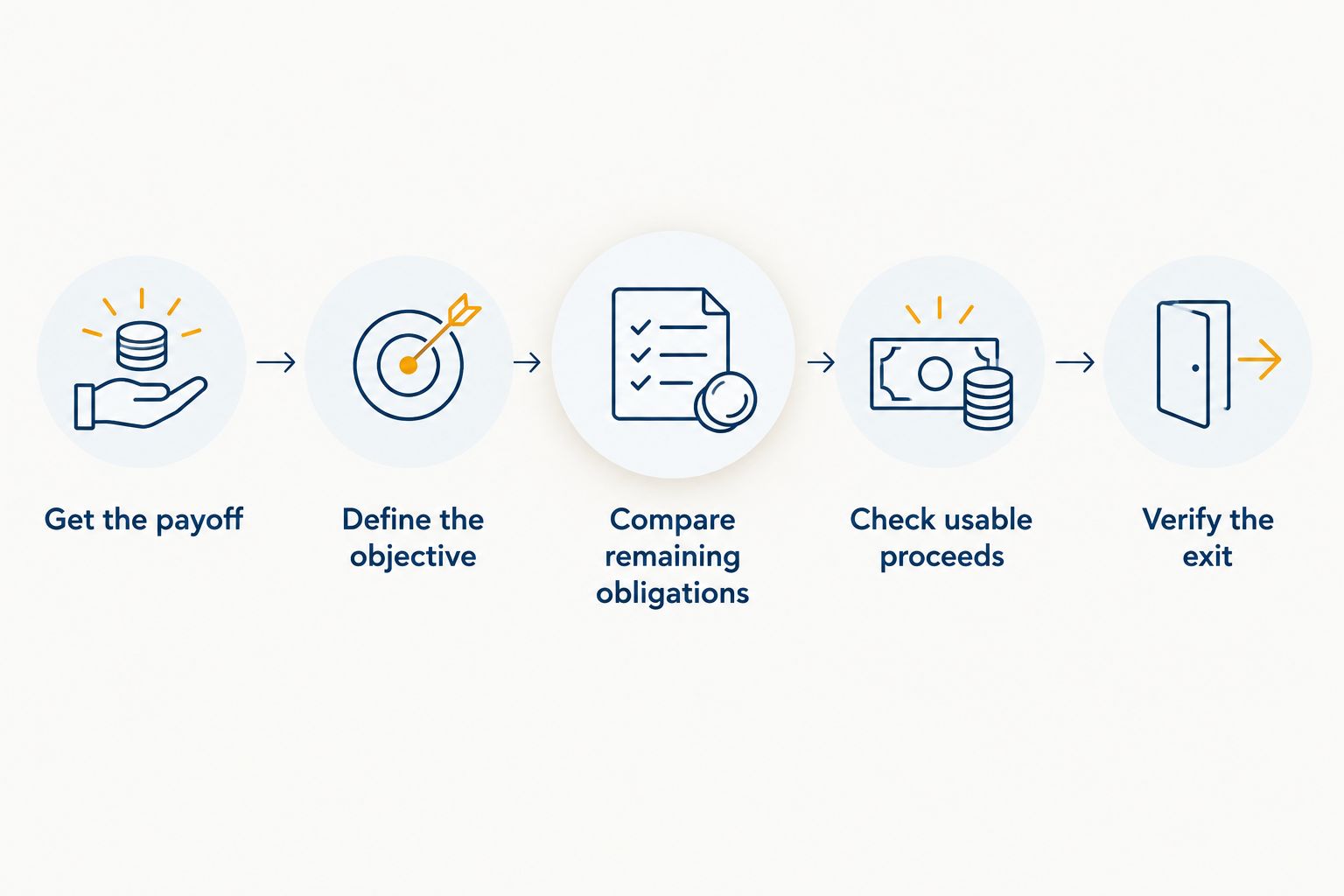
Use this decision sequence for a 2026 MCA review:
- Get the payoff. Request a written payoff statement valid through the expected closing date, including any conditions for an early-payoff reduction.
- Define the objective. Decide whether you need lower collections, lower remaining cost, additional working capital or removal of overlapping obligations.
- Compare remaining obligations. Put the current agreement’s future collections beside the replacement’s full payment or remittance schedule.
- Check usable proceeds. Separate money applied to the existing payoff from money actually available to your business.
- Verify the exit. Confirm who pays the existing funder, when collections stop and what documents establish that the obligation is satisfied.
A factor rate is a multiplier used to calculate a contractual purchase amount; it is not an annual percentage rate. Use the guide to comparing factor rates on a merchant cash advance before treating a smaller multiplier as proof of a better replacement.
Who benefits from comparing before the MCA is paid off?
An early comparison fits a business with a specific, measurable problem. Examples include collections that conflict with payroll, inventory purchases or the time between completing work and receiving customer payments.
The question is not whether the business wants more money. It is whether a different funding structure solves the underlying timing problem without creating an obligation the business cannot support.
Jon Lynch Financial Group is best suited to U.S. business owners generating at least $35,000 per month who want to compare business-funding options. That threshold identifies the primary brokerage audience; it is not an approval standard or a promise of eligibility.
For your 2026 decision, separate these objectives:
- Payment relief: You need collections to fit operating cash flow.
- Cost reduction: You want to reduce the total obligation remaining from today.
- New working capital: You need usable funds after the existing position is paid off.
- Simplification: You want to replace overlapping obligations with a clearly documented structure.
An offer can meet one objective and fail another. Write down the priority before reviewing proposals.
Why does refinancing before payoff matter?
Replacing an MCA resets the decision around money still owed and money still needed. Amounts already remitted are part of your history, but they do not establish whether a new agreement is better from today onward.
This distinction prevents a misleading comparison between the original advance and the replacement’s headline funding amount. Part of the new funding can go toward the existing payoff rather than into your operating account.
Compare the business’s position after closing, not the size of the advertised advance. A replacement that looks larger can provide little usable working capital once the old obligation and closing deductions are accounted for.
Also distinguish a liquidity decision from a savings decision. Accepting a higher remaining cost for manageable collections is a different choice from refinancing to reduce cost; document which choice you are making.
How does replacing an MCA actually work?
A merchant cash advance, or MCA, can be structured as a purchase of future receivables rather than a loan. The written agreement determines the structure, collection mechanics and contractual obligations.
Replacing that agreement with a term loan is not the same transaction as replacing it with another purchase of future receivables. Identify the new product before comparing its terms.
Ask the proposed provider to explain:
- What obligation the new agreement creates.
- How much funding is applied to the existing payoff.
- What deductions reduce the proceeds available to your business.
- Whether collections are fixed or tied to actual receipts.
- What happens when revenue falls.
- How the existing funder’s collection authorization is closed out.
A payoff statement does not itself prove that payment occurred. Request confirmation of satisfaction and clarify the process for any applicable lien release or termination filing.
Keep enough operating cash available for the transition. Do not assume that the new provider’s closing date and the existing funder’s final withdrawal will align without coordination.
How should you compare the remaining numbers?
For a 2026 comparison, build a worksheet from current written documents, not an old sales proposal. Use the same assumed closing date for both paths so the payoff and remaining collections refer to the same point in time.
| Comparison item | Keep the current MCA | Replace the current MCA |
|---|---|---|
| Best for | A manageable obligation with a clear finish | A documented improvement in cost or cash-flow fit |
| Remaining obligation | Collections still due under the existing agreement | Full obligation under the replacement, plus any unresolved old obligation |
| Usable new cash | No proceeds from a new transaction | New proceeds less payoff and deductions |
| Collection burden | Existing schedule and adjustment provisions | New schedule and adjustment provisions |
| Main advantage | Avoids a new financing transaction | Can change the collection structure or provide working capital |
| Main drawback | Preserves the current cash-flow burden | Can extend the obligation or increase remaining cost |
| Evidence needed | Current balance, contract and collection history | Written offer, payoff allocation and closing process |
Use these calculations without substituting estimated contract terms:
Usable new cash = replacement proceeds − existing payoff − deductions at closing.
Remaining outflow after replacement = future payments or remittances under the new agreement + any separate closing payments + any unresolved existing obligation.
Do not count the old payoff twice. If the replacement funds it and the new agreement’s total obligation already includes that financing, adding the payoff again distorts the comparison.
For a loan, compare the disclosed APR alongside total payments and the schedule. For a receivables purchase, understand the purchase amount, remittance mechanics and estimated collection period; a factor rate alone does not provide an annualized comparison.
Is waiting until payoff better than refinancing now?
Waiting is better when the current collections remain manageable and the replacement does not improve your position enough to justify a new obligation. A near-term finish deserves particular attention: replacing it with a longer schedule changes the business’s commitment even if each withdrawal is smaller.
Do not refinance merely because an offer is available. First establish what happens if you keep the existing agreement and fund ordinary operations without another transaction.
Waiting is not the right answer when the business cannot support the current schedule. In that situation, review contractual adjustment rights, discuss the issue with the existing funder and compare replacement options before assuming another advance is the only solution.
Which alternatives should you compare in 2026?
Compare structures by the problem they solve. These are options to evaluate, not statements that your business qualifies or that a provider will accept an MCA payoff.
| Option | Best for | Potential benefit | Main limitation |
|---|---|---|---|
| Keep the existing MCA | Businesses with manageable remaining collections | Avoids starting a replacement transaction | Does not change the current burden |
| Contractual reconciliation | Businesses whose receipts have fallen, where the agreement provides it | Aligns collections with the contract’s adjustment provisions | Depends on the actual agreement and required evidence |
| Term loan | A defined funding need with a planned repayment schedule | Makes scheduled payments easier to model | Requires underwriting and confirmation of permitted proceeds use |
| Business line of credit | Recurring working-capital needs | Allows borrowing within an approved facility | Access, repayment and draw conditions depend on the agreement |
| Another receivables purchase | Businesses evaluating revenue-linked funding | Can provide replacement funding or working capital | Can extend collections and add cost |
| Invoice factoring | Businesses with eligible unpaid business invoices | Uses invoice receivables as the funding basis | Eligibility and customer-payment arrangements require review |
Contractual reconciliation means requesting an adjustment under the agreement’s provisions to reflect actual receipts. It is not the same as refinancing, and it is not a universal right across every contract.
Choose the structure that matches the cash-flow problem, not the one with the simplest sales pitch. Confirm that any proposed loan, credit facility or receivables transaction permits the intended payoff and business use.
Why does the right refinancing time vary?
There is no single payoff percentage that establishes the right refinancing date. Your decision depends on documented terms and operating needs:
- Existing payoff terms: An early closeout must be evaluated using the actual written payoff, including any applicable reduction.
- Replacement collections: Frequency, amount and adjustment mechanics determine the effect on operating cash.
- Revenue timing: Customer receipts need to support payroll, suppliers and the proposed collection schedule.
- Net working capital: Proceeds used to retire the old position are not available for new business expenses.
- Qualification and structure: Credit, bank activity, existing obligations and product rules belong in the underwriting discussion.
- Closing coordination: Payoff timing, collection cessation and applicable releases affect whether the transition is complete.
Review these factors together. An attractive collection schedule does not compensate for an unclear payoff process.
What risks should stop you from signing?
Pause when the proposal lowers withdrawals but does not clearly disclose the full new obligation. Also pause when you cannot determine whether the old funder will be paid in full.
Other reasons to stop and clarify include unexplained deductions, conflicting payment schedules, unclear default provisions, restrictions on additional financing and uncertain personal-guarantee obligations. Have qualified legal counsel review provisions you do not understand.
Does a lower payment mean refinancing saves money?
A lower payment does not establish savings. Compare the total remaining outflow and the length of the new obligation; spreading collections over more time can reduce each withdrawal while increasing what remains payable overall.
Is adding another MCA the same as refinancing?
Adding another MCA is not refinancing if the existing obligation remains open. You then have overlapping collections rather than a completed replacement, so evaluate the combined burden before proceeding.
Should you stop withdrawals while arranging a replacement?
Do not assume you can stop contractual withdrawals without consequences. Review the agreement, communicate with the funder and obtain legal advice before changing authorized collections.
What documents should you prepare before requesting options?
Prepare a clear 2026 funding file so each provider evaluates the same business position. Ask each prospective provider for its current document requirements rather than assuming a universal checklist guarantees approval.
Start with:
- The existing MCA agreement and any amendments.
- A current payoff statement and collection history.
- Business bank statements and a list of existing financing obligations.
- A cash-flow forecast showing operating expenses and expected customer receipts.
- The business purpose for any additional working capital.
- Written replacement proposals, including deductions and collection schedules.
- Relevant financial statements, tax records or receivables reports requested for underwriting.
Show where deposits come from. Distinguish ordinary business revenue from financing proceeds, transfers and other non-operating deposits so the cash-flow comparison reflects the business itself.
Ask every provider the same closing question: what written evidence will show that the old obligation is satisfied and its collections have ended? Keep that answer with the proposal.
What does the broker handle, and who makes the funding decision?
Jon Lynch Financial Group is a broker, not a direct lender. Its business-funding work helps owners compare options through third-party lenders and funders; those providers conduct underwriting and establish applicable product terms.
Revenue-based financing can be structured as a purchase of future receivables rather than a loan. Products discussed here are for business purposes, and approval, amounts, rates, decisions and funding times are not guaranteed.
FAQ
When should I refinance an MCA before payoff?
Refinance before payoff when the documented replacement improves your remaining cost or cash-flow position and closes the existing obligation on acceptable terms. Compare the written payoff, usable proceeds and full new collection schedule before signing.
Do I need to pay down a specific percentage before refinancing an MCA?
No single payoff percentage establishes the right refinancing date. Eligibility depends on the proposed provider’s current program and underwriting, while the business decision depends on your remaining obligations and cash flow.
Does paying off an MCA early reduce what I owe?
An early payoff does not automatically reduce your contractual obligation. Request a written payoff statement and verify any reduction against the agreement and its conditions.
Is refinancing an MCA the same as consolidating MCAs?
Refinancing replaces an existing obligation; consolidation brings multiple obligations into a replacement structure. Neither description proves the old agreements will close, so verify payoff allocation and satisfaction documents.
Can I replace an MCA with a business loan?
A business loan is an option to evaluate, not an assured exit. Confirm eligibility, permitted use of proceeds, total payments and the process for paying off the MCA.
Will refinancing give my business additional working capital?
Refinancing provides additional working capital only if proceeds remain after the existing payoff and closing deductions. Compare usable cash rather than the headline funding amount.
Does Jon Lynch Financial Group directly fund MCA refinancing?
Jon Lynch Financial Group is a broker, not a direct lender. Business-purpose funding is subject to third-party underwriting and product terms, with no guaranteed approval or outcome.
Related guides
- How to get out of a stacked merchant cash advance position
- Business line of credit lenders
- Revenue-based financing vs. merchant cash advance
One last thing: define what success means before applying
A smaller withdrawal is a cash-flow result, not proof of a cheaper transaction. For your 2026 review, write one sentence defining success: lower remaining cost, manageable collections, usable working capital or a documented exit from overlapping obligations.
Then collect your payoff statement and compare proposals against that objective. U.S. businesses generating at least $35,000 per month should Compare Business Funding Options; businesses below $35,000 per month should use Explore Self-Serve Funding. Both routes require evaluation of the applicable terms, not an assumption of approval.