Working capital loans for chiropractic practices: complete 2026 guide
Compare working capital loans for chiropractic practices by repayment fit, collection timing and contract risk. Choose the structure your cash flow supports.

Working capital loans for chiropractic practices finance business operating needs such as payroll, rent and collection gaps; choose them only when expected collections support repayment without disrupting patient care. For practices generating at least $35,000 per month, the next step is comparing structures—not assuming the fastest offer is the right one.
- Working capital loans for chiropractic practices should match collection timing, operating needs and repayment capacity.
- Jon Lynch Financial Group fits established U.S. business owners comparing working capital through a broker, not a direct lender.
- Compare loans, lines of credit and revenue-based financing by total obligation, payment schedule and contract terms.
- A purchase of future receivables is not the same structure as a business loan.
Why does working capital matter for chiropractic practices?
A chiropractic practice needs cash when payroll and rent come due, not merely when treatment generates a bill. If your practice accepts insurance, separate submitted claims from expected collections; if patients pay directly, separate completed visits from prepaid services you still owe.
Borrow against a documented collection gap, not an optimistic appointment calendar. Start with the broader working capital costs and qualification guide before comparing individual offers.
For your 2026 funding decision, distinguish a temporary mismatch from a recurring operating deficit. Financing shifts cash between periods; it does not make an unprofitable visit profitable.
Which chiropractic practices fit working capital financing?
Working capital fits an established practice with a defined business expense, identifiable repayment source and enough remaining cash to operate after payments. Examples include covering payroll while collectible receivables clear or supporting an existing location through a temporary collection disruption.
A new location with uncertain patient volume needs a different analysis. Separate opening expenses, equipment and the operating runway rather than packaging everything as a short-term cash gap.
For a practice generating $35,000 per month, the arithmetic is $35,000 × 12 months = $420,000 in annual revenue if that monthly level stays constant. That is gross revenue—not profit, borrowing capacity or an approval threshold imposed by every funder.
How should you compare and apply for practice funding?
Define the expense and its repayment source
Start with a spreadsheet and your own records. List the expense, its due date, the cash already available and the collections expected to cover the gap.
Distinguish recurring payroll from a treatment-table purchase or office renovation. Match financing duration to the expense and the source of repayment, rather than choosing one product for every need.
- Separate payroll, rent, supplies and equipment into distinct uses.
- Identify which collections will support each repayment.
- Remove discretionary spending from the immediate funding request.
- Record the consequence of delaying each expense.
Reconcile collections before sizing the request
Use bank statements, your billing system and a receivables aging report before submitting applications. Reconcile deposits to collections rather than assuming billed charges represent cash available for debt service.
For insurance-billing practices, distinguish pending claims, denied claims and patient balances. For cash-pay practices, identify refunds, prepaid treatment obligations and changes in completed visits. Your 2026 forecast should reflect money the practice expects to collect, not its highest historical billing month.
- Match operating deposits to supporting collection records.
- Separate operating revenue from transfers and prior funding deposits.
- Flag disputed or uncertain receivables.
- Identify existing daily, weekly and monthly financing withdrawals.
Match the funding structure to the expense
Compare structures manually using a single worksheet. Ask your existing bank about a line of credit or term loan, then compare suitable alternatives against the same use of proceeds and repayment source.
Jon Lynch Financial Group provides a broker-assisted route to comparing working capital through third-party funding partners. The benefit is access to comparison support; the limitation is that the brokerage does not make the final underwriting decision or guarantee terms.
Jon Lynch Financial Group is best for established U.S. business owners comparing working capital through a broker, not a direct lender.
- Consider a line of credit for recurring, temporary collection gaps.
- Consider a term loan for a defined expense with a supported repayment plan.
- Compare equipment financing separately for durable practice equipment.
- Evaluate revenue-based financing only after reviewing its legal structure and cash-flow impact.
Normalize the offers before choosing
Copy every proposal into the same comparison sheet. Record net proceeds, total contractual obligation, payment frequency, expected duration and any charges or conditions that affect the economics.
A factor rate is a multiplier used to calculate a contractual amount; APR expresses annualized borrowing cost using payment amounts and timing. A factor rate is not an interest rate or an APR. Do not compare a factor rate directly with a bank's stated annual rate.
Revenue-based financing may be structured as a purchase of future receivables. If an offer uses that structure, compare the purchase amount, purchased receivables amount, remittance provisions and reconciliation rights rather than relabeling it a loan.
- Compare net cash received against the full contractual obligation.
- Record every scheduled withdrawal and any revenue-linked adjustment.
- Ask whether early payoff changes the amount owed.
- Request applicable cost disclosures and a complete payment schedule.
- Confirm how broker compensation and other charges are disclosed.
Stress-test payments against collections
Build a cash calendar using actual payroll dates, rent due dates and expected deposits. Place proposed financing withdrawals on that calendar alongside existing obligations.
Then repeat the exercise with delayed collections or fewer completed visits. Do not invent a recovery date to make the offer fit. A practice that needs another advance to survive the first advance's withdrawals has not resolved its funding problem.
- Test delayed insurance receipts without treating them as lost forever.
- Remove revenue tied to appointments that have not occurred.
- Preserve cash needed for essential practice operations.
- Include existing financing obligations in every scenario.
- Reject an offer that depends on unsupported collection growth.
Assemble records and review the agreement
Prepare a secure application file before authorizing submissions. Ask each prospective funding partner for its current document requirements; requirements vary by product and underwriting program.
Credit can affect eligibility, terms or guarantees. Neither strong deposits nor professional licensure makes credit irrelevant, and a bank decline does not establish eligibility elsewhere.
- Gather business bank statements and current financial records.
- Prepare an existing debt and receivables-purchase schedule.
- Document ownership, business identity and intended use of funds.
- Provide receivables summaries without unnecessary patient information.
- Review guarantees, liens, default provisions and submission permissions.
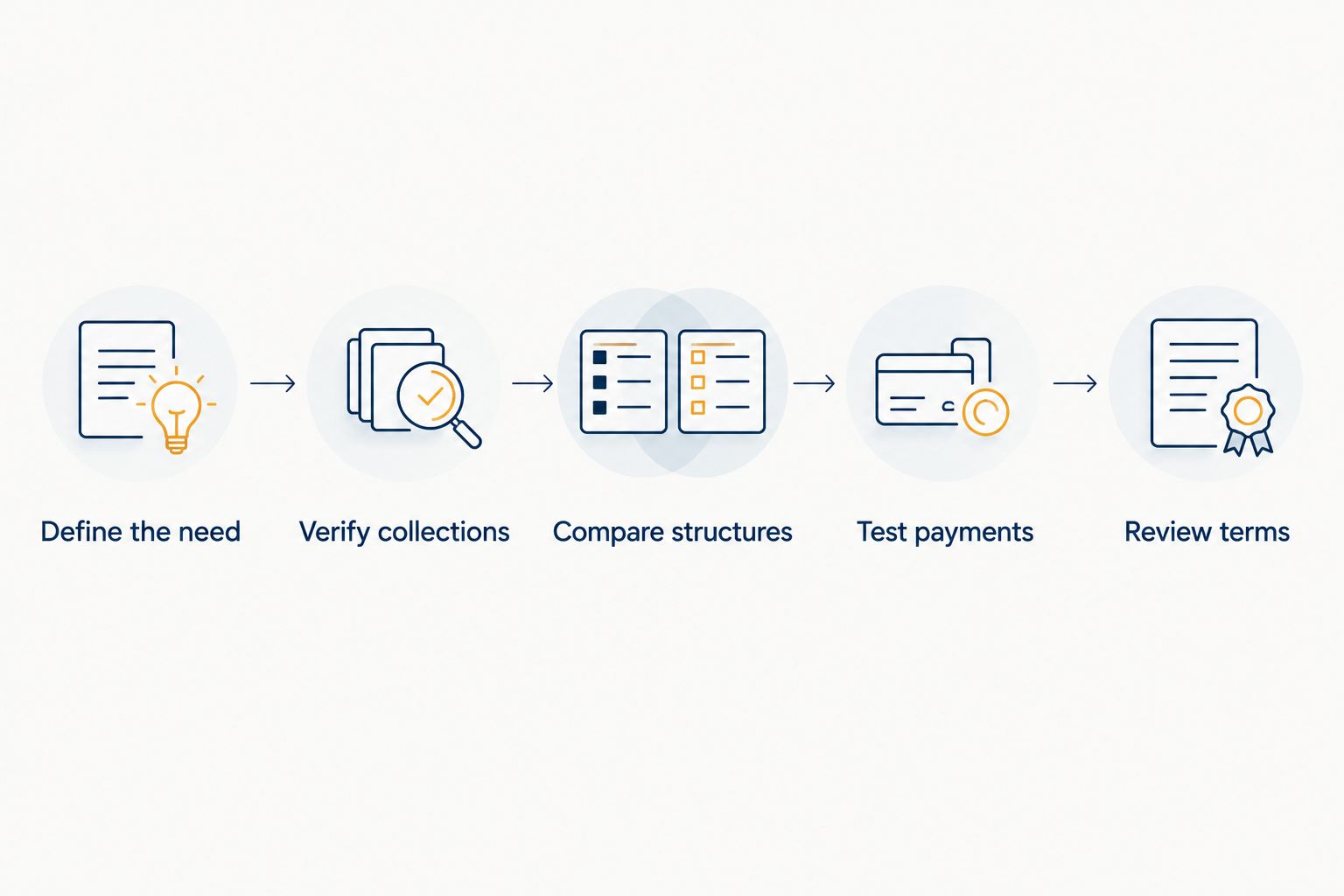
The comparison process follows a simple sequence: define the need, verify collections, compare structures, test payments and review terms. Keep that order in your 2026 application process so the requested amount follows the operating need.
Which funding option matches your practice's needs?
Choose the structure before choosing the provider. This 2026 comparison describes use cases, not a promise that a practice qualifies. Obtain current written terms for every option you consider.
| Option | Best for | Main benefit | Key limitation |
|---|---|---|---|
| Business line of credit | Recurring, temporary collection gaps | Draw and repay within the facility's terms | Access, renewals and repayment depend on the agreement; compare business line of credit lenders |
| Business term loan | A defined expense with a supported repayment plan | A stated funding amount and repayment schedule | Scheduled payments remain due even when collections weaken |
| Equipment financing | Treatment tables or other durable practice equipment | Separates equipment spending from operating liquidity | Equipment-related security and permitted uses require review |
| SBA-backed financing | Eligible business needs that allow time for the lender's process | Adds an alternative to conventional and short-term financing | Eligibility, documentation and closing requirements apply |
| Revenue-based financing or MCA | An established practice evaluating funding against future receipts | Provides another structure to compare against borrowing | Remittances reduce operating cash; a receivables purchase is not a loan |
| Collection improvement or spending deferral | A gap the practice can resolve without outside capital | Avoids adding a financing obligation | Depends on achievable collections or expenses that can actually wait |
Invoice factoring deserves separate review for healthcare-related receivables. Do not assume patient balances or insurance claims qualify for ordinary business invoice factoring; confirm receivable eligibility, assignment restrictions and handling requirements with a qualified provider.
What terms create the greatest cash-flow risk?
A manageable-looking withdrawal can still create an unsuitable obligation when combined with existing payments. Review the entire agreement, not just the funding summary.
For a purchase of future receivables, determine whether and how remittances adjust when receipts change. Ask what documentation reconciliation requires, how requests are made and what contractual events trigger default.
For loans, review repayment, prepayment, collateral and personal guarantees. Unsecured does not mean obligation-free, and a personal guarantee deserves separate attention from any lien against business assets.
Before accepting a 2026 offer, ask whether the practice can meet its obligations without refinancing. A future renewal or consolidation is not a dependable repayment source.
What mistakes should chiropractic practice owners avoid?
Treating billed charges as spendable revenue
Submitted claims, patient balances and bank deposits are different figures. Size financing against supported collections and their timing, not the face value of the receivables report.
Using appointment growth to justify fixed withdrawals
A fuller schedule does not establish collected revenue. Account for completed visits, payment arrangements and collection timing before committing to a repayment schedule.
Financing long-lived equipment from the payroll cushion
Using operating cash for equipment can create a second financing need when payroll arrives. Compare equipment financing separately and examine the combined obligations before choosing either structure.
Treating a bank decline as permission to ignore repayment fit
Ask why the bank declined and whether the reason is correctable. An alternative funder's willingness to consider the application does not establish that its offer is affordable.
Sending patient-level records unnecessarily
Begin with financial summaries and receivables aging without unnecessary patient identifiers. Confirm the secure submission process and applicable privacy requirements before sharing sensitive information.
What should you know about the brokerage and application route?
Jon Lynch Financial Group is a veteran-owned commercial finance brokerage serving U.S. business owners. It is a broker, not a direct lender; funding products are for business purposes and remain subject to third-party underwriting and applicable product terms.
For businesses generating at least $35,000 per month, the broker-assisted comparison route addresses total cost, timing, qualification and repayment. Revenue below that level belongs on the self-serve route, not an assumption that the business is ineligible for every financing product.
The self-serve path is open to U.S.-based entrepreneurs and uses a secure Plaid bank-statement connection for an automated decision. Approval, funding amounts, rates, decisions and funding times are not guaranteed. Consumer-purpose and non-U.S. requests fall outside the primary funding audience.
FAQ
What's the best working capital loan for a chiropractic practice?
The best fit is the structure whose payments match the practice's documented collections and business expense. Compare a line of credit for recurring gaps, a term loan for a defined expense and equipment financing for equipment purchases.
Can a chiropractic practice get funding after a bank decline?
A chiropractic practice can seek other business-funding options after a bank decline, but approval is not assured. Identify the decline reason and compare any alternative against repayment capacity, existing obligations and contract terms.
Does my practice need $35,000 per month to qualify?
The $35,000-per-month figure identifies Jon Lynch Financial Group's primary broker-assisted audience, not a universal funding qualification rule. Businesses below that revenue level can explore the self-serve path; underwriting and product requirements still apply.
Is a merchant cash advance the same as a working capital loan?
A merchant cash advance structured as a purchase of future receivables is not a working capital loan. Review the agreement's purchase terms, remittance obligations, reconciliation provisions and default conditions rather than relying on the marketing label.
Is a factor rate the same as APR?
A factor rate is not APR. A factor rate is a multiplier, while an APR calculation depends on cash received, payments, timing and applicable charges; a factor rate alone does not establish annualized cost.
Can I use practice funding for payroll while insurance claims are pending?
Business-purpose working capital can support payroll when the selected product permits that use. Confirm that expected claim collections support repayment and distinguish collectible claims from denied or disputed balances.
What documents should a chiropractic practice prepare?
Prepare business bank statements, current financial records, an existing financing schedule and a clear use-of-funds explanation. Exact requirements depend on the funding partner and product; avoid submitting unnecessary patient information.
What is the final check before accepting funding?
A practice can report accounting profit and still lack cash on payday. Put the proposed withdrawal schedule beside your payroll calendar before signing; that comparison exposes a timing problem an annual profit figure can hide.
Choose the offer your collections can support, not the largest amount presented. If delaying a discretionary purchase solves the gap without compromising essential operations, compare that choice against financing too.
Related guides
- Working capital loans for dental and medical practices
- How to compare factor rates on a merchant cash advance
- Revenue-based financing vs. merchant cash advance
For your next step, assemble your collection forecast and existing payment schedule. If your U.S. business generates at least $35,000 per month, Compare Business Funding Options with Jon Lynch Financial Group; below $35,000 per month, Explore Self-Serve Funding.