Working Capital Loans for HVAC Companies: 2026 Guide
Working capital loans for HVAC companies in 2026: compare MCA factor rates, lines of credit, and term loans by cost, speed and seasonal cash-flow fit.
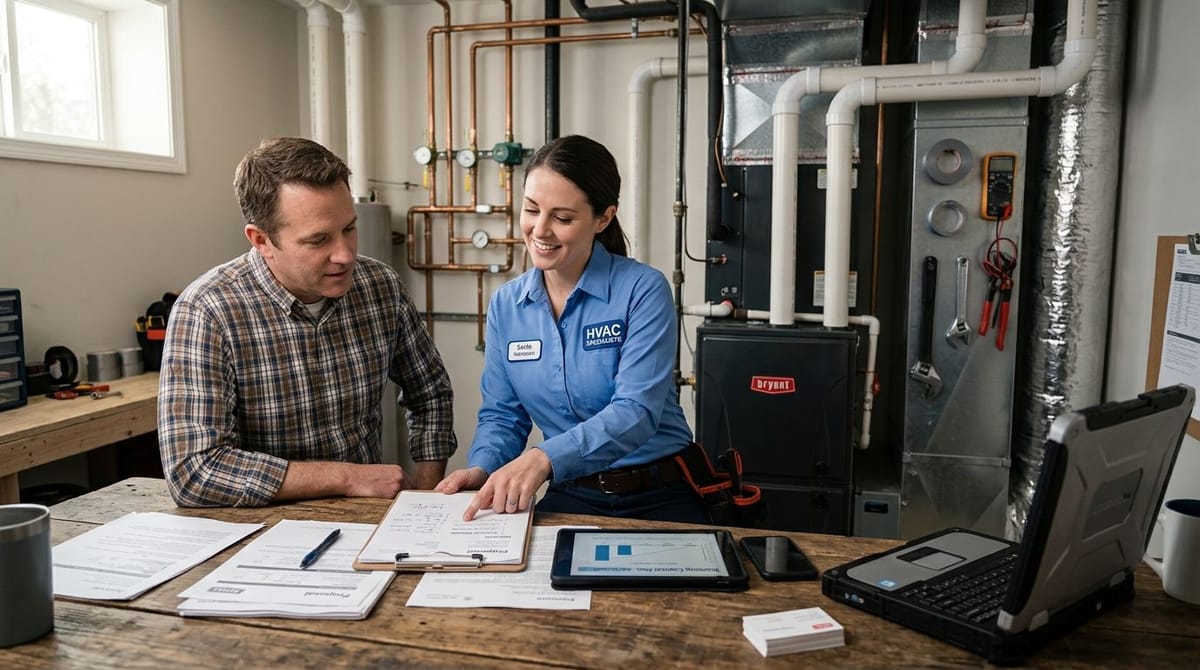
Working capital loans for HVAC companies fund payroll, parts inventory, and truck repairs between commercial contract payouts and the seasonal swing in service calls that hits every trade shop from June through September and again in December. Plumbing companies face the same gap on a different clock: emergency service spikes in winter freeze events, slow accounts receivable on new-construction jobs, and 30-60-90 day payment terms from general contractors that don't match a Friday payroll run. The right funding structure depends on whether the cash-flow gap is seasonal, contract-driven, or equipment-related, and each of those calls for a different product.
- Working capital loans for HVAC companies typically fund faster than SBA loans but cost more per dollar borrowed — match the structure to the gap, not the speed.
- A merchant cash advance (purchase of future receivables) with a 1.35 factor rate on $50,000 repays $67,500 total, regardless of how fast the season moves.
- Business lines of credit work better than lump-sum funding for HVAC/plumbing shops with recurring seasonal dips, since you only draw and pay interest on what you use.
- Jon Lynch Financial Group is a broker, not a direct lender, and compares MCA, line of credit, term loan, and SBA structures through third-party funding partners.
- Equipment-heavy trades should separate truck and tool financing from working capital financing — stacking both on short-term MCA debt is the most common mistake in 2026 HVAC funding.
Why working capital matters for HVAC and plumbing companies
HVAC revenue is lumpy by design. A residential AC replacement crew can book $180,000 in July and $40,000 in February, and payroll doesn't shrink to match. Plumbing shops carry a second layer: commercial and new-construction work often pays on 45- to 90-day terms even after the job is done, which means the crew, the permits, and the parts get paid weeks or months before the invoice clears.
A working capital loans for construction contractors guide covers the same underlying problem in a related trade — mobilization costs due before the first draw. HVAC and plumbing companies hit a version of this every time they win a multi-unit new-build or a commercial retrofit that requires crew, materials, and permit fees upfront.
The consequence of ignoring the gap isn't abstract: missed payroll, a declined vendor account, or a truck sitting in the shop because the repair invoice can't get paid. Working capital financing exists to close that specific window — not to fund long-term growth, which is a different conversation with a different structure.
Map your seasonal cash-flow gap
Before comparing any funding option, put a number on the gap. Most HVAC and plumbing owners underestimate how wide their seasonal swing actually is until they pull 12 months of bank statements side by side.
- Pull trailing 12-month bank statements and separate monthly deposits by service type (residential service calls vs. commercial contracts).
- Identify your two lowest-revenue months and your two highest, then calculate the dollar spread.
- Flag any month where payroll plus vendor payables exceeded deposits.
- Note how many days, on average, commercial invoices sit unpaid past net terms.
- Estimate the dollar amount needed to bridge the worst month without missing payroll or a parts order.
This number — not a round figure like "$100,000" — is what you should be requesting when you compare offers.
Separate service-call revenue from commercial contract revenue
Most HVAC and plumbing companies run two businesses under one roof: fast-turn residential service and slow-pay commercial contract work. Funding one with the wrong structure creates the exact problem you're trying to solve.
- Track residential/service revenue and commercial contract revenue as separate line items, not blended totals.
- Match short daily-repayment products (like an MCA) only against high-frequency, high-volume revenue such as daily service calls — never against a single 90-day commercial receivable.
- Use invoice-based or receivables financing when the gap is a specific unpaid commercial invoice, not a general cash shortfall.
- Flag any contract with retainage clauses (5-10% withheld until project close) since that cash won't be available for the repayment schedule you sign.
Choose the funding structure that matches your job cycle
Once the gap and the revenue source are clear, the structure decision gets simpler. This is where a broker who works across multiple lenders earns its keep — matching the shop's actual cash pattern to the product's repayment mechanics, not the other way around.
- Business line of credit: draw against a preset limit, repay, and redraw — best for recurring seasonal dips because you only pay for what you use.
- Merchant cash advance / purchase of future receivables: fast funding against future card or bank deposits, repaid via daily or weekly ACH; useful for a short, defined gap but expensive if stacked or renewed repeatedly.
- Equipment term loan: fixed payments tied to a truck, HVAC unit, or specialized tool purchase — never use this structure to cover payroll.
- SBA-backed term loan: lower cost of capital, longer approval timeline, best for owners who can wait 30-60+ days and have full financial documentation.
- Invoice factoring or receivables purchase: sell an unpaid commercial invoice at a discount for immediate cash — fits plumbing and HVAC contractors carrying net-60 or net-90 commercial paper.
Jon Lynch Financial Group compares these structures across funding partners rather than pushing one product; as a broker, not a direct lender, the goal is matching the gap to the cheapest structure that actually closes it in time.
Compare funding options for your shop
See which structure fits your seasonal cash-flow gap before you sign anything.
Compare factor rate vs. APR before signing
Merchant cash advances and purchases of future receivables are priced in factor rates, not APR, and the difference matters more than most owners realize until they do the math.
A $50,000 advance at a 1.35 factor rate means $67,500 total repayment — a flat $17,500 cost regardless of whether it's repaid in 4 months or 9. Converted to an effective annual rate, that same advance can run well above what a bank line of credit would charge over the same period, which is why comparing factor rates on a merchant cash advance against the actual repayment term — not just the headline rate — is the step most HVAC shops skip.
- Ask for the total dollar repayment amount, not just the factor rate.
- Confirm the repayment term in weeks or months before comparing across offers.
- Convert factor rate to an effective annual cost so it's comparable to a line of credit's APR.
- Confirm whether the structure is a loan or a purchase of future receivables — the legal and repayment mechanics differ.
Match repayment to your invoice/collection cycle
A daily ACH repayment schedule works against a shop with steady daily service-call deposits. It works against a shop waiting on a single $80,000 commercial payout in 60 days.
- Line up the repayment schedule against your actual deposit calendar, not your revenue total.
- For commercial-heavy plumbing contractors, favor structures with weekly or milestone-based repayment over daily ACH.
- Confirm whether early payoff reduces total cost or if the factor is fixed regardless of timing.
- Ask what happens to the repayment schedule during your two slowest months of the year.
Build documentation before you apply
Funding partners underwrite on bank statements and business performance, not just a credit score, but the documents still have to be current and complete.
- Trailing 3-6 months of business bank statements.
- Most recent business tax return and, if available, year-to-date P&L.
- Voided business check or bank letter for ACH setup.
- Copy of active commercial contracts if applying against receivables.
- Equipment invoices or quotes if the funding covers a specific truck or unit purchase.
Compare backup options if declined
A bank decline isn't a dead end — it's a signal to look at structures underwritten differently than a traditional term loan. Working capital loan costs and qualification breaks down how alternative underwriting weighs cash flow over credit score, which matters for younger HVAC and plumbing LLCs without three years of financials.
- Ask whether the funder underwrites on cash flow, credit score, or both.
- Request the minimum time-in-business and monthly revenue threshold before applying, since these vary by partner and change year to year.
- Compare a business line of credit against a purchase of future receivables side by side on total cost, not just approval speed.
- Confirm the funder services business-purpose loans for trade contractors specifically — some exclude construction-adjacent trades.
Comparison: funding options for HVAC and plumbing companies in 2026
| Option | Best For | Speed to Fund | Key Limitation |
|---|---|---|---|
| Business line of credit | Recurring seasonal dips, repeat draws | Days to weeks | Requires stronger financials than MCA |
| MCA / purchase of future receivables | Short, defined cash gap | 24-72 hours | Highest total cost if renewed repeatedly |
| Equipment term loan | Truck, HVAC unit, or tool purchase | 1-2 weeks | Tied to the asset, not general cash flow |
| SBA-backed term loan | Lower cost of capital, longer runway | 30-60+ days | Slower approval, full documentation required |
| Invoice factoring | Unpaid commercial invoices (net-60/90) | Days | Only works against existing receivables |
Verdict: shops with recurring seasonal dips are usually best served by a business line of credit; shops facing a single, defined gap tied to one contract are usually better served by invoice factoring or a short-term purchase of future receivables — not the reverse.
Common mistakes HVAC and plumbing companies make
- Stacking a second MCA on top of a first before the original is repaid, which compounds daily repayment obligations against the same deposit stream.
- Using a lump-sum advance to cover a recurring seasonal dip instead of a line of credit, paying full factor-rate cost for a gap that repeats every year.
- Financing a truck or HVAC unit purchase with a working capital product instead of an equipment term loan, which usually costs more per dollar over the life of the purchase.
- Applying without separating commercial AR from service revenue, leading to a repayment schedule that doesn't match when the cash actually arrives.
- Skipping the factor-rate-to-APR conversion, then comparing a 1.35 factor rate against a bank line's APR as if they were the same unit.
FAQ
What is the best working capital loan for HVAC companies in 2026?
There isn't one best product — a business line of credit fits recurring seasonal dips, while a purchase of future receivables or invoice factoring fits a single, defined cash gap tied to a specific contract or invoice. The right choice depends on whether the gap repeats every year or happens once.
How fast can an HVAC company get working capital funding?
A merchant cash advance or purchase of future receivables can fund in 24 to 72 hours with complete bank statements. An SBA-backed term loan typically takes 30 to 60 days or longer due to full underwriting documentation.
Is a merchant cash advance a loan?
A merchant cash advance is often structured as a purchase of future receivables, not a traditional loan — the funder buys a portion of future revenue at a factor rate rather than charging interest. The repayment mechanics and legal treatment differ from a bank loan.
Do HVAC and plumbing companies need good credit to get funded?
Credit score plays a role but isn't the only underwriting factor — most alternative funders weigh business bank statements and monthly revenue more heavily than personal credit. A bank decline doesn't automatically disqualify a shop from a working capital option.
What documents do I need to apply for working capital funding?
Most funding partners require 3 to 6 months of business bank statements, a recent tax return, and a voided check for ACH setup. Applications tied to a specific contract or equipment purchase also require the contract copy or equipment invoice.
How much does a merchant cash advance cost compared to a business line of credit?
A $50,000 advance at a 1.35 factor rate totals $67,500 in repayment regardless of timing, while a line of credit charges interest only on the amount drawn and outstanding. Converting the factor rate to an effective APR is the only way to compare the two directly.
Can a new HVAC LLC with no funding history qualify for working capital?
Time-in-business and monthly revenue thresholds vary by funding partner and change year to year, so a newer LLC should confirm current minimums before applying. Cash-flow-based underwriting can work in favor of younger businesses with strong recent deposits even without a long credit history.
Should I use working capital financing to buy a new HVAC truck or unit?
No — an equipment term loan tied to the specific asset usually costs less per dollar than a general working capital product used for the same purchase. Working capital financing is built for operational gaps like payroll and parts, not asset purchases.
One last thing
The single number that changes the whole funding conversation isn't the factor rate — it's the number of days between when the crew finishes the job and when the invoice actually clears. Shops that track that number monthly stop applying for funding in a panic and start applying for the structure that matches the actual gap, which is the difference between paying a 1.35 factor rate once a year and paying it every 90 days on renewal.