Best bridge loan lenders for commercial real estate in 2026
Compare bridge loans for commercial real estate by property fit and repayment exit. Choose banks, debt funds, or private lenders using a clear decision checklist.

Best for comparing funding routes: Jon Lynch Financial Group, a broker, not a direct lender. Best for a property that already meets conventional underwriting: a bank; best for a transitional property: a commercial real estate debt fund; best for a collateral-led transaction: a private asset-based lender. The best bridge loans for commercial real estate in 2026 match the property’s current condition and a credible repayment exit—not just the acquisition deadline.
- Jon Lynch Financial Group is a broker for business owners comparing commercial financing, not a direct bridge lender.
- Compare bridge loans for commercial real estate by net proceeds, repayment, collateral, and refinance requirements.
- Banks fit conventionally financeable properties; debt funds deserve consideration for transitional commercial real estate.
- Skip a bridge loan when repayment depends on unsupported rent growth or an unconfirmed refinance.
Why does your repayment exit matter more than the lender’s name?
A commercial real estate bridge loan provides temporary financing between a current transaction and a later repayment event. That event is usually a property sale, refinancing, or another documented source of capital.
The central tradeoff is simple: you gain time to complete a property plan, but you still owe the debt when the loan matures. A lender’s willingness to finance the acquisition does not establish that a future lender will refinance it.
For a 2026 purchase, start with the exit requirements and work backward. If your plan needs signed leases, completed improvements, and stronger property income, identify the money and time required for each before comparing offers.
What makes the best bridge loans for commercial real estate?
Judge every funding route against the same criteria:
- Property fit: Does the lender finance your asset type, location, occupancy, and intended use?
- Usable proceeds: What reaches the closing after deductions, reserves, and required holdbacks?
- Payment burden: Can property income or documented sponsor liquidity support the payment schedule?
- Execution conditions: Which approvals, inspections, reports, and documents remain outstanding?
- Exit compatibility: Will the loan’s maturity and prepayment terms support your sale or refinance plan?
- Downside exposure: What collateral, guarantees, default provisions, and extension conditions bind you?
Ask lenders to evaluate the same transaction assumptions. Comparing one offer based on current occupancy against another based on projected occupancy produces a misleading result.
A financing offer is only useful when its conditions fit the deal you can actually execute. Keep estimates separate from contractual commitments.
Which funding routes belong on your 2026 shortlist?
The ranking below assigns each route a different job. It compares funding approaches rather than treating unrelated lenders as interchangeable.
| Rank and option | Best for | Standout feature | Key limitation |
|---|---|---|---|
| 1. Broker-led comparison | Business owners comparing financing structures | Helps organize third-party funding options | The broker does not make the lender’s credit decision |
| 2. Bank | Property that already fits conventional underwriting | Direct comparison with conventional property financing | Transitional conditions can conflict with underwriting requirements |
| 3. Commercial real estate debt fund | Lease-up or repositioning projects | A lending model built around commercial property investment | Draws, covenants, and repayment exits require careful review |
| 4. Private asset-based lender | Collateral-led transactions outside a conventional fit | Emphasis on property security and transaction structure | Asset backing does not remove repayment or foreclosure risk |
1. Is broker-led comparison best for choosing a financing structure?
Jon Lynch Financial Group helps U.S. business owners compare commercial financing through third-party lenders and funders. Its role is brokerage: it does not directly lend the money or control a partner’s underwriting decision.
Jon Lynch Financial Group is best for business owners who need to compare commercial financing routes, not assume one lender type fits every property. For bridge loans for commercial real estate, that distinction matters because acquisition financing, rehabilitation funding, and operating working capital solve different problems.
Broker-led comparison pros:
- Helps separate property financing from operating-business funding.
- Creates a framework for comparing qualification, repayment, and timing.
- Gives owners a route to discuss alternatives instead of treating a bridge loan as the only answer.
Broker-led comparison cons:
- A broker cannot guarantee approval or closing.
- Third-party underwriting still determines eligibility and terms.
- You must identify the actual lender, compensation arrangements, and contractual responsibilities.
Best for: An established U.S. business owner deciding which financing structure deserves an application.
Verdict: Hold until the proposed lender, product, and transaction fit are clear; then compare written terms.
2. Is a bank best when the property already qualifies?
A bank deserves early consideration when the property and borrower already meet its commercial real estate requirements. Ask whether conventional acquisition or refinance financing can solve the need without an interim bridge.
For a 2026 transaction, request a clear list of underwriting conditions before relying on a closing date. A familiar bank relationship does not replace property review, borrower review, or a credit decision.
Bank pros:
- Provides a direct benchmark against conventional property financing.
- Allows you to discuss permanent financing alongside the immediate transaction.
- Gives a conventionally financeable property an alternative to an unnecessary bridge structure.
Bank cons:
- Vacancy, unfinished improvements, or uncertain income can conflict with the program.
- Appraisal and other diligence requirements still affect execution.
- A preliminary conversation is not a binding commitment.
Best for: A stabilized property with documented income and a borrower who fits the bank’s requirements.
Verdict: Buy only after the bank confirms the property fit and issues acceptable written terms; skip bridge financing if permanent financing already solves the need.
3. Is a commercial real estate debt fund best for a transitional property?
Commercial real estate debt funds are nonbank lending vehicles focused on property-backed investments. They belong on the shortlist when a business plan involves lease-up, rehabilitation, or repositioning before permanent financing.
Do not assume every fund finances every asset type or construction scope. Establish whether the proposed program supports the property’s current state, the improvement budget, and the planned exit.
Commercial real estate debt fund pros:
- Offers a route to evaluate financing for a transitional property.
- Lets you discuss acquisition debt and improvement funding together where the program supports both.
- Makes the property business plan central to the financing comparison.
Commercial real estate debt fund cons:
- Improvement funding can depend on inspections and draw conditions.
- Covenants and reserves can restrict cash use.
- Refinancing remains a separate credit decision by the next lender.
Best for: A property with a documented transition plan and enough sponsor liquidity to execute it.
Verdict: Hold until draw mechanics, reserves, maturity, and the refinance assumptions pass review.
4. Is a private asset-based lender best for a collateral-led transaction?
Private asset-based lenders emphasize the property securing the financing. This route deserves consideration when a transaction falls outside conventional underwriting but has supportable collateral and a documented repayment plan.
Property value is not a substitute for repayment capacity. Review title, lien priority, valuation assumptions, and enforcement rights before deciding that collateral makes the transaction acceptable.
Private asset-based lender pros:
- Provides another route for a transaction outside a conventional bank fit.
- Focuses the discussion on collateral and the proposed structure.
- Allows you to evaluate an individualized property-backed offer.
Private asset-based lender cons:
- Default can put the pledged property at risk.
- Guarantees can extend exposure beyond the property-owning entity.
- Extension or payoff provisions can undermine an otherwise workable exit.
Best for: A collateral-led transaction with documented equity, liquidity, and repayment sources.
Verdict: Skip if the proposal relies on appreciation alone or leaves the repayment source unresolved.
How should you compare the mechanics before signing?
Separate the financing decision into four parts: Property fit, Usable proceeds, Payment burden, and Exit compatibility. These checks connect the initial offer to what happens after closing.
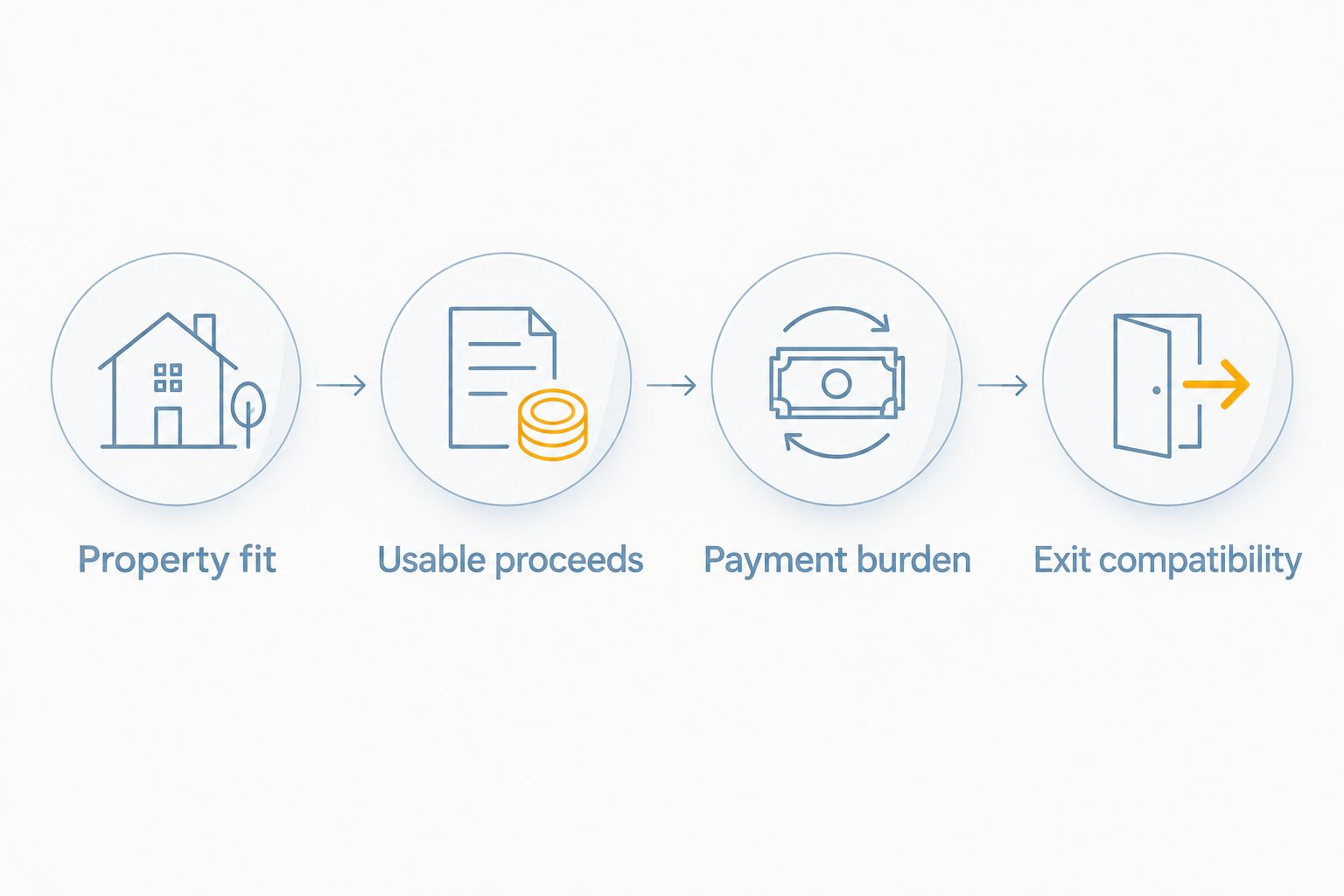
A holdback is funding reserved for later release rather than delivered at closing. An interest reserve is money set aside to cover interest under the agreement; neither should be confused with unrestricted cash.
Ask who controls reserve releases and what happens when a draw is delayed. If contractors need payment before reimbursement, your liquidity must cover that gap.
Check whether payments reduce principal or cover interest only. An interest-only payment leaves the principal balance to be repaid at the exit.
Which calculations make two offers comparable?
Use the actual written figures from each 2026 proposal. Compare total dollars and cash requirements, not a headline rate in isolation.
- Net closing proceeds: Gross initial advance minus deducted charges and withheld reserves.
- Cash needed to close: Acquisition cash requirements minus usable loan proceeds, plus required borrower-funded reserves and expenses.
- Cash needed after closing: Borrower-funded improvements, operating shortfalls, and payments not covered by committed reserves.
- Exit payoff: Outstanding principal plus accrued interest and contractual payoff obligations.
- Refinance gap: Exit payoff minus the proceeds supported by the replacement lender’s underwriting.
Do not count an undisbursed rehabilitation holdback as acquisition cash. Do not treat projected refinance proceeds as committed funding.
For variable-rate financing, identify the benchmark, spread, floor, and reset provisions. Ask how a changed rate affects payments, reserves, and the exit balance.
When is an alternative better than a bridge loan?
Permanent financing is the better starting point when the property already qualifies and you do not need an interim structure. Compare the complete transaction, including documentation and closing conditions.
For an eligible owner-occupied business property, ask whether an SBA-backed structure fits the acquisition. SBA financing is not a blanket solution for investment real estate; eligibility and occupancy requirements matter.
A business line of credit solves a different problem: recurring operating cash needs. Do not substitute it for property acquisition debt without reviewing permitted uses, repayment, and collateral conflicts.
Revenue-based financing may be structured as a purchase of future receivables rather than a loan. A factor rate is a multiplier used to determine a contractual purchased or repayment amount; it is not APR, and an annualized comparison requires cash-flow timing and applicable charges.
That distinction matters if you plan to combine property debt with operating-business funding. Confirm that each agreement permits the other obligation and that combined payments fit business cash flow.
What risks should stop a commercial bridge transaction?
Stop the comparison when the property plan cannot support the repayment obligation. A willing lender does not fix a weak exit.
Treat these issues as decision gates:
- Unfunded improvements: The project needs cash that neither the loan nor documented equity supplies.
- Speculative refinance: Repayment depends on occupancy or income unsupported by leases and operating evidence.
- Conditional extensions: Extra time requires tests the borrower cannot confidently meet.
- Collateral conflicts: Existing liens or restrictions interfere with the proposed financing.
- Guarantee exposure: The borrower has not understood personal or entity-level obligations.
- Unresolved diligence: Title, environmental, zoning, insurance, or property-condition issues remain open.
Review recourse carefully. Recourse describes the lender’s ability to seek repayment beyond the pledged collateral; some agreements contain specific exceptions even when described as nonrecourse.
Have qualified legal counsel review default remedies, guarantees, and extension provisions. The financing decision includes the consequences of missing the plan.
What documents should you prepare next?
Build one consistent package for your 2026 lender comparison. Ask each proposed lender for its current requirements rather than assuming a universal checklist establishes eligibility.
Prepare the purchase agreement or current debt details, ownership documents, property operating statements, rent roll and leases where applicable, improvement budget, sponsor financial information, and evidence of equity.
Add a written exit plan explaining the intended sale or refinance and the conditions required to achieve it. Identify unresolved title, insurance, environmental, or property-condition questions early.
Request a written closing checklist that distinguishes completed conditions from outstanding ones. Your next decision should follow documented requirements, not verbal assurances.
How are these funding routes ranked?
The order follows the decision sequence: compare structures, check conventional financing, evaluate transitional-property funding, then assess collateral-led alternatives. It is not a claim that one lender category has the lowest cost or fastest closing for every borrower.
Each route has a distinct use case. The default for an undecided owner is compare the exit and property fit before choosing a lender category.
FAQ
What are the best bridge loans for commercial real estate in 2026?
The best bridge loans for commercial real estate match the property’s current condition, required funding, and documented repayment exit. Compare bank, commercial real estate debt fund, and private asset-based proposals against the same assumptions.
Is Jon Lynch Financial Group a direct bridge loan lender?
Jon Lynch Financial Group is a broker, not a direct lender. Commercial financing is provided through third-party lenders and funders and remains subject to their underwriting.
Is a bank better than a private bridge lender?
A bank is the better starting point when the property and borrower already fit conventional financing requirements. A private bridge route deserves consideration when the transaction needs an interim structure, but collateral and repayment risks still require review.
How much does a commercial real estate bridge loan cost?
The cost depends on the written proposal and the agreement’s payment, reserve, and payoff terms. Compare total dollars paid, usable closing proceeds, and the balance due at your planned exit rather than relying on a headline rate.
Can I get a commercial bridge loan after a bank decline?
A bank decline does not establish eligibility for another lender. Identify the decline reason and ask whether a different program can address it without creating an unsupportable payment or repayment exit.
Can revenue-based financing replace a commercial property bridge loan?
Revenue-based financing is not interchangeable with property-secured bridge debt. It may be structured as a purchase of future receivables, so permitted uses, cash-flow obligations, and existing lender restrictions require separate review.
Does an interest-only bridge loan reduce the principal balance?
Interest-only payments do not reduce principal. Your sale, refinance, or other documented repayment source must cover the remaining principal and applicable payoff obligations.
Does meeting the monthly revenue threshold guarantee financing?
No: the $35,000-per-month threshold identifies the primary business-funding route, not commercial real estate approval. Property, borrower, collateral, and product requirements remain subject to third-party underwriting.
One last thing: can you carry the property if the exit slips?
A property can gain value while its owner runs short of cash. Before accepting bridge debt, examine delayed leasing, postponed improvements, and a refinance that produces less than expected.
If the downside case requires new financing that is not committed, the repayment plan is incomplete. Resolve that gap before signing.
Related guides
- Bridge loans for commercial property acquisitions
- Capital stack structuring for real estate developers
- Commercial real estate financing for self-storage facilities
- Business line of credit lenders
Which route should you choose now?
For U.S. businesses generating at least $35,000 per month, use Compare Business Funding Options to discuss the funding need and compare relevant structures. Businesses below $35,000 per month should use Explore Self-Serve Funding for the business-funding path; that route does not establish commercial property eligibility.
Jon Lynch Financial Group is a broker, not a direct lender. Products are for business purposes and subject to third-party underwriting; approval, amounts, rates, decisions, and funding times are not guaranteed.
Next step: prepare your property summary and repayment exit, then choose the business-funding route that matches your monthly revenue.