Best business line of credit lenders ranked by credit limit 2026
Find the best business line of credit lenders by credit limit: choose usable capacity over headline limits and compare repayment, collateral, and fit.

Best for asset-supported capacity: an asset-based revolving line. Best for recurring operating gaps: a bank or credit union line. Best for comparing third-party offers: Jon Lynch Financial Group, a broker, not a direct lender. For 2026, rank business line of credit lenders by usable approved credit and repayment fit—not the largest advertised ceiling.
- Compare the best business line of credit lenders by credit limit using approved availability, repayment requirements, and collateral restrictions.
- Asset-based revolving lines fit businesses whose eligible receivables or inventory support borrowing.
- Bank and credit union lines fit recurring working capital needs when underwriting and repayment terms align.
- Jon Lynch Financial Group fits U.S. business owners comparing third-party business funding, not seeking a direct lender.
Why does the largest credit limit matter less than available cash?
A credit limit is the ceiling written into a facility; available credit is what you can draw after outstanding balances and contractual restrictions. A larger ceiling does not necessarily produce more usable working capital.
If your business generates at least $35,000 per month, Jon Lynch Financial Group offers a brokerage route for comparing business-purpose funding. That revenue figure identifies the intended service audience; it is not an approval threshold or a promise of a particular limit.
Your first decision is whether you need repeat access to cash or a single funded amount. A revolving line supports repeated borrowing and repayment under its agreement; a term loan funds a defined borrowing need on a repayment schedule.
What makes the best business line of credit for your limit needs?
Judge every 2026 proposal against these criteria before comparing headline limits:
- Usable capacity: Separate the facility ceiling, approved commitment, outstanding balance, and currently drawable amount.
- Repayment fit: Match payment frequency and principal reduction requirements to when customers pay you.
- Total financing cost: Request all interest, fees, and other required charges under the same borrowing scenario.
- Qualification: Confirm how the lender evaluates revenue, credit, operating history, collateral, and existing obligations.
- Continued access: Read draw conditions, renewal requirements, and the lender's rights to restrict further borrowing.
- Security and liability: Identify collateral liens, personal guarantees, and restrictions on additional financing.
Which funding routes belong on your shortlist at a glance?
The order below prioritizes asset-supported capacity, then general operating credit, then digital access and comparison support. It is a decision order—not a claim that every lender in one group approves larger limits than every lender in another.
| Rank and route | Best for | How capacity is determined | Standout feature | Key limitation |
|---|---|---|---|---|
| 1. Asset-based revolving line | Receivables- or inventory-supported borrowing | Eligible collateral, advance terms, reserves, and facility ceiling | Connects availability to qualifying business assets | Availability changes with collateral eligibility and reserves |
| 2. Bank or credit union line | Recurring operating gaps | Lender underwriting, cash flow, credit, and any required collateral | Revolving access under a negotiated agreement | Approval and continued access depend on lender requirements |
| 3. Online business line | Businesses prioritizing a digital application | Provider underwriting and the specific facility agreement | Digital submission and account access where offered | Draw mechanics and repayment structures require close comparison |
| 4. Commercial finance brokerage | Comparing different funding structures | Each third-party lender or funder's underwriting | Helps compare offers across funding types | The broker does not approve or supply the credit itself |
1. Is an asset-based revolving line best for collateral-backed capacity?
Best for: established businesses with eligible receivables or inventory. An asset-based line connects borrowing availability to qualifying collateral through a borrowing base—a calculation defined in the financing agreement.
A facility's headline ceiling is only one constraint. Customer eligibility, invoice aging, inventory valuation, concentration limits, and reserves can reduce the amount available to draw.
Asset-based revolving line pros:
- Connects borrowing capacity to qualifying operating assets.
- Supports recurring working capital needs when the facility permits repeated draws.
- Makes collateral eligibility central to the capacity discussion.
Asset-based revolving line cons:
- Requires collateral reporting and monitoring under the agreement.
- Can lose availability when invoices become ineligible or reserves increase.
- Places specified business assets at risk if obligations are not met.
Ask the lender to calculate availability using your actual receivables and inventory, not just discuss its program ceiling. Request an explanation of what happens when a major customer pays late.
Verdict: Hold until the borrowing-base calculation supports your required cash gap.
2. Is a bank or credit union line best for recurring operating gaps?
Best for: businesses seeking a revolving facility matched to repeatable cash-flow needs. A bank or credit union line lets you borrow within an approved facility, repay according to its terms, and draw again when the agreement permits.
For your 2026 comparison, evaluate the complete proposal rather than assuming a familiar institution offers the best terms. Your existing banking relationship is a starting point, not a substitute for written approval conditions.
Bank or credit union line pros:
- Fits recurring needs such as inventory purchases and customer-payment gaps.
- Provides a defined facility agreement for borrowing and repayment.
- Lets you evaluate revolving credit separately from one-time term borrowing.
Bank or credit union line cons:
- Requires satisfaction of the institution's underwriting standards.
- Can include financial reporting, collateral, or guarantee obligations.
- Does not make future renewals or additional draws unconditional.
Ask whether the facility requires periodic principal reduction or full repayment. A line that must be cleared at an inconvenient point in your operating cycle can create another cash shortage.
Verdict: Hold until the payment and renewal requirements match your collection cycle.
3. Is an online business line best for a digital application?
Best for: owners who prioritize digital submission and can evaluate draw-level terms. An online application is a delivery method, not a separate guarantee of favorable credit terms.
Confirm that the offer is actually revolving credit. Products presented together on a funding platform can have different legal structures, repayment schedules, and redraw rights.
Online business line pros:
- Supports remote application where the provider offers it.
- Provides a route beyond your existing banking relationship.
- Lets you compare digital account tools alongside financing terms.
Online business line cons:
- Does not establish approval speed or usable capacity by itself.
- Requires careful review of each draw's repayment obligations.
- Can differ substantially from another provider's product despite similar naming.
Use the same requested draw and repayment assumptions across proposals. The business line of credit lenders guide provides a broader framework for comparing lender fit alongside capacity.
Verdict: Skip any offer that leaves redraw rights or repayment mechanics unclear.
4. Is a commercial finance brokerage best for comparing structures?
Best for: U.S. business owners comparing third-party funding rather than one institution's product. Jon Lynch Financial Group offers access to business funding options through third-party lenders and funders, including lines of credit and other working capital structures.
The distinction matters: brokerage assistance is not a credit facility. Each third party determines its own underwriting, approval conditions, and contractual terms.
Commercial finance brokerage pros:
- Creates a comparison route across different funding structures.
- Helps frame the decision around timing, qualification, repayment, and total cost.
- Supports evaluating alternatives when a revolving line does not fit.
Commercial finance brokerage cons:
- Does not control a third party's approval or credit limit.
- Requires separating revolving loans from non-revolving alternatives.
- Does not remove the need to review every agreement and disclosure.
Request a clear identification of the lender or funder behind each proposal, the product's legal structure, and all applicable compensation and charges.
Verdict: Hold until each offer identifies who supplies the funds and what you are signing.
How should you calculate the credit limit your business needs?
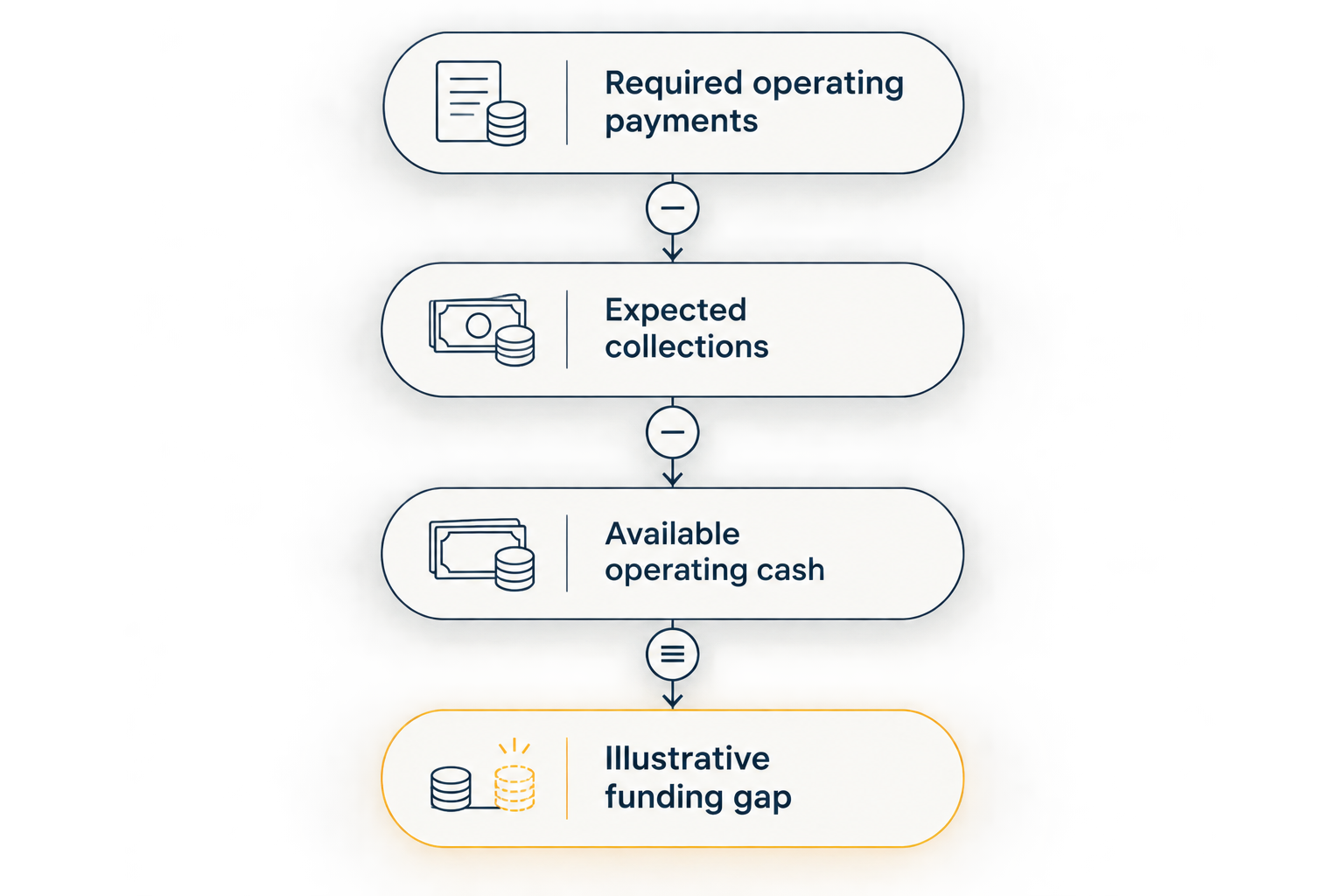
Build your request around the largest cash shortfall between required payments and expected collections. Do not use annual revenue alone to choose a limit.
Illustrative operating example—not a financing quote: Suppose your business must pay $80,000 in operating obligations over 30 days, expects $50,000 in customer collections during that period, and has $10,000 in cash available for those obligations.
- Required operating payments: $80,000.
- Less expected collections: $50,000.
- Less available operating cash: $10,000.
- Illustrative funding gap: $80,000 − $50,000 − $10,000 = $20,000.
A $20,000 gap does not automatically justify a $20,000 facility. Test what happens if collections arrive late, and distinguish a prudent contingency from borrowing that your business cannot repay.
How does an existing balance change availability?
In a separate illustrative example, a $100,000 approved line with $40,000 already drawn leaves $60,000 before other restrictions: $100,000 − $40,000 = $60,000.
A borrowing base, reserve, or draw restriction can reduce that amount further. Ask for the available-to-draw figure as of the comparison date.
When is another funding structure a better fit?
A revolving line is not the default answer to every capital need. Match the structure to how the funded activity returns cash.
- Term loan: Compare for a defined, one-time business expenditure; the limitation is a repayment obligation that continues regardless of the project's outcome.
- Equipment financing: Compare when the need is a specific equipment purchase; the limitation is financing tied to that asset and its agreement.
- Invoice factoring: Compare when eligible customer invoices are central to the gap; the limitations include invoice eligibility, contractual fees, and customer-payment mechanics.
- Revenue-based financing: Compare the actual contract and remittance requirements; the limitation is committing future business receipts under the agreed structure.
For seasonal businesses, planning for seasonal cash flow dips starts with identifying which obligations fall due before seasonal receipts arrive. Borrowing addresses that timing mismatch only when the business has a credible source of repayment or remittance.
Revenue-based financing may be structured as a purchase of future receivables, including arrangements commonly called merchant cash advances. That is not the same as a revolving loan, and a purchased-receivables amount is not an available credit limit.
Which terms should disqualify a proposal?
Reject comparisons that treat a factor rate as an APR. A factor rate is a multiplier used to determine a contractual amount; APR expresses annualized borrowing cost and requires attention to timing and cash flows.
A factor rate alone does not establish an APR. For 2026 offers, request the applicable disclosures and a full payment or remittance schedule rather than comparing unlike figures.
Also stop when:
- The payment schedule exceeds the cash your business can support.
- The agreement's product structure differs from the sales explanation.
- Collateral or guarantee obligations remain unexplained.
- You must assume another approval to meet existing payments.
- The lender or funder will not clarify draw restrictions or default provisions.
A bank decline does not mean credit is irrelevant elsewhere. Ask which underwriting issue caused the decline and whether another structure actually addresses it.
What documents should you prepare before comparing offers?
Prepare current bank statements, financial statements, a debt schedule, business ownership information, and a written explanation of the funding use. For collateral-supported requests, prepare receivables aging and inventory information as applicable.
The exact document list depends on the third-party program. Request it before submitting, along with permission and credit-inquiry requirements.
How were these funding routes ranked?
This 2026 decision order prioritizes the source of usable capacity, followed by repayment fit, qualification, continued access, and liability. It does not declare one institution the highest-limit lender for every borrower.
Default choice: compare a conventional revolving line first when you need repeat access; evaluate an asset-based facility when eligible assets are central to the requested capacity. Use brokerage assistance when comparing different structures or third-party offers.
FAQ
What's the best business line of credit lender by credit limit?
The best lender is the one offering sufficient usable approved credit on terms your business can support. An advertised maximum does not establish your approval amount or current draw availability.
Is an asset-based line always bigger than a bank line?
No. Asset-based describes how availability is supported, while bank describes a type of institution; a bank can also offer asset-based financing. Compare actual proposals and borrowing-base calculations.
Does a larger approved credit limit mean I can draw all of it?
No. Outstanding balances, borrowing-base restrictions, reserves, and contractual draw conditions can reduce available credit. Request the currently drawable amount in writing.
Can I compare a merchant cash advance with a business line of credit?
Yes, but compare them as different structures. A merchant cash advance may be a purchase of future receivables rather than a loan, and it does not establish revolving redraw rights.
Does Jon Lynch Financial Group directly approve business lines of credit?
No. Jon Lynch Financial Group is a broker, not a direct lender. Business-purpose products are subject to the relevant third-party lender or funder's underwriting and terms.
Does monthly revenue of $35,000 guarantee business funding?
No. That figure identifies the primary audience for the brokerage comparison route, not an approval guarantee. Businesses below that level have a separate self-serve funding path.
Related guides
- How long business line of credit approval takes
- Working capital loans: costs and qualification
- How much collateral a secured business loan requires
One last thing: what happens after you repay a draw?
Ask whether repaying principal restores borrowing availability automatically or whether another review applies. A line's usefulness depends on access after repayment—not just its opening limit.
For your next step, write down the cash gap, required date, and affordable repayment schedule. If your U.S. business generates at least $35,000 per month, Compare Business Funding Options; below $35,000 per month, Explore Self-Serve Funding. Neither route promises approval, an amount, a rate, or funding timing.