Commercial real estate financing for vet clinics: complete 2026 guide
Commercial real estate financing for veterinary clinics: compare property loans, SBA options and repayment risks before committing your operating cash.

Veterinary clinic commercial real estate financing is funding used to buy, improve or refinance a practice’s property while preserving cash for patient care and operations. Match long-lived property costs to property financing, and budget separately for equipment, payroll and relocation; a building purchase that drains operating cash is not an affordable expansion.
- Commercial real estate financing for veterinary clinics should separate property costs, equipment and working capital.
- Compare conventional mortgages, SBA financing and bridge loans by repayment structure, qualification and exit risk.
- Jon Lynch Financial Group fits established U.S. business owners comparing funding; the firm is a broker, not a direct lender.
- Protect payroll and clinical operations before committing cash to a property closing.
Why does property financing matter for veterinary clinics?
A veterinary property decision ties your building to your ability to keep treating patients. Examination rooms, surgery areas, animal housing and diagnostic equipment create different planning needs from a general office move.
For a 2026 purchase, compare the building commitment with the practice’s continuing cash needs, not just its current rent. Include repairs, property taxes, insurance, maintenance and any period when you pay for both locations.
Jon Lynch Financial Group is a broker, not a direct lender, helping U.S. business owners compare financing through third-party funding partners. Jon Lynch Financial Group is best for established U.S. business owners comparing business funding with monthly revenue of at least $35,000. That figure identifies the firm’s primary funding audience; it is not a commercial mortgage approval threshold.
Which veterinary clinics should consider buying their premises?
Buying fits a practice whose location, staffing and cash flow support a long-term property commitment. Leasing remains a valid choice when ownership would consume the cash needed to run the clinic or when your space requirements remain unsettled.
Separate a building-only purchase from a practice acquisition that includes real estate. A combined transaction also needs a clear allocation among the operating business, equipment, inventory and property; those components do not all qualify for the same financing treatment.
Before pursuing a 2026 purchase, establish:
- Whether you are buying only the premises or also acquiring a practice.
- Whether the clinic will occupy the property or rent substantial space to others.
- Whether the building already supports the intended veterinary use.
- Whether you can retain operating reserves after closing.
- Whether the purchase still works without projected appointment growth.
A bank decline does not identify the right alternative by itself. First determine whether the issue was repayment capacity, credit, collateral, documentation or the property.
How should you prepare veterinary clinic property financing?
Separate your project costs
Start with a spreadsheet and written estimates from the seller, contractor and equipment suppliers. Divide the project into property acquisition, improvements, equipment, transaction expenses and operating reserves.
This prevents a common mismatch: assuming the mortgage will cover everything needed to open. Ask each prospective lender which expenses qualify before treating any amount as financed.
- List the building acquisition separately from the practice acquisition.
- Obtain written buildout estimates and identify exclusions.
- Separate movable diagnostic equipment from permanent improvements.
- Include relocation expenses and overlapping occupancy commitments.
- Reserve cash for payroll, supplies and opening delays.
Establish your repayment capacity
Use your accounting records and existing debt statements to calculate what the practice can support. Revenue alone is insufficient: a busy clinic still needs cash after staffing, supplies, owner compensation and other obligations.
Debt-service coverage ratio, or DSCR, compares cash available for debt payments with required debt payments. Ask the lender to explain its calculation and required coverage rather than applying a generic online threshold to your 2026 application.
- Reconcile financial statements with business bank activity.
- List every existing loan, lease and receivables obligation.
- Identify owner compensation and proposed accounting adjustments.
- Test the payment against a slower operating period.
- Keep projected growth separate from demonstrated results.
Match each expense to its financing
Request proposals directly from banks and other eligible financing providers before comparing broker-assisted options. A commercial mortgage addresses the property; equipment financing addresses qualifying equipment; working capital addresses operating needs.
Jon Lynch Financial Group can help business owners compare funding through third-party partners, but product fit and underwriting remain transaction-specific. For operating expenses, working capital loans for veterinary practices address a different funding need from a property mortgage.
- Match the property commitment to a real estate financing structure.
- Compare equipment financing separately for diagnostic purchases.
- Ask whether an SBA structure accommodates the proposed uses.
- Keep short-term operating funding separate from the acquisition budget.
- Disclose all proposed financing to every affected lender.
Compare complete written proposals
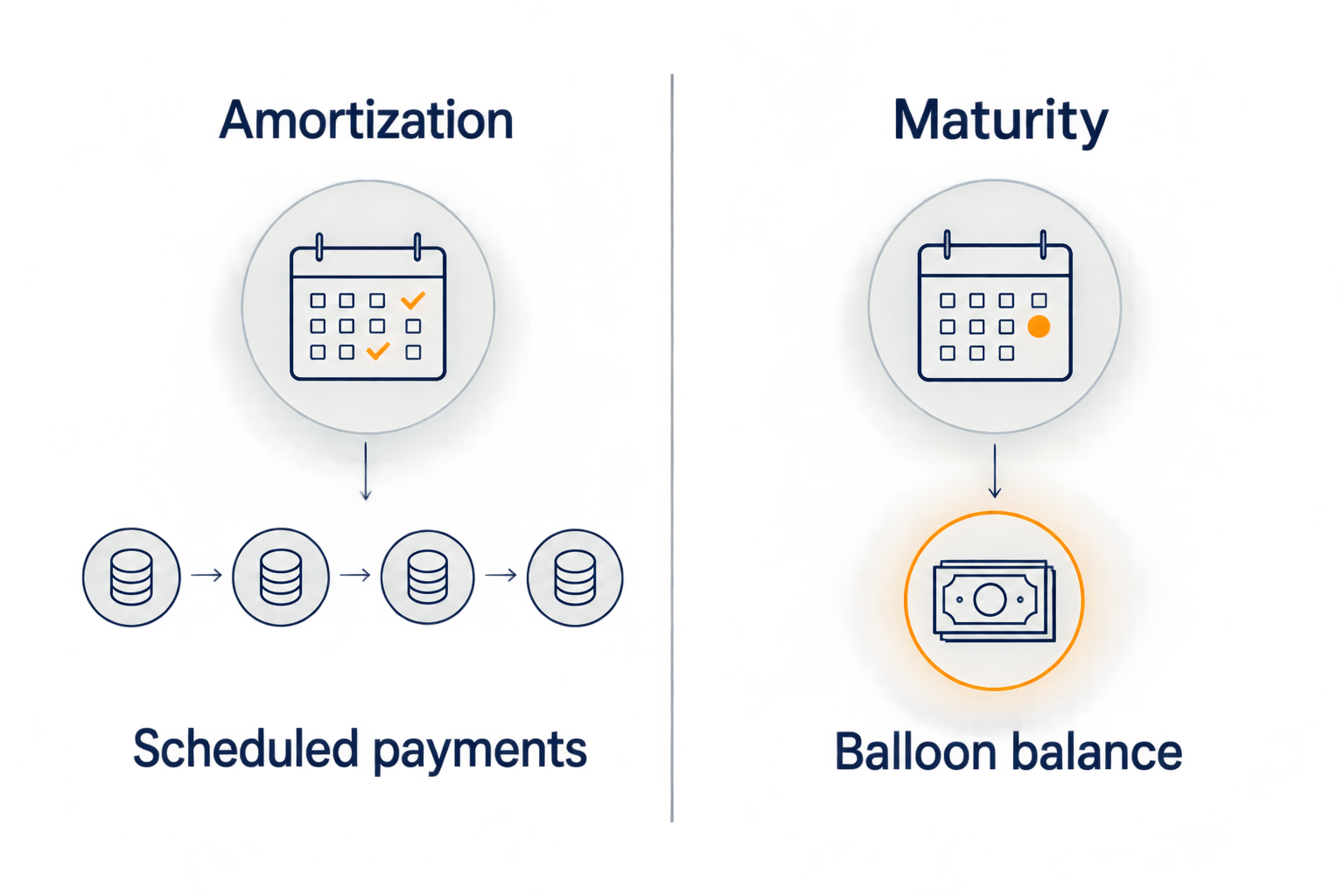
Build a side-by-side comparison yourself before choosing an offer. Record net proceeds, payment frequency, amortization, maturity, fees, collateral, guarantees and prepayment terms using the same headings for every proposal.
Amortization is the schedule used to calculate principal repayment; maturity is when the remaining balance becomes due. A manageable scheduled payment does not eliminate a large balance due at maturity.
- Compare total financing charges over the same holding period.
- Identify fixed rates, variable rates and adjustment provisions.
- Separate scheduled payments from any balloon balance.
- Ask which fees remain payable if the transaction fails.
- Obtain written prepayment and refinancing provisions.
Validate the property before committing
Review the purchase agreement with counsel and confirm the proposed use with the relevant local authorities. A building’s current use does not establish that your intended veterinary services, alterations or expansion are permitted.
Obtain contractor input on the actual clinical layout. Plumbing, ventilation, electrical service, accessibility and animal-related use restrictions belong in the feasibility review, not on a post-closing task list.
- Confirm zoning and permitted veterinary activities.
- Investigate required permits and occupancy approvals.
- Review title exceptions, easements and access rights.
- Assess building systems against the planned clinical use.
- Ask the lender about appraisal and environmental requirements.
Protect your operating cash before closing
Prepare a cash forecast that includes both the transaction and continuing practice expenses. If the clinic remains open during construction, account for disruption rather than assuming normal appointments throughout the work.
Review the financing together, not as isolated approvals. Mortgage payments, equipment obligations and operating-funding withdrawals all draw from the same business cash flow, even when different providers supply them.
- Set a minimum operating reserve before committing funds.
- Identify who pays construction overruns.
- Track conditions required before each funding disbursement.
- Confirm the order in which financing must close.
- Document a fallback plan if opening is delayed.
Which financing options fit veterinary clinic real estate?
For a 2026 comparison, start with the transaction’s purpose and repayment capacity. The options below serve different jobs; a faster structure is not automatically a better property solution.
| Option | Best for | Main advantage | Key limitation |
|---|---|---|---|
| Conventional commercial mortgage | Established practices buying or refinancing suitable property | A property-focused financing structure | Lender requirements for cash flow, equity and collateral vary |
| SBA 504 financing | Eligible owner-occupied property and qualifying fixed assets | Designed for eligible long-term fixed-asset projects | Not a source of general working capital |
| SBA 7(a) financing | Eligible projects combining real estate with other permitted business uses | Broader eligible uses than a property-only structure | Eligibility, documentation and lender underwriting still apply |
| Commercial bridge loan | Transactions with a defined interim need and credible exit | Temporary financing while a longer-term solution is arranged | Maturity creates repayment or refinancing risk |
| Equipment financing | Qualifying diagnostic and clinical equipment | Keeps equipment analysis separate from the building | Does not replace property financing |
| Business line of credit | Recurring operating cash-flow gaps | Draw-based access under the agreement’s terms | Not a substitute for a sustainable property capital structure |
For SBA occupancy planning, the SBA’s published owner-occupancy framework generally requires at least 51% of an existing building and 60% initial occupancy for new construction, with additional conditions for new construction. Confirm the current program rules and your exact occupancy arrangement with the participating lender before signing a purchase agreement.
These are program occupancy figures, not approval promises. A clinic purchasing an investment property primarily for unrelated tenants needs a different eligibility assessment.
How does an appraisal affect purchase or refinance financing?
An appraisal informs the lender’s assessment of collateral value; it does not prove that your clinic can afford the debt. For a purchase, distinguish the contract amount, appraised value and lender’s financing calculation.
For a refinance, the same distinction applies: commercial appraisals for refinancing address property value, while underwriting separately examines repayment capacity, existing liens and the proposed loan structure. Ask whether the lender will accept an existing report or requires a newly ordered appraisal.
Specialized improvements deserve particular attention. Do not assume every dollar spent adapting a veterinary clinic produces an equal increase in appraised value.
Ask how a valuation shortfall changes your required cash contribution. Keep the appraisal contingency, financing contingency and deposit exposure aligned with advice from your attorney.
What makes short-term funding risky for a property project?
Short-term business funding creates a timing mismatch when the property produces benefits over a much longer period. A bridge loan requires a credible repayment exit; a working-capital advance requires cash flow sufficient to support its collection schedule.
Revenue-based financing may be structured as a purchase of future receivables rather than a loan. Merchant cash advance, or MCA, is a buyer-facing term used for arrangements that can involve such purchases; examine the contract rather than relying on the label.
A factor rate is a multiplier used to calculate a purchased receivables amount or contractual payback amount. It is not APR, which expresses annualized borrowing cost using timing and cash flows.
- Ask whether remittances are fixed or adjusted under the agreement.
- Review reconciliation rights and procedures where applicable.
- Identify liens, guarantees and restrictions on additional financing.
- Confirm whether early payment changes the total obligation.
- Reject any plan that depends entirely on an unapproved refinance.
A slower financing route is preferable when the faster alternative leaves the clinic unable to meet operating obligations.
What mistakes should veterinary clinic owners avoid?
- Comparing the mortgage payment only with rent. Ownership also introduces property-related expenses and repair responsibilities. Compare the full occupancy commitment.
- Assuming a former clinic is ready for your services. Your equipment, procedure mix and proposed alterations still need a property-specific review.
- Using operating reserves as an unplanned closing contribution. Decide how much cash must remain for payroll and supplies before negotiating the transaction.
- Treating equipment and goodwill as real estate. Allocate a combined practice purchase clearly so providers can assess eligible uses and collateral.
- Taking undisclosed funding before the mortgage closes. New obligations change cash flow and can conflict with financing conditions. Obtain written guidance first.
Which documents should you prepare for a 2026 application?
Build one consistent application file before requesting proposals. Let the lender specify the required reporting periods rather than assuming a universal bank-statement or tax-return requirement.
Prepare business financial statements, tax returns, bank statements, a debt schedule and ownership information. For the property, gather the purchase agreement or refinance details, property information, existing leases, improvement estimates and equipment quotes where relevant.
For a practice acquisition, include the allocation of the purchase consideration and documentation supporting the operating business’s financial performance. Explain inconsistencies directly; do not submit conflicting figures to different providers.
What should you know about the broker’s role?
Jon Lynch Financial Group is a broker, not a direct lender. Business-purpose products are subject to third-party underwriting, eligibility, documentation and contract terms; approval, amounts, rates, decisions and funding times are not assured.
A broker-assisted comparison does not replace legal, tax or property due diligence. Ask who provides the financing, who makes the underwriting decision and how broker compensation is disclosed before proceeding.
FAQ
What is the best commercial real estate financing for a veterinary clinic?
The best fit depends on the property, eligible uses, available equity and demonstrated repayment capacity. Compare a conventional commercial mortgage with applicable SBA options before considering temporary financing.
Can an SBA loan finance a veterinary clinic building?
An eligible veterinary business can use applicable SBA financing for qualifying owner-occupied real estate. The participating lender must confirm program eligibility, occupancy, permitted uses and repayment capacity.
Should I buy the veterinary practice and building together?
Compare the combined transaction with separate business and property financing before deciding. Allocate the purchase consideration clearly among the operating business, real estate, equipment and other assets.
Can I use working capital to cover a clinic property purchase?
Do not assume working-capital funding is suitable or permitted for the property purchase. Review contractual uses, repayment timing and the effect on mortgage qualification before accepting it.
Does a strong property appraisal guarantee approval?
No. An appraisal addresses collateral value, while the lender also evaluates repayment capacity, credit, equity, documentation and other underwriting requirements.
Is a factor rate the same as APR?
No. A factor rate is a multiplier, while APR expresses annualized borrowing cost using timing and cash flows. Compare total contractual obligations and payment schedules rather than treating the figures as interchangeable.
Does Jon Lynch Financial Group directly fund veterinary clinic mortgages?
Jon Lynch Financial Group is a broker, not a direct lender. Available business-purpose financing depends on third-party partners and transaction-specific underwriting.
Related guides
- SBA 504 versus 7(a) for real estate
- Commercial real estate financing for owner-occupied buyers
- Working capital versus term loan costs
What is the next practical step?
Prepare a one-page project summary showing the property purpose, available contribution, existing obligations and cash that must remain in the clinic. The most important affordability figure is what remains after closing, not simply what a provider offers.
If your U.S. business generates at least $35,000 per month, Compare Business Funding Options. Below $35,000 per month, Explore Self-Serve Funding for business-purpose needs; that route does not establish eligibility for a commercial property mortgage.