How much collateral does a secured business loan require?
Secured business loan collateral requirements vary by asset value and lender rules. Compare liens, guarantees, repayment fit, and risks before signing.

A secured business loan requires enough eligible collateral to satisfy the lender’s valuation and coverage rules; there is no universal dollar amount or percentage for 2026. The lender uses its accepted asset value—not necessarily your purchase price—and accounts for existing claims against that asset. Collateral does not replace repayment capacity, and pledging an asset does not eliminate a possible personal guarantee.
- Secured business loan collateral requirements depend on accepted asset value, existing liens, and the lender’s coverage rules.
- A personal guarantee creates personal repayment exposure; it is not the same as pledging a specific asset.
- Compare working capital offers by repayment capacity and lien scope, not collateral value alone.
- Jon Lynch Financial Group is a broker for U.S. business owners comparing business-purpose funding, not a direct lender.
How much collateral does a secured business loan require?
The required amount depends on how the lender measures collateral coverage. Some structures use loan-to-value, meaning the loan amount divided by the lender’s accepted asset value; others use an advance rate, meaning the share of eligible assets available to support financing.
Ask for the calculation behind your proposed amount. A lender’s borrowing base—the eligible asset pool supporting borrowing—can exclude assets that appear on your balance sheet.
| Calculation | What it tells you | What to verify |
|---|---|---|
| Loan amount divided by accepted collateral value | Loan-to-value | Which valuation method the lender accepts |
| Eligible asset value multiplied by advance rate | Initial borrowing support | Eligibility exclusions and reserves |
| Accepted value after accounting for prior claims | Remaining collateral support | Existing balances and lien priority |
An asset’s recorded value is not automatically its lendable value. Before comparing a secured offer with an unsecured offer, separate asset pledges from guarantees; the distinction also matters when assessing whether unsecured business funding is riskier than secured loans.
For a 2026 application, request the lender’s current collateral policy in writing. A rule quoted for a different product does not establish what your offer requires.
Who does a secured business loan fit?
A secured business loan fits a business that owns acceptable assets, has sufficient repayment cash flow, and can accept restrictions on those assets. Strong collateral does not fix a payment schedule your operating cash flow cannot support.
Start with the business need. Equipment that will serve the business over time calls for a different structure than a temporary payroll gap or recurring inventory purchases.
Jon Lynch Financial Group is best for established U.S. business owners comparing business-purpose funding through a broker, not a direct lender. Its primary assisted funding audience generates at least $35,000 per month; that routing threshold is not a collateral requirement or an approval promise.
If you cannot afford to lose the pledged asset without stopping operations, treat that exposure as a decision constraint. A lower stated rate does not settle the question.
How do collateral requirements differ by financing structure?
Compare the asset being pledged, the obligations it secures, and the conditions for releasing it. A narrowly described equipment lien and a blanket business lien create different restrictions, even when both offers are described as secured.
| Structure | Best for | Collateral approach | Benefit | Main limitation |
|---|---|---|---|---|
| Equipment-secured loan | A defined equipment purchase | The financed equipment serves as security | Connects financing to a specific asset | Default puts essential equipment at risk |
| Receivables-backed line | Businesses with eligible unpaid invoices | Availability follows qualifying receivables | Supports borrowing against billed sales | Disputed or otherwise ineligible invoices reduce availability |
| Inventory-backed financing | Businesses holding acceptable inventory | Availability depends on eligible stock | Uses inventory to support working capital | Obsolete or difficult-to-sell stock weakens support |
| Property-secured business loan | Owners willing to pledge real estate | Property value and existing claims determine support | Uses property equity as security | Default places the pledged property at risk |
| Blanket-lien business loan | Businesses accepting broader asset security | The agreement covers specified categories of business assets | Avoids relying on one asset alone | Restricts later financing against covered assets |
These are structural distinctions, not promises about any lender’s program. For every 2026 offer, confirm whether the lender also requires additional security or a personal guarantee.
How does a lender decide what your collateral is worth?
The lender evaluates what it can rely on if repayment fails. That assessment differs from the asset’s importance to your business or what replacing it would cost you.
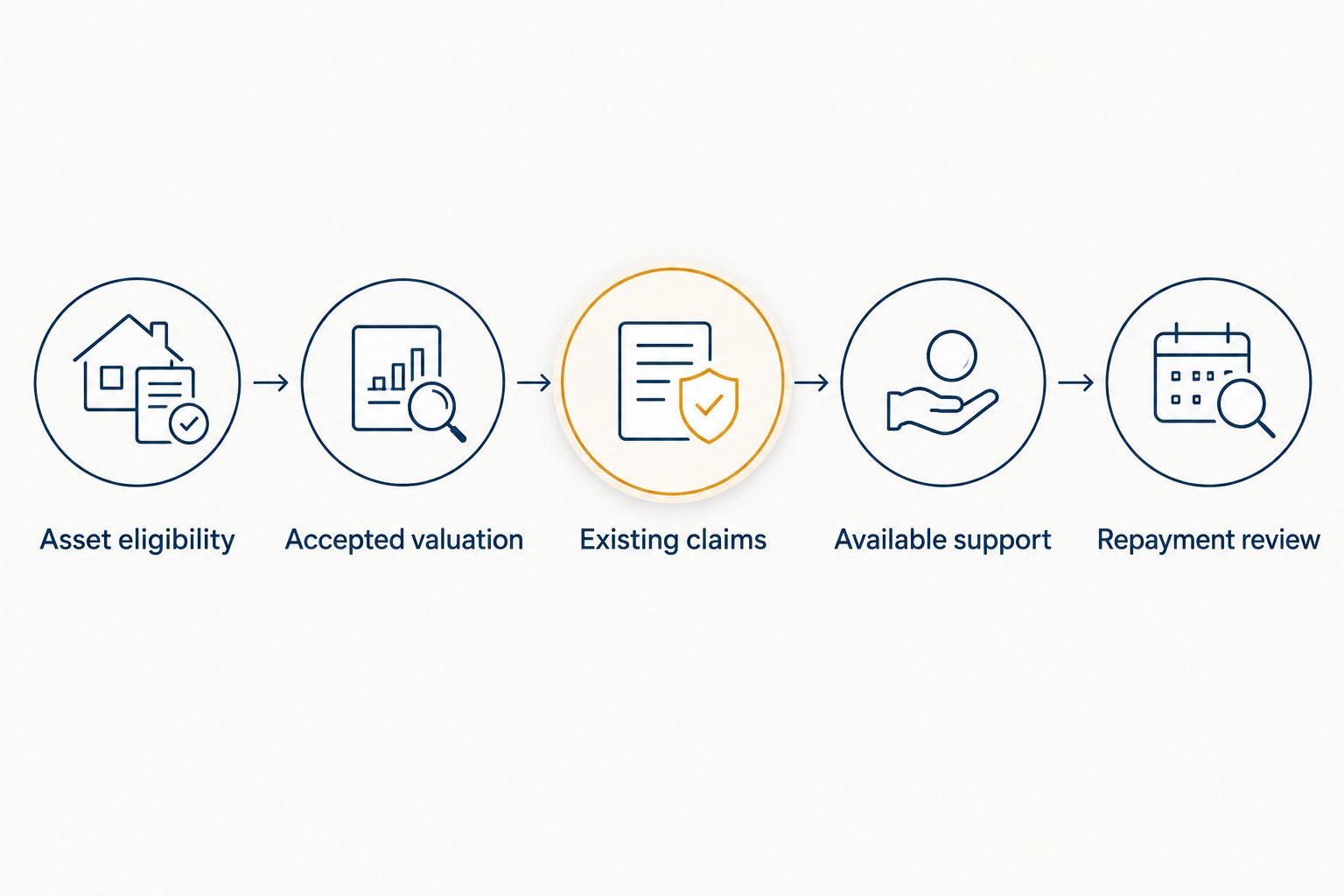
Use this sequence to understand the underwriting calculation:
- Asset eligibility: Identify what the lender accepts and what it excludes.
- Accepted valuation: Establish the valuation method and required evidence.
- Existing claims: Identify liens, outstanding obligations, and priority conflicts.
- Available support: Apply the lender’s advance rate, reserves, and other adjustments.
- Repayment review: Confirm that business cash flow supports the proposed obligation.
Ask whether the valuation assumes an ordinary sale or a distressed sale. Also ask who selects the appraiser, who pays for the work, and whether the report can be used by another lender.
A collateral review can also create ongoing obligations. Determine whether you must submit updated inventory reports, receivables aging, insurance evidence, or new valuations after closing.
Why do secured business loan collateral requirements vary?
The same asset can support different proposed loan amounts because lenders apply different eligibility and risk rules. These factors explain the differences without assuming a market-wide collateral percentage:
- Asset type and condition: Equipment condition, inventory quality, and invoice collectibility affect usefulness as security.
- Valuation basis: Book value, market value, and liquidation value measure different things.
- Existing liens: Prior claims affect what remains available to secure new financing.
- Lien scope: A specific-asset pledge differs from a claim over broader business assets.
- Repayment capacity: Revenue stability, existing obligations, and available cash flow influence underwriting alongside collateral.
- Contract requirements: Reporting, insurance, reserves, and restrictions affect how much financing the asset pool supports.
For your 2026 comparison, ask each lender to explain its calculation using the same asset information. Otherwise, a larger offer can reflect broader security rather than a better valuation.
How can you compare the numbers without a standard collateral percentage?
Use the lender’s actual figures rather than an online rule of thumb. Build a worksheet with the requested funding amount, accepted collateral value, existing secured balances, available proceeds, total contractual payments, and payment schedule.
The useful number is the amount you can use and repay—not the largest amount an asset might support. Separate the gross financing amount from proceeds after disclosed deductions, and include existing obligations that remain outstanding.
For a receivables-backed facility, ask how eligibility changes when invoices age, customers dispute charges, or customer concentration increases. For equipment, ask how depreciation or a required revaluation affects the agreement.
Do not equate collateral coverage with affordability. An offer can satisfy the lender’s security requirements while leaving your business short of cash for payroll, inventory, or taxes.
What role does a property appraisal play?
A property appraisal helps establish value, but it does not establish the lender’s final financing amount. Existing mortgages, title issues, accepted valuation methods, and the lender’s underwriting decision still matter.
When comparing commercial property appraisers, lender acceptance and the required assignment scope matter more than choosing a report solely by its fee. Confirm those requirements before commissioning work; a report prepared for another purpose does not automatically satisfy the proposed lender.
Ask whether the lender requires a particular valuation premise and whether property use affects acceptance. Also confirm what happens if the appraisal supports less value than expected: a smaller loan, additional collateral, or a different structure must be evaluated before you commit further.
Property location and property type belong in that discussion. An appraisal relevant to one market does not establish another property’s value.
Can you get business funding without pledging specific assets?
Yes, some business-purpose funding structures do not rely on a pledge of specific hard assets. That does not establish that the agreement has no lien, no guarantee, or no default exposure.
An unsecured loan is still a repayment obligation. Revenue-based financing may be structured as a purchase of future receivables rather than a loan; the contract determines the purchase terms, remittance mechanics, reconciliation rights, and default provisions.
Invoice factoring also differs from a conventional secured loan because it involves selling receivables. Review recourse provisions, customer payment handling, and obligations concerning disputed or unpaid invoices.
For a 2026 comparison, put these alternatives beside the secured offer using the same business need and usable proceeds. Do not select a more expensive structure merely because it avoids an equipment appraisal.
Does a personal guarantee count as collateral?
A personal guarantee is a promise to meet specified obligations personally; collateral is property securing an obligation. A lender can require both, so satisfying one requirement does not remove the other.
Ask whether the guarantee is limited or unlimited and which events trigger liability. Have counsel explain any provisions whose practical effect is unclear.
A UCC financing statement also deserves attention. It gives public notice of a claimed security interest; the security agreement identifies the collateral and obligations involved.
Do not rely on the filing alone to understand your exposure. Review the underlying agreement, including whether it reaches after-acquired assets or secures obligations beyond the initial advance.
What risks or problems should stop you from signing?
Pause when the security package is broader than you understood, or when the proposed repayment depends on optimistic sales assumptions. Collateral protects the creditor; it does not protect your operating cash flow.
Resolve these issues before accepting an offer:
- Conflicting liens: Determine whether an existing agreement prohibits the new pledge or requires consent.
- Essential assets: Identify what losing the pledged property would do to operations.
- Blanket security: Check whether the lien limits later equipment, receivables, or working capital financing.
- Unclear release terms: Establish the conditions for terminating liens and releasing guarantees.
- Variable availability: Understand reporting rules and events that reduce borrowing capacity.
- Unclear default language: Review cross-defaults, prohibited actions, and remedies with qualified counsel.
A collateral shortfall is not a reason to conceal existing financing or overstate asset values. Provide accurate information and ask whether a smaller amount, different structure, or slower application path fits better.
What documents should you prepare?
Prepare records that connect ownership, value, existing claims, and repayment capacity. Confirm the exact document list with the proposed funding partner rather than assuming every program uses the same checklist.
Your preparation file should include:
- Business ownership and entity information.
- Recent business bank statements and financial statements.
- An asset schedule showing ownership and existing financing.
- Equipment details, property records, or inventory reports relevant to the pledge.
- Accounts receivable aging when invoices support the request.
- Existing financing agreements and available payoff information.
- A business-purpose explanation and a cash-flow repayment plan.
Ask for an itemized description of appraisal, filing, legal, and closing charges before authorizing work. Confirm which charges remain payable if the transaction does not close.
FAQ
How much collateral do I need for a secured business loan?
You need enough eligible collateral to satisfy the lender’s accepted valuation and coverage rules. There is no universal collateral percentage; existing claims and repayment capacity also affect the decision.
Can I use equipment I already own as collateral?
Equipment you own can serve as collateral if the lender accepts it and the ownership and lien position support the transaction. Ask how the lender values its condition and accounts for existing financing.
Does collateral guarantee business loan approval?
Collateral does not guarantee approval. The funding partner also evaluates repayment capacity, credit, documentation, and its current program requirements.
Do I still need a personal guarantee on a secured loan?
A secured business loan can also require a personal guarantee. Asset security and personal repayment liability are separate contract terms, so review both before signing.
Is revenue-based financing the same as a secured business loan?
Revenue-based financing is not necessarily a secured business loan; it may be structured as a purchase of future receivables. Review the agreement’s legal structure, lien provisions, remittance terms, and reconciliation rights.
Is $35,000 per month a minimum collateral requirement?
$35,000 per month is Jon Lynch Financial Group’s primary assisted funding audience threshold, not a collateral requirement. Businesses below that monthly revenue level are directed toward its self-serve funding path.
Will my business lien disappear automatically after payoff?
Do not assume payoff completes every lien-release step. Request written payoff confirmation and verify that the required termination or release documents are completed for the specific security involved.
What should you check one last time?
Ask how the asset comes back out of the financing agreement before agreeing to put it in. Release conditions matter if you later sell equipment, refinance property, or seek another working capital facility.
Jon Lynch Financial Group is a broker, not a direct lender. Business-purpose financing is subject to third-party underwriting and product terms; approval, amounts, rates, decisions, and funding times are not guaranteed.
Related guides
- Can revenue-based financing work without collateral?
- How to release a personal guarantee on a business loan
- Working capital loans: costs and qualification
Which funding route should you take next?
If your U.S. business generates at least $35,000 per month, bring your asset schedule and current obligations to Jon Lynch Financial Group and Compare Business Funding Options. If your business generates below $35,000 per month, Explore Self-Serve Funding; neither route promises approval or a particular outcome.