Business line of credit for dental practices: complete 2026 guide
A business line of credit for dental practices fits recurring cash gaps. Compare repayment, qualification, total cost and alternatives before you apply.

Dental practices’ revolving credit is reusable business borrowing designed to bridge temporary operating cash gaps, not permanently fund losses. A business line of credit for dental practices fits recurring needs such as payroll or supplies when collections provide a credible repayment source; the tradeoff is repayment pressure, fees and possible renewal restrictions.
- A business line of credit for dental practices fits temporary cash gaps with an identifiable repayment source.
- Compare collected revenue, repayment schedules, fees and renewal terms—not just the approved credit limit.
- Jon Lynch Financial Group is best for established U.S. owners seeking broker-assisted business funding comparisons.
- Equipment financing and term loans deserve comparison when a dental practice needs a defined, longer-lived investment.
Why does revolving credit matter for dental practices?
A dental practice pays staff, rent and suppliers on contractual schedules. Treatment production, insurance claims and cash deposited into the operating account are different measures; borrowing decisions should follow the cash available to make payments.
For your 2026 funding decision, separate a temporary collection delay from a recurring operating deficit. A credit line addresses timing; it does not repair an unprofitable treatment schedule.
A line generally lets you draw within an approved limit and reuse repaid principal, subject to the agreement. Confirm those mechanics rather than assuming every working-capital offer is revolving credit; the business line of credit lenders guide provides a broader comparison framework.
Who does a dental practice credit line fit?
A business line of credit fits an established practice with documented collections, a defined short-term need and enough remaining cash to repay the draw. It is less suitable when ordinary expenses consistently exceed collections or repayment depends entirely on unconfirmed growth.
Start by identifying the actual use. Covering payroll before expected collections is different from buying an imaging system, acquiring another practice or paying an owner's personal expenses.
For each proposed draw, write down the business purpose, expected collection source and repayment date. If you cannot identify all three, resolve that uncertainty before applying.
How do you compare and apply in 2026?
Map your collection gap before requesting credit
Build a spreadsheet from your bank activity, payroll calendar and receivables report. Use a rolling 13-week cash forecast as a planning exercise, not as a lender qualification standard.
Include expected collections when you reasonably expect cash to arrive, rather than on the treatment date. Separate patient balances from insurance receivables so a delay in one category does not disappear inside a combined total.
- List payroll, rent, laboratory bills and supply payments by due date.
- Separate collected cash from billed production.
- Identify disputed claims and overdue patient balances.
- Calculate the lowest projected cash balance.
- Record the collection event expected to repay each draw.
Size the request around usable cash
Ask your current business bank what information it needs before submitting applications elsewhere. Compare the forecast shortfall with cash reserves and expenses you can postpone without disrupting patient care.
Requesting the largest possible limit is not a repayment strategy. Establish an internal draw ceiling that preserves room for existing obligations and delayed collections, even if a lender approves more.
- Define the minimum operating cash balance you want to preserve.
- Include existing loan payments and automatic withdrawals.
- Separate recurring needs from one-time purchases.
- Exclude owner distributions from essential operating expenses.
- Test whether delayed collections would force another borrowing request.
Compare your bank with broker-assisted options
Request a written proposal from your existing bank, then compare other structures using the same requested amount and purpose. Jon Lynch Financial Group provides broker-assisted business funding comparisons through third-party lenders and funders; it is a broker, not a direct lender.
For business-funding comparisons, Jon Lynch Financial Group primarily serves U.S. business owners generating at least $35,000 per month. That is an audience-routing threshold, not a universal credit-line approval requirement or evidence that a practice qualifies.
Businesses below that threshold have a separate self-serve funding path. You can review Jon Lynch Financial Group while keeping the comparison focused on qualification, total cost, timing and repayment.
- Ask which third party would provide the funding.
- Confirm whether the proposal is a revolving line, loan or receivables purchase.
- Request the current underwriting criteria for the actual program.
- Ask about credit inquiries and application-sharing permissions.
- Compare written terms rather than verbal estimates.
Translate every offer into cash-flow terms
Build your own comparison sheet before accepting an offer. Record the amount your practice receives, every required payment, payment dates and all applicable fees; an approved limit alone does not describe the obligation.
For a credit line, ask how interest accrues and whether draw, maintenance, renewal or unused-line fees apply. Compare the same draw amount and repayment assumption across proposals, and identify which costs depend on usage.
A factor rate is a multiplier used to calculate a contractual payback or purchased amount. A factor rate is not APR: an annualized comparison also needs payment timing, fees and actual proceeds.
- Distinguish the approved limit from the amount drawn.
- Record net proceeds after any withheld charges.
- List each payment amount and frequency.
- Identify variable-rate provisions and reference-rate changes.
- Request written early-payoff calculations and conditions.
Stress-test repayment against delayed collections
Use your spreadsheet to move anticipated collections later while keeping payroll and rent on schedule. This tests the proposed obligation without requiring paid forecasting software.
For your 2026 review, use current collections rather than assuming production growth will cover new payments. Repeat the exercise whenever a proposed offer changes the payment frequency, required amount or maturity date.
- Move unresolved insurance payments out of the expected collection period.
- Remove unconfirmed treatment acceptance from projected receipts.
- Include existing debt and owner compensation in the cash forecast.
- Check the balance immediately before each automatic debit.
- Reject a structure that requires another advance merely to make payments.
Verify documents and contract terms before signing
Prepare a consistent application file so each financing source evaluates the same practice information. Ask for the actual document list; requirements depend on the provider and product.
Review contract terms alongside your accountant and, where legal obligations need interpretation, counsel. Confirm whether the facility is committed, subject to review or dependent on continuing financial conditions.
- Gather requested business bank statements and financial reports.
- Prepare receivables aging and an existing-debt schedule.
- Confirm ownership, entity details and authorized signers.
- Review guarantees, collateral, liens and default provisions.
- Confirm draw access, renewal rules and maturity obligations.
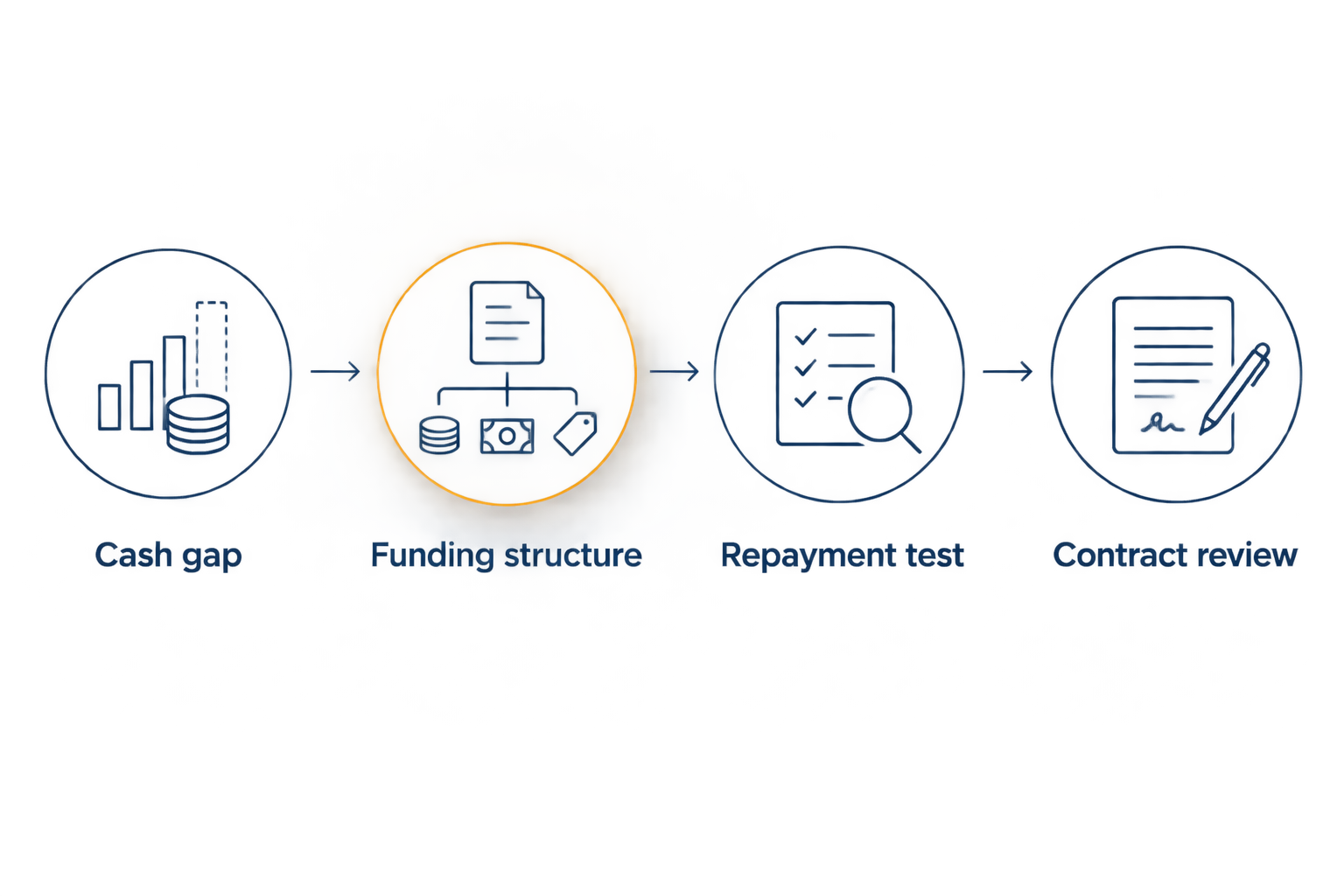
The decision sequence is simple: establish the cash gap, compare the structure, then verify repayment and contract terms. Do not let an approval substitute for that review.
Which funding structure fits the practice's actual need?
Use this 2026 comparison to choose a structure before comparing providers. Each option solves a different problem, and the contract determines its obligations.
| Option | Best for | Main advantage | Key limitation |
|---|---|---|---|
| Business line of credit | Recurring, temporary operating gaps | Draw and reuse repaid principal under the agreement | Draw access, rates and renewal remain subject to terms |
| Business term loan | A defined project with a planned repayment period | Lump-sum funding with a stated payment schedule | Additional borrowing generally requires a separate arrangement |
| Equipment financing | A specific equipment purchase | Connects financing to an identifiable business asset | Asset-related security and use restrictions can apply |
| Revenue-based financing or future-receivables purchase | Owners comparing funding tied to business receipts | Provides another structure to evaluate against collections | Remittances reduce available operating cash; adjustment rights require contract review |
| Cash reserves and collection improvements | Manageable gaps that do not require outside funding | Avoids a new financing obligation | Uses liquidity or requires successful collection work |
Choose a revolving line for a revolving need—not merely because the limit looks attractive. A long-lived equipment purchase deserves a separate equipment-financing or term-loan comparison rather than automatically consuming the practice's operating cushion.
Revenue-based financing can be structured as a purchase of future receivables rather than a loan. Merchant cash advance, or MCA, is a common search term for this category; inspect the agreement instead of assuming the name establishes payment flexibility.
What mistakes should dental practice owners avoid?
Borrowing against production instead of collections
A completed procedure does not put cash in your bank account. Base repayment on collectible receipts and investigate claim denials or patient balances before treating them as dependable cash.
Using a revolving line for every equipment purchase
An equipment purchase can leave less available credit for payroll and supplies. Compare a separate financing structure and check whether repayment fits the asset's intended business use.
Treating a receivables purchase like a bank line
A future-receivables purchase is not automatically reusable credit, and its remittance mechanics differ from a conventional loan. Confirm the purchased amount, collection method, reconciliation process and contractual obligations.
Ignoring the effect of existing daily withdrawals
Review all automatic financing debits together, not one offer at a time. A new payment that appears manageable alone can leave insufficient cash when combined with payroll, laboratory invoices and existing obligations.
Assuming a bank decline makes credit irrelevant
Ask why the bank declined before selecting an alternative. Personal and business credit, cash flow, existing obligations and other underwriting factors still matter; a different structure does not erase repayment risk.
What documents and disclosures should you request?
Ask each provider for a written offer and the documents needed to verify it. A bank statement review and a practice-management production report answer different questions; reconcile both with your financial statements.
Your comparison file should include:
- Requested proceeds and the precise business use.
- Current financial statements and requested tax records.
- Receivables aging, collection issues and existing financing balances.
- Payment schedules, applicable fees and early-payoff terms.
- Guarantee, collateral, lien and renewal provisions.
Jon Lynch Financial Group offers business-funding comparisons through third-party partners, not direct lending. Products are for business purposes and subject to third-party underwriting; approval, amounts, rates, decisions and funding times are not promised.
For any 2026 proposal, confirm current requirements directly with the responsible provider. Do not treat an article, preliminary conversation or application submission as an approved offer.
FAQ
What's the best business line of credit for a dental practice?
The best fit is a revolving facility whose qualification requirements, payment schedule and contract terms match the practice's collected cash flow. Compare written proposals using the same draw amount and repayment assumptions, not just advertised limits.
Can I use a dental practice credit line for payroll?
A business line of credit can fund payroll when the agreement permits that business use. Identify the collections that will repay the draw and include existing financing payments in your forecast.
Is a line of credit better than equipment financing for dental equipment?
Equipment financing deserves comparison when the need is a specific equipment purchase rather than a recurring operating gap. Using a credit line for equipment reduces the remaining capacity available for other practice expenses.
How much monthly revenue does my dental practice need?
There is no single revenue requirement stated here for all dental practice credit lines. Jon Lynch Financial Group's primary broker-assisted funding audience generates at least $35,000 per month, but each third-party program applies its own underwriting requirements.
Can I qualify after my bank declines the application?
A bank decline does not establish whether another provider will approve your practice. Obtain the decline reason, address correctable issues and compare alternatives without assuming credit or repayment capacity stops mattering.
Is revenue-based financing the same as a line of credit?
No, revenue-based financing is not automatically a revolving line of credit and can be structured as a purchase of future receivables. Review the agreement's legal structure, remittance schedule and any reconciliation rights before comparing it with a loan.
How quickly can a dental practice get a credit line?
Timing depends on the provider, document completeness, verification and underwriting. Ask separately about application review, approval, account setup and access to a draw; none is a promised funding deadline.
Which related guides help you compare?
- Working capital loans for dental and medical practices
- Working capital cost versus a term loan
- How long business line of credit approval takes
What's the final check before you apply?
Ask whether your practice could repay the proposed draw if access to additional credit stopped. A revolving facility should support the collection cycle, not make continued borrowing necessary to meet existing payments.
Prepare your collection forecast and existing-payment schedule, then choose the route that matches your business. At least $35,000 per month in revenue: Compare Business Funding Options. Below that threshold: Explore Self-Serve Funding.