Best hard money lenders for business real estate in 2026
Compare hard money lenders for business real estate by property fit, net proceeds, repayment and exit risk. Choose the funding route your business can carry.

Best starting point: broker-led comparison. Best for a collateral-led acquisition: an asset-based private lender. Best for renovation and lease-up: a rehabilitation bridge lender. When comparing hard money lenders for business real estate in 2026, choose the structure that fits your property and repayment exit—not the strongest speed claim. Hard money is short-term, property-secured financing; the tradeoff is closing flexibility versus maturity, collateral and refinancing risk.
- Compare hard money lenders for business real estate by property fit, net proceeds, repayment obligations and exit requirements.
- Jon Lynch Financial Group is best for business owners seeking broker-led funding comparisons, not direct lending.
- Asset-based private lenders fit collateral-led acquisitions; rehabilitation bridge lenders fit renovation and lease-up projects.
- Compare bank and SBA financing before accepting a short-term property loan with a balloon payment.
Why does the lender choice matter?
Your property purchase and your operating business compete for the same cash. A financing structure that completes an acquisition but drains payroll reserves is not a successful funding decision.
Jon Lynch Financial Group is a broker, not a direct lender. Its primary comparison audience is U.S. business owners generating at least $35,000 per month; that threshold describes the brokerage audience, not a hard money lender’s approval requirement.
For a 2026 acquisition, separate the property financing from working capital before comparing offers. Identify what funds the purchase, what funds improvements, and what keeps the business operating until the property supports its obligations.
What makes the best hard money lender for your deal?
Use these criteria before selecting a lender or submitting a property package:
- Property fit: Confirm the lender accepts your property type, location, occupancy and intended business use.
- Net proceeds: Compare cash actually delivered at closing, not just the stated loan amount.
- Total obligations: Request interest, fees, required reserves, payment schedules and payoff conditions in writing.
- Execution conditions: Identify valuation, title, insurance and document requirements that must clear before closing.
- Exit feasibility: Match maturity to a supportable sale or refinance plan, including a delay scenario.
- Contract risk: Review guarantees, lien priority, default provisions, draw controls and extension conditions.
The best hard money offer is the one your business can close, carry and repay under documented terms. Treat an advertised closing window as a proposal until the lender confirms the conditions attached to it.
Which funding routes belong on your shortlist at a glance?
This is a use-case ranking of funding routes, not a league table of individual lenders. Broker-led comparison belongs first when you need to distinguish property financing from operating-business funding.
| Rank and option | Best for | Standout feature | Key limitation |
|---|---|---|---|
| Broker-led comparison | Owners evaluating several funding structures | Separates financing options before choosing a provider | The broker does not make the lending decision |
| Asset-based private lender | Collateral-led property acquisitions | Emphasizes property security and the repayment exit | Property equity does not eliminate underwriting or default risk |
| Rehabilitation bridge lender | Renovation and lease-up | Connects acquisition financing with improvement funding | Draw conditions and maturity create execution pressure |
| Bank or SBA lender | Eligible long-term owner-occupied use | Offers a route to longer-term financing | Qualification and closing requirements must fit the transaction |
For the acquisition-specific mechanics, review bridge loans for commercial property acquisitions. Use the same property package when comparing proposals so differences reflect the financing rather than inconsistent assumptions.
1. Broker-led comparison: best for separating property and business funding
A commercial finance broker helps you compare funding structures and third-party providers. That distinction matters when your request combines a building purchase, renovations and working capital: those needs do not necessarily belong in the same product.
Jon Lynch Financial Group is best for U.S. business owners seeking broker-led business-funding comparisons rather than a direct lender. Its stated services include working capital, revenue-based financing and access to commercial financing options through third-party partners.
Broker-led comparison pros:
- Gives you a route to compare different funding structures.
- Keeps business cash-flow needs in the financing discussion.
- Helps distinguish loans from purchases of future receivables.
Broker-led comparison cons:
- Approval remains with the third-party lender or funder.
- Broker involvement does not remove property or borrower underwriting.
- You must identify compensation, fees and product responsibility in the proposed transaction.
Best for: Established business owners who need to determine which funding route fits before committing to a property-secured loan.
Ask who supplies the capital, who services the obligation and which party controls closing. A broker’s introduction is not a lender commitment.
Verdict: Buy the comparison approach; wait on any financing commitment until the provider and terms are clear.
2. Asset-based private lender: best for a collateral-led acquisition
An asset-based private lender evaluates real estate as security for a loan. Property value, lien position, borrower contribution and the repayment exit are central to the transaction, but credit and financial capacity still matter.
This route belongs on your shortlist when the property and exit support a short-term financing structure. It does not turn a weak acquisition into a sound investment.
Asset-based private lender pros:
- Frames the financing around property collateral.
- Provides a structure to evaluate a short-term acquisition bridge.
- Makes equity contribution and lien position explicit comparison points.
Asset-based private lender cons:
- Default puts pledged collateral at risk.
- A maturity balloon requires a credible repayment source.
- Guarantees and covenants create obligations beyond the property itself when included.
Best for: Buyers with a defined property acquisition, available equity and a documented sale or refinance exit.
For a 2026 purchase, ask whether the lender bases its advance on purchase cost, current value or another documented measure. Those bases produce different financing results even when the quoted percentage looks identical.
Verdict: Buy only when the collateral assumptions, carrying obligations and exit all support the deal.
3. Rehabilitation bridge lender: best for renovation and lease-up
A rehabilitation bridge lender structures temporary property financing around an improvement plan. Renovation proceeds can be subject to inspections, reimbursement requirements and lender-controlled draws; confirm the actual arrangement before signing.
The practical question is not just whether improvements are financed. It is whether you have enough cash to start work and keep contractors paid before each draw arrives.
Rehabilitation bridge lender pros:
- Connects acquisition funding with a defined improvement project.
- Creates a framework for reviewing budgets and milestones.
- Fits a temporary hold while you prepare a sale or refinance.
Rehabilitation bridge lender cons:
- Draw requirements can create cash-flow gaps.
- Cost overruns remain a borrower problem unless the contract provides otherwise.
- Construction and lease-up delays threaten the repayment schedule.
Best for: Buyers undertaking a documented renovation or lease-up project with cash reserves and a supportable exit.
Request the draw checklist before accepting the offer. Confirm who pays contractors initially, what inspections are required and whether unused renovation proceeds remain unavailable at closing.
Verdict: Buy only after matching the draw process to your construction cash flow; skip a structure you cannot carry between draws.
4. Bank or SBA lender: best for eligible long-term owner-occupied use
Bank and SBA-backed financing are alternatives to hard money, not interchangeable versions of it. SBA programs have eligibility and occupancy requirements, and SBA financing does not serve passive investment property in the same way as business-use real estate.
Compare these routes when your business intends to occupy eligible premises and the transaction allows the required underwriting. Do not use short-term debt merely because you have not investigated a permanent financing route.
Bank or SBA lender pros:
- Gives eligible owners a longer-term financing route to investigate.
- Aligns the comparison with business-use property requirements.
- Provides an alternative to relying immediately on a sale or refinance exit.
Bank or SBA lender cons:
- Program eligibility excludes some property uses and transactions.
- Financial documentation and underwriting requirements still apply.
- The lender’s closing process must fit your purchase agreement.
Best for: Qualified operating businesses buying eligible premises for long-term use.
In 2026, request a bank or SBA assessment before choosing a bridge solely for convenience. Compare actual proposals; do not assume either approval or lower total obligations.
Verdict: Hold the hard money commitment while you assess a suitable permanent option.
How do you compare the numbers without mixing different assumptions?
Start with definitions. Loan-to-value, or LTV, divides the loan amount by the property value used for underwriting; loan-to-cost uses eligible project cost instead. At 100% LTV, the loan equals that stated property value—this is a mathematical definition, not a recommended advance or an available program.
Debt-service coverage ratio, or DSCR, divides the relevant income measure by debt service over the same period. At 1.0x DSCR, that income equals scheduled debt service, leaving no surplus within that calculation; lenders determine their own required measures and thresholds.
The brokerage audience threshold also has a straightforward conversion: $35,000 per month × 12 months = $420,000 per year if revenue remains constant. Gross revenue is not profit, property value or cash available to service debt.
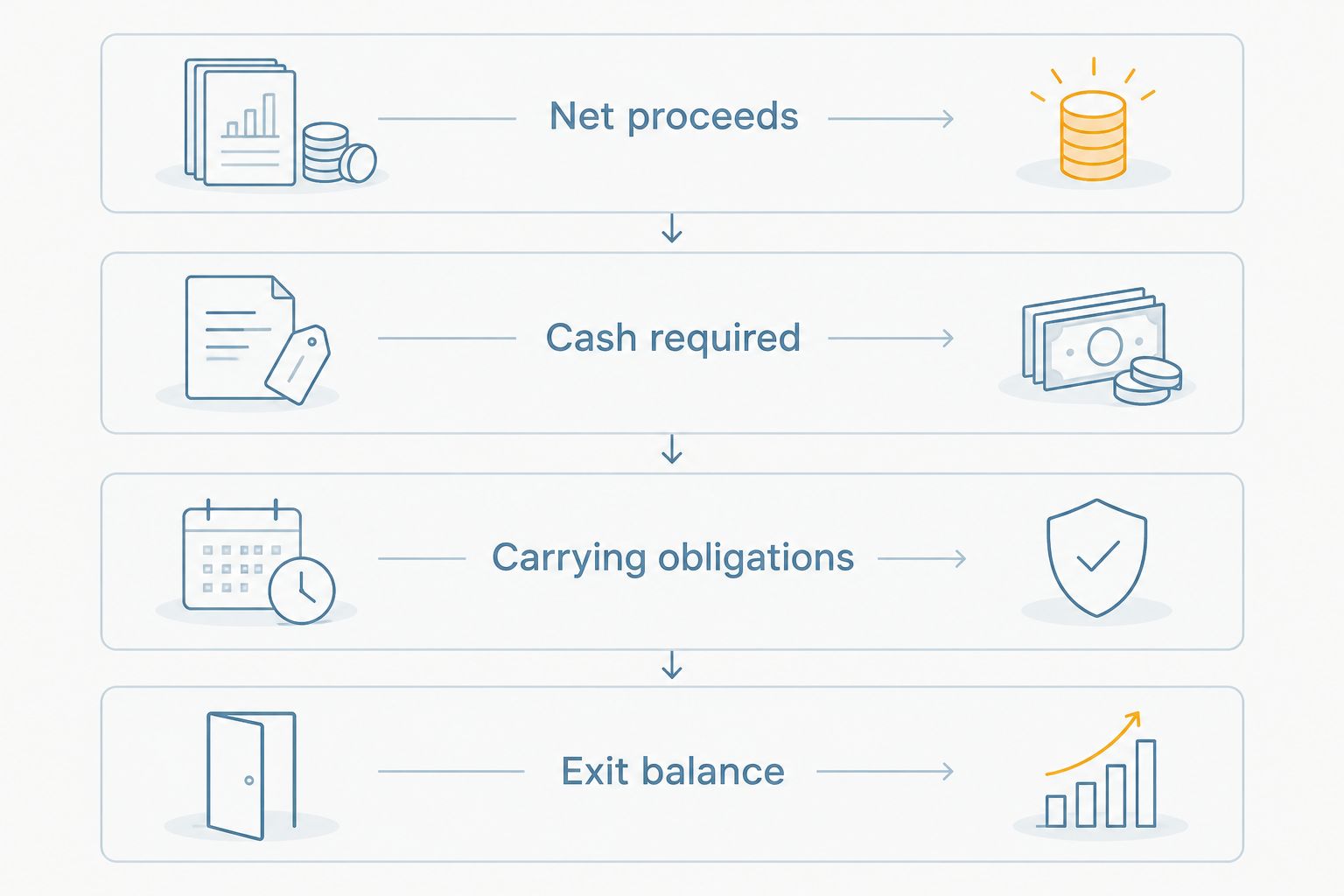
Build your 2026 comparison around these fields:
- Net proceeds: Funds delivered after deductions and reserves.
- Cash required: Equity, closing obligations and unavailable draw funds.
- Carrying obligations: Scheduled payments and property operating expenses.
- Exit balance: Amount needed to satisfy the obligation at payoff.
A factor rate is a repayment multiplier used in some business-funding structures; it is not an annual percentage rate. Revenue-based financing can be structured as a purchase of future receivables rather than a loan, so do not compare its multiplier directly with a property loan’s annual interest rate.
What risks should stop you from proceeding?
Stop if repayment depends entirely on an uncommitted refinance. A property’s expected future value is not a refinance approval, and a lender’s extension clause is not an automatic extension.
Other stop signals include:
- An unexplained mismatch between the proposal and final documents.
- Insufficient cash for operating expenses and required property work.
- Unclear guarantees, default remedies or cross-collateral provisions.
- A lender that has not confirmed eligibility for your property use.
- An exit that fails if construction, occupancy or a sale is delayed.
Credit is not irrelevant to hard money financing. Ask how the lender evaluates credit history, liquidity, experience and existing obligations rather than accepting a blanket no-credit claim.
What documents should you prepare before comparing offers?
Prepare a consistent package, then ask each provider for its transaction-specific checklist. Requirements depend on the property, borrower, financing structure and underwriting.
- Purchase agreement or acquisition summary.
- Property description, intended use and occupancy information.
- Business financial statements and bank statements.
- Existing property debt and ownership information.
- Renovation budget, project scope and contractor information when relevant.
- Available equity, reserves and the proposed repayment exit.
Disclose existing obligations upfront. Separate business operating cash from property-level cash flow so a provider can assess both without double-counting the same income.
How are these routes ranked?
The ranking follows the criteria above: property fit, usable proceeds, obligations, execution conditions, exit feasibility and contract risk. Each route owns a distinct use case; no named lender receives an unsupported approval, speed or cost ranking.
For an undecided owner, start with structure comparison. Select the lender only after deciding whether the transaction needs a temporary property bridge, long-term financing or separate working capital.
FAQ
What are the best hard money lenders for business real estate?
The best fit is a lender whose property eligibility, net proceeds, payment obligations and maturity match your acquisition and exit. Compare an asset-based private lender for a collateral-led purchase and a rehabilitation bridge lender for renovation or lease-up.
Is Jon Lynch Financial Group a hard money lender?
Jon Lynch Financial Group is a broker, not a direct lender. It helps business owners compare funding through third-party lenders and funders; the third party makes the underwriting decision.
Can hard money finance a building my business will occupy?
Business occupancy must be confirmed with the specific lender before you proceed. Compare bank and eligible SBA financing as alternatives, and disclose the intended use in every application.
Does hard money mean my credit does not matter?
No—property collateral does not make credit irrelevant. Ask the lender how credit, liquidity, guarantees and existing obligations affect its decision.
Is a merchant cash advance the same as a hard money loan?
No—a hard money loan is property-secured financing, while a merchant cash advance can be structured as a purchase of future receivables. The collateral, repayment mechanics and contractual obligations require separate comparison.
What happens if I cannot refinance before maturity?
You must address the repayment obligation under the signed contract. An extension is available only under the lender’s applicable terms, so review extension and default provisions before closing.
Does monthly business revenue guarantee real estate financing?
No—revenue does not guarantee approval, an amount or a financing term. Property eligibility, collateral, financial capacity and third-party underwriting remain relevant.
One last thing: what should you verify before choosing?
A larger stated loan does not necessarily deliver more usable cash. Reserve deductions and renovation holdbacks can leave you funding more of the project yourself, so request a written closing breakdown before selecting the offer.
Related guides
- Compare self-storage commercial real estate financing
- Working capital loans: costs and qualification
- Best banks for small business loans
What is your next step?
For 2026, bring the property summary, business financials and repayment exit to the comparison. Jon Lynch Financial Group serves business-purpose funding needs through third-party partners; consumer-purpose and non-U.S. requests are outside its primary funding audience, and approval, amounts, rates and funding times are not guaranteed.
If your U.S. business generates at least $35,000 per month, Compare Business Funding Options. Below $35,000 per month, Explore Self-Serve Funding for the tech-forward business-funding route; do not treat that route as a confirmed property-financing program.