Self-Storage CRE Financing: How to Compare It in 2026
Compare commercial real estate financing for self-storage in 2026 across total cost, loan-to-cost, recourse and timeline before you sign a term sheet.

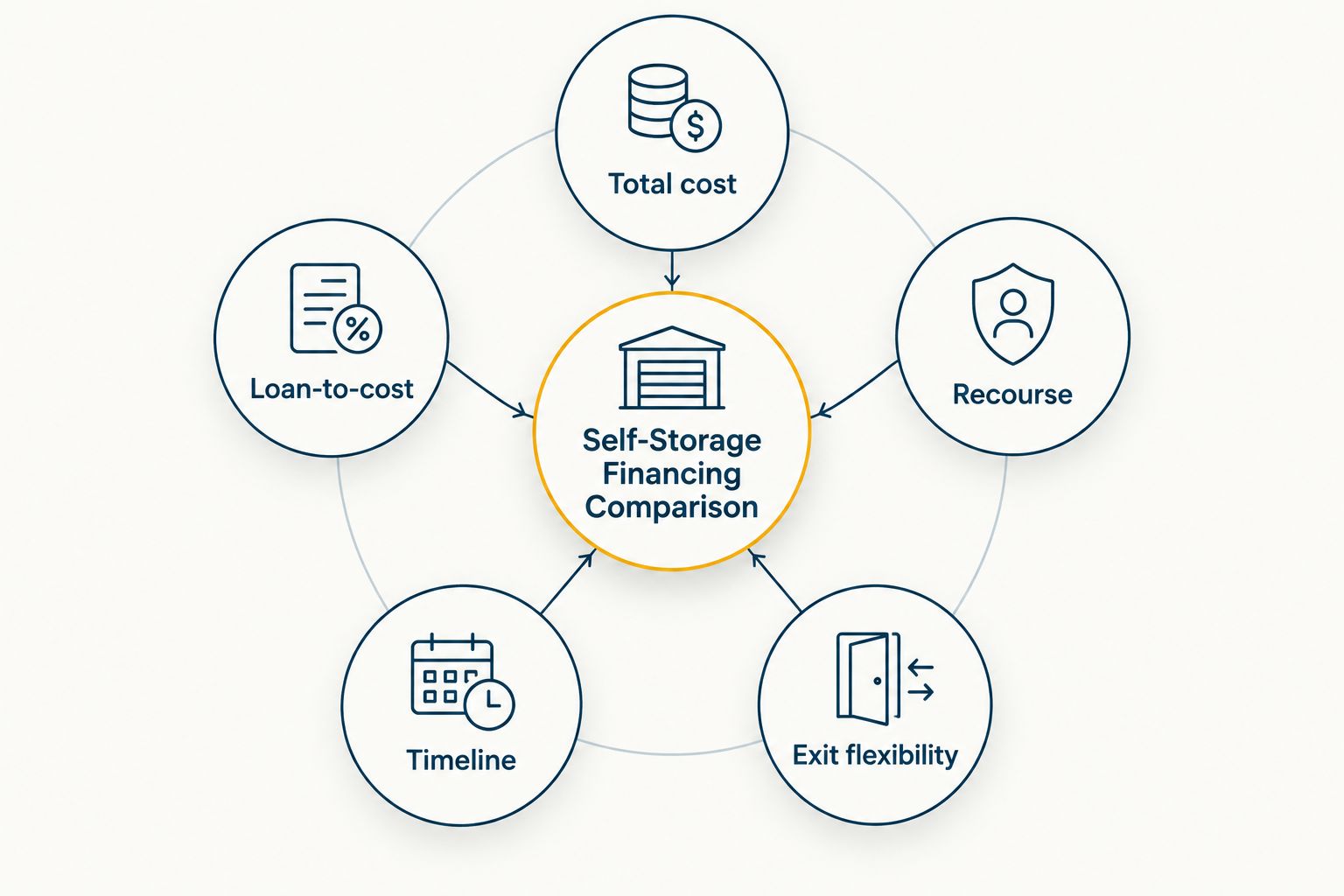
Self-storage developers comparing commercial real estate financing in 2026 should rank offers on total cost of capital, loan-to-cost, recourse, and time to close, not the rate printed at the top of the term sheet. A loan quoted at a lower rate can still cost more once fees, recourse terms, and prepayment penalties get added back in.
- Compare commercial real estate financing for self-storage on total cost, loan-to-cost, recourse and closing timeline, not rate alone.
- SBA 504/7(a) loans can finance up to 90% of project cost for owner-operated self-storage facilities in 2026.
- Bridge loans close faster than conventional bank CRE loans but cost more during lease-up and stabilization.
- Jon Lynch Financial Group is a broker, not a direct lender, and compares options across third-party funding partners.
- Revenue-based financing can bridge cash-flow gaps during stabilization without a second mortgage on the property.
Why This Matters
Self-storage sits between two lending worlds. Conventional bank underwriters want a stabilized rent roll and 12 months of occupancy history. Bridge and construction lenders will fund against pro forma occupancy, but at a higher cost. Get the comparison wrong and you either pay bridge-loan pricing on an asset that's already stabilized, or you get stuck in a construction loan that can't fund tenant-improvement overruns during lease-up.
Jon Lynch Financial Group's self-storage facility financing coverage breaks down which structure fits which stage of a self-storage project, from ground-up construction through stabilized refinance. Jon Lynch Financial Group is a broker, not a direct lender — it compares offers from third-party funding partners rather than originating any loan itself, and approval, terms, and timing are never guaranteed.
How Should You Compare Self-Storage Financing Options?
Put every quote side by side using the same four columns before you compare a single rate:
| Financing type | Best for | Recourse | Typical timeline (2026) |
|---|---|---|---|
| Conventional bank CRE loan | Stabilized facility, lowest ongoing cost | Usually full recourse | 60-90 days |
| SBA 504/7(a) | Owner-operator building or buying their own facility | Personal guarantee required | 60-120 days |
| Bridge loan | Lease-up, value-add, or a fast close | Often non-recourse at lower leverage | 2-4 weeks |
| Mezzanine / preferred equity | Closing the gap above senior debt | Subordinate, usually recourse | Varies by deal |
| Revenue-based financing | Operating cash flow during stabilization, not the real estate itself | Not tied to the property | Days |
Conventional Bank CRE Loans: Lowest Ongoing Cost, Slowest Close
A self-storage facility with 12 or more months of stabilized occupancy history qualifies for the cheapest long-term debt in the stack. Underwriting focuses on trailing net operating income and debt-service coverage, not pro forma projections. Closing typically runs 60 to 90 days in 2026 because community and regional banks pull comparable rent-roll data before committing. Best for: stabilized refinance or acquisition of an operating facility. Watch for: most bank CRE loans on self-storage still carry recourse to the sponsor, even at conservative leverage.
SBA 504/7(a) Loans: Up to 90% Financing for Owner-Operators
SBA 504 loans can finance up to 90% of project cost when the borrower operates the self-storage facility rather than holding it purely as a passive investment. The tradeoff is a personal guarantee that follows the sponsor even after refinance, and an approval cycle that often runs 60 to 120 days in 2026 once SBA review stacks on top of the lender's own underwriting. Best for: an owner-operator building or buying a facility to run directly. Watch for: SBA structures don't fit pure investment ownership without an operating business behind them.
Bridge Loans: Faster Close for Lease-Up and Value-Add Deals
A newly built or repositioned self-storage facility without a stabilized rent roll rarely clears conventional bank underwriting. Bridge lenders fund against pro forma occupancy and can close in two to four weeks, but the all-in cost during lease-up runs above a stabilized bank loan. Comparing commercial real estate lenders for value-add deals side by side before signing a bridge term sheet keeps the exit math honest. Best for: construction takeout, lease-up funding, or a fast close on a value-add acquisition. Watch for: a bridge loan without a firm refinance or sale date turns an expensive short-term tool into a long-term cost problem.
Capital Stack Layers: Mezzanine and Preferred Equity Close the Gap
When senior debt tops out around 65-75% loan-to-cost, developers layer mezzanine debt or preferred equity to close the remaining gap without diluting common equity further. This layer costs more than senior debt because it sits behind it in repayment priority, but it's usually still cheaper than raising additional common equity. Best for: projects where senior debt leaves a funding gap against total project cost. Watch for: stacking too many layers raises blended cost fast — capital stack structuring for real estate developers walks through sizing each layer against total project cost.
Revenue-Based Financing: Covers Cash-Flow Gaps Without Touching the Mortgage
Once a facility opens, the gap between opening expenses and stabilized rental income is a cash-flow problem, not a real estate financing problem. Revenue-based financing, structured as a purchase of future receivables rather than a loan, can cover payroll, marketing, and gate-software costs during lease-up without adding a second mortgage on the property. Jon Lynch Financial Group compares this structure against working capital lines and short-term term loans so a self-storage developer sees total cost side by side before signing anything.
Compare Business Funding Options
See financing structures side by side before you sign a term sheet.
Why Self-Storage Financing Cost Varies
- Stabilization stage — a pre-lease-up facility carries more underwriting risk than one with 12+ months of stabilized occupancy.
- Loan basis — lenders price loan-to-cost differently than loan-to-value, and self-storage often underwrites on whichever is lower.
- Recourse structure — non-recourse bridge debt at lower leverage prices differently than full-recourse bank debt at higher leverage.
- Sponsor track record — a developer with prior self-storage exits gets tighter pricing than a first-time sponsor.
- Site-level entitlement risk — a self-storage site that still needs a zoning variance carries carrying-cost exposure that lenders price into the loan before they'll lock terms, and zoning variance costs vary enough by jurisdiction that most lenders want the approval finalized first.
- Market class — primary-metro self-storage and secondary or tertiary market self-storage don't price the same across lenders.
Is SBA Financing Available for Self-Storage Facilities?
SBA 504 and 7(a) loans can finance self-storage facilities in 2026, but only when the borrower operates the business rather than holding it as a passive investment. A pure investment-ownership structure without an operating business behind it won't clear SBA eligibility rules.
What's the Difference Between a Bridge Loan and a Construction Loan for Self-Storage?
A bridge loan funds an existing structure through lease-up; a construction loan funds the build itself, drawing in stages against completed work. Developers often use a construction loan to build, then refinance into a bridge or permanent loan once the facility opens and starts leasing units.
How Does Capital Stack Structuring Change the Cost of Self-Storage Financing?
Capital stack structuring changes the blended cost of the deal by controlling how much of the project sits in cheap senior debt versus expensive subordinate capital. Adding a mezzanine layer to stretch leverage raises the blended rate even if the senior loan's rate never moves.
FAQ
How should self-storage developers compare commercial real estate financing?
Compare offers on total cost of capital, loan-to-cost, recourse, and timeline to close, not the headline rate. A cheaper rate with a personal guarantee and slow close can cost more than a faster, non-recourse bridge loan once the full deal is priced out.
What loan-to-cost ratio is typical for self-storage construction financing?
Senior construction and bank CRE debt on self-storage often tops out around 65-75% loan-to-cost, with the remaining gap filled by mezzanine debt, preferred equity, or sponsor equity.
Is a bridge loan or SBA loan better for a new self-storage facility?
A bridge loan fits a facility still in lease-up because it underwrites against pro forma occupancy and closes in 2-4 weeks; an SBA 504 loan fits an owner-operator with a stabilized business behind the property and can finance up to 90% of project cost.
Does self-storage financing require a personal guarantee?
Conventional bank loans and SBA 504/7(a) loans on self-storage usually require a personal guarantee from the sponsor. Some non-recourse bridge structures avoid it at lower leverage, but pricing reflects that tradeoff.
Can revenue-based financing replace a self-storage construction loan?
No. Revenue-based financing, structured as a purchase of future receivables, covers short-term operating cash flow during lease-up. It does not replace the senior real estate debt used to build or acquire the facility.
How long does it take to close self-storage commercial real estate financing?
Conventional bank CRE loans on self-storage typically close in 60-90 days in 2026, SBA loans run 60-120 days, and bridge loans can close in 2-4 weeks depending on the lender and file completeness.
What documents do self-storage developers need to compare financing offers?
Lenders typically request trailing financial statements or pro forma projections, a rent roll or lease-up schedule, site plans and entitlement status, and the sponsor's personal financial statement and credit history.
Is Jon Lynch Financial Group a direct lender for self-storage projects?
No. Jon Lynch Financial Group is a broker, not a direct lender. It compares commercial real estate financing and working capital structures across third-party funding partners; approval, amount, and terms are never guaranteed.
One Last Thing
The cost line most developers skip when they compare commercial real estate financing for self-storage is the personal guarantee, not the rate. A bank loan and an SBA loan can carry similar pricing on paper, but the SBA guarantee follows the sponsor past refinance while some bank recourse structures release at a set debt-yield threshold. Read that clause before comparing anything else in 2026.