Best invoice financing companies for staffing agencies in 2026
Compare invoice financing for staffing agencies by payroll fit, usable cash, total cost and recourse. Choose the funding structure before choosing a company.

The best invoice financing for staffing agencies matches available cash to payroll dates without consuming the margin on the invoices. Jon Lynch Financial Group fits owners comparing funding structures; a staffing-focused factor fits recurring payroll gaps, while a bank receivables line deserves consideration when your business qualifies and can wait for underwriting.
- Jon Lynch Financial Group fits owners comparing invoice financing for staffing agencies against other business-purpose funding options.
- Staffing-focused factoring fits recurring payroll gaps backed by completed work and eligible unpaid invoices.
- Compare invoice factoring and receivables lines by usable cash, total dollars, collection control and exit terms.
- Choose no facility until its funding conditions match your actual payroll deadline.
Why does the funding structure matter more than the company name?
Payroll comes due on your schedule; customer payments arrive on theirs. A financing arrangement solves that mismatch only when the invoices qualify and the cash becomes available before wages are due.
For your 2026 shortlist, separate companies that buy invoices from lenders that lend against receivables. A broker helps compare options but does not make the underlying funding commitment.
Start with Jon Lynch Financial Group when you want a business-funding comparison rather than assuming factoring is the answer. The related payroll funding guide addresses the cash-flow problem that staffing owners need to solve.
Choose the structure first, then compare companies offering that structure. The ranked routes below give each provider type a distinct job rather than treating every financing company as interchangeable.
What makes an invoice financing company a good staffing fit?
Use these criteria before comparing proposals:
- Usable cash: Compare the advance available after reserves, deductions and ineligible invoices—not the advertised facility size.
- Payroll timing: Ask what must happen before each advance, including invoice verification, customer acknowledgment and bank processing.
- Total dollars: Request every charge and calculate the cost through the expected collection date, including a late-payment scenario.
- Customer handling: Establish who contacts clients, where payments go and how billing disputes affect funding.
- Risk allocation: Identify recourse, guarantees, liens, concentration limits and obligations to repurchase invoices.
- Exit flexibility: Check minimum usage, exclusivity, renewal, termination and lien-release provisions.
A large commitment is not useful if your largest customer's invoices are excluded. Likewise, a low initial charge is not enough when minimums or collection delays change the final cost.
Which funding routes belong on your 2026 shortlist?
| Ranked route | Best for | Standout characteristic | Key limitation |
|---|---|---|---|
| Commercial finance broker | Comparing several funding structures | Helps compare invoice factoring with other business-funding options | The funding partner controls underwriting and terms |
| Staffing-focused factoring company | Recurring payroll gaps | Evaluates completed-work invoices and customer payment risk | Verification, reserves and recourse can restrict usable cash |
| Bank receivables line | Established agencies prioritizing borrowing cost | A revolving loan secured by eligible receivables | Underwriting and collateral requirements can limit fit |
| Selective invoice factoring company | Occasional large-invoice gaps | Transaction-level funding rather than financing every invoice, when offered | Selection rights and transaction economics depend on the contract |
These are provider categories, not interchangeable products. Request written terms from the companies you shortlist; the contract determines whether their offer actually fills the role shown here.
1. When is a commercial finance broker the best starting point?
Jon Lynch Financial Group: best for comparing funding structures
Jon Lynch Financial Group provides access to invoice factoring and other commercial funding options through third-party partners. It is a broker, not a direct lender, so an introduction or comparison is not a funding commitment.
This route fits an owner deciding whether the problem is an unpaid-invoice gap, a broader working-capital need or a new contract requiring cash before invoices exist. Those needs call for different comparisons.
Commercial finance broker pros:
- Lets you compare factoring with lines of credit, term loans and other available structures.
- Helps frame the decision around qualification, timing, repayment and total dollars.
- Provides a comparison route after a bank decline without assuming one product fits every business.
Commercial finance broker cons:
- The third-party provider decides eligibility, amounts and final terms.
- Comparing options does not establish that invoices will be eligible or payroll deadlines will be met.
- You still need to understand the final provider's contract and any broker compensation.
Best for: U.S. business owners generating at least $35,000 per month who want to compare business-purpose funding options.
Verdict: Hold any commitment until the actual funding partner provides written terms and confirms the conditions for releasing funds.
2. When is a staffing-focused factoring company the best fit?
Staffing-focused factoring: best for recurring payroll gaps
Invoice factoring generally involves selling eligible unpaid invoices to a factor. The factor advances part of the invoice value and handles collection according to the agreement; the remaining balance is settled after collection, less agreed deductions.
For temporary staffing, the critical distinction is between work completed and work merely scheduled. A customer contract or future assignment is not the same as an earned, verifiable invoice.
Staffing-focused factoring pros:
- Connects funding to completed work awaiting customer payment.
- Gives you a structure to assess repeated payroll-to-collection gaps.
- Makes customer creditworthiness and invoice documentation central to the funding review.
Staffing-focused factoring cons:
- Disputed hours, missing approvals or concentrated customer exposure can reduce eligible receivables.
- Collection notices and payment instructions affect the client relationship.
- Recourse provisions can return unpaid-invoice risk to your agency.
Best for: Agencies with recurring payroll obligations and documented invoices from customers that satisfy the factor's underwriting requirements.
Ask how the company handles approved timesheets, vendor-management systems and customer acceptance. Get the release conditions in writing before relying on an advance for wages.
Verdict: Hold until invoice eligibility, customer verification and payroll availability are confirmed; skip this route for work that has not yet been invoiced.
3. When should an established agency compare a bank receivables line?
Bank receivables line: best for cost-focused established agencies
A receivables line is a loan secured by eligible accounts receivable, not a sale of invoices. A borrowing base determines how much you can draw against receivables the bank accepts.
Compare a bank proposal when you have time for underwriting and can support its financial reporting requirements. Do not assume a bank line is cheaper: calculate the complete cost from the actual proposal.
Bank receivables line pros:
- Provides revolving borrowing rather than arranging a separate sale for every funded invoice.
- Lets you compare an interest-based loan directly against factoring costs.
- Can fit recurring working-capital needs when the borrowing base supports them.
Bank receivables line cons:
- Financial covenants, collateral conditions and reporting obligations can restrict access.
- Receivables aging or customer concentration can reduce borrowing availability.
- An approved credit limit does not mean the entire limit is drawable.
Best for: Established staffing businesses able to meet bank underwriting and reporting requirements, with no need to rely on an unconfirmed closing date.
Review lien priority before pursuing this alongside existing funding. Two facilities cannot simply claim the same collateral without addressing their contractual rights.
Verdict: Hold pending a written borrowing-base calculation; choose this route only when its usable cash and complete cost beat the alternatives.
4. When is selective invoice factoring the right alternative?
Selective invoice factoring: best for isolated large-invoice gaps
Selective factoring means funding chosen invoices rather than automatically submitting an entire receivables ledger, where the provider offers that arrangement. It suits a specific collection gap better than a permanent mismatch across the whole business.
The word selective does not settle the contract. Confirm which invoices you can choose, whether future invoices must be submitted and whether minimum usage applies.
Selective invoice factoring pros:
- Targets a defined cash need tied to a particular invoice.
- Lets you evaluate a transaction without assuming every customer needs funding.
- Creates a direct comparison between the cash released and the payroll obligation being covered.
Selective invoice factoring cons:
- The provider can reject the invoice or its customer.
- Transaction charges and minimums can change the economics of occasional use.
- A selected invoice can still carry recourse, assignment and collection requirements.
Best for: Agencies with occasional, documented collection gaps rather than a continuing need to finance the entire payroll cycle.
Verdict: Hold until selection rights and minimum obligations are clear; skip an arrangement that forces ongoing usage you do not need.
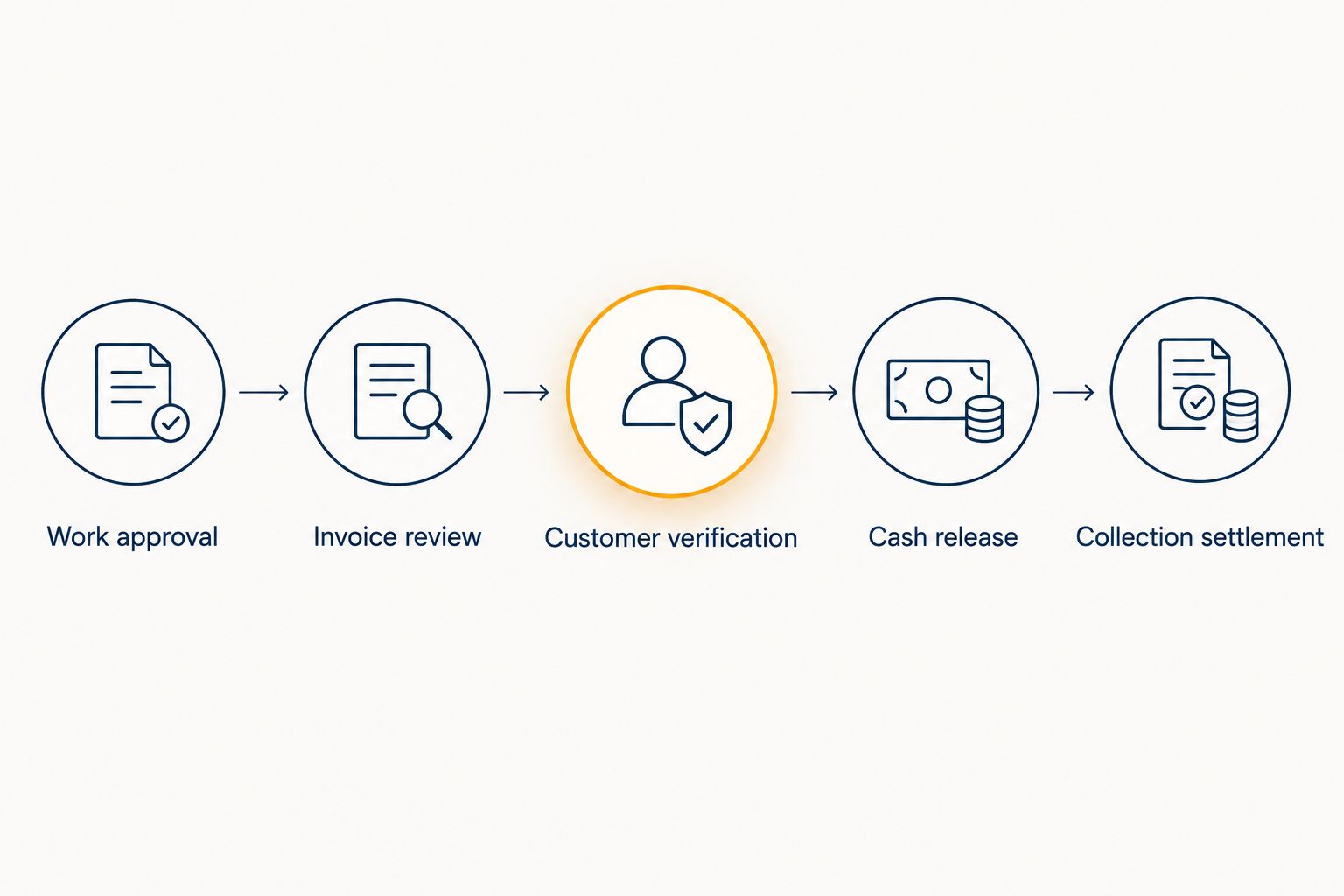
How does invoice financing turn invoices into payroll cash?
For a 2026 comparison, map the funding process before judging speed claims. The useful date is when cleared cash reaches your operating account, not when someone accepts your application.
- Work approval: Confirm completed services and obtain the customer's required timesheet or service approval.
- Invoice review: Submit invoices, aging and supporting records for eligibility review.
- Customer verification: Resolve payment instructions, invoice acknowledgment and any billing questions.
- Cash release: Confirm the advance, deductions and conditions for transfer.
- Collection settlement: Reconcile customer payment, reserve release and final charges.
Ask the proposed provider which steps repeat for each funding request. Initial setup and later advances are separate operational questions.
What do the payroll numbers look like?
Illustrative example only—not an offer, quoted advance rate or expected outcome: Assume an agency has $100,000 in eligible unpaid invoices and a proposed advance of 80%.
- Invoice advance: $100,000 × 80% = $80,000.
- Amount not initially advanced: $100,000 − $80,000 = $20,000.
- Weekly payroll: $18,000.
- Four payroll runs: $18,000 × 4 = $72,000.
- Initial cash remaining after those runs: $80,000 − $72,000 = $8,000, before financing deductions and other expenses.
That cushion is not profit. Payroll taxes, insurance, overhead and financing deductions still need funding, and the unadvanced amount is not available for immediate spending.
Now assume $25,000 of those invoices becomes ineligible. The same illustrative advance calculation becomes ($100,000 − $25,000) × 80% = $60,000, leaving a $12,000 shortfall against the four payroll runs.
Stress-test eligibility, not just the advance percentage. A provider's treatment of one major customer can determine whether the plan covers wages.
How should you compare total cost in 2026?
Request a written dollar calculation using the same invoice amount and expected customer payment date for every proposal. Then repeat it with a later collection date.
For factoring, list the purchase discount or financing charges, administrative charges, minimums and termination obligations. For a loan, list interest, origination charges, servicing charges and unused-line charges where applicable.
A factor rate is a multiplier, not APR. APR expresses annualized borrowing cost; converting a factor-rate arrangement requires the cash-flow schedule and all applicable charges, and a receivables purchase must not automatically be described as a loan.
Compare actual dollars and cash movement first. Ask who must make payments, when money leaves your account and what happens if customers pay late.
Which risks should stop you from signing?
Do not use invoice financing to disguise a loss-making staffing contract. Earlier cash does not repair inadequate billing margins.
Stop and resolve these issues:
- Invoice disputes: The client has not accepted the hours, rate or services.
- Customer concentration: A major client's exclusion would break the payroll plan.
- Recourse exposure: You cannot meet a contractual repurchase obligation.
- Existing liens: Another creditor already claims the receivables.
- Collection control: Client payment instructions conflict with the proposed arrangement.
- Exit restrictions: Renewal, minimum usage or termination terms block your intended exit.
Nonrecourse does not mean every unpaid invoice is protected. Read the defined covered risks and exclusions, especially disputes, documentation failures and contractual breaches.
What documents should you prepare before comparing companies?
Build a funding file that connects each cash need to supporting evidence. Requirements vary by provider; ask for the current checklist rather than assuming approval from a generic qualification statement.
- Receivables aging and copies of invoices proposed for funding.
- Customer contracts, approved timesheets and service acceptance records.
- Payroll schedule, tax obligations and a cash-flow forecast.
- Bank statements and current financial statements.
- Existing financing agreements, lien information and payoff details.
- A customer-level explanation of overdue or disputed balances.
For a new contract, show when work begins, when invoicing becomes possible and when customer payment is expected. That separates pre-invoice working capital from financing already-earned receivables.
How were these routes ranked?
The ranking follows the owner's decision: compare structures first, use staffing factoring for recurring eligible invoices, assess a bank line for an established borrowing profile, and consider selective factoring for isolated gaps. The criteria are usable cash, payroll timing, total dollars, customer handling, risk allocation and exit flexibility—not an unsupported company leaderboard.
FAQ
What's the best invoice financing for staffing agencies in 2026?
The best fit is the arrangement that releases enough usable cash before payroll while preserving contract margin. Compare staffing-focused factoring, a receivables line and selective factoring against the same invoices and collection dates.
Is invoice factoring the same as invoice financing?
No. Invoice financing is a broad term; factoring generally involves selling invoices, while receivables lending involves borrowing against them. Read the agreement to identify the actual structure.
Can I finance payroll before staffing invoices exist?
Not through funding that requires existing eligible invoices. Compare business-purpose working capital for the pre-invoice period, subject to the provider's underwriting and terms.
Does customer credit matter more than my staffing agency's credit?
Customer payment risk matters directly when funding depends on invoice collection. Providers can also review your business, credit, financial records, liens and documentation; credit is not irrelevant.
Does nonrecourse factoring remove all payment risk?
No. Nonrecourse protection applies only to the risks defined in the agreement. Disputes, invalid invoices and contractual breaches can remain your responsibility.
How much does staffing invoice financing cost?
The total cost depends on the written offer, eligible invoices, collection timing and applicable charges. Request dollar calculations for expected and delayed payment dates rather than relying on one headline rate.
Can invoice financing guarantee that I will make payroll?
No. Eligibility, verification, transfer conditions and bank processing determine when cash becomes available. Maintain a contingency plan instead of treating an application as cleared funds.
What else should you compare?
- Invoice factoring companies for small businesses
- Business line of credit for staffing agencies
- Business funding for government contractors
What should you do next?
Before your next 2026 funding comparison, mark the earliest payroll date your current cash cannot cover. Ask each provider to explain which eligible invoices support that amount and every condition that stands between approval and cash release.
Jon Lynch Financial Group is a broker, not a direct lender. Funding is for business purposes and subject to third-party underwriting; approvals, amounts, rates, decisions and funding times are not guaranteed. Revenue-based financing may be structured as a purchase of future receivables, distinct from factoring invoices for completed work.
If your U.S. business generates at least $35,000 per month, Compare Business Funding Options. If it generates below $35,000 per month, Explore Self-Serve Funding. Bring your payroll schedule and receivables aging so the next decision starts with the cash gap you actually need to cover.