Best merchant cash advance companies for contractors in 2026
Compare merchant cash advance for construction contractors by repayment fit, receivables terms and cash-flow risk. Start with broker-led funding comparisons.

Best for comparing funding structures: Jon Lynch Financial Group. Best for an accepted unpaid invoice: invoice factoring. Best for recurring cash-flow gaps: a business line of credit. For a merchant cash advance for construction contractors in 2026, choose the company by its written collection terms and your cash-flow capacity—not by the largest offer.
- Jon Lynch Financial Group is a broker-led comparison option for established U.S. contractors, not a direct lender.
- A merchant cash advance for construction contractors must fit collections after payroll, materials and existing obligations.
- Compare future-receivables purchases with invoice factoring, business lines of credit and equipment financing.
- Businesses generating at least $35,000 monthly should Compare Business Funding Options; smaller businesses should Explore Self-Serve Funding.
Why does the funding company matter for contractors?
Construction funding has to survive the gap between doing the work and collecting payment. A signed contract, an approved invoice and money deposited into your account are different underwriting facts.
The best company for your business is the one whose funding structure fits that gap without consuming the cash needed to finish the job. For your 2026 shortlist, distinguish a broker that compares options from the third-party funder that signs the agreement and administers collections.
This guide ranks funding routes by contractor use case, rather than presenting an unsupported leaderboard of named MCA companies. Start with the route that fits your receivables, then compare written proposals from the companies offering it.
What makes the best contractor funding option?
Use these criteria before considering the funding amount:
- Collection fit: Match the withdrawal schedule to actual deposits, not projected contract revenue.
- Total obligation: Compare net proceeds, all required payments or purchased receivables, and separately charged fees.
- Contract structure: Identify whether you are borrowing money or selling future receivables.
- Qualification fit: Ask how the program evaluates revenue, credit, existing financing and construction payment patterns.
- Downside terms: Read reconciliation, default, guarantee, security-interest and additional-financing provisions.
- Timing certainty: Separate an initial indication from completed underwriting, signed documents and cleared funds.
A company that cannot explain its agreement in plain English is not ready for your shortlist. Do not sign until you understand what happens when a customer pays late.
Which contractor funding routes compare at a glance?
| Rank and option | Best for | Standout feature | Key limitation |
|---|---|---|---|
| 1. Broker-led comparison | Established contractors comparing structures | Access to different third-party funding options | Broker does not make the final underwriting decision |
| 2. Direct future-receivables funder | A defined working-capital gap supported by ongoing collections | Purchase of future business receivables | Collection obligations can strain operating cash |
| 3. Invoice factoring company | Accepted, eligible unpaid invoices | Funding tied to specific receivables | Disputes, retainage and assignment restrictions require review |
| 4. Business line of credit provider | Repeated gaps between expenses and customer payments | Draw-and-repay borrowing structure | Qualification and renewal requirements vary |
| 5. Equipment finance provider | A specific machine or equipment purchase | Financing tied to the equipment need | Does not replace general-purpose working capital |
The order is a decision sequence, not a claim that an MCA is cheaper or more suitable than a loan. Move past the first option whenever another structure matches the expense and repayment source more closely.
1. Jon Lynch Financial Group: best for comparing contractor funding routes
Jon Lynch Financial Group helps U.S. business owners compare business-purpose funding through third-party lenders and funders. Its options include working capital, revenue-based financing, purchases of future receivables, lines of credit, term loans, equipment financing and invoice factoring.
Best for: Established contractors generating at least $35,000 per month who want to compare total obligation, timing, qualification and repayment before choosing a structure. That figure defines the primary comparison audience; it is not an approval threshold for every partner program.
Jon Lynch Financial Group pros:
- Lets you consider funding structures beyond an MCA.
- Provides a broker-led route for comparing business-funding needs.
- Includes equipment and invoice-based options alongside working capital.
Broker-led comparison cons:
- The third-party provider controls underwriting and final terms.
- Brokerage does not establish that any particular offer is suitable or less expensive.
Ask who the funding counterparty is, how broker compensation works and which alternatives were considered. Verdict: Hold any acceptance until the written comparison identifies the structure, obligations and provider.
2. Direct future-receivables funder: best for a defined collections-backed gap
A merchant cash advance can be structured as a purchase of future receivables rather than a conventional loan. The funder provides money in exchange for a contractual amount of future business receipts; the agreement determines collection mechanics and reconciliation rights.
Best for: Contractors with ongoing collections and a specific business-purpose gap whose proposed obligations fit cash remaining after essential expenses. An expected award or an unsigned change order is not the same as collected revenue.
Direct future-receivables funder pros:
- Offers a structure based on future business receipts.
- Can address working-capital needs beyond a single equipment purchase.
- Allows you to examine the actual collection and reconciliation provisions directly.
Direct future-receivables funder cons:
- Frequent withdrawals can conflict with uneven progress payments.
- Early settlement savings and payment adjustments depend on the agreement.
Ask whether withdrawals reflect actual receipts or an estimate, and how to request an adjustment when receipts fall. Verdict: Hold until the slow-collection cash forecast supports the proposed withdrawals.
3. Invoice factoring company: best for accepted unpaid invoices
Invoice factoring involves selling eligible invoices to a factoring company. It connects the funding decision to receivables already created rather than relying only on future business collections.
Best for: Contractors with completed, accepted work and eligible invoices owed by customers the factor will approve. Confirm that the invoice is assignable and separate the payable amount from retainage or disputed work.
Invoice factoring company pros:
- Ties the funding request to identifiable invoices.
- Gives you a clear customer-payment source to evaluate.
- Provides an alternative to financing against general future revenue.
Invoice factoring company cons:
- Disputed or conditional invoices require separate eligibility review.
- Customer notification, recourse and assignment terms can affect operations.
Ask what happens if the customer refuses payment, offsets the invoice or pays late. Also confirm who communicates with your customer. Verdict: Hold until invoice eligibility, recourse and customer-payment procedures are clear.
4. Business line of credit provider: best for recurring cash-flow gaps
A business line of credit lets you borrow within an approved limit, repay and draw again under the facility's terms. It is a borrowing structure, not a purchase of future receivables.
Best for: Contractors repeatedly paying labor and suppliers before receiving customer payments. Compare the facility against your recurring need, not just the first draw.
Business line of credit provider pros:
- Supports repeated borrowing under an approved facility.
- Lets you match individual draws to specific expenses.
- Separates the available limit from the amount currently borrowed.
Business line of credit provider cons:
- Credit, financial condition and other requirements affect qualification.
- Renewal, draw restrictions and repayment terms require review.
Check how interest and fees apply, whether the provider can restrict further draws, and what happens at renewal. Verdict: Hold until both the first draw and the ongoing facility fit your cash cycle.
5. Equipment finance provider: best for a specific equipment purchase
Equipment financing ties the funding request to machinery or other business equipment. It belongs on your shortlist when the expense is a defined asset rather than payroll or general job mobilization.
Best for: Contractors buying equipment with an identifiable business use and a repayment plan supported by operating cash flow.
Equipment finance provider pros:
- Matches the financing purpose to the asset being acquired.
- Keeps the equipment decision separate from payroll funding.
- Lets you compare ownership, security and end-of-term terms explicitly.
Equipment finance provider cons:
- Does not solve unrelated operating cash shortages.
- Asset requirements and security provisions vary by agreement.
Ask whether you own the equipment immediately, what security interest applies and whether a final payment is required. Verdict: Hold until the asset terms and repayment obligation fit the equipment's business purpose.
How does a contractor MCA work in practice?
For a merchant cash advance for construction contractors, the agreement matters more than the label. Revenue-based financing can be structured as a loan or a purchase of future receivables; do not assume that every product using the same name has the same legal or payment mechanics.
A factor rate is a multiplier used to calculate a contractual amount from an advance amount. It is not APR, because the multiplier alone does not express an annualized cost or account for the timing of payments.
Use the guide to comparing MCA factor rates to understand that distinction. Request the complete payment assumptions and applicable disclosures rather than treating a factor rate as an interest rate.
Reconciliation is the agreement's process for adjusting collections to reflect actual receipts, where provided. Read the process, required evidence and response terms; a reference to reconciliation is not enough by itself.
What do the cash-flow numbers show?
The following is an illustrative operating-cash example, not a funding quote, qualification standard or promised outcome. It tests cash capacity without assigning a financing price.
Assume a contractor collects $60,000 during one month and pays $48,000 in essential operating expenses. Cash remaining before funding obligations is $60,000 minus $48,000, or $12,000.
If proposed collections under a funding agreement total $8,000 during that month, the remaining cushion is $12,000 minus $8,000, or $4,000. That cushion must absorb anything excluded from the expense estimate.
Now assume customer collections fall to $50,000 while expenses remain $48,000. Only $2,000 remains before the proposed $8,000 obligation, leaving a $6,000 cash shortfall unless collections are adjusted or another cash source exists.
Your 2026 comparison should therefore test both the expected month and a delayed-payment month. Monthly revenue is not the same as cash available for withdrawals.
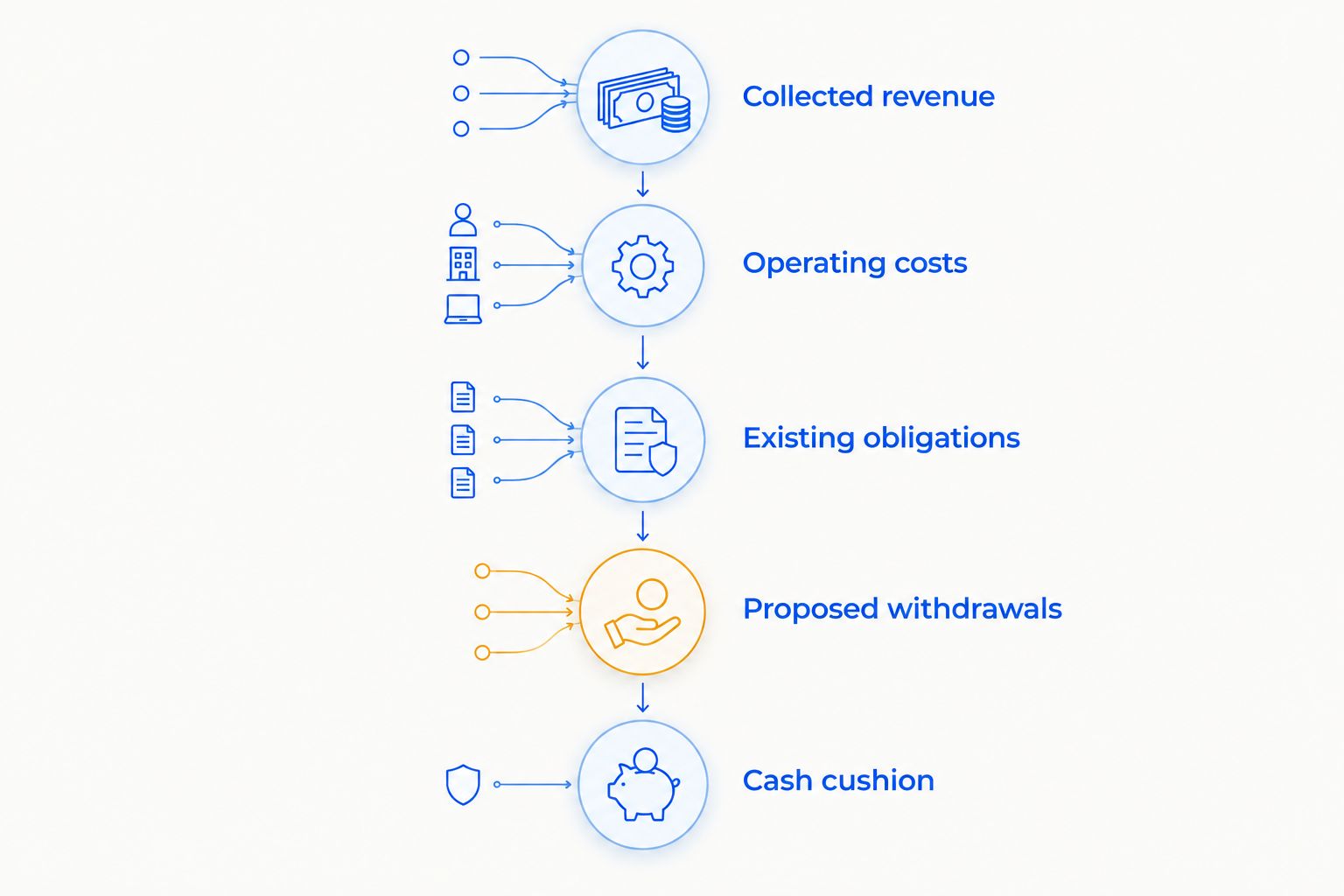
Use this sequence for each proposal:
- Collected revenue: Start with deposited customer payments.
- Operating costs: Deduct payroll, materials and essential overhead.
- Existing obligations: Deduct current financing and other committed payments.
- Proposed withdrawals: Apply the new agreement's actual schedule.
- Cash cushion: Check what remains before accepting.
What risks should remove an offer from your shortlist?
An offer is unsuitable when its obligations depend on cash you cannot reasonably identify. A larger advance does not fix a job whose collection schedule cannot support the agreement.
For every 2026 proposal, examine these issues:
- Retainage: Do not treat withheld funds as immediately available cash.
- Disputed work: Exclude unresolved change orders from dependable collections.
- Existing funding: List every current payment and withdrawal before adding another.
- Guarantees and liens: Identify exactly what obligations and assets the documents cover.
- Default triggers: Read provisions concerning additional financing, account changes and missed obligations.
- Early settlement: Obtain written terms rather than assuming an early payoff reduces the obligation.
A bank decline does not establish that an MCA is the right next step. Determine whether the decline concerned credit, cash flow, documentation or another issue, then compare an alternative that addresses that issue.
Which documents should you prepare before comparing companies?
Build a funding file that explains both your business and the job-related cash gap. Ask each provider for its current requirements; no single checklist establishes eligibility across all programs.
Prepare:
- Recent business bank statements and an explanation of unusual deposits.
- Existing financing agreements and current payment schedules.
- Accounts-receivable aging, accepted invoices and retainage details.
- Relevant contracts and the expected customer-payment sequence.
- Business identification and ownership information requested by the provider.
- A cash forecast connecting the funding purpose to repayment or collections.
Ask how credit affects the specific program. Revenue-based underwriting does not mean credit is irrelevant, and submitting documents does not establish approval.
How were these options ranked?
The ranking follows the decision criteria above: collection fit, total obligation, structure, qualification, downside terms and timing. Broker-led comparison comes first for owners who have not established which structure fits; invoice, credit-line and equipment routes each address a distinct need.
It is not a ranking based on customer scores, funded volume or measured approval speed. The deciding evidence is your business file and the written proposal.
FAQ
What's the best merchant cash advance company for a construction contractor?
The best fit is a company whose written collection terms work with your actual cash flow. Jon Lynch Financial Group provides a broker-led comparison route for established U.S. business owners, while third-party funders determine approval and contract terms.
Is a merchant cash advance a business loan?
A merchant cash advance can be structured as a purchase of future receivables rather than a business loan. Read the agreement to identify the legal structure, collection obligations and reconciliation provisions.
Can I qualify after a bank declines my construction business?
A bank decline does not determine eligibility for every other funding program. Third-party providers assess their own requirements, including revenue, credit, existing obligations and the business's financial condition.
Is invoice factoring better than an MCA for contractors?
Invoice factoring is a closer structural match when the funding need concerns eligible, accepted unpaid invoices. Compare recourse, assignment, customer notification and total obligations before choosing it over a future-receivables purchase.
Does a factor rate tell me the APR?
A factor rate does not tell you the APR. It is a multiplier; annualized cost depends on cash received, applicable charges and payment timing.
What if my construction business makes less than $35,000 per month?
Businesses below $35,000 in monthly revenue should Explore Self-Serve Funding. The route is open to U.S.-based entrepreneurs, uses a secure bank-statement connection through Plaid and remains subject to verification and product terms.
Can I get contractor funding immediately?
A funding time is not guaranteed. Underwriting, verification, bank processing and product terms determine when an approved transaction can be completed.
Which related guides match your funding decision?
- Business funding for government contractors
- Business line of credit lenders
- How to get out of a stacked merchant cash advance position
What should you do before accepting funding?
One last thing: a profitable job can still produce a cash shortage when expenses arrive before collections. For your 2026 decision, ask for a written proposal and place its withdrawal schedule alongside your expected customer deposits before accepting.
Jon Lynch Financial Group is a broker, not a direct lender. Products are for business purposes and subject to third-party underwriting; approval, amounts, rates, decisions and funding times are not guaranteed.
Choose the next step that matches your business: generating at least $35,000 per month, Compare Business Funding Options; generating below $35,000 per month, Explore Self-Serve Funding.
Choose Your Business Funding Route
Select the route matching your monthly revenue, then compare terms before accepting funding.