Best no credit check business funding for seasonal businesses 2026
Best no credit check business funding for seasonal businesses: compare repayment fit, credit-review rules, factoring and future-receivables risks.

Best overall comparison route: Jon Lynch Financial Group for established U.S. businesses generating at least $35,000 per month. Best for seasonal sales: revenue-based financing with documented sales-adjustment terms; best for unpaid B2B invoices: invoice factoring. No funding category automatically means no credit check, and the central tradeoff is whether repayment still fits when seasonal revenue falls.
- The best no credit check business funding for seasonal businesses depends on repayment fit, not an advertising label.
- Jon Lynch Financial Group compares business funding through third parties; credit-review requirements depend on the funding partner.
- Revenue-based financing needs contract-level review of sales adjustments, reconciliation, and off-season obligations.
- Invoice factoring fits completed B2B sales; purchase-order financing addresses eligible orders before fulfillment.
Why does seasonal repayment matter more than a credit-check label?
A seasonal business needs funding that survives its weakest collection period, not just its busiest sales month. In 2026, start with the source of repayment: future customer sales, existing invoices, or a specific purchase order.
Separate three claims: no hard personal credit inquiry, no minimum personal credit score, and no credit review. They mean different things. A funder can use a soft inquiry, review business credit, or consider an owner's history without describing the process as a traditional bank application.
Jon Lynch Financial Group is best suited to established U.S. business owners comparing working-capital structures, not borrowers seeking a promised credit-check exemption. The company is a broker, not a direct lender.
What makes the best seasonal business funding?
Use these criteria before comparing offers:
- Credit-review clarity: Get written confirmation of personal and business credit checks, inquiry type, and application-stage requirements.
- Off-season affordability: Model withdrawals against low-season collections after essential operating expenses.
- Total obligation: Compare net proceeds, total contractual payments or purchased receivables, fees, and early-exit terms.
- Repayment mechanics: Distinguish fixed installments from sales-linked remittances and understand adjustment procedures.
- Asset or transaction fit: Match unpaid invoices, confirmed orders, or future sales to the appropriate structure.
- Contract exposure: Review guarantees, liens, default triggers, and restrictions on additional financing.
A lower credit barrier does not establish affordability. Reject a structure that requires another advance just to meet its existing withdrawals.
Which options belong on your 2026 shortlist?
This ranking compares funding routes, not verified no-credit-check providers. Each option has a separate use case; credit policies require confirmation with the actual funding partner.
| Rank and option | Best for | Standout feature | Key limitation |
|---|---|---|---|
| 1. Jon Lynch Financial Group comparison route | Established owners comparing multiple structures | Broker-assisted comparison of business funding alternatives | Third parties control underwriting and product terms |
| 2. Revenue-based financing for seasonal businesses | Businesses collecting ongoing seasonal sales | Structures tied to business revenue or future receivables | Sales adjustments depend on the actual agreement |
| 3. Invoice factoring | Businesses waiting on completed B2B sales | Converts eligible unpaid invoices into working capital | Customer eligibility, disputes, and recourse matter |
| 4. Purchase-order financing | Businesses fulfilling eligible customer orders | Supports supplier payments before customer collection | Not general-purpose payroll or overhead funding |
1. When is a brokerage comparison the best starting point?
Best for: established U.S. businesses that need to compare structures before choosing one. Jon Lynch Financial Group helps business owners compare working capital, revenue-based financing, purchases of future receivables, and other options through third-party funding partners.
The primary comparison audience generates at least $35,000 per month. That figure identifies the service route; it is not a universal approval threshold or a promise that a partner will fund the business.
Brokerage comparison pros:
- Places different funding structures in the same decision process.
- Keeps qualification, timing, total obligation, and repayment in view.
- Gives established owners a route beyond a single product category.
Brokerage comparison cons:
- A broker does not control a third party's approval decision.
- Credit-check policies are not uniform across funding partners.
- Comparing offers does not remove guarantees, liens, or repayment risk.
Ask which companies will receive your application and when each credit authorization applies. Request comparable written terms before choosing a product, rather than treating a preliminary discussion as an approval.
Verdict: Hold any acceptance until the underlying funder's credit policy and off-season payment burden are clear.
2. When is revenue-based financing best for seasonal sales?
Best for: businesses with ongoing collections and a documented way to adjust remittances when sales decline. Revenue-based financing links funding economics to business revenue; depending on the agreement, it may be structured as a purchase of future receivables rather than a loan.
A merchant cash advance, or MCA, commonly involves purchasing future receivables. The label alone does not establish how withdrawals change when your seasonal receipts fall.
Revenue-based financing pros:
- Uses business sales and collections as central underwriting information.
- Can fund business-purpose working-capital needs beyond individual invoices.
- Supports seasonal comparison when the agreement provides meaningful reconciliation rights.
Revenue-based financing cons:
- Frequent withdrawals can strain cash needed for payroll and inventory.
- A quoted sales percentage does not explain the adjustment process.
- Early delivery of purchased receivables does not automatically reduce the obligation.
For a 2026 offer, read the reconciliation provision: the process for aligning collected remittances with actual eligible sales. Identify who requests it, which records are required, when changes take effect, and what happens during a business closure.
Verdict: Hold unless the documented remittance process fits your low season; skip an offer you cannot support without refinancing.
3. When is invoice factoring best for seasonal cash gaps?
Best for: businesses that have completed B2B work but are waiting for customers to pay. Invoice factoring involves selling eligible accounts receivable to a factor. It addresses a collection delay, not the absence of sales.
Customer creditworthiness and invoice validity are central to the transaction. That does not establish that the factor ignores the owner's credit or other business obligations.
Invoice factoring pros:
- Matches funding to an identifiable outstanding receivable.
- Separates completed sales from uncertain future demand.
- Provides an alternative to funding based only on future retail receipts.
Invoice factoring cons:
- Disputed, ineligible, or already pledged invoices complicate eligibility.
- Customer notification and collection arrangements affect the relationship.
- Recourse provisions can leave your business responsible for specified unpaid invoices.
Ask how reserves are released, who handles collection, and what happens if a customer pays late or disputes the work. Nonrecourse language also needs scrutiny: it does not mean every reason for nonpayment transfers to the factor.
Verdict: Hold until invoice eligibility, customer contact, and recourse obligations are documented.
4. When is purchase-order financing best for seasonal inventory?
Best for: businesses with eligible customer orders that need supplier funding before fulfillment. Purchase-order financing supports the transaction before delivery and invoicing. It is different from factoring, which addresses an existing receivable.
The financing arrangement depends on the order, supplier, customer, and transaction economics. Do not treat an order as equivalent to unrestricted working capital.
Purchase-order financing pros:
- Connects funding to a defined customer purchase.
- Addresses a supplier-payment gap before collection.
- Keeps the comparison focused on whether the order supports its financing burden.
Purchase-order financing cons:
- Does not solve unrelated rent, payroll, or general operating losses.
- Supplier performance and customer acceptance create execution risk.
- Financing obligations can erode the order's remaining margin.
Confirm who pays the supplier, who controls customer collections, and how delays or cancellations affect your obligations. Include freight, returns exposure, and fulfillment expenses when judging the transaction.
Verdict: Hold until the complete order economics work; skip it for a general off-season cash shortage.
How were these seasonal funding routes ranked?
The ranking prioritizes structure selection, off-season affordability, credit-review clarity, and contract exposure. A brokerage comparison comes first for owners who have not identified the right product; the remaining routes serve future sales, completed invoices, and unfulfilled orders respectively.
This is not a ranking of approval odds or funding speed. Neither can be inferred from a product label.
How should you compare the cash-flow impact?
Build a 12-month cash-flow forecast that includes your full seasonal cycle. Then prepare a 13-week cash-flow forecast around the proposed funding date to identify near-term withdrawal pressure.
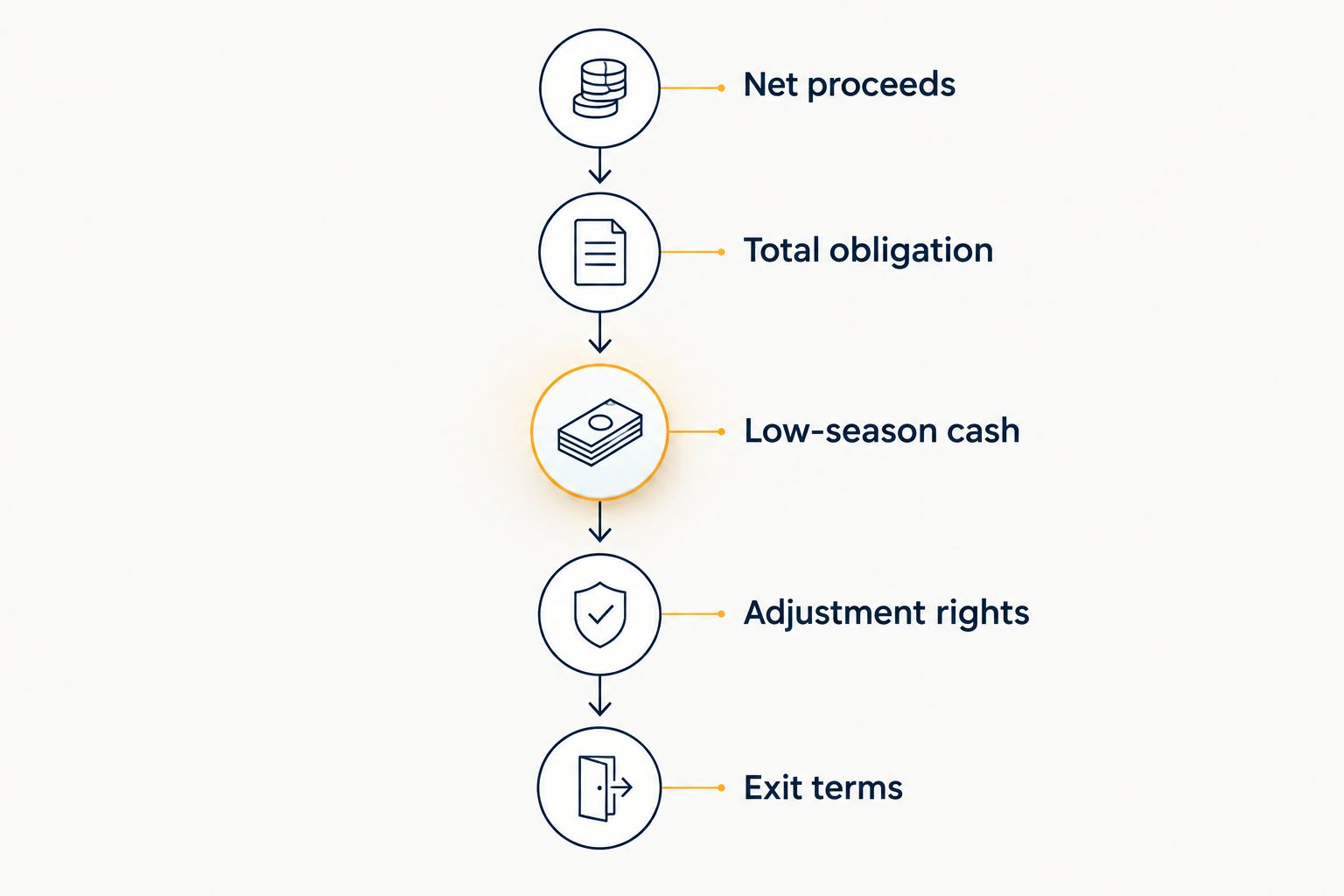
Use the same sequence for every 2026 offer:
- Net proceeds: Identify the amount actually reaching your business after deductions.
- Total obligation: Record the complete contractual repayment or receivables-delivery obligation.
- Low-season cash: Subtract payroll, suppliers, rent, taxes, and existing payments from conservative collections.
- Adjustment rights: Identify how the contract handles lower sales, delays, and closure.
- Exit terms: Confirm early-payoff treatment and restrictions on replacement funding.
A factor rate is a multiplier used to calculate a contractual amount from the funded or purchase amount. It is not APR, an annualized measure of borrowing cost. Comparing the two requires the actual cash received, fees, and payment timing; a factor rate alone cannot establish an equivalent APR.
Which alternatives deserve a look before you accept?
A business line of credit deserves comparison when your cash gap recurs and you can plan ahead. It provides borrowing capacity subject to the agreement, but credit review, renewal terms, and repayment requirements still apply.
A term loan deserves comparison for a defined business expense with a supportable repayment plan. Slower funding is the better choice when its documented economics and schedule fit your business better than a faster alternative.
Also examine customer deposits, earlier invoicing, and supplier payment terms where commercially appropriate. These are operating decisions, not guaranteed substitutes for financing, but they can reduce the amount you need to raise.
What should disqualify an offer?
Skip funding when the repayment plan depends on an unconfirmed seasonal rebound. An existing operating loss does not become affordable because the application avoids a hard inquiry.
Other reasons to stop include:
- An unclear explanation of credit authorization or application sharing.
- Withdrawals that leave insufficient cash for essential expenses.
- Pressure to sign before receiving the complete agreement.
- Misalignment between promised sales adjustments and written contract terms.
- A plan to add funding without checking existing contractual restrictions.
For 2026 applications, distinguish a bank decline caused by credit history from one caused by weak repayment capacity. A different underwriting model does not repair an unsupported cash-flow forecast.
What documents should you prepare?
Prepare recent business bank statements, a debt and payment schedule, and records explaining your seasonal pattern. Include prior peak and low periods so the reviewer can assess the cycle rather than a single strong month.
For factoring, organize invoice aging, customer details, and proof of completed work. For purchase-order financing, organize the customer order, supplier terms, fulfillment plan, and transaction budget. Exact document requirements come from the funding partner.
FAQ
What's the best no credit check business funding for seasonal businesses?
The best route depends on what supports repayment: ongoing sales, eligible unpaid invoices, or a specific customer order. No category automatically excludes credit checks, so confirm the funding partner's policy before authorizing an application.
Does no credit check mean my personal credit cannot be reviewed?
No; confirm exactly what the phrase covers. Ask whether the provider reviews personal credit, business credit, or both, and whether an inquiry is soft or hard.
Is revenue-based financing better than factoring for seasonal businesses?
Revenue-based financing fits future-sales comparisons, while factoring fits eligible invoices from completed B2B sales. The better choice depends on your collection cycle, contractual obligations, and low-season cash flow.
Will MCA payments fall automatically when seasonal sales decline?
Do not assume MCA withdrawals fall automatically. Read the agreement's remittance and reconciliation provisions, including the procedure for requesting adjustments and the supporting records required.
Can I qualify just because my business earns $35,000 per month?
No; monthly revenue alone does not establish eligibility. The $35,000-per-month figure identifies the primary broker-assisted comparison audience, while actual decisions remain subject to third-party underwriting.
What if my business generates less than $35,000 per month?
U.S.-based entrepreneurs below that threshold can use the self-serve funding route. Applicants securely connect bank statements through Plaid for an automated decision; approval and timing are not assured.
Is seasonal business funding available without a personal guarantee?
Personal-guarantee requirements depend on the specific agreement and funding partner. No credit check, unsecured funding, and no personal guarantee are separate claims that require separate confirmation.
Which related guides support your comparison?
What is the next practical step?
One last thing: an annual revenue average can hide the month that breaks your repayment plan. Bring your lowest collection period into the comparison before discussing the largest possible funding amount.
Jon Lynch Financial Group is a broker, not a direct lender. Funding is for business purposes, subject to third-party underwriting and product terms; approval, amounts, rates, decisions, and timing are not assured. Revenue-based financing may be structured as a purchase of future receivables rather than a loan.
Choose your next step using current monthly business revenue: at least $35,000 per month: Compare Business Funding Options. Below $35,000 per month: Explore Self-Serve Funding.



