Best purchase order financing companies in 2026
Compare purchase order financing companies by supplier funding, trade fit and collection terms. Choose the structure that protects your order's remaining profit.

Best starting point for goods-order funding: King Trade Capital. Best for cross-border trade comparisons: Express Trade Capital. Best for comparing broader working-capital alternatives: Jon Lynch Financial Group, a broker, not a direct lender. The best purchase order financing companies in 2026 are the ones whose written terms match your supplier-payment gap without consuming the profit that makes the order worth accepting.
- Shortlist King Trade Capital when supplier payments stand between your business and fulfilling a goods order.
- Compare Express Trade Capital for purchase order financing tied to import and export transactions.
- Consider SouthStar Capital when purchase order financing must connect with invoice factoring after delivery.
- Jon Lynch Financial Group helps established U.S. businesses compare working capital; it is not a direct lender.
- Choose purchase order financing companies by transaction fit, total cost, payment control and remaining profit.
Who does purchase order financing fit in 2026?
Purchase order financing fits businesses that have a customer order for goods but need help paying the supplier before delivery. It addresses a specific transaction, not every cash-flow problem your business faces.
That distinction matters. An order can show revenue on paper while leaving you unable to pay the supplier, freight carrier or other parties needed to complete it.
If you need payroll funding, equipment or general operating cash, compare a different structure. A purchase order facility should not be your default simply because you received a bank decline.
Jon Lynch Financial Group is best for established U.S. business owners generating at least $35,000 per month who want to compare business-funding options. That threshold describes the brokerage's primary audience, not an approval requirement shared by purchase order funders.
What makes the best purchase order financing companies?
Judge the transaction before judging the company name. These criteria determine whether a proposal solves the problem:
- Transaction fit: Does the provider support your goods, supplier, customer and delivery arrangement?
- Supplier payment: What supplier expenses does the facility cover, and what must you pay separately?
- Remaining profit: What remains after supplier costs, logistics, financing charges and other order expenses?
- Collection control: Who receives the customer's payment, and when does your business receive the balance?
- Completion risk: What happens if goods arrive late, fail inspection or the customer disputes the invoice?
- Exit structure: Does customer payment settle the transaction directly, or does invoice factoring take over after delivery?
Ask each company to answer these questions against the same order documents. A general product description is not a transaction-specific commitment.
Which companies belong on your 2026 shortlist at a glance?
The companies below occupy different decision slots. The table distinguishes purchase order specialists from a brokerage route for broader alternatives; it does not treat them as interchangeable lenders.
| Company or comparison route | Best for | Main reason to shortlist | Key limitation |
|---|---|---|---|
| King Trade Capital | Supplier funding for goods orders | Purchase order and trade-finance focus | Transaction financing does not replace general operating cash |
| Express Trade Capital | Import and export transactions | Trade finance spanning purchase orders and receivables | Cross-border delivery and documentation require careful review |
| SouthStar Capital | Connecting supplier funding with receivables funding | Purchase order financing and invoice factoring offerings | Separate financing stages require a combined cost comparison |
| Jon Lynch Financial Group | Comparing alternatives to purchase order financing | Access to business-funding options through third-party partners | Broker, not a direct lender; no specific purchase order facility is promised |
Use the shortlist to request comparable written proposals, not to select a company by position alone. Current transaction eligibility and contract terms control the decision.
1. King Trade Capital: best for supplier-funded goods orders
King Trade Capital specializes in purchase order and trade financing. It belongs on the shortlist when your immediate problem is paying for goods needed to fulfill a customer order.
Start with the supplier invoice, customer purchase order and delivery plan. Ask how the proposed facility moves money to the supplier and how customer collections settle the transaction.
King Trade Capital pros
- Its financing focus matches the pre-delivery supplier-payment problem.
- A transaction-based discussion keeps the specific order central to underwriting.
- It provides a relevant comparison against borrowing general working capital for the same purchase.
King Trade Capital cons
- A purchase order structure does not automatically cover unrelated payroll or overhead.
- Funding the supplier does not remove your responsibility for completing the sale.
- Your order still needs enough profit to support the financing and fulfillment expenses.
Best for: Businesses selling goods with a defined customer order and a supplier-payment gap.
Ask whether supplier deposits, inspection expenses and freight sit inside or outside the proposal. Also ask what happens if the supplier requests payment before the financing conditions are satisfied.
Verdict: Hold until King Trade Capital provides written terms for your actual order.
2. Express Trade Capital: best for import and export comparisons
Express Trade Capital provides trade-finance services, including purchase order financing and factoring. Its trade-finance focus makes it a relevant candidate when your supplier, customer or shipment crosses borders.
Cross-border transactions add practical questions beyond funding the goods. Confirm who handles shipping documents, inspection requirements, customs-related expenses and payment conditions.
Express Trade Capital pros
- Its trade-finance focus is relevant to international goods transactions.
- Purchase order financing and factoring allow you to discuss both sides of delivery.
- It gives importers and exporters a specialist comparison against a general working-capital facility.
Express Trade Capital cons
- Financing does not resolve customs delays, damaged goods or disputed acceptance.
- A proposal must explain which logistics expenses remain your responsibility.
- Currency and shipping arrangements need separate attention in cross-border transactions.
Best for: Importers and exporters comparing transaction funding with broader business capital.
For a wider structural comparison, review business funding options for import and export companies. Keep the supplier-payment gap separate from the business's other operating needs.
Verdict: Hold until Express Trade Capital's proposal addresses the complete shipment and collection cycle.
3. SouthStar Capital: best for the delivery-to-collection handoff
SouthStar Capital offers purchase order financing and invoice factoring. It belongs on the shortlist when you need to understand both supplier funding before delivery and receivables funding afterward.
Invoice factoring means selling eligible invoices to obtain cash before the customer pays. It is different from financing a purchase order that has not yet become a completed, billable sale.
SouthStar Capital pros
- Its offerings support a discussion of pre-delivery and post-delivery funding.
- You can compare the handoff from purchase order financing to factoring.
- The comparison helps identify where customer collections go and when your balance is released.
SouthStar Capital cons
- Two financing stages require a combined expense calculation.
- An invoice dispute can interfere with the expected collection path.
- Customer notification and payment instructions need review before you commit.
Best for: Businesses planning how supplier funding will transition into invoice collection.
Ask for the full transaction waterfall: customer payment, financing settlement, deductions and the remaining amount released to your business. Review the factoring terms alongside the purchase order agreement, not afterward.
Verdict: Hold until SouthStar Capital documents the handoff and combined obligations.
4. Jon Lynch Financial Group: best for comparing alternatives
Jon Lynch Financial Group is a commercial finance brokerage serving U.S. business owners. Its funding options through third-party partners include working capital, lines of credit, term loans, invoice factoring and revenue-based financing.
This is an alternative-comparison route, not a claim that the brokerage directly provides purchase order financing. It fits owners who need to determine whether order-specific funding is the right structure at all.
Brokerage route pros
- You can compare financing structures against the actual business need.
- Lines of credit, term loans and factoring address different cash-flow stages.
- The comparison can focus on total dollars, qualification, timing and repayment.
Brokerage route cons
- Third-party lenders and funders make underwriting decisions.
- A specific purchase order program is not promised.
- General working-capital funding creates obligations beyond the individual order.
Best for: Established U.S. businesses generating at least $35,000 per month that want to compare business-purpose funding alternatives.
Businesses below $35,000 per month have a separate self-serve route. Neither route guarantees approval, an amount, a rate or a funding time.
Verdict: Hold until the proposed structure matches both the order and your wider cash flow.
How does purchase order financing work?
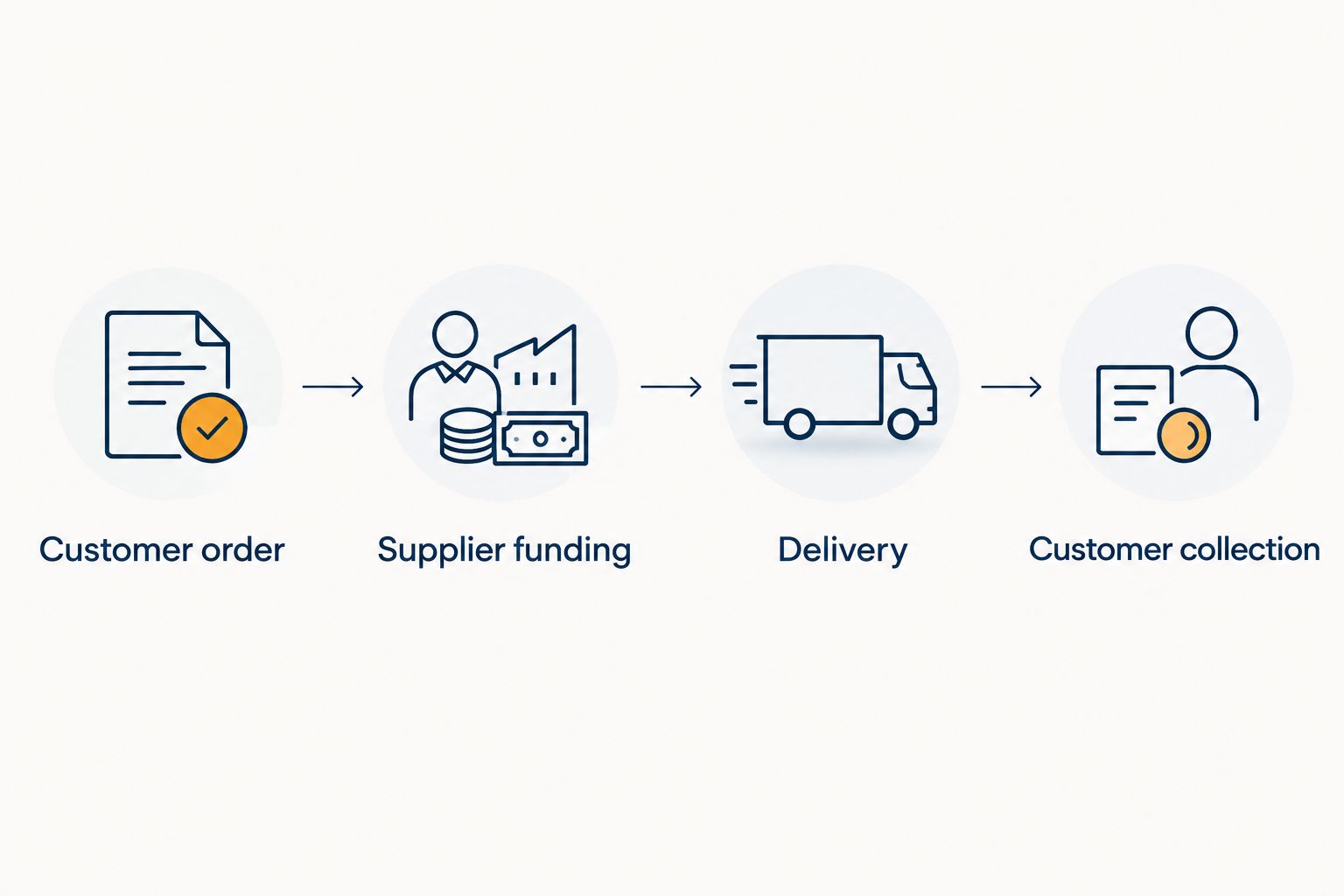
A typical purchase order transaction moves from a customer order to supplier funding, delivery and collection. The exact payment arrangements depend on the agreement.
- Customer order: Establish the goods, buyer, delivery requirements and payment terms.
- Supplier funding: Confirm the supplier's invoice and the funder's payment conditions.
- Delivery: Complete shipment, acceptance and the documents needed to bill the customer.
- Customer collection: Direct payment according to the contract, settle financing obligations and release the remaining balance.
Do not assume customer payment flows straight into your normal bank account. Understand payment control before sending revised instructions to your customer.
How should you calculate the order's remaining profit?
Start with the sale proceeds, not the funding amount. The useful result is what your business keeps after completing and financing the order.
Use this calculation:
Customer payment − supplier expense − freight and fulfillment expense − financing charges − other transaction expenses = remaining transaction profit.
Ask for charges expressed in total dollars for the proposed transaction. Identify which charges increase when delivery or customer payment takes longer, and which apply regardless of timing.
Then build a delayed-payment version using the contract's actual terms. If the order only works when everything happens exactly on schedule, the financing decision needs more scrutiny.
A factor rate on a merchant cash advance is different from APR: it is a multiplier used to calculate the purchased receivables amount or contractual total. APR expresses annualized borrowing cost and depends on cash-flow timing; a multiplier alone does not establish it.
Which alternatives should you compare in 2026?
Your funding choice should follow the stage of the cash gap. Do not borrow against future business revenue when the real problem is an eligible invoice waiting for payment without comparing the alternatives.
| Funding structure | Best for | Main advantage | Main drawback |
|---|---|---|---|
| Purchase order financing | Supplier expense before goods delivery | Ties funding to a specific transaction | Does not automatically cover wider operating expenses |
| Invoice factoring | Completed sales with eligible unpaid invoices | Addresses the post-delivery collection gap | Deductions and customer-payment arrangements need review |
| Business line of credit | Repeated working-capital needs | Supports borrowing and repayment within agreed terms | Approval, limits and ongoing conditions depend on underwriting |
| Term loan | A defined business expense with a repayment plan | Establishes a scheduled repayment obligation | Payments continue independently of one order's performance |
| Revenue-based financing | Business funding assessed against revenue | Provides another comparison route for established businesses | Remittances reduce operating cash; contract structure matters |
Revenue-based financing can be structured as a purchase of future receivables rather than a loan. Read the agreement's reconciliation, collection and default provisions instead of relying on the product label.
What risks should disqualify a proposal?
Skip a proposal you cannot explain in plain English. A funded order is not automatically a profitable order.
Stop and resolve these issues before signing:
- Unclear expenses: The proposal leaves financing charges or supplier-payment deductions unexplained.
- Thin remaining profit: Fulfillment and financing leave too little room for ordinary setbacks.
- Uncertain acceptance: Customer inspection or cancellation rights threaten collection.
- Supplier concerns: Quality, delivery capacity or payment instructions remain unresolved.
- Conflicting claims: Existing liens or financing agreements affect the same goods or receivables.
- Unclear liability: Guarantees, recourse or default provisions expose obligations you have not evaluated.
Purchase order financing companies do not share one universal approval rule. Customer credit, supplier performance, transaction economics and your business's circumstances all belong in the discussion.
What documents should you prepare?
Prepare the transaction packet before asking for a firm comparison. Keep the information consistent across every provider.
- Customer purchase order and sales agreement.
- Supplier quote or invoice and payment requirements.
- Delivery schedule and shipping arrangements.
- Customer acceptance and payment terms.
- Business financial records and bank statements requested by the provider.
- Existing financing agreements and relevant lien information.
- A breakdown of fulfillment expenses and expected remaining profit.
Ask each provider what is still needed, who makes the funding decision and which conditions remain outstanding. A preliminary discussion is not a commitment to fund.
How were these companies ranked?
This 2026 shortlist ranks decision fit: goods-order funding, cross-border trade, the factoring handoff and broader alternatives. It does not rank unverified approval rates, funding times or customer outcomes.
The named specialists belong in a transaction-specific comparison. The brokerage route belongs in the comparison when another funding structure fits better.
FAQ
What's the best purchase order financing company for my business?
The best purchase order financing company is the one whose written proposal fits your supplier, customer, goods and delivery cycle while leaving sufficient transaction profit. Shortlist King Trade Capital, Express Trade Capital or SouthStar Capital according to the transaction you need to fund.
Is purchase order financing the same as invoice factoring?
No. Purchase order financing addresses supplier funding before delivery, while invoice factoring addresses eligible invoices after a sale has become billable. Some transactions use both, so compare their combined obligations.
Can purchase order financing cover payroll?
Do not assume a purchase order facility covers payroll. Confirm permitted uses in the agreement and compare general working-capital funding when payroll is the primary need.
Do purchase order financing companies ignore credit?
No. Credit remains relevant, including the customer's ability to pay and other parties' financial circumstances. Each provider sets its own underwriting requirements.
How much does purchase order financing cost?
The cost is determined by the written transaction proposal and contract. Request total financing charges, conditions that increase those charges and the amount remaining after settlement.
Is Jon Lynch Financial Group a direct purchase order lender?
No. Jon Lynch Financial Group is a broker, not a direct lender, and a specific purchase order financing facility is not promised. Its role is helping U.S. business owners compare business-funding options through third-party partners.
What if my business generates less than $35,000 per month?
Businesses below $35,000 per month can Explore Self-Serve Funding. The U.S. business-purpose route uses a secure Plaid bank-statement connection for an automated decision, with approval and timing dependent on eligibility, verification, bank processing and product terms.
Which route should you choose?
For an unfulfilled goods order, start with a purchase order specialist. For a completed sale, compare factoring. For recurring operating needs, compare working-capital structures. That is the practical default for 2026.
Before accepting an order, confirm whether the customer must approve revised payment instructions. An attractive funding proposal is not executable if its collection arrangement conflicts with the sales contract.
What should you read next?
- How to finance inventory for an import and export business
- Best invoice factoring companies for small businesses
- Working capital loans: costs and qualification
What is your next step?
These options are for business purposes and remain subject to third-party underwriting. Consumer-purpose and non-U.S. requests are outside the primary funding audience; approval, amounts, rates, decisions and funding times are never guaranteed.
Gather your customer order, supplier invoice and expense breakdown. If your U.S. business generates at least $35,000 per month, Compare Business Funding Options; below that threshold, Explore Self-Serve Funding.
Choose your business funding route
Match your revenue level and business need to the appropriate funding comparison path.