Business Credit Building for Franchise Owners: 2026 Guide
Franchise owners build business credit through separate entities, D-U-N-S Numbers and reporting trade lines in 2026 -- not stacked personal guarantees across units.

Franchise owners build business credit by separating each unit's legal entity from personal finances, opening trade lines that actually report, and structuring funding so growth into a second or third location doesn't require stacking a personal guarantee on top of the last one. A franchise brand's national reputation does not transfer to a new unit's credit file — every LLC starts blank.
- Business credit building for franchise owners starts with a D-U-N-S Number and a legal entity separate from the owner's Social Security number.
- PAYDEX scores of 80 or higher on the Dun & Bradstreet 1-100 scale open trade credit without a personal guarantee.
- Multi-unit franchise owners who stack personal guarantees across locations put every unit at risk if one location misses a payment.
- Jon Lynch Financial Group compares SBA, term loan and revenue-based financing paths for franchise owners whose business credit file is still thin.
Why business credit matters for franchise owners
Most franchise agreements require the owner to sign a personal guarantee on the lease, the equipment financing and often the initial development loan. That guarantee doesn't disappear once the doors open — it stays attached until the owner refinances it away or the lender agrees to release it.
A franchise owner opening a second or third unit is underwritten unit by unit in most cases, not as one combined "franchise business." A unit with 12 months of clean bank statements and a Dun & Bradstreet file with real trade lines gets priced and underwritten differently than a brand-new LLC with nothing on file, even under the same franchise banner. A thin or nonexistent business credit file is the single biggest reason multi-unit franchise owners end up personally guaranteeing every location instead of just the first one.
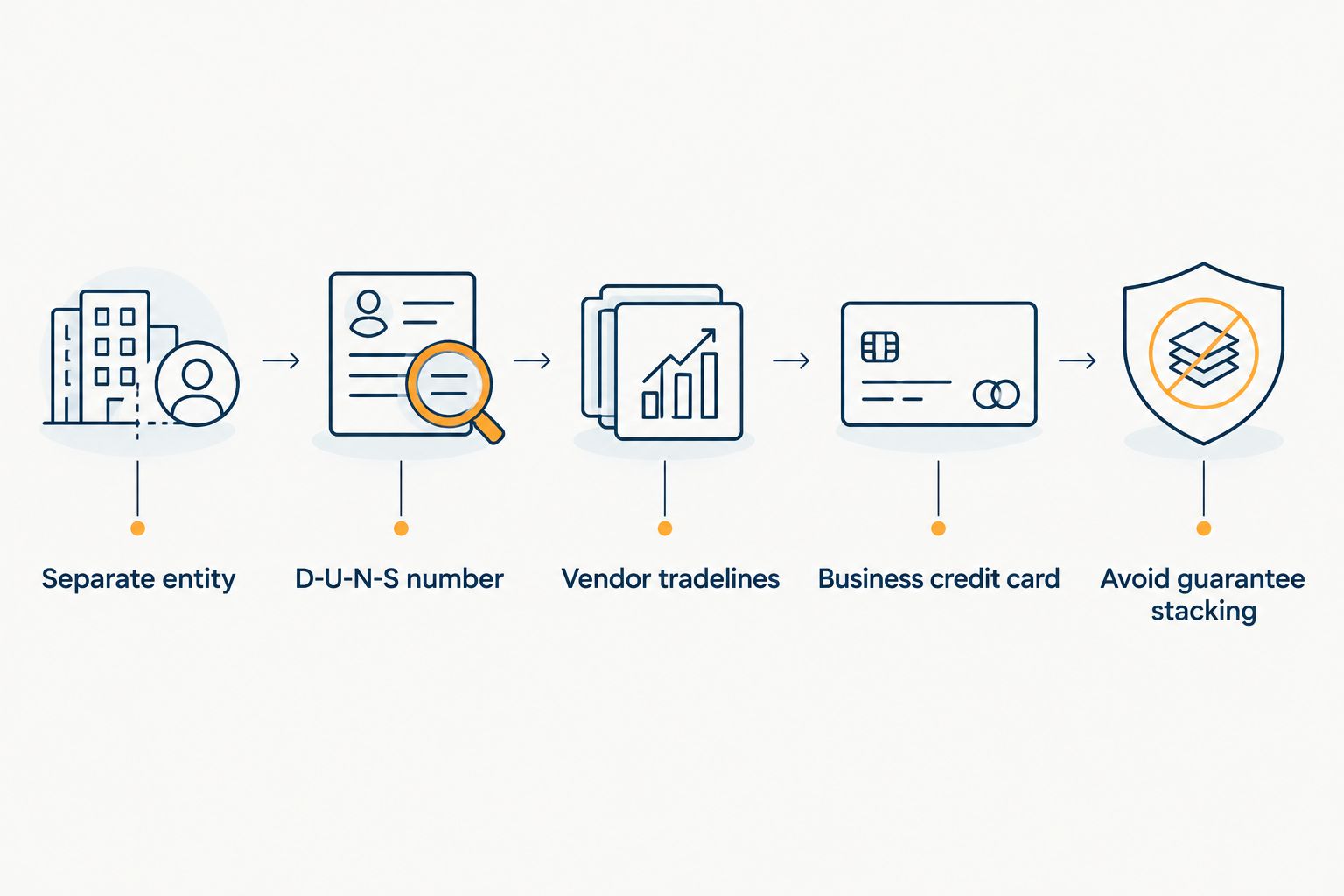
Build the credit file before you need it: a 7-step process
Separate the franchise entity from your personal finances
Lenders, franchisors and business credit bureaus all check whether the entity applying is actually distinct from the owner's Social Security number.
- Form a standalone LLC or corporation for the unit, with its own EIN issued directly from the IRS.
- Open a dedicated business bank account titled exactly to the entity's legal name — not the owner's name.
- Use one consistent business address and phone number across the franchisor's registration, the state filing and the IRS record.
- Stop paying unit-level expenses on a personal card once the entity and bank account exist.
Register for a D-U-N-S Number and build the business credit file
This is the step most new franchise owners skip because it costs nothing and produces no immediate result — which is exactly why it needs to happen on day one.
- Request a free D-U-N-S Number from Dun & Bradstreet; it's the 9-digit identifier lenders pull to check the business credit file.
- List the same legal name, address and phone number used on the LLC filing and the bank account — mismatches delay the file.
- Confirm with the franchisor whether it reports any co-branded vendor accounts to a bureau under the unit's name.
- Expect the file to sit mostly blank for the first 60-90 days until a vendor or lender reports activity.
Franchise owners can compare how to build business credit fast without a personal guarantee once the entity and D-U-N-S Number are in place — the fast paths only work once the paperwork underneath them is correct.
Open trade lines with vendors who report payment history
A trade line only helps the credit file if the vendor actually reports it — many don't unless asked directly.
- Prioritize vendors tied to recurring franchise costs: food or beverage distributors, packaging suppliers, uniform services, POS providers.
- Pay on or before the due date for at least three consecutive billing cycles before applying for a larger line.
- Ask each vendor which bureau — Dun & Bradstreet, Experian Business or Equifax Business — receives its reporting feed; most report to only one.
- Franchise owners who need reporting history faster than the typical 6-12 month vendor timeline can use business tradelines to raise a corporate credit score.
Apply for a business credit card that reports to commercial bureaus
A business card is often the fastest revolving trade line a new unit can get, but only if the issuer reports to a business bureau at all.
- Apply under the entity's EIN, not as a personal-guarantee-only consumer card.
- Confirm the issuer reports to at least one of the three major commercial bureaus before applying — not all of them do.
- Keep utilization under 30% of the assigned limit; commercial scoring models penalize high revolving balances the same way consumer models do.
- Run recurring, budgeted expenses through it rather than one large purchase that spikes utilization overnight.
Structure funding to avoid stacking personal guarantees across units
This is where multi-unit franchise owners lose the most leverage — not on the first unit, but on the second and third.
- Ask every lender or funder whether the personal guarantee applies to the single location or the entire franchise portfolio.
- Push for unit-level underwriting once a location has 12 or more months of standalone bank statements.
- Compare term loans, SBA financing and revenue-based financing on total dollars repaid, not the monthly payment alone. Multi-unit franchise owners hit this decision hardest when opening a second or third location on top of an existing guarantee.
- Ask an existing lender in writing what it takes to release a personal guarantee once the entity's financials stand on their own.
Monitor the business credit score and correct errors
A score built and never checked drifts — miscoded trade lines and duplicate files are common across franchise units sharing a similar DBA.
- Pull the Dun & Bradstreet, Experian Business and Equifax Business files at least twice a year; each scores differently and lenders don't all check the same one.
- Dispute any trade line reporting under the wrong entity name or address.
- Track the PAYDEX trend, not just the current number — a move from 65 to 80 over two quarters tells a lender more than a static 80.
- Set the review to the franchise's fiscal year-end, when lenders usually request updated financials anyway.
Time funding applications around franchise growth stages
Credit building and funding decisions work best on a schedule, not in reaction to a cash-flow gap.
- Open trade lines and a business card in year one, before a remodel or second unit is on the table.
- Request franchisor-mandated capital (buildout, equipment refresh) 60-90 days ahead of the deadline so underwriting isn't rushed.
- Reserve revenue-based financing for timing problems, not cost problems — it typically costs more in total dollars than a term loan or line of credit.
- Reserve SBA and bank financing for planned growth where a 30-90 day underwriting window fits the calendar.
Comparing the options side by side
| Option | Best for | Key limitation |
|---|---|---|
| Vendor trade lines | Owners with steady vendor relationships and 12+ months of history | Reporting takes 6-12 months to move a score |
| Business credit card | Owners who want fast, revolving reporting history | Approval often still checks personal credit early on |
| SBA loan | Franchise acquisition or major buildout with 30-90 days to close | Requires a personal guarantee and full financial documentation |
| Revenue-based financing | Owners who need capital before the credit file is built out | Costs more in total dollars than a term loan or line of credit |
Verdict: the fastest path to a usable business credit file combines a reporting business card with two or three vendor trade lines started in the first 90 days — not a single big financing move.
Compare Business Funding Options
See how funding structures affect your credit file and guarantee exposure across units.
Common mistakes franchise owners make
- Mixing personal and business expenses on one card — this resets any progress toward a clean business credit file every time it happens.
- Signing a personal guarantee on every unit without asking about release terms — by the third location, one slow month at any unit threatens all three.
- Assuming the franchisor's national vendor deals automatically report to a bureau — most don't unless the local unit sets up its own reporting relationship.
- Waiting for a bank decline to start building business credit — a unit with 18 months of trade lines and a PAYDEX score in place before it needs capital gets better terms than one applying cold after a decline in 2026.
FAQ
What is a good business credit score for a franchise owner in 2026?
A PAYDEX score of 80 or higher on the Dun & Bradstreet 1-100 scale is generally considered strong. Franchise owners applying for a second or third unit typically need that range for a lender to consider unit-level underwriting instead of a full personal guarantee.
How long does it take to build business credit for a new franchise unit?
A D-U-N-S Number can be issued almost immediately, but vendor trade lines usually take 6-12 months of consistent payment history before they meaningfully move a score. Business credit cards can add reporting history faster if the issuer reports to a commercial bureau.
Do I need a D-U-N-S Number for each franchise location?
If each location operates under its own LLC and EIN, yes — each entity needs its own D-U-N-S Number and builds a separate credit file. Franchise brands do not share credit history across units.
Can franchise owners build business credit without a personal guarantee?
Vendor trade lines and many business credit cards can be built without a personal guarantee once the entity has its own EIN and bank account. Larger financing like SBA loans and most term loans still require one until the file is established enough for the lender to release it.
Is a business credit card alone enough to build franchise credit?
No — a business card is one trade line among several a lender wants to see. Combining it with two or three reporting vendor accounts builds a more complete file faster than a card by itself.
What's the difference between a franchise unit's credit and the franchisor's credit?
Each franchise unit's LLC has its own credit file separate from the franchisor's national brand rating. A well-established franchise brand does not pass down its credit standing to a new unit's entity.
How does business credit affect funding for a second or third franchise unit?
Lenders that see 12+ months of standalone bank statements and an established trade line history are more likely to underwrite the new unit on its own financials instead of requiring the owner to guarantee it personally alongside existing units.
Should franchise owners use revenue-based financing to build business credit?
Revenue-based financing and merchant cash advances are generally not reported to business credit bureaus, so they don't build a credit file. They're a speed tool for cash-flow timing, not a credit-building tool.
One last thing
A franchise brand that's been operating for 20 years gives a new unit zero head start on its credit file — the LLC opened last month is exactly as unproven to a lender as any other new business, D-U-N-S Number or not. Register the D-U-N-S Number and open the first reporting trade line before opening day, not after the first slow month. That single sequencing decision is what separates franchise owners who refinance a personal guarantee away in year two from the ones still carrying it on unit four.