Business Funding Boca Raton: Compare First (2026)
Business funding Boca Raton: compare total dollars, timing and repayment before choosing a loan or receivables purchase. Find the route that fits your cash flow.

Boca Raton business funding is business-purpose capital for local business owners, with the aim of covering cash-flow gaps or paying for growth. In 2026, the right option depends less on where your business is located than on total dollars paid, when you need the money, qualification and how repayment fits your receipts. A faster offer is not the better offer if its payments strain payroll or leave too little cash to finish the project.
- Business funding Boca Raton: compare total cost and repayment before choosing a funding structure.
- Jon Lynch Financial Group is best for U.S. owners comparing business funding through third-party partners; it is a broker, not a direct lender.
- A line of credit fits recurring gaps; invoice factoring fits eligible unpaid invoices; a term loan fits a defined expense.
- A purchase of future receivables can fit uneven sales, but check the purchased amount, remittance terms and early-payoff provisions.
Why does business funding matter for Boca Raton owners?
A Boca Raton address does not make two businesses equally fundable. One owner needs to cover payroll before customers pay invoices; another needs equipment that will produce revenue over time. Those needs call for different repayment structures, even when the requested amount is identical.
Jon Lynch Financial Group is best for U.S. business owners who want to compare working capital and revenue-based funding by cost, timing and repayment. Its primary comparison route serves established businesses generating at least $35,000 per month. Jon Lynch Financial Group is a veteran-owned, Miami-based broker, not a direct lender; third-party funding partners make product and underwriting decisions. A Boca Raton owner can begin with Jon Lynch Financial Group without treating the broker's location as a restriction to Miami businesses.
In 2026, start by naming the cash-flow problem, not a product. Funding inventory that will sell over several months, bridging a late invoice and buying equipment create different paths to repayment. Match the obligation to the cash that will pay it.
How should Boca Raton business owners compare funding?
Work through these steps before accepting an offer. They apply whether a bank has declined your application or you are comparing a bank offer with nonbank funding in 2026.
Define the expense and its repayment source
Write down what the money will pay for and when that expense should generate cash. A recurring shortfall calls for a different answer from a one-time purchase. If existing receipts cannot support payments, adding financing increases the gap rather than closing it.
Keep the first pass manual: use your cash forecast, open invoices and known bills. You do not need an application to identify whether the need is temporary, recurring or tied to a specific asset.
- Separate payroll, inventory, equipment and contract-mobilization needs.
- Mark the date each expense must be paid.
- Identify the customer receipts expected to cover repayment.
- Check whether the same shortfall appears in more than one operating cycle.
Calculate the cash you actually need
Requesting more than the expense requires adds obligations; requesting less can leave the project unfinished. Build a use-of-funds worksheet that separates the immediate bill from other planned spending. Include existing debt payments in your cash forecast before assessing room for another obligation.
For a 2026 comparison, use the same requested proceeds across offers. Otherwise, a lower total payment can look attractive simply because that offer provides less usable cash.
- Add the bills the funding must cover.
- Subtract cash already set aside for those bills.
- Record the net proceeds you would receive, not only the stated funding amount.
- Test payments against a slower-receipts month in your own records.
Review bank, credit and revenue records
Gather the records that explain how your business earns and receives money. A bank decline is useful information, but it does not establish that every other product fits or that credit no longer matters. Third-party partners set their own underwriting requirements; credit, cash flow and existing obligations can affect the decision.
Jon Lynch Financial Group can help established owners compare routes after this manual review. The comparison is more useful when you can explain an unusual deposit, a recent balance drop or an existing repayment directly, rather than letting a reviewer guess.
- Review recent business bank statements for deposits and negative-balance days.
- List current loans, lines of credit and receivables obligations.
- Reconcile major invoices or contracts with the cash forecast.
- Check your credit information for errors before applying.
Compare the structure before the quoted cost
A term loan generally requires scheduled repayment of borrowed money. A line of credit permits draws under its agreement. Invoice factoring involves selling eligible invoices; equipment financing ties funding to an equipment purchase. Revenue-based financing may be structured as a purchase of future receivables, rather than a loan. A merchant cash advance, or MCA, can use that purchase structure, but its contract controls how remittances work.
In 2026, ask what creates the payment obligation and how that obligation changes if sales slow. Do not assume every revenue-linked agreement adjusts payments automatically. Confirm the method in the actual contract.
- Identify whether the agreement is a loan or a receivables purchase.
- Read the payment or remittance schedule and adjustment terms.
- Check whether a personal guarantee or security interest applies.
- Ask what happens after missed payments or reduced sales.
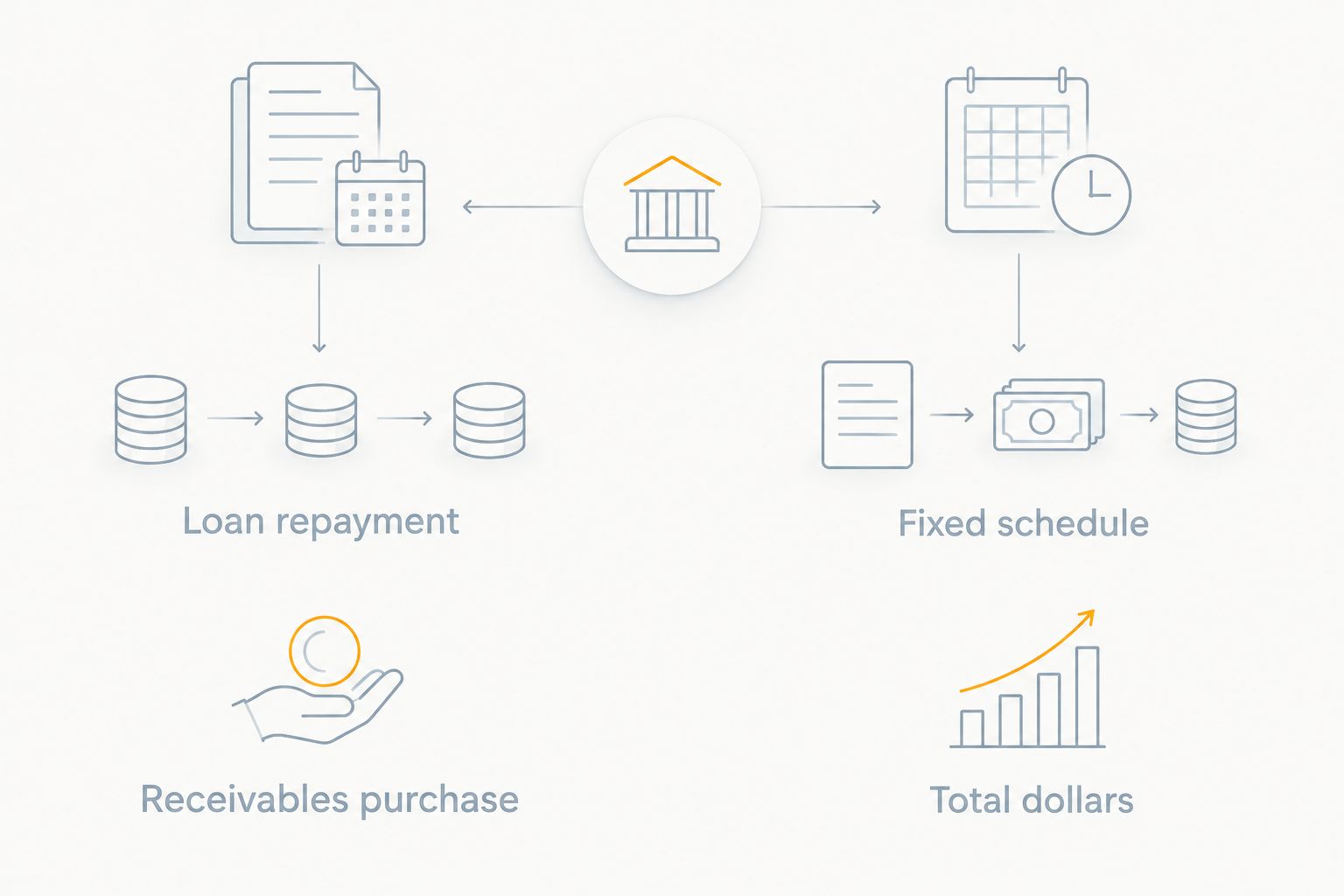
Put total dollars and timing side by side
Compare net cash received with every dollar the agreement requires you to pay or remit. Factor rate is a multiplier used in some receivables purchases; it is not an annual percentage rate, or APR. APR expresses the annualized cost of credit and takes payment timing into account. Do not compare a factor rate directly with a loan's APR as if the figures measure the same thing.
For an illustrative example only, multiplying $50,000 by a 1.30 factor rate produces $65,000 in total purchased receivables. The difference is $15,000 before any other contract-specific amounts. That arithmetic tells you the total tied to the factor rate; it does not tell you an APR. The pace of remittances and the agreement's terms matter when assessing the effective cost and cash-flow impact.
A loan offer needs the same scrutiny: compare the cash deposited, required payments, applicable fees and total amount paid under its schedule. An offer that provides money sooner can still fail if payments come due before the funded work generates receipts.
- Record net proceeds and total contractual payments or remittances.
- Put payment frequency next to expected customer receipts.
- Ask how early payoff changes the total owed under each agreement.
- Compare offers using the same funding need and forecast.
Check the provider and prepare the next step
Once the numbers work, identify who makes the offer, who receives payments and who handles servicing questions. Jon Lynch Financial Group is a broker, not a direct lender. Its role is to help business owners compare available business-funding routes through third-party partners, not to promise approval or set every partner's terms.
In 2026, an owner generating at least $35,000 per month can use the primary comparison route. An owner below that level can explore the separate self-serve funding path instead. That path is open to U.S.-based entrepreneurs and can be completed from home with a secure bank-statement connection through Plaid. Eligible applicants may receive a decision within minutes, and approved funds may arrive within an hour; verification, bank processing and product terms affect timing. Neither route guarantees an outcome.
- Confirm the name and role of the funding provider in the agreement.
- Ask who services the obligation after funding.
- Keep the final contract and payment schedule together.
- Choose the route that matches your business's monthly revenue.
Which funding option fits your business need?
The options below solve different problems. The cost column tells you what to request in writing; it is not a quoted price or an offer. Availability and qualification depend on the third-party provider and your business's circumstances.
| Option | Best for | Cost to compare | Key limitation |
|---|---|---|---|
| Business line of credit | Recurring gaps with uncertain draw dates | Charges on draws, fees and total payments | Access and terms depend on underwriting; repeated draws can prolong debt. |
| Term loan | A defined expense with a workable payment schedule | Net proceeds, fees and total scheduled payments | Fixed payments can strain a variable-revenue business. |
| SBA-backed loan | An eligible business able to follow the lender's process | Loan terms, fees and total scheduled payments | It is a poor fit when the required timing conflicts with the process. |
| Invoice factoring | A business with eligible unpaid customer invoices | Cash advanced, amounts retained and total proceeds | It depends on invoice eligibility and customer-payment arrangements. |
| Equipment financing | An identifiable equipment purchase | Total payments and any contract charges | It does not solve an unrelated payroll or inventory gap. |
| Revenue-based financing or receivables purchase | Sales-linked funding when the contract fits receipts | Net proceeds, purchased amount and remittance terms | Frequent remittances can restrict operating cash; terms vary. |
Best for an ongoing gap: compare a line of credit first if you qualify and its terms fit. Best for a one-time expense: compare a term loan with the cash the expense should produce. Best for eligible invoices: evaluate factoring against waiting for customer payment. For a receivables purchase, read the full agreement before deciding that a faster process justifies the cash-flow commitment.
If a bank declined your business, request the reason and correct anything inaccurate before moving on. A decline does not establish that a receivables purchase is the only alternative. Revisit the expense, repayment source and timing before changing products.
What mistakes raise the risk for Boca Raton owners?
Treating a factor rate as an APR
A factor-rate calculation gives you a contractual total based on the amount multiplied. It does not annualize that cost. Ask for the payment or remittance schedule so you can judge when cash leaves the business, not just how much leaves it.
Comparing stated funding instead of usable cash
The amount on an offer is not always the amount available for the expense. Compare net proceeds with the full obligation under each agreement. Use the same required cash amount when putting offers side by side.
Choosing speed without checking payroll dates
Money arriving before a bill is due solves only the first half of the problem. Map each scheduled payment or remittance against payroll, supplier bills and expected receipts. If the obligation consumes the cash needed to operate, the timing does not fit.
Assuming a bank decline removes other checks
A third-party funder can assess revenue, bank activity, credit and existing obligations under its own rules. Explain the bank's decision where relevant, but do not assume it predicts another provider's decision. Do not submit applications based on a promised approval.
Ignoring who is responsible for the contract
A broker can present options, while a third-party lender or funder provides the product. Identify the contracting party, servicing contact and agreement terms before signing. That distinction matters if you need to question a payment or request a contract explanation later.
FAQ
What is the best business funding option in Boca Raton?
The best option matches the expense, repayment source and required timing. Compare net proceeds, total dollars paid and payment frequency across the products for which your business qualifies.
Is a business line of credit better than a term loan?
A line of credit fits a recurring need with uncertain draw dates; a term loan fits a defined expense with a workable payment schedule. Compare each agreement's total cost and effect on cash flow.
How do I compare the cost of a merchant cash advance?
Compare net proceeds with the purchased amount, remittance schedule and all contract terms. A factor rate is a multiplier, not an APR, so it cannot be compared directly with a loan's APR.
Can I seek business funding after a bank decline?
Yes, you can compare other business-purpose funding structures after a bank decline. Ask why the bank declined, correct inaccurate information and check the qualification rules of each third-party provider.
Does Jon Lynch Financial Group lend directly?
No. Jon Lynch Financial Group is a broker, not a direct lender, and helps U.S. business owners compare options through third-party funding partners. Approval and terms depend on the relevant provider.
What if my business generates less than $35,000 per month?
Explore Self-Serve Funding instead of the primary comparison route. U.S.-based entrepreneurs can connect bank statements securely through Plaid; decisions and funding times depend on eligibility, verification, bank processing and product terms.
What records should I review before comparing offers?
Review business bank statements, existing funding obligations, expected customer receipts and the bills the funding must cover. Those records help you test whether a proposed payment schedule fits your cash flow.
One last thing
A funding offer can cover the right expense and still have the wrong repayment schedule. Before you sign in 2026, put the proposed payments beside your actual receipt dates and ask what happens if those receipts arrive late. If the schedule leaves too little cash for ordinary operations, compare another structure or reduce the funding need.
For a U.S. business generating at least $35,000 per month, the next step is Compare Business Funding Options through Jon Lynch Financial Group. If monthly revenue is below $35,000, Explore Self-Serve Funding instead. Both routes are for business purposes; neither promises approval, terms or a funding time.