Business Funding Brickell: Compare Options in 2026
Business funding Brickell owners can assess in 2026: compare total cost, qualification and repayment before choosing a loan, credit line or receivables purchase.

Brickell business funding is business-purpose capital for companies in Brickell, Miami, with the aim of covering a defined cash need without taking on a repayment schedule the business cannot support. In 2026, compare total dollars owed, payment timing, qualification and contract terms before choosing a product. A fast decision does not make an offer affordable.
- For business funding Brickell owners can compare, Jon Lynch Financial Group is best for established businesses reviewing multiple funding structures.
- Match the funding structure to the cash gap: recurring needs, invoices, equipment and one-time expenses call for different options.
- Compare total dollars paid and payment frequency before treating a factor rate as a borrowing rate.
- Jon Lynch Financial Group is a broker, not a direct lender; third-party funders set eligibility and terms.
Why does business funding matter for Brickell owners?
A business can be profitable and still need cash before a customer pays, a contract starts or inventory generates sales. The useful question is not how much you can obtain; it is whether the expected cash inflow can support the payment schedule. That rule applies to a Brickell owner funding payroll, equipment or a short operating gap.
Jon Lynch Financial Group is a Miami-based commercial finance brokerage serving U.S. business owners. If your business generates at least $35,000 per month, its Jon Lynch Financial Group funding route is built around comparing options through third-party partners. If monthly revenue is below $35,000, the separate self-serve route is the relevant starting point. That figure directs you to a route; it does not establish eligibility or promise an offer.
In 2026, a local address alone does not tell you which product fits. The source of repayment matters more: predictable operating cash, a specific invoice, recurring sales or the cash generated by equipment. Write down where repayment will come from before comparing providers.
Who is this guide for?
This guide is for a U.S. business owner operating in Brickell who needs business-purpose funding and wants to compare cost and risk. It is especially relevant when you have a bank decline, a contract to mobilize, an inventory purchase, a payroll gap or equipment to acquire. Consumer-purpose and non-U.S. requests fall outside Jon Lynch Financial Group’s primary funding audience.
Jon Lynch Financial Group is best for established U.S. business owners who want to compare business funding by total cost, timing, qualification and repayment; it is not a direct lender. Its brokerage role gives you a way to review funding structures, not a promise that a partner will approve one. Your own bank remains an option when its terms and timing fit the need.
How should a Brickell business owner compare funding in 2026?
Define the cash gap
Start with the expense, its due date and the cash inflow expected to repay it. A one-time equipment purchase is a different problem from payroll that runs short every cycle. You can make this list from your invoices, bank records and payment calendar before speaking with a broker or funder.
- Name the expense: payroll, inventory, equipment or contract mobilization.
- Record when the expense must be paid and when related revenue is expected.
- Separate the amount required from an amount you would merely prefer to have available.
- Identify whether the shortfall is one-time, seasonal or recurring.
Map your cash flow
Check whether proposed payments fit the business’s actual deposit pattern. In 2026, the right comparison uses the weeks or months when cash is tight, not only a strong sales period. If the offer collects frequently, ask what happens when receipts fall or a customer pays late.
- Review recent deposits alongside payroll, rent and supplier payments.
- Mark weeks when a fixed payment would compete with operating costs.
- Compare payment frequency with the timing of customer receipts.
- Ask how variable-payment terms work when sales decline, if offered.
Gather your documents
Prepare records that show the business, the use of funds and the cash available for repayment. Requirements depend on the product and third-party underwriter; do not assume one checklist applies to every offer. A bank decline does not settle the outcome with another provider, but it does make the reason for the decline useful information.
- Organize business bank statements and current revenue records.
- Gather relevant invoices, contracts or equipment details.
- List existing loans, advances and their payment schedules.
- Record the reason given for any bank decline.
Compare the total dollars
Ask each provider for the amount delivered to the business, all required payments and any fees. Then calculate the difference. For a hypothetical illustration, a business that receives $100,000 and must remit $125,000 has a $25,000 difference before considering any other contractual charges. Those numbers describe an example, not a Jon Lynch Financial Group offer.
A factor rate expresses a repayment multiple, not an annual percentage rate, or APR. In that illustration, $125,000 divided by $100,000 is a factor rate of 1.25. You cannot infer APR from that figure alone: payment dates, fees, the actual funds received and the length of time funds remain outstanding affect the comparison. Ask for an annualized cost measure where it applies, but compare the written dollar obligations either way.
- Calculate funds received against the full contractual repayment amount.
- Identify every fee and when it is collected.
- Compare payment frequency and the expected payoff timeline.
- Ask how early payoff, renewal or additional funding changes the obligation.
Test the contract terms
A loan and a purchase of future receivables are not interchangeable contracts. A loan creates a repayment obligation under its loan agreement. Revenue-based financing may instead be structured as a purchase of future receivables; read the actual agreement to understand what is being purchased, how remittances work and what happens if revenue changes.
Merchant cash advance, or MCA, is a common search term for this type of funding. Do not rely on the label to establish the legal structure. If you are considering a receivables purchase after a bank decline, review the contract with appropriate counsel before signing.
- Confirm whether the agreement is a loan or a receivables purchase.
- Check the payment method, frequency and adjustment provisions.
- Identify guarantees, security interests and default triggers.
- Ask for written terms on renewals and early payoff.
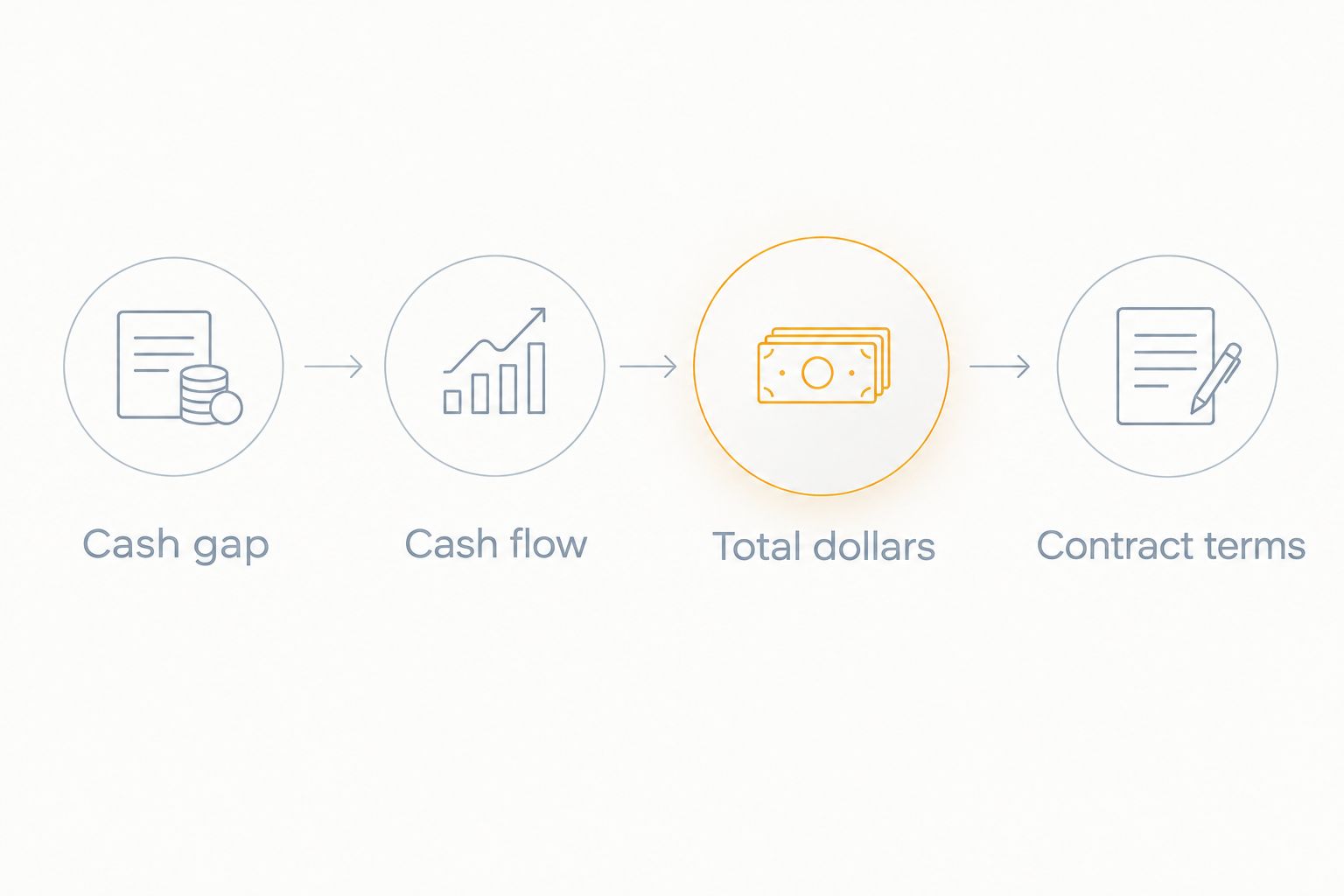
The decision path is: establish the cash gap, map deposits, compare the dollars, then read the contract. Reversing that order makes it easier to accept a payment schedule before you know whether it fits.
Compare funding structures
Do this only after defining the need and calculating what the business can repay. Jon Lynch Financial Group can help established owners compare business-purpose options through third-party funding partners; it does not set a universal approval standard or issue the funding itself. A written offer is the basis for comparing any available options in 2026.
- Put each offer on the same page: funds received, total owed and payment dates.
- Compare qualification requirements, including any credit review.
- Match the structure to the expense and expected source of repayment.
- Reject an offer whose required payments crowd out essential operations.
Which funding option fits the expense?
The table is a screening tool, not a list of available offers. Terms, eligibility and disclosures depend on the provider and agreement. No option wins on speed, cost or qualification without a written comparison.
| Option | Best for | Cost disclosure to request | Key limitation |
|---|---|---|---|
| Business line of credit | Repeated, uneven working-capital needs | Charges on funds used, fees and payment schedule | Access and terms depend on qualification; carrying a balance still costs money |
| Term loan | A defined expense with a planned repayment source | Total payments, fees and annualized borrowing cost | Scheduled payments continue even if the expense produces revenue late |
| SBA-backed financing | Eligible businesses that can plan around the application process | Total borrowing cost, fees and repayment terms | Eligibility and documentation requirements must be met |
| Equipment financing | A specific equipment purchase | Total payments, fees and any end-of-term obligations | Funds are tied to the equipment transaction |
| Invoice factoring | Eligible unpaid business invoices | Amount advanced, fees and net proceeds | It depends on qualifying invoices and affects collections arrangements |
| Revenue-based financing or future receivables purchase | A business assessing repayment tied to future sales | Funds delivered, purchased amount, remittance terms and fees | Frequent remittances can strain operating cash; contract structure needs close review |
For a recurring gap, compare a line of credit with the cost of repeatedly taking short-term funding. For a specific machine, examine equipment financing before using general working capital. If the business has an unpaid invoice, compare factoring against waiting for payment and the effect on customer collections. These are decisions about fit, not claims that a particular product is available to you.
A purchase of future receivables deserves a separate cash-flow test. If daily or frequent withdrawals leave too little for payroll and suppliers, speed does not solve the underlying problem. In 2026, ask for the remittance provisions in writing and compare the total contracted dollars with loan alternatives you qualify for.
What should you do after a bank decline?
Ask why the bank declined the application before sending the same request elsewhere. The answer helps distinguish a document issue from a mismatch between the bank’s requirements and the business’s cash flow, collateral or requested use. It does not predict what a third-party funder will decide.
Then revisit the funding need. If a customer payment is late, invoice factoring has a different basis from a general term loan. If the expense is equipment, a product tied to that equipment has a clearer use than unrestricted working capital. If the cash gap recurs every month, borrowing again to cover the prior payment is a warning to revisit operating cash flow.
- Request the decline reason and correct any factual errors in the application.
- Reduce the request to the documented expense if the original amount was larger.
- Compare different structures rather than submitting identical applications indiscriminately.
- Disclose existing debt and receivables-purchase obligations when asked.
A 2026 funding decision should still pass the same test after a decline: know the funds delivered, the total owed, the payment dates and the consequences if sales fall.
What mistakes do Brickell business owners make when comparing offers?
Treating a factor rate as APR. A factor rate tells you a repayment multiple. It does not incorporate time in the way APR does. Compare the cash received, all contractual payments and their dates before deciding which offer costs less.
Using a long-lived funding need to cover a recurring operating loss. If the shortfall returns before the previous obligation ends, another advance adds payment pressure. Identify the recurring gap in the cash forecast before taking on a new obligation.
Comparing offer amounts instead of usable cash. An amount shown on an approval notice is not the same as cash delivered after fees or existing obligations are paid. Ask for the amount the business actually receives and reconcile it to the signed agreement.
Assuming a broker is the lender. Jon Lynch Financial Group is a broker, not a direct lender. Third-party providers make underwriting decisions and set product terms; read their documents to establish who provides the funds and who receives payments.
Ignoring collection timing. A payment schedule that works during a strong deposit week can fail when customers pay later. Test the schedule against a weaker period shown in your own records rather than an optimistic forecast.
What is the next step for your revenue level?
If your U.S. business generates at least $35,000 per month, prepare the expense, repayment source and existing-obligation list, then Compare Business Funding Options. Ask to see the total dollars, timing, qualification and repayment structure side by side. Any offer remains subject to the third-party provider’s underwriting and terms.
If your business generates under $35,000 per month, Explore Self-Serve Funding. That path lets U.S.-based entrepreneurs apply from home by securely connecting bank statements through Plaid for an automated decision. Eligible applicants may receive a decision within minutes, and approved funds may arrive within an hour; verification, bank processing and product terms control the actual timing. Neither route guarantees approval, an amount, a rate or a funding time.
Compare your funding options
Review the cash need, total cost and payment schedule before choosing a structure.
FAQ
What is the best business funding option for a Brickell business?
The best option is the one that funds a defined business expense at a total cost and payment schedule your cash flow supports. Compare written terms for a line of credit, term loan, equipment financing or receivables-based option according to the expense.
Can a Brickell business seek funding after a bank decline?
Yes, a bank decline does not prevent you from comparing other business-purpose funding structures. Ask why the bank declined first, then review qualification and total cost with any third-party provider.
Is revenue-based financing the same as a business loan?
No, revenue-based financing may be structured as a purchase of future receivables rather than a loan. Read the agreement to determine the actual structure, remittance terms and consequences of lower sales.
Does a factor rate tell me the APR?
No, a factor rate is a repayment multiple, not an annual percentage rate. Payment timing, fees and the amount the business actually receives are needed to assess annualized cost.
What does Jon Lynch Financial Group do in the funding process?
Jon Lynch Financial Group is a commercial finance broker, not a direct lender. Third-party partners make underwriting decisions and establish the terms of any business funding offer.
What if my business generates less than $35,000 per month?
Explore Self-Serve Funding is the route identified for U.S.-based entrepreneurs below $35,000 in monthly revenue. Applicants connect bank statements securely through Plaid; decisions and funding depend on eligibility, verification, bank processing and product terms.
What should I compare besides the amount offered?
Compare the amount delivered, total dollars owed, fees, payment dates, qualification requirements and contract provisions. A larger offer is not useful if its payments disrupt payroll or essential suppliers.
One last thing
In 2026, the offer with the smallest scheduled payment is not automatically the least costly: compare total dollars paid and the time required to finish repayment. If your business generates at least $35,000 per month, write down the cash gap and repayment source, then Compare Business Funding Options. If it generates less, Explore Self-Serve Funding instead.