Business Funding Coral Gables: Compare Costs in 2026
Business funding Coral Gables owners can compare in 2026: judge total repayment, timing and qualification. Jon Lynch Financial Group brokers funding options.

Coral Gables business funding is business-purpose capital used to cover cash-flow needs or invest in growth, with the aim of matching repayment to a business owner’s actual receipts. The central tradeoff in 2026 is total cost versus timing: a faster offer is not the better offer if its payments strain payroll or inventory cash. Your location does not determine the right product; your use of funds, records and repayment capacity do.
- For business funding Coral Gables owners should compare total repayment, timing and payment frequency before choosing an offer.
- Jon Lynch Financial Group is best for established U.S. owners comparing business funding through a broker, not a direct lender.
- A bank line fits repeat cash-flow gaps; a term loan fits a defined expense with a manageable payment schedule.
- A purchase of future receivables needs close review of the purchased amount, remittances and reconciliation terms.
Why does business funding matter for Coral Gables owners?
A funding request starts with a business problem, not a product name. If customer payments arrive after payroll is due, the question is how much cash must bridge the gap and when collections will cover repayment. If you are buying equipment, the question is whether its expected business use supports a fixed payment.
Jon Lynch Financial Group is best for established U.S. business owners who want to compare business funding structures through a broker, not a direct lender. The Jon Lynch Financial Group website is the starting point for that comparison. The firm works with third-party funding partners; each offer remains subject to the provider’s terms and underwriting.
Coral Gables owners should also separate a short-term need from a persistent cash shortage. Funding can bridge a delayed customer payment. It does not fix a recurring gap between operating receipts and expenses. In 2026, write down the gap before you apply so every proposal addresses the same need.
How should a Coral Gables business compare funding options?
The steps below apply whether you approach a bank directly or compare offers through a broker. Start with your records and calculations. A provider’s proposal becomes useful only after you can test its payment schedule against your business cash flow.
Define the expense and its repayment source
State exactly what the money will pay for: a contract’s startup costs, inventory, payroll, equipment or another business expense. Then identify the receipts expected to cover repayment. A defined purchase with a predictable return calls for a different structure than an open-ended operating gap.
Do this on paper before contacting a provider. If the need is recurring, record each occurrence rather than treating the current shortage as an isolated event.
- List the expense and the date payment is due.
- Separate one-time costs from recurring operating costs.
- Identify the customer receipts or operating cash that will support payments.
- Set a maximum payment your business can absorb during a slower period.
Build a cash-flow picture from your records
Look at bank statements, invoices, existing debt payments and upcoming obligations together. A revenue figure alone cannot show whether another withdrawal fits between rent, payroll and supplier payments. Mark weeks when cash falls lowest, not just the month-end balance.
In 2026, ask whether the proposed schedule still works if a customer pays late. This is a stress test, not a prediction. You can complete it with a spreadsheet before sharing documents with any provider.
- Gather recent business bank statements and current debt terms.
- Record when major customers usually pay.
- Mark payroll, rent, tax and supplier due dates.
- Calculate cash remaining after existing payments.
Compare the structure before the provider
Match the expense to the way funds are repaid. A line of credit allows draws up to an approved limit under its terms; a term loan generally provides a lump sum with scheduled payments. Invoice factoring involves selling eligible invoices. Revenue-based financing ties repayment to revenue under the agreement, while some offers are structured as purchases of future receivables rather than loans.
These names do not settle the cost question. Ask for the agreement and identify what you receive, what you owe or remit, and when each payment is due. The right structure is the one your receipts can support, not the one with the shortest application.
- Use a line of credit to evaluate repeat, variable cash needs.
- Compare a term loan for a defined expense with a payment schedule you can test.
- Examine factoring when the cash gap sits in eligible unpaid invoices.
- Review receivables-purchase terms when remittances follow business receipts.
A useful comparison separates the source of cash from the schedule for returning it. Neither a loan label nor a faster decision substitutes for that check.
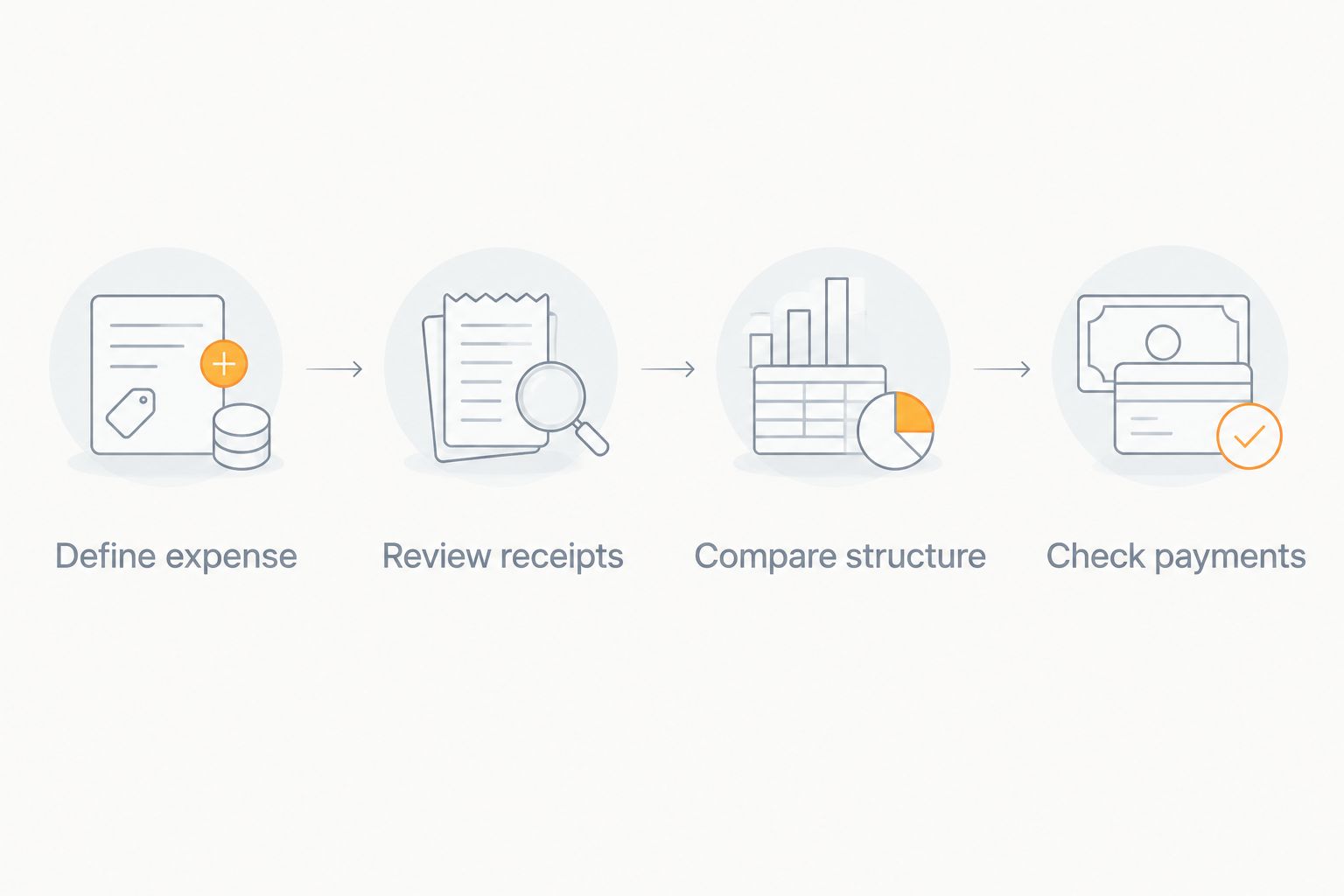
Calculate total dollars before comparing rates
For a loan, request the amount advanced, fees, payment schedule and total of payments. For a purchase of future receivables, request the purchase price, the amount of receivables purchased, the remittance method and any fees. A factor rate is a multiplier applied to the funded amount; it is not an annual percentage rate, or APR. The time to completion and payment pattern matter when comparing a factor-rate offer with a loan.
Here is an illustrative calculation, not an offer: a business receives $50,000 under an agreement with a 1.20 factor rate. Multiplying $50,000 by 1.20 gives $60,000 in total scheduled remittances before any separately disclosed charges. The difference is $10,000. If the illustrative schedule collects $500 on each of 120 business days, those remittances total $60,000. That arithmetic shows the cash commitment; it does not establish an APR or describe a current provider’s terms.
- Write down the cash the business actually receives.
- Add every scheduled payment or remittance.
- Ask which charges sit outside the stated multiplier or payment total.
- Compare payment frequency alongside total dollars.
- Request the provider’s APR disclosure where applicable; do not treat a factor rate as APR.
Test timing against the real deadline
Write down when the expense must be paid, then ask each provider about its application, verification and disbursement steps. A quick preliminary response does not mean funds are available to spend. Bank processing, document review and product terms affect the final timeline.
If the deadline allows a slower process, compare bank and SBA options rather than assuming speed must lead the decision. If a deadline is close, calculate the cost of waiting and the cost of the faster offer separately. In 2026, reject any comparison that substitutes a stated decision time for a verified funding date.
- Record the date the business must pay the expense.
- Ask what documents the provider needs before a final decision.
- Confirm what happens after approval and before disbursement.
- Keep a fallback plan if verification takes longer than expected.
Check qualification without assuming an outcome
Review the criteria for each product before applying. Providers assess factors such as business revenue, bank activity, credit, existing obligations and the purpose of funds under their own programs. A bank decline is a reason to inspect the decision and compare alternatives, not proof that another provider will approve the request.
Jon Lynch Financial Group’s primary comparison route is for U.S. business owners generating at least $35,000 per month. Owners below $35,000 per month can consider its self-serve path: applicants securely connect bank statements through Plaid for an automated decision. Eligible applicants can receive a decision within minutes, and approved funds can arrive within an hour; verification, bank processing and product terms control actual timing. Neither route guarantees approval.
- Check your monthly revenue against the $35,000 per month routing threshold.
- Review the reason for a previous bank decline.
- Disclose existing loans and receivables-purchase obligations.
- Ask how personal and business credit affect the specific offer.
Read the agreement and compare written offers
Put competing proposals side by side using the same amount of cash received. Review how payments change if receipts slow, whether a personal guarantee applies, and what the agreement says about early completion or missed payments. For receivables purchases, inspect reconciliation provisions and the definition of purchased receipts rather than assuming every contract works the same way.
Jon Lynch Financial Group can help established owners compare third-party options, but it is a broker, not a direct lender. The funding provider is responsible for its offer and underwriting. Read that provider’s written terms before accepting any business-purpose funding in 2026.
- Compare cash received, total payments and payment dates.
- Identify fees, security interests and any personal guarantee.
- Read default, reconciliation and early-completion terms.
- Keep copies of every written offer and agreement.
Which funding option fits your Coral Gables business?
Use this table to narrow the options before requesting terms. It does not rank providers or imply that every product is available to every applicant. No starting cost is stated because cost depends on a written offer, the amount advanced and its terms.
| Option | Best for | How to compare cost | Key limitation |
|---|---|---|---|
| Bank line of credit | Repeat cash-flow gaps | Review interest, fees and costs tied to draws | Qualification and access depend on the bank’s terms |
| Business term loan | A defined expense with predictable payments | Compare total payments, fees and payment frequency | Fixed payments continue when receipts slow |
| SBA-backed loan | Owners able to complete a lender-led process | Compare the lender’s written loan terms and fees | Application and eligibility requirements need review |
| Invoice factoring | Businesses with eligible unpaid invoices | Compare cash received with fees and amounts collected | Availability depends on the invoices and customer terms |
| Revenue-based financing or receivables purchase | Owners whose receipts can support the contract’s remittances | Compare cash received, purchased amount and payment method | Frequent remittances can pressure operating cash |
| Equipment financing | A specific business equipment purchase | Compare total payments and agreement terms | Funding is tied to the equipment transaction |
Best for a repeating gap: start by comparing a line of credit with the cost of repeatedly taking lump-sum funding. Best for a single planned purchase: compare a term loan or equipment financing against the useful business purpose of the purchase. These are selection rules, not approval predictions. For every row, test the actual provider agreement against the same cash-flow forecast.
What mistakes do Coral Gables owners make when seeking funding?
Comparing a factor rate directly with a loan APR. A 1.20 factor rate in the illustrative calculation means $60,000 in scheduled remittances on $50,000 received before separately disclosed charges. It does not mean 20% APR. Obtain the schedule and a valid annualized comparison before deciding whether a different product costs less.
Using gross revenue as a payment budget. Sales do not equal available cash. Payroll, taxes, suppliers and existing debt still have to be paid. Test the proposed withdrawals against the lowest-cash periods in your records, not the strongest month.
Applying for a product before defining the need. A contract mobilization expense, a delayed invoice and an equipment purchase create different repayment patterns. Name the expense and its expected source of repayment first; then compare products that match it.
Treating a preliminary response as funded cash. A decision and a disbursement are separate events. Ask what verification remains, when the provider can release funds and whether the receiving bank must process the transfer. Do not commit to an expense based on an unverified timeline.
Skipping existing obligations in the comparison. Another daily or weekly remittance changes how much cash remains for a new one. List every current payment before reviewing a proposal. If the combined schedule fails your cash-flow test, reduce the request or reconsider the structure rather than relying on hoped-for sales.
FAQ
What is the best business funding option in Coral Gables?
The best option is the one that covers a defined business need at a total cost and payment schedule your receipts can support. Compare written line-of-credit, loan, factoring or receivables-purchase terms before choosing.
Can I get business funding in Coral Gables after a bank decline?
A bank decline does not rule out every business funding product. Review the bank’s reason for declining and compare alternatives under each provider’s current underwriting requirements; approval is not assured.
Is revenue-based financing the same as a business loan?
No, revenue-based financing is not automatically a business loan. Some agreements are structured as purchases of future receivables; read the contract to identify what is being purchased and how remittances work.
How do I compare an MCA factor rate with a loan APR?
Do not compare the factor rate directly with APR. Calculate total dollars paid, obtain the remittance schedule and use a valid annualized calculation to compare financing costs over time.
Does Jon Lynch Financial Group lend directly?
No. Jon Lynch Financial Group is a broker, not a direct lender. Third-party lenders or funders set their own terms and make underwriting decisions.
What if my business generates under $35,000 per month?
Explore Self-Serve Funding if your U.S.-based business generates under $35,000 per month. The application uses a secure Plaid bank-statement connection for an automated decision; eligibility and timing depend on verification and product terms.
Can I use these funding options for personal expenses?
No. The funding options discussed here are for business purposes. Consumer-purpose requests are outside Jon Lynch Financial Group’s primary funding audience.
What should I prepare before comparing offers in 2026?
Prepare business bank statements, the amount needed, the intended business use and a list of current payment obligations. Use those records to test each offer’s total cost and payment schedule.
One last thing
A lower total payment is not automatically the better decision if its schedule arrives before the receipts meant to support it. In 2026, compare each written offer on cash received, total dollars paid, payment timing and what happens when receipts slow. If your U.S. business generates at least $35,000 per month, Compare Business Funding Options. If it generates less, Explore Self-Serve Funding. Neither route promises a decision or funding outcome.
Compare business funding options
Review total cost, payment timing and qualification against your business need.